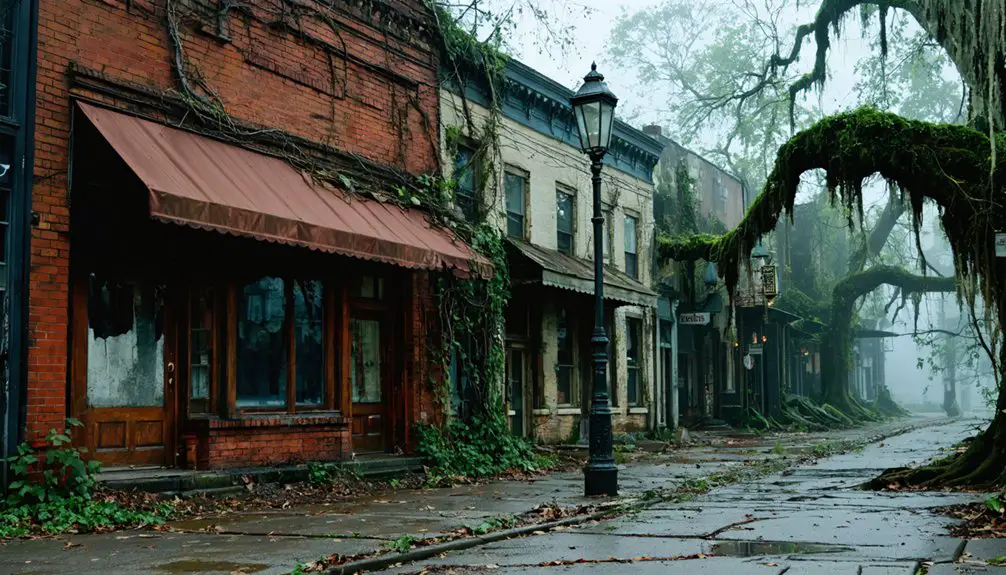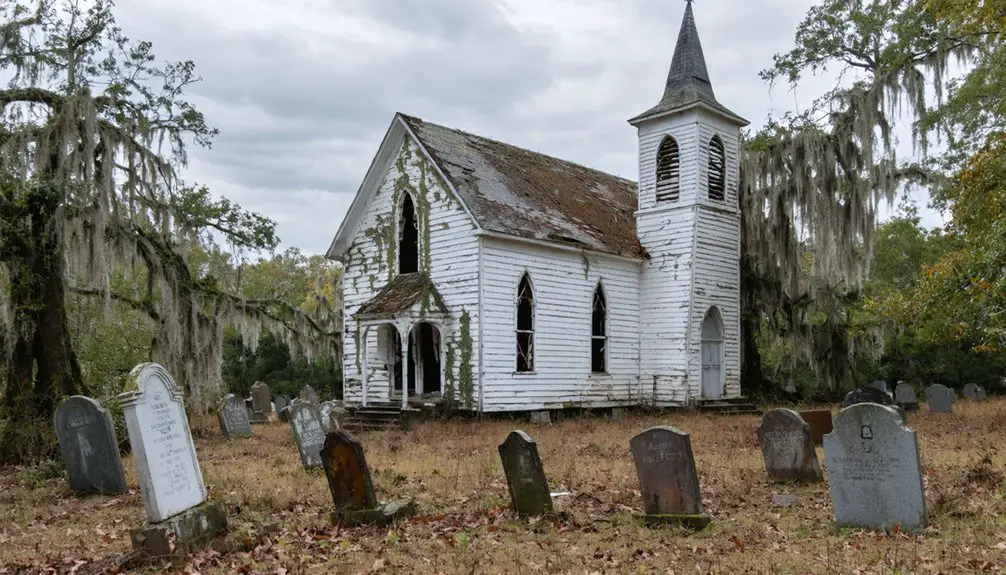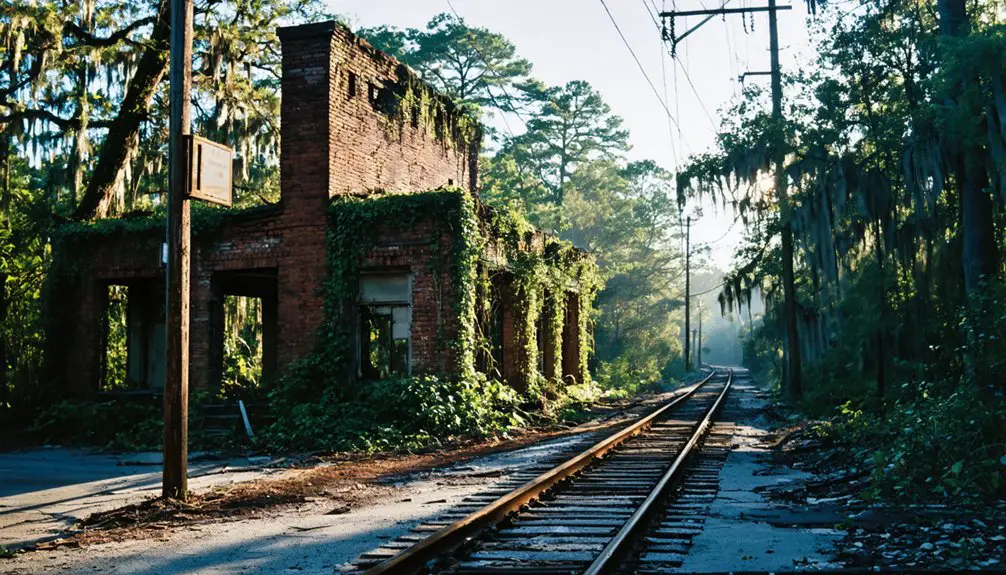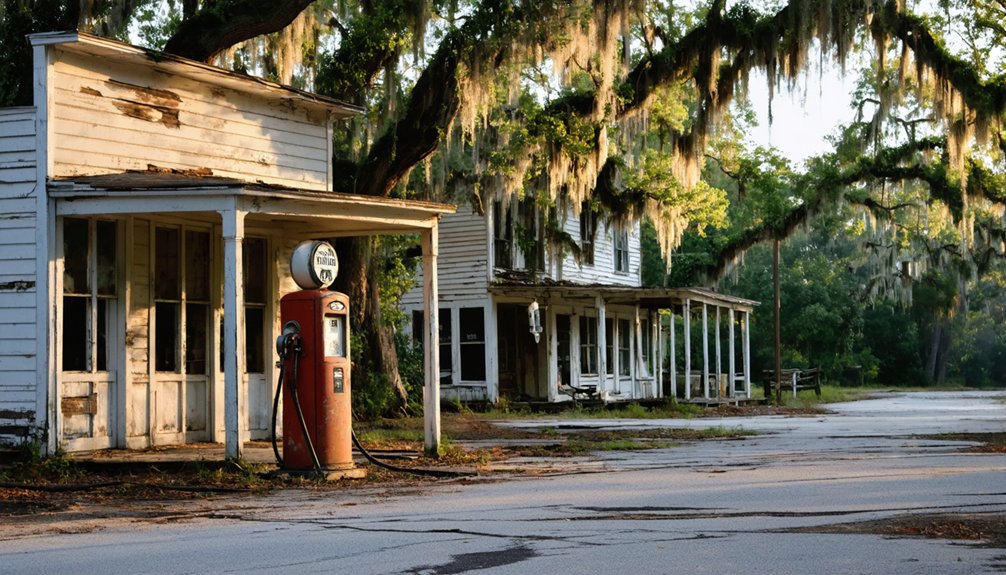
You’ll find between 11 and 15 ghost towns documented in South Carolina, depending on classification standards you’re applying. The disparity stems from whether you’re counting settlements with zero residents and tangible structural remains versus those experiencing economic abandonment while retaining partial populations. Barnwell County holds the highest concentration with five verified sites, while locations like Colonial Dorchester and Ellenton represent different abandonment circumstances—from natural decline to federal displacement. The precise count requires examining archival records, archaeological evidence, and historical documentation that reveal each settlement’s unique story.
Key Takeaways
- South Carolina contains between 11 and 15 ghost towns, depending on definitions and sources used for classification.
- Barnwell County has the highest concentration, hosting five of the eleven verified ghost town sites in the state.
- Notable ghost towns include Dorchester, Dunbarton, Ellenton, Pinckneyville, and Glenn Springs, each with unique historical features.
- Towns were abandoned due to economic collapse, natural disasters, environmental changes, infrastructure decline, and government relocations.
- True ghost towns have zero residents, while partial ghost towns retain 1-25% of their original population.
Counting South Carolina’s Abandoned Settlements: What the Numbers Tell Us
While definitive counts of South Carolina’s ghost towns vary across archival sources, documented evidence reveals between 11 and 15 formally recognized abandoned settlements throughout the state.
South Carolina’s documented ghost towns number between 11 and 15, though archival sources reveal conflicting counts of these formally recognized abandoned settlements.
National rankings identify 11 sites, whereas Wikipedia’s extensive registry catalogs 15 specific locations including Andersonville, Dorchester, and Dunbarton.
You’ll find Barnwell County contains the highest concentration with five ghost towns, though true abandoned settlements remain remarkably rare given the state’s population density.
Geotab mapping data pinpoints three ghost towns within 50 miles of Greenville alone.
These discrepancies reflect preservation challenges in maintaining accurate historical records amid economic decline.
Hamburg’s transformation from a thriving 19th-century railroad hub to complete abandonment exemplifies how industrial shifts erase entire communities from South Carolina’s landscape, leaving behind contested documentation and fragmented archival trails.
Many abandoned settlements show vacancy rates that mirror patterns found in economically distressed neighborhoods nationwide, where declining populations and depressed housing markets create long-term community instability.
Researchers utilize the USGS GNIS database alongside county historical listings to identify and verify place names of former communities that have vanished from modern maps.
The Most Notable Ghost Towns Across the Palmetto State
Across South Carolina’s diverse regions, five settlements demonstrate the spectrum of abandonment that defines the state’s ghost town legacy. Dorchester stands as the crown jewel—a 325-acre state historic site where preservation efforts maintain 1696 colonial ruins, including tabby fort walls and church towers that’ve earned it recognition as the state’s creepiest location. The site sits 15 miles from Charleston along the Ashley River, offering visitors tangible connections to early American colonial history.
Ella’s Grove presents authentic commercial abandonment with B.F. Davis store remains connected to Palmer Cemetery’s prominent family graves. The Davis family’s store operated continuously from 1867 until the early 1950s, with a rebuild in 1915 extending its commercial life.
Pinckneyville, dubbed “Little Charleston,” offers upstate stone foundations representing fleeting prosperity.
Glenn Springs showcases resort heritage through its 1834 hotel ruins and former academy grounds.
These sites anchor South Carolina’s ghost town documentation, each providing documented evidence of settlement patterns while attracting those seeking haunted legends and historical verification beyond conventional tourism.
Why These Communities Were Left Behind
The historical record reveals five distinct catalysts that transformed thriving South Carolina settlements into abandoned landscapes. You’ll find government intervention most dramatic in Ellenton’s case, where federal atomic energy development displaced 6,000 citizens.
Natural disasters proved equally devastating—Andersonville’s textile economy couldn’t withstand repeated flooding within twelve years. Economic decline systematically hollowed communities like Salters Depot and Ferguson, where railroad obsolescence and exploitative company currencies drove residents elsewhere.
Primary Abandonment Factors:
- Federal nuclear site acquisition and forced relocation
- Catastrophic flooding destroying industrial infrastructure
- Economic decline from failed business models
- Revolutionary War strategic abandonment
Historic preservation now safeguards sites like Dorchester, where you’re free to examine colonial-era structures. The former residents of Ellenton now face restricted access due to severe radioactive contamination at the Savannah River Site, which renders the area one of the most toxic locations on Earth. The displacement’s human toll became evident as many older residents who relocated passed away within ten years of leaving their communities. These documented patterns demonstrate how external forces—governmental, environmental, and economic—superseded individual choice in determining community survival across South Carolina’s landscape.
Where to Find Ghost Towns in South Carolina by Region
South Carolina’s ghost towns concentrate in four geographically distinct zones, each shaped by the abandonment factors documented in historical records. You’ll find Barnwell County hosts five of the state’s eleven documented sites, making it the primary destination for archaeological exploration.
The Upstate Region preserves Pinckneyville’s “Little Charleston” foundations and Pickens Courthouse’s 1851 church structure. Lowcountry locations include Colonial Dorchester (established 1697) and Hell Hole Swamp’s bootlegging remnants near Jamestown.
Lake Hartwell’s submersion of Andersonville creates underwater archaeological sites requiring specialized access.
Historic preservation efforts vary markedly across regions—Dorchester maintains protected structures while Chappells’ Main Street buildings deteriorate without intervention. Colonial Dorchester’s status as a trading post established in 1697 marks it as one of the oldest documented settlements in the state’s ghost town inventory.
Your freedom to explore these locations depends on land ownership classifications, with Francis Marion National Forest providing accessible public sites. The Charleston area features the decommissioned Charleston Navy Yard, which ceased operations in 1996 and now stands as a testament to the state’s military and industrial heritage.
Understanding the Difference Between True and Partial Ghost Towns
- Population thresholds – True ghost towns have zero residents; partial ghost towns retain 1-25% of peak population.
- Structural requirements – Some historians require tangible building remains; others accept sites with only archaeological evidence. Ghost towns are characterized by visible infrastructure like buildings and roads that remain after abandonment.
- Economic indicators – Complete cessation of commercial activity versus diminished economic function. Towns become abandoned due to economic failure, natural disasters, or insufficient government support.
- Documentation standards – Historical records confirming abandonment dates and circumstances.
You’ll need region-specific archival sources to determine South Carolina’s exact classifications.
Frequently Asked Questions
Can You Legally Visit South Carolina’s Ghost Towns?
Like scattered pages from history’s ledger, you’ll find access varies: Historical preservation opens Colonial Dorchester freely, while Property ownership restrictions protect sites like Andersonville. You’re permitted where state-managed documentation exists, though radioactive Ellenton remains forever closed.
Are Any Ghost Towns in South Carolina Haunted or Have Paranormal Activity?
You’ll find documented urban legends surrounding Dorchester’s colonial cemetery and Hamburg’s violent past, though archival records emphasize historical significance over paranormal claims. Most ghost town folklore remains unverified by researchers prioritizing archaeological evidence and factual preservation efforts.
What Artifacts or Structures Remain in South Carolina’s Ghost Towns Today?
You’ll find four documented sites preserve abandoned architecture and historical artifacts: Dorchester’s oyster shell tabby fort walls, Pinckneyville’s stone foundations, Pickens Courthouse’s 1851 church, and Glenn Springs’ former academy traces—each offering tangible evidence of South Carolina’s unrestricted colonial past.
How Does South Carolina’s Ghost Town Count Compare to Neighboring States?
You’ll find South Carolina’s 11 ghost towns lag behind neighboring states—North Carolina and Georgia each document 16, Tennessee records 12. Unlike regions with extensive abandoned mining operations, your state prioritized historical preservation over industrial expansion, limiting ghost town formation.
Are There Guided Tours Available for South Carolina Ghost Towns?
You’ll find limited guided tours for South Carolina’s ghost towns. Most sites offer self-guided exploration with historical preservation markers. Colonial Dorchester provides state-managed access, while locations like Pinckneyville and Glenn Springs present excellent photography opportunities for independent documentation.
References
- https://kids.kiddle.co/List_of_ghost_towns_in_South_Carolina
- http://freepages.rootsweb.com/~gtusa/history/usa/sc.htm
- https://www.loveexploring.com/gallerylist/188219/the-us-state-with-the-most-ghost-towns-revealed
- https://en.wikipedia.org/wiki/List_of_ghost_towns_in_South_Carolina
- https://www.randomconnections.com/ghost-towns-of-south-carolina/
- https://sctravelguide.com/2018/06/11/south-carolina-ghost-towns/
- https://www.youtube.com/watch?v=KQOA3Q1z0Nc
- https://www.geotab.com/ghost-towns/
- https://247wallst.com/special-report/2018/11/02/30-american-ghost-towns-3/
- https://www.youtube.com/watch?v=Tcq6Sk9LYZI