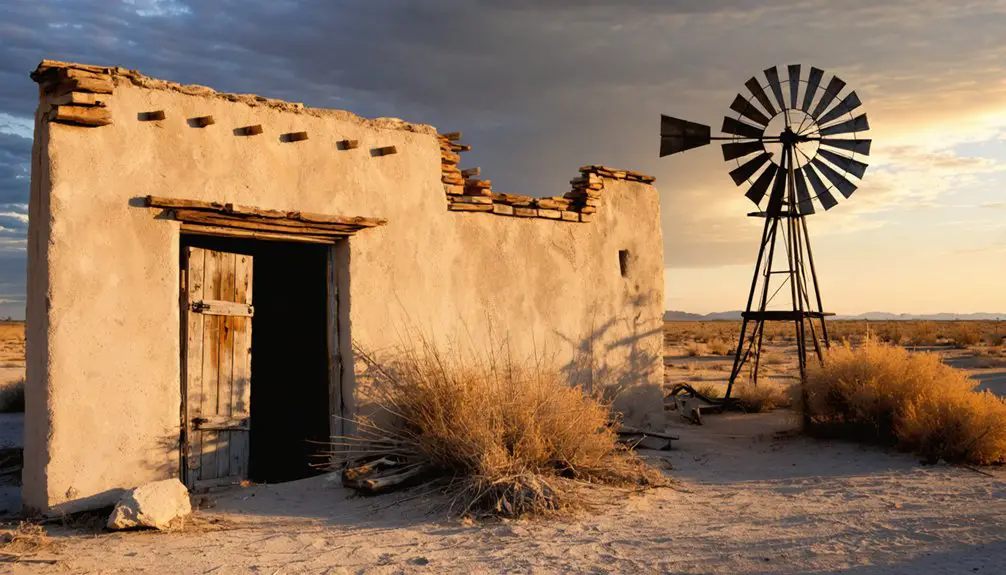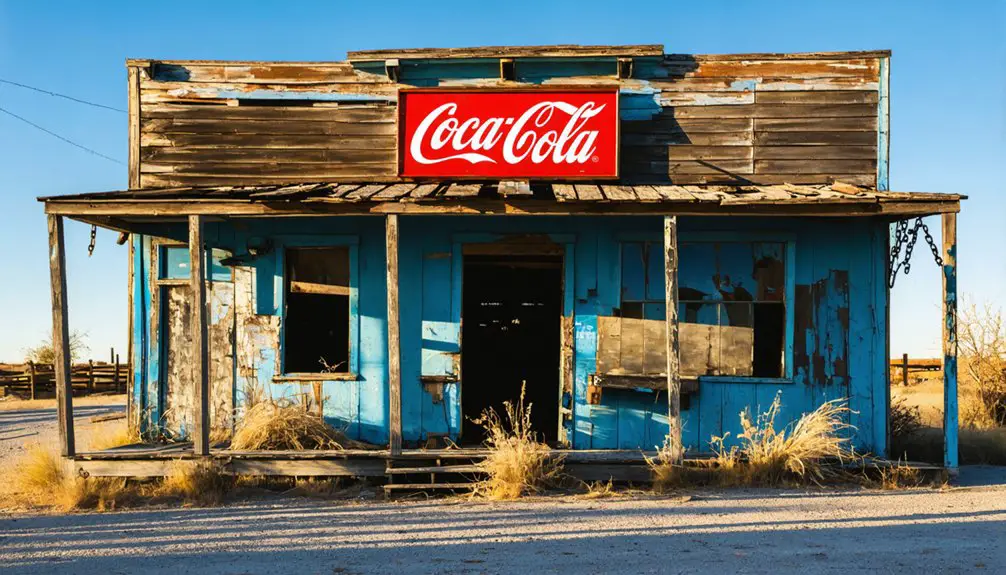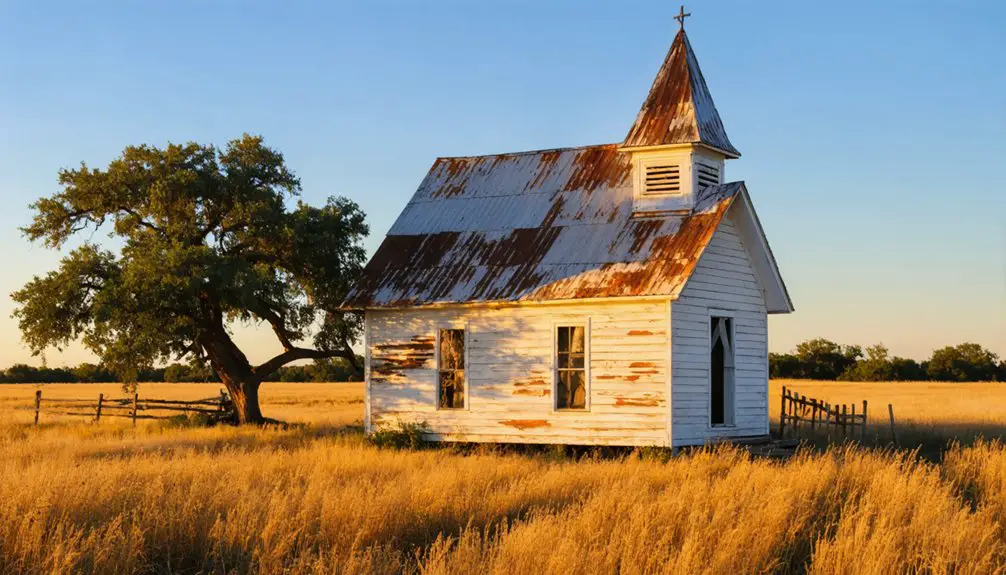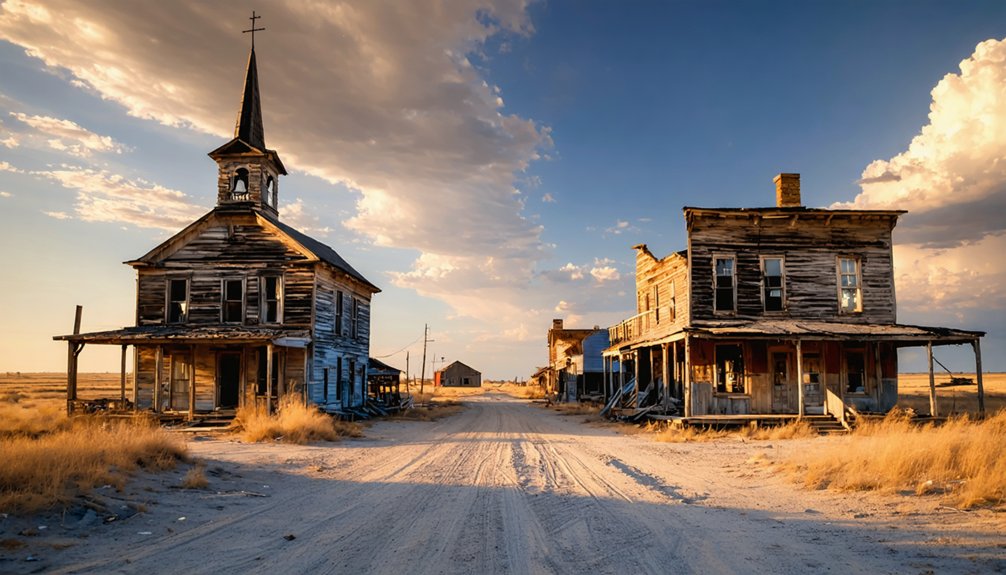
Texas leads the nation with an estimated 511 to 3,800 ghost towns, depending on how you define “abandoned.” Wilson County alone contains 31 documented sites, while 75 counties currently face ongoing population decline that’s creating new ghost towns. You’ll find these abandoned settlements scattered across the state, from railroad-bypassed communities to depleted mining operations and shuttered military towns. Economic shifts, resource exhaustion, and infrastructure failures drove most abandonments, though many sites now serve as preserved landmarks where you can explore Texas’s frontier heritage and understand the forces that shaped settlement patterns.
Key Takeaways
- Texas has the most ghost towns in the U.S., with an estimated 511 documented locations according to standard classifications.
- Some sources identify over 3,800 ghost towns nationally, with Texas leading, though definitions and counts vary significantly.
- Wilson County contains the highest concentration with 31 ghost towns, reflecting historical settlement patterns and economic decline.
- Not all abandoned settlements qualify as official ghost towns, as classification criteria differ among researchers and documentation sources.
- Seventy-five Texas counties currently experience population decline, creating potential “ghost towns in formation” across the state.
Counting Texas Ghost Towns: Estimates and Research Findings
According to extensive geographic databases, Texas claims the distinction of harboring more ghost towns than any other U.S. state, with estimates placing the total at 511 documented locations. However, you’ll find significant challenges in achieving historical accuracy when counting these abandoned settlements.
Texas leads the nation with 511 documented ghost towns, though defining and counting these abandoned settlements remains historically complex.
Wikipedia’s incomplete county-by-county lists demonstrate how definitions vary—some sources classify towns with small populations like Pedernales (37 residents) as ghost towns, while the Texas Almanac disputes such designations for communities retaining inhabitants.
Geotab’s mapping project identifies over 3,800 U.S. ghost towns, confirming Texas’s 511-town lead over California’s 346 and Kansas’s 308. Classification disputes also affect towns like Stiles and Stewart’s Mill, which are not officially classified as ghost towns by the Texas Almanac or the Handbook of Texas despite their abandoned or semi-active status.
Demographic trends reveal Wilson County holds the state record with 31 ghost towns, reflecting broader rural-to-urban migration patterns that continue reshaping Texas’s settlement landscape. The railroad bypassing Gomez in Terry County exemplifies how transportation route decisions historically determined whether settlements would thrive or become ghost towns.
Counties With the Most Abandoned Settlements
Wilson County leads Texas with 31 documented ghost towns, but contemporary demographic data reveals the High Plains region now functions as the state’s most active incubator of abandoned settlements.
You’ll find 27 counties experiencing net out-migration between 2022 and 2023, with remote settlement patterns collapsing across this concentrated zone. Armstrong County’s seat Claude lost 7% of its population in one year, while towns like Muleshoe and Plainview collectively shed 400 residents.
The region’s demographic decline creates distinct patterns:
- 75 Texas counties lost population, but High Plains communities face the most severe contraction.
- Infrastructure remains oversized for dwindling populations, with fire stations and services built for larger bases.
- Housing shortages paradoxically accelerate abandonment, creating chicken-or-egg dynamics preventing new development.
- School districts expanded rapidly between 2019-2022, but enrollment plateaued or shrank by 2024-2025, causing financial strains as bond payments continue despite stagnant tax revenues.
- Population decline results from more deaths than births combined with residents relocating to resource-based hubs like Lubbock and Amarillo for employment opportunities.
This demographic fracture contradicts statewide growth projections toward 50 million residents by 2050.
Famous Ghost Towns Worth Visiting Today
Texas preserves some of America’s most accessible ghost town ruins, where you can walk through authenticated historical sites rather than sanitized reconstructions.
Terlingua’s mercury mining structures and boot hill cemetery attract visitors seeking haunted legends near Big Bend National Park, while preservation efforts maintain Glenrio’s Route 66 architecture along I-40.
You’ll find Medicine Mound’s Hicks-Cobb General Store transformed into a cultural museum documenting Comanche ceremonial grounds.
Old Bluffton offers unique underwater exploration beneath Lake Buchanan’s surface, revealing 1852 foundations during low-water periods.
Indianola’s coastal monuments mark hurricane-destroyed settlements accessible through motorcycle tours, where European immigrants, especially Germans, once arrived at Texas’s second most important port.
The abandoned mining town features self-guided exploration opportunities, with Day of the Dead festivities bringing the ruins to life through candles and campfire stories.
These sites represent tangible connections to frontier commerce, mining booms, and highway culture—authenticated spaces where you’re free to explore Texas’s unvarnished past without guided restrictions or commercialized interpretations.
Current Population Levels in Former Boomtowns
While preserved ghost towns draw heritage tourists to authenticated ruins, contemporary demographic data reveals 75 Texas counties lost population between 2022 and 2023, creating what researchers now classify as “modern ghost towns in formation.”
Armstrong County’s seat of Claude saw its population plummet 7% from 1,307 to 1,218 in a single year from 2021 to 2022, despite maintaining a grocery store, fire stations, and functioning ambulance services.
Claude’s population crashed 7% in just one year while grocery stores and emergency services continued operating normally.
You’ll find similar patterns across former boomtowns experiencing economic decline:
- Vernon dropped below 10,000 residents, triggering automatic cuts to state funding and essential services
- High Plains communities like Gomez face infrastructure neglect after highways bypassed their commercial districts and promised railroads never materialized
- Towns including Mules, Littlefield, and Floyd lost hundreds of residents within twelve months
These aren’t abandoned ruins—they’re functioning communities steadily hemorrhaging population despite maintaining basic civic infrastructure. Port Arthur experienced over 10% population decline in the past decade, reflecting broader patterns of economic contraction across Texas industrial communities. This rural population decline mirrors broader rural urban migration trends documented across more than 500 ghost towns throughout Texas.
What Caused These Texas Towns to Disappear
Railroad companies wielded unprecedented power over Texas settlement patterns during westward expansion, making routing decisions that determined which communities would thrive and which would wither into obscurity.
When the South Plains and Santa Fe Railway bypassed Gomez in favor of Brownfield, residents watched their prosperity vanish.
You’ll find similar stories across Texas—Belle Plain’s population fled to Baird after losing both railroad access and county seat status.
Resource depletion devastated mining communities like Shafter, where silver exhaustion dropped population from 1,500 to 11.
Without economic diversification, these towns couldn’t survive.
Military closures compounded problems—Shafter’s population plummeted after Fort D.A. Russell and Marfa Army Air Field shutdowns post-WWII.
Hagerman faced a different fate when the construction of Denison Dam in 1943 flooded 83,000 acres and submerged most of the town.
These abandoned settlements became tangible links to Texas’s dynamic past, serving as educational tools that reflect on infrastructure development and population shifts.
Natural disasters and inadequate rural infrastructure finished what economics started, leaving only cemeteries and historical markers behind.
Preserved Ghost Towns and Historic Landmarks
Among the estimated 511 ghost towns scattered across Texas, preservation efforts have transformed several abandoned settlements into accessible historic landmarks that document the state’s frontier evolution. Restoration efforts at Fort McKavett State Historic Site maintain original barracks and officers’ quarters from the 1850s military outpost.
While Terlingua Ghost Town combines mining structures with tourism strategies centered on its annual chili cook-off. You’ll find these preserved locations throughout the state:
- La Lomita Historic District in Hidalgo County showcases mission-style adobe architecture on the 1975 National Register.
- Independence Historic Site preserves Baylor University’s original campus and Sam Houston’s 1854 baptism church.
- Medicine Mound retains its Hicks-Cobb general store and ceremonial dolomite hills.
These sites offer unrestricted exploration of authentic frontier structures without commercial development constraints.
Frequently Asked Questions
Can You Legally Explore Abandoned Ghost Towns in Texas?
You can legally explore most Texas ghost towns on public land, but you’ll face legal restrictions on private property without permission. Preservation efforts protect certain historic sites, so you should research ownership and access rules beforehand.
What Personal Belongings Remain in Deserted Texas Ghost Town Buildings?
Time’s swept most treasures away—you’ll find few personal belongings in Texas ghost towns. Most sites like Gomez and Sycamore hold nothing. Haunted legends persist, but forgotten artifacts rarely survive decades of abandonment, weather, and scavengers claiming what remained.
Are Texas Ghost Towns Safe to Visit Alone?
You shouldn’t explore Texas ghost towns alone due to structural collapse risks, wildlife hazards, and isolation from emergency services. Ghost town preservation efforts restrict access, while ghost town ghost stories often mask real dangers like unstable ruins and private property violations.
How Do You Find Unmarked Ghost Town Locations in Texas?
Looking for hidden ruins? You’ll find unmarked ghost town locations through Wikipedia’s county lists, drought-exposed reservoir sites, Atlas Obscura tags, and local historical preservation records—transforming forgotten settlements into accessible tourist attractions across Texas’s backcountry.
Do People Still Own Property in Texas Ghost Towns?
Yes, you’ll find active property ownership in Texas ghost towns. Historical preservation efforts continue through private owners—like three Germans owning Lobo since 2001—while La Lomita’s National Register listing protects its legacy for future generations.
References
- https://en.wikipedia.org/wiki/List_of_ghost_towns_in_Texas
- https://www.ksat.com/holidays/2018/10/30/texas-has-more-ghost-towns-than-any-other-state/
- https://www.hipcamp.com/journal/camping/texas-ghost-towns/
- https://www.texasstandard.org/stories/texas-population-boom-ghost-towns-rural-urban-suburban-shift/
- https://texashighways.com/culture/history/what-the-heck-is-a-ghost-town/
- https://www.geotab.com/ghost-towns/
- https://www.texasescapes.com/TOWNS/Texas_ghost_towns.htm
- https://kkyr.com/ghost-towns-of-america-texas-has-the-most/
- https://www.ghostsandgetaways.com/blog-1/27-fascinating-ghost-towns-in-texas
- https://www.youtube.com/watch?v=8r02xeyalvQ