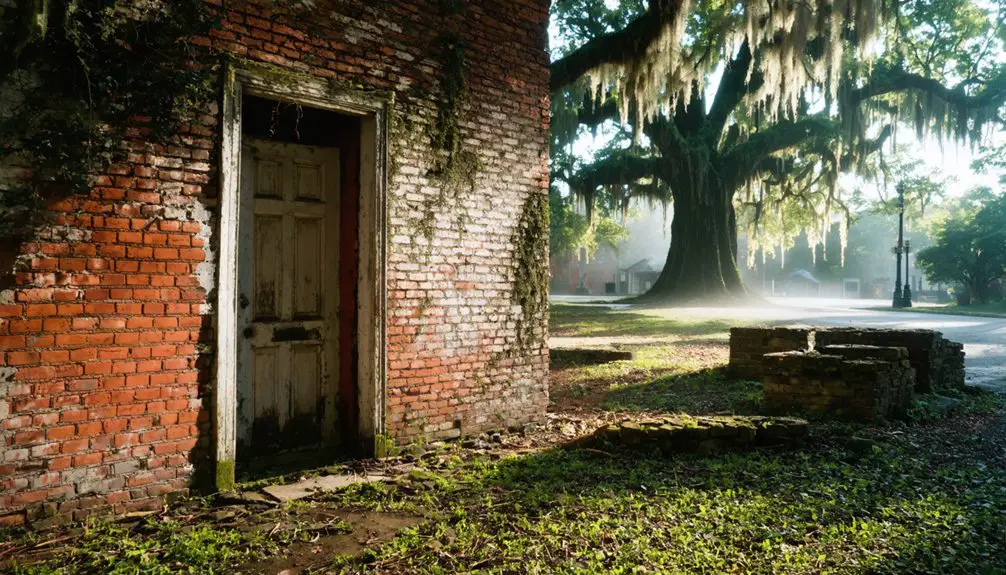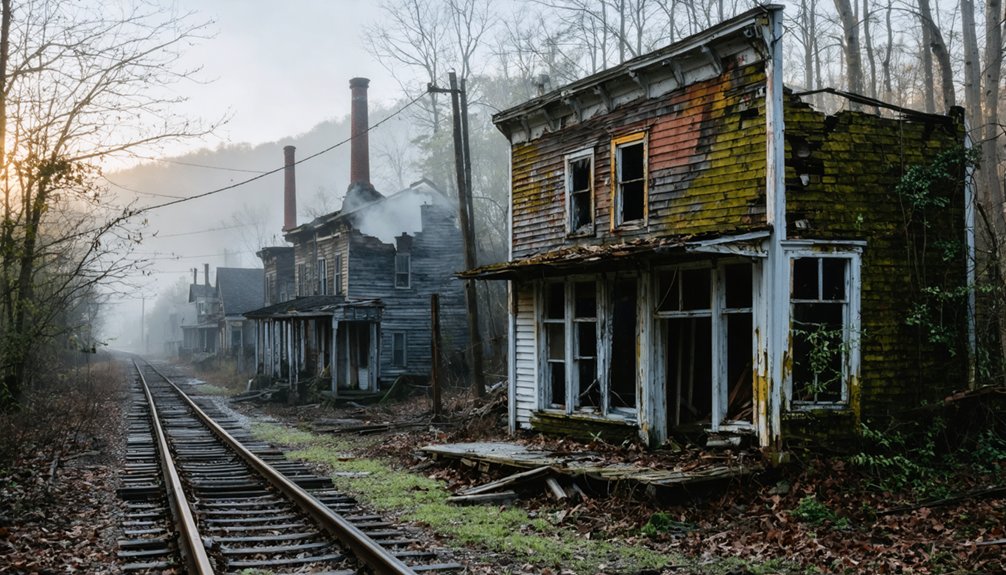
You’ll find conflicting counts ranging from 9 to 22 ghost towns across Virginia, depending on how strictly sources define “abandoned.” Wikipedia documents 22 sites including colonial-era Jamestown (capital until 1699) and Henricus, while Close-to-Me lists only 9, emphasizing coal towns like Pocahontas. The variation stems from debates over what qualifies as truly deserted versus partially depopulated. These settlements span Fairfax, York, and Chesapeake counties, abandoned due to resource depletion, natural disasters, and transportation shifts—and their stories reveal fascinating patterns about Virginia’s economic evolution.
Key Takeaways
- Virginia has between 9 and 22 documented ghost towns, with sources varying based on definitions of abandonment versus partial occupation.
- Wikipedia lists 22 sites including Bigler’s Mill and Colchester, while other sources cite approximately 19 locations like Ca Ira and Elko Tract.
- Notable colonial-era ghost towns include Jamestown (1607) and Henricus (1611), both abandoned due to conflicts, disease, and environmental challenges.
- Mining ghost towns like Pocahontas emerged in the 1880s and declined after coal production ceased in 1955 following resource depletion.
- Geographic concentrations exist in Fairfax County, York County, and Chesapeake, with abandonments caused by economic shifts, natural disasters, and transportation changes.
Counting Virginia’s Abandoned Settlements: What the Sources Say
Determining an exact count of Virginia’s ghost towns proves surprisingly difficult, as different sources provide conflicting numbers ranging from 9 to 22 abandoned settlements.
Wikipedia documents 22 sites, including Bigler’s Mill and Colchester, while YouTube sources and Geotab cite 19 locations featuring Ca Ira and Elko Tract.
Close-to-Me’s documentation identifies just 9 ghost towns, highlighting Ca Ira’s tobacco port origins and Pocahontas’s coal mining legacy.
These discrepancies stem from varying definitions of what constitutes true urban decay versus partial abandonment.
You’ll find examples like Union Level in Mecklenburg County, deserted after railroad rerouting, and Batestown in Prince William County woven into Virginia’s historical legends.
The counts deliberately exclude Jamestown and Henricus, creating further debate about classification criteria among researchers documenting these forsaken communities.
These sites reflect diverse historical eras from early settlements and colonial courthouses to mining camps and transportation hubs.
Many of these abandoned settlements hold historical and cultural significance as researchers continue efforts to preserve their stories for future generations.
Jamestown and Henricus: Colonial-Era Ghost Towns That Shaped History
While most Virginia ghost towns faded into obscurity after economic decline, Jamestown and Henricus stand apart as colonial-era settlements whose abandonment shaped American history itself.
You’ll find Jamestown, established May 14, 1607, became Virginia’s capital until 1699 before depopulation transformed it into archaeological ruins. The 1622 Powhatan ambush killed over 300 settlers, triggering Virginia Company’s charter revocation in 1624.
Today, midnight legends persist around triangular James Fort’s haunted corridors where colonists endured the Starving Time.
Henricus, founded 1611 by Sir Thomas Dale ten miles south, served as an administrative alternative until the 1622 uprising destroyed it completely.
This settlement featured North America’s first English hospital and planned Indian college—ambitious visions cut short, leaving only archaeological evidence of freedoms once pursued. The early colony faced catastrophic losses from bad water, mosquitoes, and insufficient food that caused dysentery and fevers among the settlers. Nathaniel Bacon’s 1676 rebellion resulted in the sacking and burning of much of Jamestown, accelerating the settlement’s decline.
Pocahontas: From Coal Boom to Near Abandonment
Deep in Tazewell County’s Powell’s Bottom, local blacksmith Jordan Nelson’s discovery of coal outcroppings for his forge ignited what would become Virginia’s first coalfield boom town.
Captain Welch’s survey revealed the remarkable 13-foot Pocahontas No. 3 seam in the early 1880s, prompting Southwest Virginia Improvement Company to open Mine No. 1 in spring 1882.
Norfolk & Western Railway’s 70-mile branch reached Pocahontas by March 1883, and you’ll find this mining history transformed the region overnight—daily production hit 1,200 tons within months.
The seam’s exceptional 15,000 Btu/lb rating fueled America’s Navy.
Yet disaster struck in 1884, devastating this industrial heritage site.
The March 1884 explosion in the Laurel workings claimed approximately 114 lives, marking one of the deadliest mining disasters in early Virginia coal history.
After producing 44 million tons over 73 years, operations ceased in 1955, leaving behind preserved beehive ovens and Virginia’s only underground tourist coal mine.
The success of Pocahontas sparked mining operations throughout Mercer and McDowell Counties, with coal camps like Bramwell, Coopers, and Freeman rapidly emerging by the mid-1880s.
Geographic Distribution Across Virginia’s Counties
You’ll find Virginia’s ghost towns concentrated in specific geographic patterns that reflect the state’s economic history. Fairfax County hosts colonial-era casualties like Matildaville in Great Falls Park and Colchester at Mason Neck.
Meanwhile, York County preserves multiple abandoned settlements including Bigler’s Mill and Warwick from the same period. Moving inland, Cumberland County’s Ca Ira near Grace Episcopal Church and Mecklenburg County’s Union Level (established March 1, 1765) demonstrate how tobacco commerce shifts emptied river-dependent communities.
In addition, coastal Virginia Beach’s Wash Woods in False Cape State Park illustrates barrier island abandonment driven by Atlantic storms and isolation. Prince William Forest Park conceals remnants of displaced 1930s communities like Joplin, Hickory Ridge, and Batestown, removed when the federal government established the park. Across the country, over 3,800 ghost towns have been identified, with Virginia contributing its share to this national phenomenon of abandoned settlements.
Regional Clusters and Patterns
Virginia’s ghost towns cluster into five distinct geographic regions, each shaped by specific economic forces and historical circumstances. Eastern Virginia concentrates abandoned settlements in York County (Bigler’s Mill, Lackey, Magruder) and metropolitan areas like Henrico County’s Elko Tract and Fairfax County’s Colchester.
Central Virginia’s abandoned sites include Cumberland County’s Ca Ira and Charlottesville’s Canada, reflecting agricultural decline.
Northern Virginia showcases Loudoun County’s Matildaville near Great Falls and James City County’s Jamestown, where folklore legends persist about colonial-era failures.
Southern Virginia demonstrates concentrated urban decay in Mecklenburg County (Union Level, Howrytown) and mining collapses in Dickenson and Buchanan Counties (Lignite, Lorraine). Many of these locations feature abandoned buildings and infrastructure such as deteriorating mine shafts, company stores, and worker housing that mark their industrial heritage.
Western Virginia’s pattern emerges through Hanover County’s Hanover Town and Augusta County’s Hickory Ridge, representing industrial abandonment. These abandoned settlements can be explored through interactive satellite maps that provide geographic visualization of their locations and historical context.
Each cluster reveals Virginia’s evolving economic landscape and settlement patterns.
County-Specific Abandoned Settlements
Across at least five major counties, abandoned settlements reveal distinct patterns of economic collapse and geographic isolation that shaped Virginia’s ghost town landscape. You’ll find Fairfax County’s Matildaville in Great Falls Park and Colchester, whose tobacco trade rivaled Alexandria before silting destroyed its port.
York County preserves records of Bigler’s Mill, Lackey, Magruder, and Warwick—communities that vanished post-colonial era.
Cumberland County’s Ca Ira disappeared as river commerce declined.
Meanwhile, Mecklenburg County’s Union Level became a ghost town after railroad abandonment, now monitored as private property despite Virginia Tourism‘s recognition.
Virginia Beach’s Wash Woods, accessible only through False Cape State Park wilderness, represents coastal communities surrendered to Atlantic storms.
These county-specific patterns demonstrate how historical preservation efforts and tourism development initiatives now protect these freedom-era settlements from complete obscurity.
Why These Communities Were Left Behind
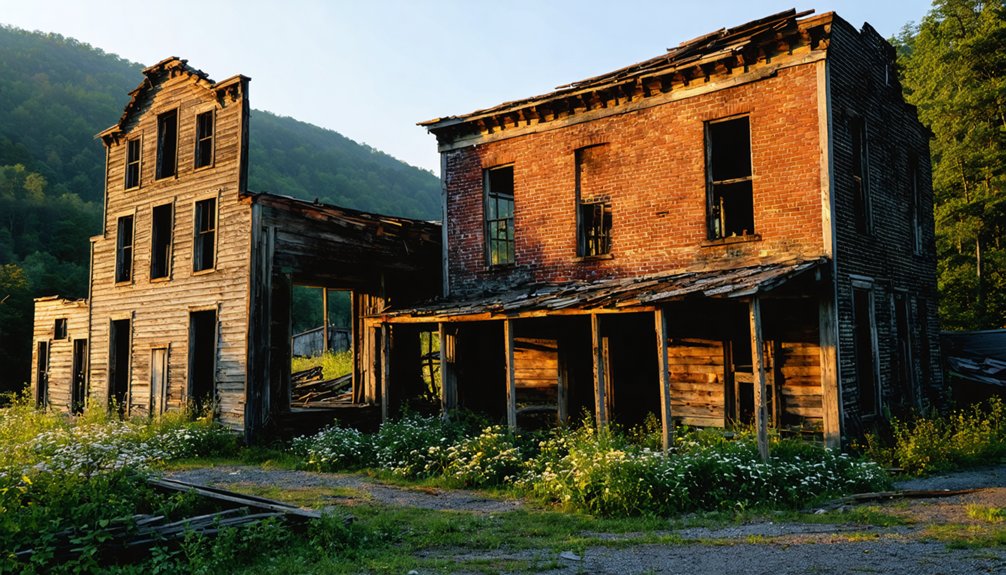
You’ll find Virginia’s ghost towns emerged from three primary catalysts that systematically eroded community viability between the 17th and 20th centuries.
Economic shifts—particularly resource depletion in mining towns like Pocahontas (which lost its metallurgical coal reserves by the 1950s) and agricultural collapse following tobacco’s decline—eliminated the financial foundations supporting entire populations.
Natural disasters and geographic obstacles, from the Willis River’s siltation that destroyed Ca Ira’s port ambitions to the deliberate flooding that submerged communities beneath Philpott Lake, combined with transportation infrastructure changes (railroad route abandonment at Union Level) to isolate settlements until abandonment became inevitable.
Economic Shifts and Decline
When coal prices plummeted and manufacturing plants shuttered their doors, Virginia’s small towns lost more than jobs—they lost their economic foundations. Pound’s population declined from 1,118 in 1950 to 877 by 2020 as coal severance tax revenue evaporated, nearly forcing charter revocation in 2022.
Martinsville lost nearly half its residents after textile and furniture factories relocated overseas for cheaper labor.
Petersburg’s Brown & Williamson closure triggered prolonged job losses, while its specialized tobacco and transportation sectors amplified vulnerability to economic shocks.
This population decline wasn’t isolated—Pocahontas peaked at 2,789 residents around 1900 before collapsing by the 1920s. Without economic resilience or diversified industries, these communities couldn’t withstand resource extraction’s shift toward capital-intensive operations requiring fewer workers, leaving tax bases hollowed and infrastructure budgets strained.
Natural Disasters and Geography
Virginia’s geography weaponized itself against vulnerable settlements, where rivers that initially attracted colonists later betrayed them through relentless flooding and erosion. Colchester’s port succumbed to silting on Occoquan Creek, while Jamestown’s marshy terrain amplified vulnerabilities that hastened its abandonment.
Flooding patterns devastated Henricus post-1622, forcing survivors from riverine sites. Coastal erosion proved equally merciless—Wash Woods surrendered to Atlantic storms that reshaped barrier islands near False Cape State Park, stranding fishing hamlets behind maritime wilderness.
Matildaville at Great Falls Park couldn’t withstand the Potomac’s erosive power. Meanwhile, resource-extraction towns like Lignite faced geographic isolation in Botetourt-Roanoke’s mountainous terrain, where depleted mines and inaccessible cove locations guaranteed abandonment.
York County’s tidal river dynamics and Falling Creek’s Appalachian waterway hazards demonstrated nature’s indifference to human ambition.
Transportation Route Changes
While rivers and terrain delivered initial blows to Virginia’s settlements, transportation evolution administered the final verdict on which communities survived into the modern era. Railroad history reveals how Union Level flourished after establishing its first postmaster in 1836, benefiting from the Atlantic and Danville Railway‘s commerce. Yet when South Hill emerged in 1889 around railway intersections, farmers abandoned Union Level for this convergence point.
Pamplin City thrived as two rail lines met, but automobile adoption devastated passenger traffic by the mid-1900s. Trains stopped serving Union Level in the 1980s, with depot and tracks removed.
Today, transportation museums preserve this legacy—South Hill’s former depot showcases a Norfolk and Western caboose, while Pamplin’s High Bridge Trail State Park occupies abandoned rail corridors, monuments to shifting transit patterns that determined community fates.
Lesser-Known Ghost Towns Worth Exploring
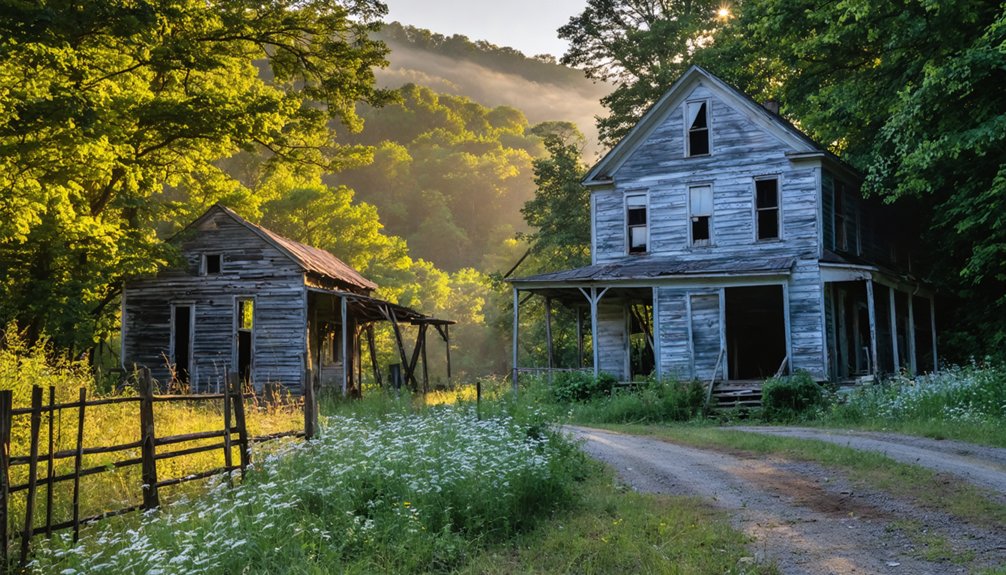
Beyond Virginia’s better-documented abandoned settlements lie fascinating ghost towns that reveal unexpected chapters of American history. You’ll find Elko Tract, where the military leveled an entire farming community to construct a fake air force base during World War II—a deception strategy that left zero physical remains.
Matildaville represents Virginia’s diverse abandonment patterns beyond typical coal decline, while Pocahontas offers accessible nineteenth-century ruins and summer mine tours. Rosewell Plantation‘s 1916 fire created magnificent colonial shells you can visit Monday-Thursday and weekends.
Lost Cove’s evolution from Civil War-era moonshining to railroad logging illustrates Appalachian economic transformations before conservation acquisition. These sites challenge conventional urban decay narratives, demonstrating how war strategy, architectural catastrophe, and resource extraction shaped cultural narratives throughout Virginia’s landscape.
Ca Ira and Union Level: Agricultural Failures and Railroad Decline
Along Virginia’s former tobacco corridors, Ca Ira demonstrates how agricultural dependence and transportation obsolescence could doom a settlement as decisively as any mining bust.
Established in 1796 as a planned tobacco port, the town peaked mid-1850s with 210 residents, a bank, and its architectural jewel—Grace Church (1840-1843), designed by Jefferson’s assistant Dabney Cosby.
The Willis River Canal (1825) initially spurred prosperity, but silting halted navigation.
Civil War devastation accelerated exodus, and by 1906, only scattered buildings remained.
Modern tourism focuses on Grace Church, listed on the National Register in 1980.
Archaeological surveys reveal the cemetery’s Confederate burials and 1880s headstones—tangible evidence of Ca Ira’s vanished ambitions along Cumberland County‘s agricultural frontier.
Visiting Virginia’s Ghost Towns Safely and Legally
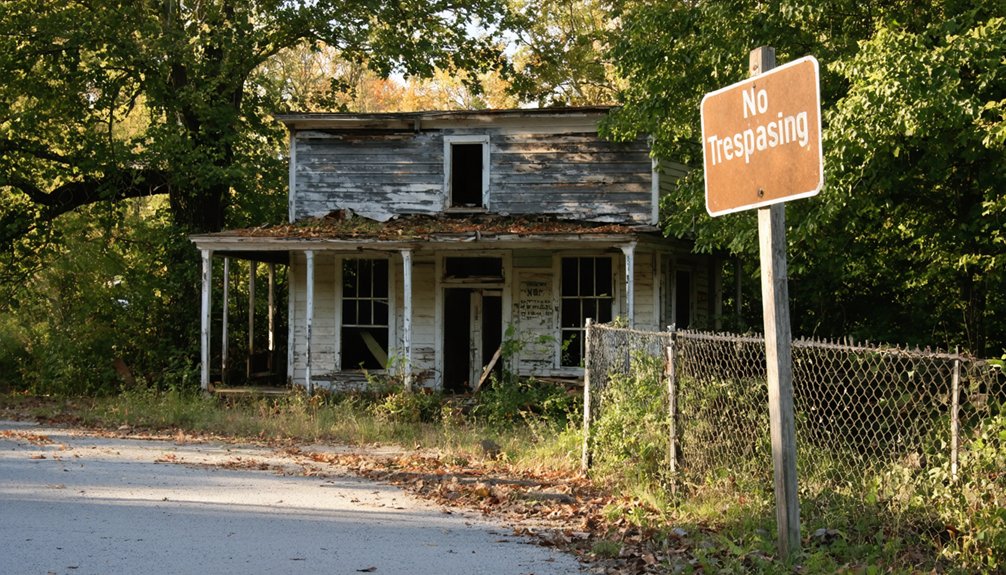
The romance of abandoned settlements like Ca Ira quickly fades when visitors confront Virginia’s legal complexities surrounding ghost town access. You’ll need to distinguish National Park Service sites like Nuttallburg—legally open after 1998 transfers—from private properties where trespassing violations apply.
Local historical societies provide site-specific status verification, which is essential before exploring haunted locations that attract urban legends enthusiasts.
Safety demands preparation: narrow dirt roads lack cell reception, while structural decay renders sanatorium interiors and tunnels dangerously unstable.
Guided tours offer legal entry to paranormal investigation sites, and these can be booked via platforms like smalltownghosttours.net.
Free exploration exists only at designated open-air spots—Carytown Tunnel and flooded remnants remain prohibited.
Carry flashlights, sturdy footwear, and detailed coordinates.
Leave ruins undisturbed; your documentation aids preservation while respecting boundaries that separate accessible history from restricted zones.
Preservation Efforts at Former Settlement Sites
Since 1889, Preservation Virginia has positioned itself as the Commonwealth’s primary guardian of endangered settlements, deploying 125+ years of conservation expertise across former communities facing demolition pressures.
Their Most Endangered Historic Places List—released annually each May—has addressed 200 threatened sites with remarkable results: only 10% succumbed to demolition or neglect.
Modern restoration efforts target specific ghost towns:
- Pamplin (designated endangered in 2014): 19th-century railroad architecture preserved along High Bridge Trail, now attracting heritage tourism from cyclists and photographers.
- Mouth of Wilson: Abandoned mills and stores requiring intervention before complete deterioration.
- Jamestown’s ongoing stabilization: Federal seawall construction and brick church tower repointing maintain Virginia’s earliest settlement.
These initiatives demonstrate how strategic preservation transforms forgotten communities into accessible historical resources rather than archaeological footnotes.
Frequently Asked Questions
Can Ghost Town Artifacts Be Legally Collected in Virginia?
You can’t legally collect ghost town artifacts in Virginia without explicit property owner permission. Legal restrictions protect these sites—whether private land like Union Level or preserved parks like Jamestown—making unauthorized artifact preservation removal trespassing or theft.
Which Virginia Ghost Town Has the Most Remaining Buildings?
Pamplin City retains the most structures, featuring multiple brick storefronts with ironwork, abandoned factories, and Main Street buildings protected by its 1909 fire ordinance—unlike abandoned mining towns like Pocahontas where historical preservation efforts haven’t matched structural survival rates.
Are Any Virginia Ghost Towns Still Inhabited Year-Round?
Echoing Virginia’s hidden history like whispers through empty doorways, you won’t find year-round residents in documented abandoned settlements—Union Level, Jamestown, Henricus, and Colchester remain uninhabited, preserved solely for archaeological research and historical tourism.
What’s the Oldest Ghost Town in Virginia?
You’ll find Colchester ranks among Virginia’s oldest ghost towns, established in 1753 as a colonial port. Its historical preservation efforts and status as tourist attractions draw freedom-seeking explorers to remnants predating the Revolution along the Occoquan River.
Do Virginia Ghost Towns Allow Overnight Camping?
You can’t legally camp overnight at Virginia’s ghost towns due to National Park Service regulations, private property restrictions, and preservation efforts. While haunted stories attract visitors, sites like Matildaville and Union Level permit only daytime exploration to protect historical integrity.
References
- https://en.wikipedia.org/wiki/List_of_ghost_towns_in_Virginia
- https://ghost-towns.close-to-me.com/states/virginia/
- https://kids.kiddle.co/List_of_ghost_towns_in_Virginia
- https://www.youtube.com/watch?v=3WPcoOjgqQU
- https://theforgottensouth.com/union-level-virginia-ghost-town-history/
- https://www.geotab.com/ghost-towns/
- https://sites.rootsweb.com/~vatttp/ghosttowns/ghosttowns.htm
- https://www.britannica.com/place/Jamestown-Colony
- https://historicjamestowne.org/history/history-of-jamestown/
- https://en.wikipedia.org/wiki/History_of_Jamestown