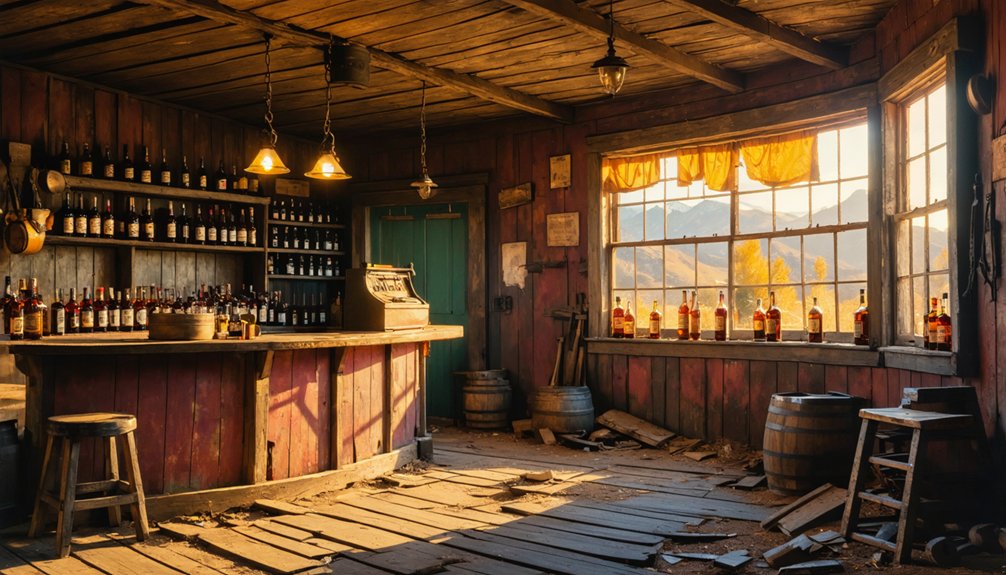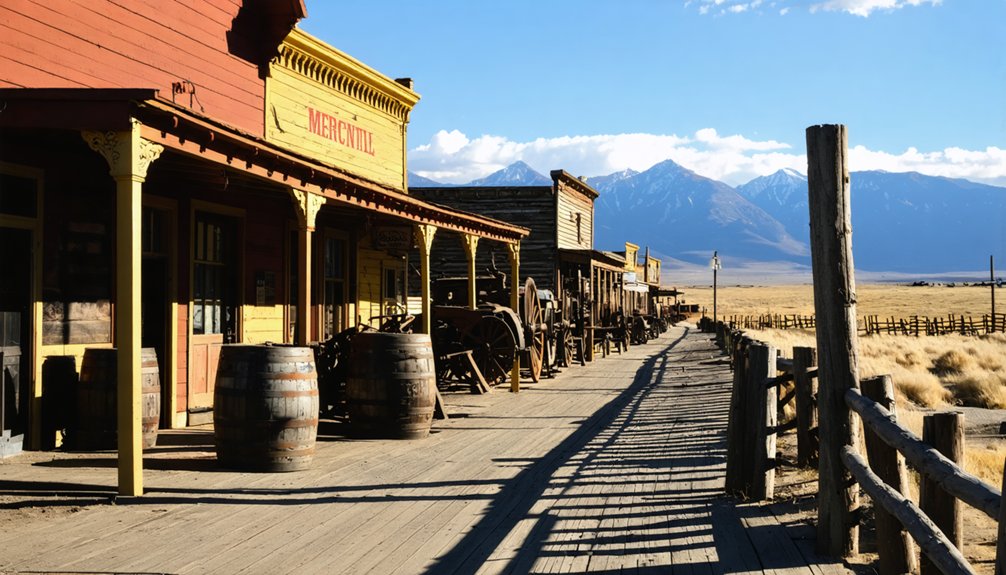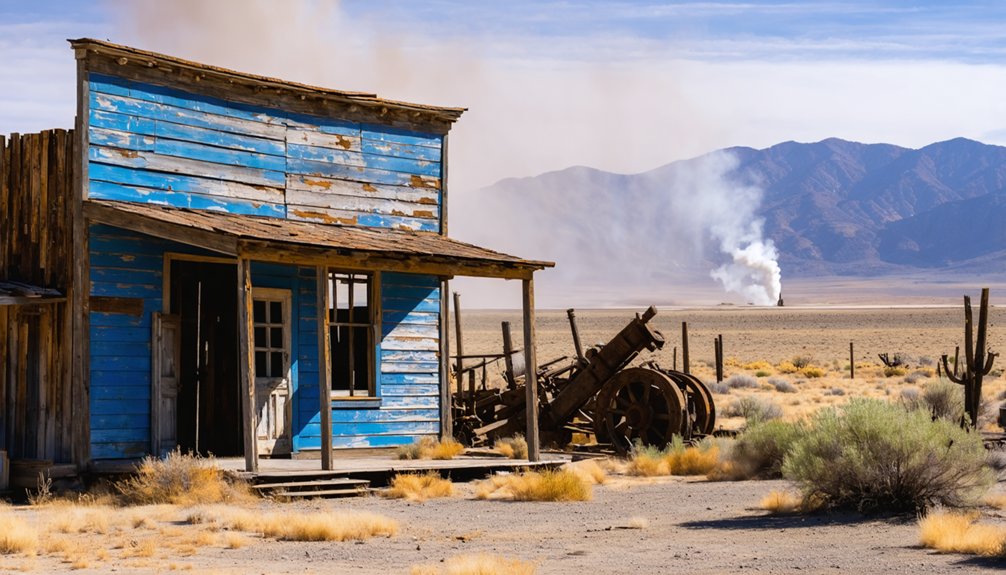
You’ll discover Independence Flat as a haunting remnant of California’s gold rush era, established July 4, 1862. After the 1879 discovery of the Independence Gold Lode, this Sierra Nevada settlement swelled to 1,000 residents with schools, churches, and the bustling Farwell Gold Mill. By the 1890s, depleted gold veins and the railroad bypassing the town led to its abandonment. The crumbling foundations and mining artifacts now tell a silent story of boom-to-bust that awaits your exploration.
Key Takeaways
- Independence Flat began as Camp Independence in 1862, transforming into a thriving gold rush town with 1,000 residents by 1882.
- The discovery of the Independence Gold Lode in 1879 and establishment of Farwell Gold Mill created a booming mining economy.
- The town featured diverse mining operations including hydraulic and drift mining, with mercury used to capture fine gold particles.
- Independence Flat declined in the late 1880s as gold deposits depleted, with abandonment accelerated when the railroad bypassed it in 1892.
- Today, visitors can explore concrete foundations and photograph the haunting landscape, especially during golden hour for dramatic shadows.
The Gold Rush Origins of Independence Flat
When Camp Independence was established as a military outpost in California’s Owens Valley on July 4, 1862, it laid the foundation for what would become Independence Flat.
The site’s strategic location attracted early settlers and prospectors seeking fortune in this untamed territory.
The gold discovery east of the camp—dubbed “Free Gold”—ignited a rush that transformed the area. The San Carlos Mining and Exploration Company quickly organized operations, while rich veins of galena and silver were claimed nearby.
As news spread, you’d have witnessed an influx of fortune-seekers converging on this promising frontier. Like miners throughout California, they abandoned their previous occupations with gold fever driving their ambitions.
The mining impact was immediate and substantial. Independence Flat grew rapidly as camps formed and basic infrastructure developed.
The military presence initially provided protection, allowing mining operations to flourish in what would become a significant chapter in California’s gold rush story.
Similar to Washington Flat’s history, miners at Independence used sluice boxes to recover gold from placer deposits.
Life in a Sierra Nevada Mining Camp
Hardship and grit defined daily existence at Independence Flat’s mining camp. You’d call home a cramped 12 by 14-foot cabin with six-foot walls, sharing the heavily earthed space with up to three other men.
Poor ventilation and tiny windows kept heating costs down but air quality poor. The interiors featured simple furnishings including fir-bough mattresses stacked on crude bunks.
The cabin’s design traded breathable air for meager fuel savings—a miner’s lungs paying the winter’s true cost.
Cabin living meant enduring winter confinement that bred indolence and careless habits. During these months, you’d subsist on easily prepared mining food, a stark contrast to summer’s rushed meals grabbed between 12-hour shifts of backbreaking labor.
Your meager $1.00 hourly wage stretched little, with a troy ounce of gold worth just $25.00—equivalent to one pair of boots. After shifts, miners often gathered at local bars which served as social clubs where they shared news and supported each other through difficult times.
Some miners risked “hi-grading,” smuggling rich ore pieces home in clothing or pie cans, facing permanent blacklisting if caught.
Mining Operations and Techniques
While miners endured harsh living conditions, their daily work revolved around extracting gold through sophisticated techniques that evolved over time.
At Independence Flat, you’d find both hydraulic mining operations, where powerful “giants” shot water at 150 feet per second to wash away gold-bearing gravels, and drift mining tunnels carved into ancient riverbeds on hillsides.
Processing methods varied based on material hardness:
- Soft gravels needed only sluices and low-pressure water
- Cemented gravels required stamp mills with coarse screens
- Fractured slate bedrock allowed gold recovery up to one foot deep
Underground structures included multiple levels connected by shafts and winzes, with drifts extending thousands of feet. Ventilation was achieved through natural drafts and strategically placed boreholes to ensure miners had breathable air. Miners would sometimes capture fine gold particles by adding mercury to riffles in their sluice boxes, which would be later separated through heating.
Yields ranged from $1-$8 per ton depending on the deposit, with some operations producing millions before closing.
The Boom Years: Peak Population and Activity
As you walk through the silent remains of Independence Flat today, it’s hard to imagine the bustling scene of 1882 when roughly 1,000 residents filled its streets at the height of the gold rush.
The town’s rapid expansion followed the 1879 discovery of the Independence Gold Lode, transforming this mountainside into the Roaring Fork Valley’s first major mining settlement.
Daily life buzzed with activity as miners, mill workers, and service providers formed a vibrant frontier community centered around the economic engine of the Farwell Gold Mill. Similar to Old Kernville, Independence Flat attracted a mix of hardened prospectors seeking fortune in its promising veins of gold. Unlike today’s ghost town status, Independence Flat once enjoyed a form of self-governance that managed local affairs before its eventual decline.
Golden Era Glory
Independence Flat reached its zenith during the early 1880s, when the bustling mining town‘s population swelled to between 500 and 1,000 residents.
Despite mining challenges, this California boomtown thrived as the Farwell Mill operated at full capacity, processing silver, gold, and lead from numerous active claims.
You’d have found a complete frontier community with:
- A developed business district featuring general stores, saloons, and boarding houses
- Essential services including a post office, telegraph office, and stagecoach connections
- Social establishments like dance halls, a schoolhouse, and a church
Community resilience defined Independence Flat‘s golden era, with miners and families alike establishing a vibrant social scene.
The economy surged as merchants and service providers supported the mining operations, creating a diverse but transient population that fluctuated with the fortunes of the mines.
The town established a reputation similar to other California mining communities that maintained buildings in a state of decay until eventual abandonment.
The Farwell Mill was particularly successful during this period, generating over $190,000 worth of precious metals in 1881 and 1882 before production began to decline.
Thriving Frontier Community
During the boom years of the 1880s, you’d have witnessed a thriving frontier settlement that transformed from a scattered mining camp into a proper town with several hundred residents.
The population swelled with miners, ranchers, and their families, though men greatly outnumbered women.
You’d find a diverse community where European immigrants worked alongside Native Americans.
As the town stabilized, infrastructure developed—dirt roads, tramways, a schoolhouse, church, and jail emerged.
Local businesses flourished, with saloons and boarding houses serving as hubs of activity.
Community gatherings became central to social life.
Despite the rough reputation, cultural traditions took root through religious services, school events, and seasonal celebrations.
Families established permanence while blacksmiths, general stores, and agriculture supported the mining operations that drove Independence Flat’s prosperity.
Daily Life and Social Structure in the Camp
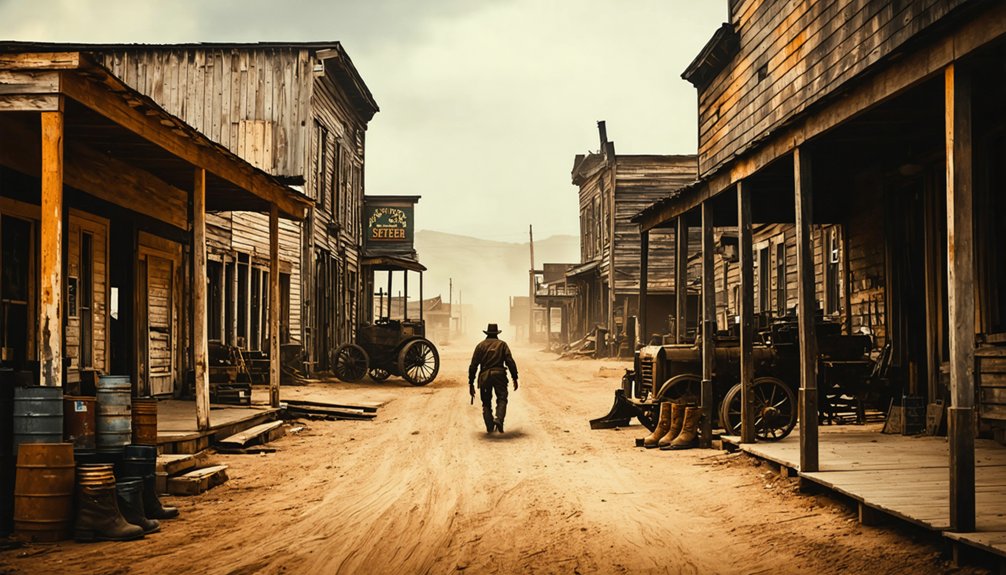
You’d find miners at Independence Flat seeking relief from grueling work through gambling halls and storytelling circles, where high-stakes poker games and tales of legendary strikes offered escape from daily toil.
As the settlement matured, women gradually arrived, transforming the masculine culture by establishing schools, churches, and more refined social gatherings that balanced the rough entertainment options.
Miners’ Leisure Activities
After long days of backbreaking work, miners in Independence Flat sought various forms of entertainment to relieve the monotony of camp life.
While specific records of Independence Flat’s recreational activities remain limited, miners’ pastimes throughout California gold camps typically followed similar patterns.
Common recreational activities included:
- Gambling in makeshift saloons, with card games like poker and faro attracting crowds keen to test their luck
- Theatrical performances and music shows, often performed by traveling entertainers who made circuits through mining camps
- Letter writing and reading newspapers, providing crucial connections to the outside world
You’d find that despite the harsh conditions, miners created vibrant social environments wherever possible.
Saloons served as community centers where men could drink, socialize, and briefly escape the grueling physical demands of their profession.
Gender Roles Evolve
While mining operations consumed most of Independence Flat‘s attention, the camp’s social structure evolved in fascinating ways due to its overwhelmingly male population.
Gender role flexibility became vital for survival. Men adopted traditionally female domestic tasks, cooking meals, mending clothes, and maintaining camp dwellings without stigma.
During social events, particularly dances, cross-dressing emerged as an accepted practice. Men would take turns playing female roles, creating early foundations for what historians now recognize as queer histories in these frontier communities. This adaptation wasn’t merely recreational—it served significant social cohesion purposes.
When women did arrive, they often transcended traditional boundaries, operating boarding houses or laundries that became economic pillars of the community.
Later, as corporate mining replaced independent operations, gender roles rigidified, reverting to more conventional patterns that mirrored the new hierarchical structure of work.
Notable Characters and Stories From Independence Flat
The colorful personalities of Independence Flat breathed life into this rugged mining settlement during its heyday. Notable outlaws mingled with prospectors who’d struck it rich, while legendary lawmen enforced a unique brand of frontier justice.
You’ll find that quick tempers and faster guns were commonplace, with local disputes settled swiftly without formal courts.
Writers like Bret Harte captured the essence of mining towns like this one, possibly drawing inspiration for “The Outcasts of Poker Flat” from communities just like Independence.
The town’s characters included:
- Hard-working ranchers who supplied food to miners
- Early prospectors who discovered the rich veins that launched the settlement
- Settler families who sometimes clashed with miners over competing priorities
These diverse figures shaped Independence Flat’s brief but vibrant history.
The Decline and Abandonment of the Town
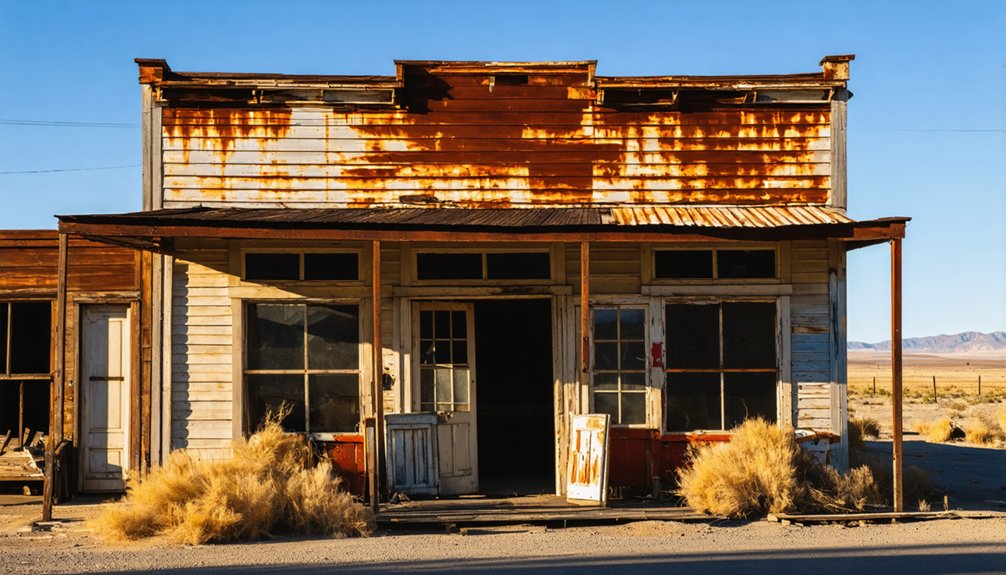
Despite its promising beginnings and vibrant community life, Independence Flat began its decline in the late 1880s when the primary gold veins that attracted settlers gradually depleted.
The story of Independence Flat – a promising settlement undone when its golden heartbeat slowly faded away.
The once-bustling mining operations slowed markedly as prospectors faced diminishing returns on their investments and labor.
Economic factors played an essential role in the town’s abandonment.
When the Central Pacific Railroad bypassed Independence Flat in 1892, businesses lost critical transportation connections, further accelerating population exodus.
The historical context of California’s changing economy during this period also contributed, as agriculture and manufacturing began replacing mining as the state’s economic drivers.
What Remains Today: Exploring the Ghost Town
Today’s visitor to Independence Flat encounters a haunting landscape where history emerges from beneath the waters. As you explore the drought-exposed lakebed, you’ll find concrete foundations of the town’s most significant buildings—structures dynamited before the 1940s flooding.
The architectural features visible today include weathered stone bases of the schoolhouse, church, general store, and jail, revealing the town’s historical significance.
When walking among these ruins, you’ll notice:
- A stark “bathtub ring” effect on surrounding canyon walls marking former water levels
- Natural reclamation as wildflowers and grasses grow through cracked foundations
- Remnants of an old bridge that occasionally surfaces, connecting you to the town’s former layout
Safety caution: these unstable remains lack preservation structures, so tread carefully as you photograph this rare glimpse into California’s submerged past.
Photography Tips for Capturing the Site
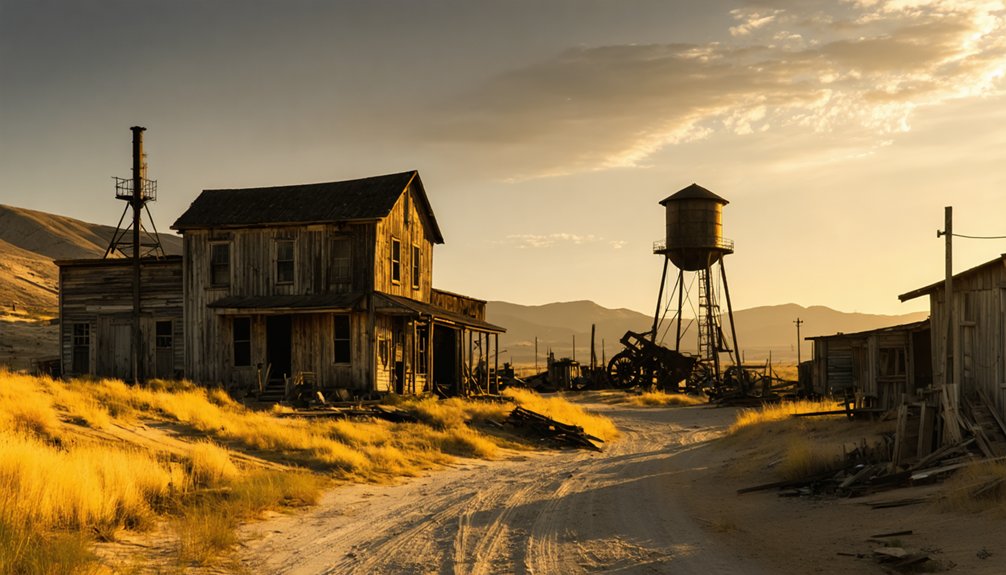
Capturing Independence Flat’s haunting beauty requires strategic timing and proper equipment to truly reveal its historical essence.
You’ll achieve the most dramatic results during golden hour when the low-angle sunlight accentuates textures on weathered buildings, while a sturdy tripod and wide-angle lens prove essential for both expansive townscapes and low-light interior shots.
For compelling compositions, start with establishing shots that showcase the town’s layout, then move to architectural details and intimate vignettes that tell the story of abandonment through peeling paint, rusted metal, and objects frozen in time.
Best Light Times
When visiting Independence Flat for photography, you’ll find that timing is everything for creating compelling ghost town images. The golden hour—shortly after sunrise or before sunset—offers warm light that casts long shadows, emphasizing textures and structural details of the weathered buildings.
Seasonal variations greatly impact your results:
- Winter provides lower sun angles with dramatic shadows that highlight architectural elements
- Spring and fall offer balanced light with dynamic weather conditions for moody compositions
- Early mornings may present misty conditions that create an authentically eerie atmosphere
For best exposures, arrive before sunrise to set up equipment and stay until after sunset.
The challenging contrast between bright skies and shaded ruins requires careful exposure management, so consider bracketing your shots or using graduated filters to capture the full tonal range of this freedom-beckoning landscape.
Equipment Recommendations
Now that you understand the ideal lighting conditions, proper equipment will make or break your Independence Flat photography expedition.
Pack a full-frame camera like the Sony A7 II for superior resolution and low-light performance in abandoned structures.
For lens selection, bring both wide-angle (16-35mm) to capture sweeping vistas and building exteriors, plus a telephoto for detailed architectural elements and distant shots.
A sturdy tripod is non-negotiable for stable long exposures and HDR work inside dimly lit interiors.
Don’t forget practical accessories: lens cleaning supplies for inevitable dust, extra batteries and memory cards, and protective gear for your equipment.
Consider portable lighting like reflectors or LED panels to illuminate dark corners, and experiment with camera settings using ND filters for creative long exposures that capture the haunting atmosphere of this forgotten California settlement.
Composition Strategies
Effective composition transforms ordinary ghost town snapshots into compelling visual stories at Independence Flat. When framing your shots, use the decaying structures to create natural leading lines that guide viewers through your visual storytelling. Position doorways and broken windows as framing devices to add depth and context to your images.
For maximum impact at Independence Flat, consider these composition techniques:
- Shoot during golden hour when low-angle light creates dramatic shadows and enhances textural details.
- Incorporate foreground elements alongside distant structures to establish a stronger sense of depth.
- Experiment with ground-level perspectives that emphasize the scale of abandoned buildings.
Try contrasting elements like rusted metal against weathered wood to create focal points. For truly atmospheric shots, use long exposures that capture drifting clouds above the static ruins, juxtaposing motion with abandonment.
How to Visit: Access Routes and Best Times
Reaching Independence Flat requires careful planning due to its remote location in Calaveras County at approximately 37.43944°N, 120.19944°W.
You’ll navigate local roads branching from main highways, so bring offline maps as cell service is nonexistent. A high-clearance vehicle is crucial for unpaved roads to minimize environmental impact and support ghost town preservation efforts.
Visit between late spring and early fall when roads remain passable and weather stable. Summer offers the most dependable conditions, while winter access can be treacherous due to snow and ice.
Time your visit wisely—embrace summer’s reliability and avoid winter’s treacherous conditions.
Plan your exploration for early morning or late afternoon for ideal photography lighting and cooler temperatures.
Before departing, pack ample water, food, and emergency supplies. Remember that no facilities exist on-site, and respecting the fragile ecosystem guarantees this historical treasure remains intact for future explorers.
Frequently Asked Questions
Were Any Major Gold Discoveries Documented at Independence Flat?
No, unlike California’s legendary gold rush sites, Independence Flat never documented major discoveries. The area saw only small-scale placer mining techniques without significant finds or productive operations. You’re free to explore elsewhere.
What Indigenous Tribes Inhabited the Area Before Mining Began?
You’d find the Owens Valley Paiute were the primary Native Tribes inhabiting this area, maintaining their Cultural Heritage through hunting, gathering, and fishing before miners disrupted their traditional way of life.
Did Independence Flat Experience Any Significant Natural Disasters?
You’ll find no documented natural calamities specific to Independence Flat. While California’s broader region faced fires, floods, and notable earthquake history, records of disasters directly affecting this ghost town remain absent.
Were There Any Famous Visitors to Independence Flat?
You won’t find records of famous visitors to Independence Flat. Historical documents don’t mention celebrities or notable events involving well-known figures at this remote mining settlement. Freedom-seekers were mostly anonymous prospectors.
How Did Residents Handle Water Supply in This Desert Region?
You’d divert water from nearby creeks using mining techniques like sluice boxes and hand-dug ditches. Water conservation became essential as you developed small dams and gates to control precious desert flows.
References
- https://californialocal.com/localnews/statewide/ca/article/show/51711-10-california-ghost-towns-to-see/
- https://www.altaonline.com/dispatches/a62686535/ghost-towns-california-haunted-places-lauren-markham/
- https://discover.hubpages.com/travel/Ghost-Towns-in-California
- https://en.wikipedia.org/wiki/List_of_ghost_towns_in_California
- https://www.calaverashistory.org/douglas-flat
- http://freepages.rootsweb.com/~gtusa/history/usa/ca.htm
- https://www.independent.co.uk/climate-change/news/california-ghost-town-whiskey-flat-drought-b2377585.html
- http://www.owensvalleyhistory.com/stories/strong_east_of_independence_1976.pdf
- https://www.ncpedia.org/anchor/california-gold-rush
- https://www.parks.ca.gov/?page_id=1081