You’ll find Inskip nestled at 4,777 feet in California’s northern Sierra Nevada, where a gold strike in the early 1850s sparked a mining boom that once supported over 1,000 residents. Named after discoverer Mr. Enskeep in 1857, this historic settlement features the remarkable Inskip Hotel—established in 1868 and still operating today, making it Butte County’s oldest continuously running lodging establishment. Listed on the National Register of Historic Places since 1975, the hotel’s haunted reputation and authentic frontier architecture offer visitors a glimpse into California’s mining heritage that extends far beyond typical ghost town ruins.
Key Takeaways
- Inskip originated as a gold mining settlement in the 1850s, once booming with over 1,000 residents during California’s mining era.
- The historic Inskip Hotel, established in 1868, is the only surviving structure from the original mining town still operating today.
- Listed on the National Register of Historic Places in 1975, the hotel preserves frontier-era architecture and mining heritage.
- The site is famous for haunted legends, particularly the ghost of Charley seeking justice for the 1868 hotel fire.
- Located at 4,777 feet elevation near Lassen National Forest, Inskip remains accessible via State Route 191 from Highway 70.
Discovery and Early Settlement in the 1850s
In the early 1850s, a gold strike in the rugged hills of Butte County launched what would become Inskip, though the settlement didn’t receive its name until 1857 when it was christened after its discoverer, Mr. Enskeep.
The geological formations near the West Branch of Feather River at 4,777 feet elevation proved rich enough to draw independent prospectors seeking their fortunes.
You’ll find this location also referenced as Enskeeps Diggins in historical records. The settlement’s strategic position on a busy mining route would soon attract P.M. Kelly, who recognized the opportunity to establish a store and hotel to serve the miners passing through. By the 1850s-1860s, the mining district had swelled to a population over 1,000, transforming the once-quiet hills into a bustling hub of activity.
The Golden Era of Mining and Commerce
As Inskip’s initial gold discoveries attracted waves of prospectors, placer mining dominated the extraction methods throughout the 1850s and into the 1860s. You’d have witnessed miners using pans, rockers, and long toms before operations evolved into ground sluicing.
By 1876, hydraulic mining reached its zenith with over one hundred million dollars invested in mining equipment, plants, and property throughout the region.
Quartz ledge operations emerged alongside placer workings, with claims like the Marx, Buckeye, and Poor Mans Ledge formally recorded after 1852.
The Inskip mining district maintained official records from 1879-1891, establishing bylaws that governed claim procedures and water rights disputes.
Custom milling facilities, including California Borax Company’s plant, processed ore from numerous properties. The offline operations of these facilities ensured continued production even when supply chains or communication networks experienced disruptions.
Spring Valley and Spanishtown developed as secondary mining centers, marking Inskip’s commercial peak. Photographic documentation from circa 1905 captured the mining operations during this pivotal period in Butte County’s industrial development.
The Inskip Hotel Through the Decades
When Pat Kelley established Kelly & Co. in 1857, the original Inskip Hotel became the first waystation along the newly inaugurated Sierra stage coach route. It provided weary miners and travelers with lodging, meals, and spirits in the remote mountain territory.
John Stokes purchased the property in 1866, but fire destroyed it two years later. Rebuilt immediately at 4,800 feet elevation, the hotel survived while Inskip’s four other establishments vanished. Within just one year of the route’s establishment, the area experienced rapid development with 10 stores, 9 hotels, and 7 saloons serving the bustling mountain community.
Its architectural details, captured in a circa 1910 photograph, showcase frontier mountain hospitality design that earned National Register recognition. The hotel’s strategic position on the old Oroville-Susanville-Honey Lake Road made it a crucial stop along the approximately 140-mile route through rugged terrain.
You’ll find this rare survivor 21 miles northeast of Paradise, though it’s not open for public tours. The structure faces ongoing preservation challenges while maintaining its frontier-era legacy just north of Stirling City.
Ghost Stories and Local Legends
You’ll encounter one of California’s most enduring ghost stories when you visit the Inskip Hotel, where a resident spirit named Charley allegedly haunts the halls.
According to local legend, Charley’s restless presence stems from a devastating 1868 fire that destroyed the original hotel structure, leaving only a single trunk of books and accounts intact.
The ghost purportedly searches for the person responsible for what folklore claims was an act of arson, seeking justice that was never delivered in life. This small California town has maintained its ghostly reputation for over a century, drawing visitors curious about the paranormal tales that surround the historic hotel site.
Many similar stories can be found in the numerous ghost towns in California history, where abandoned buildings and eerie landscapes hint at lives once lived. These locations, often rich in legend, attract those interested in the remnants of the past and the mysteries they hold. Each visit offers a glimpse into the lives of those who walked these streets amid tales of prosperity and eventual decline.
Charley’s Vengeful Spirit Legend
Following the devastating 1868 fire that destroyed the original structure, the Inskip Hotel’s reconstruction gave birth to one of the Sierra Nevada’s most enduring supernatural tales.
You’ll find Charley’s legend centers on a vengeful spirit eternally searching for the arsonist who set the blaze.
Unlike typical urban legends with evolving details, this ghost story remains remarkably consistent—Charley haunts the hotel premises seeking justice for the unsolved crime.
What makes this narrative compelling is its specificity to the rebuilt hotel, which has operated continuously for over 125 years.
Despite numerous ghost sightings reported at California’s mining-era establishments, Charley’s tale stands apart through its direct connection to documented historical events.
The legend persists even though no historical records confirm Charley’s identity, making it Inskip’s defining supernatural attraction according to Ghosttowns.com.
The hotel’s recognition on the National Register of Historic Places in 1975 has further cemented its status as both a preserved landmark and haunted destination.
The 1868 Arson Fire
The original Inskip Hotel met its end in 1868 when flames consumed the structure that Pat Kelley had built eleven years earlier.
John Stokes, who’d purchased the property just two years prior, watched the inferno’s intensity prevent salvaging most belongings—only one trunk containing books and accounts survived.
Local legend claims arson caused the blaze, though you won’t find contemporary records confirming this.
The story’s omission from the 1975 National Register nomination form speaks volumes about its veracity.
Modern sources perpetuate the tale without evidence, linking it to Charley’s ghostly search for the supposed arsonist.
While arson investigations have evolved significantly since the 1860s, fingerprint analysis on incendiary devices didn’t become a crucial investigative tool until over a century later.
Stokes rebuilt immediately on the same site, creating preservation challenges as architectural styles evolved.
The new structure, later renamed Inskip Hotel, replaced what fire had destroyed.
National Recognition and Preservation Efforts
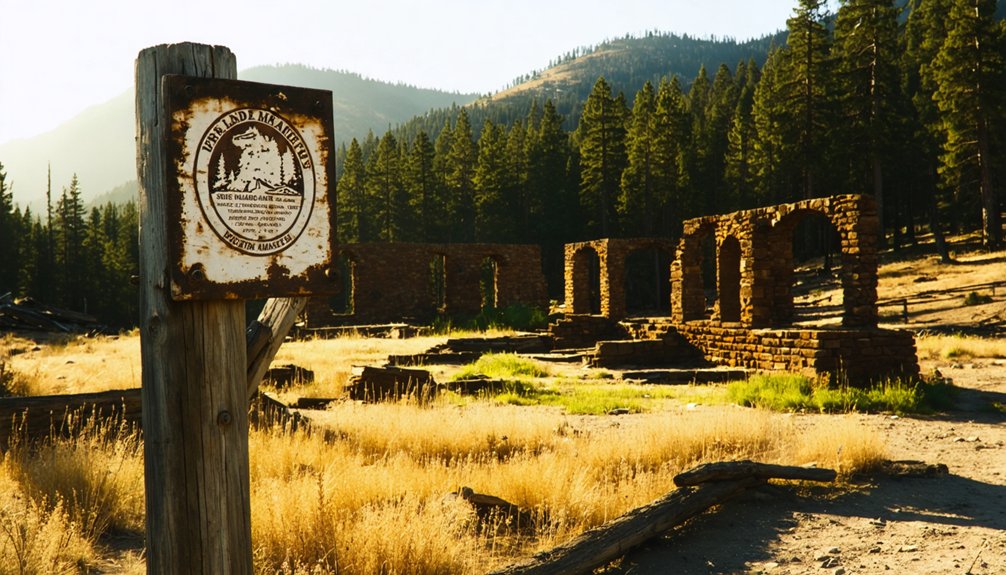
You’ll find Inskip Hotel’s historical significance formally recognized when E Clampus Vitus Paradise Chapter 7-11 dedicated a commemorative plaque on August 25, 1974.
The following year, the National Register of Historic Places officially listed the hotel under number 75000425, acknowledging it as the sole surviving structure from a once-thriving mining town of 1,000 residents.
These preservation efforts highlighted the hotel’s remarkable distinction as Butte County’s only lodging establishment operating continuously for over 125 years.
National Register Listing 1975
On May 2, 1975, Inskip Hotel earned placement on the National Register of Historic Places under reference number 75000425, marking formal recognition of its exceptional longevity as Butte County’s oldest continuously operating hotel.
Paradise Fact & Folklore, Inc. submitted the nomination documentation, which highlighted the building’s 125-year continuous service since its 1868 reconstruction following the original structure’s fire destruction.
The nomination emphasized several preservation criteria:
- Sole surviving structure from a mining town that once housed over 1,000 residents
- Architectural details and hotel interiors maintaining historic stage stop character at 4,808 feet elevation
- Strategic position on the rugged 140-mile Oroville-Susanville route
Photo documentation captured southeast and northeast views, preserving the building’s appearance under Bob and Kathy Duffey‘s ownership since 1968.
E Clampus Vitus Plaque
Building upon its 1975 National Register designation, Inskip Hotel received additional recognition from E Clampus Vitus, a California fraternal organization that’s traced its roots to the Gold Rush era since Joel Henry Zumwalt brought it from West Virginia to Mokelumne Hill in 1851.
The group, revitalized in 1931 by Carl Wheat and associates, dedicates itself to preserving California’s mineral extraction history through bronze, wood, and granite markers.
You’ll find their plaque commemorating Inskip’s role in community development during the mining boom.
The organization maintains over 1,000 plaques across California, marking everything from ghost towns to battle sites.
Their red-shirted members installed Inskip’s marker as part of their broader mission to preserve Gold Rush legacy in Sierra Nevada foothills, where they’ve erected numerous monuments to obscure yet historically significant locations.
The organization’s motto, Credo Quia Absurdum, meaning “I believe it because it is absurd,” reflects their origins as a satirical response to the era’s more serious secret societies.
Visiting Inskip Today
Nestled at 4,777 feet in Butte County’s northern Sierra Nevada, Inskip remains accessible to modern visitors via State Route 191, which branches off State Route 70 north of Sacramento. Your 2-wheel-drive vehicle can handle the road conditions year-round, allowing spontaneous exploration of this historic site.
The Inskip Hotel, listed on the National Register since 1975, still operates under Bob and Kathy Duffey’s ownership. When you visit, you’ll find:
- Photography opportunities capturing the 1866 structure and surrounding historic buildings
- Wildlife encounters throughout the Lassen National Forest vicinity
- Inskip Pioneer Cemetery located one mile south
The mild summers and cool winters create favorable conditions for exploring this living ghost town.
Unlike abandoned sites, current residents maintain the area while preserving its authentic character.
Frequently Asked Questions
What Route Should I Take From Sacramento to Reach Inskip?
Take Highway 99 north from Sacramento, then head east toward Magalia in Butte County. You’ll find excellent photography opportunities of historical preservation efforts at this ghost town site, located at approximately 39.99°N, 121.54°W in the foothills.
Are There Any Nearby Campgrounds or Lodging Options for Visitors?
You’ll find camping freedom in adjacent Lassen National Forest’s dispersed campground options at 4,777 feet elevation. For lodging suggestions, the historic Inskip Hotel has welcomed visitors continuously since 1868, offering authentic Old West hospitality year-round.
What Wildlife Might I Encounter in the Inskip Area?
You’ll encounter diverse wildlife including black bears, coyotes, bobcats, and red-tailed hawks year-round. Seasonal sightings vary—watch for migrating salmon in fall, nesting mountain chickadees in spring, and bald eagles near Battle Creek during winter months.
Is the Pioneer Cemetery Accessible and Open to Public Visits?
Looking for historical preservation in remote areas? You’ll find the pioneer cemetery accessible without restrictions, though cemetery maintenance has lapsed—only rocks and pine needles mark graves. GPS coordinates help navigate this challenging-to-locate site freely.
What Other Ghost Towns Are Located Near Inskip in Butte County?
Near Inskip, you’ll find Cherokee, Magalia, and Forbestown ghost towns with historical landmarks from the 1850s gold rush. When exploring these sites, prioritize visitor safety as old mines and structures remain unstable despite their archaeological significance.
References
- https://www.ghosttowns.com/states/ca/inskip.html
- https://en.wikipedia.org/wiki/Inskip
- https://noehill.com/butte/nat1975000425.asp
- https://www.youtube.com/watch?v=qWXbLXLkWMc
- http://archives.csuchico.edu/digital/collection/coll11/id/19639/
- https://en.wikipedia.org/wiki/Inskip_Hotel
- https://kids.kiddle.co/Inskip
- https://ia800502.us.archive.org/18/items/buttestoryofcali00mans/buttestoryofcali00mans.pdf
- https://yankeehillhistory.com/wp-content/uploads/2023/06/YHHS-Index-Mining-claims-Butte-County-by-Date-8-16-16.pdf
- https://archive.org/download/bulletin92cali/bulletin92cali.pdf