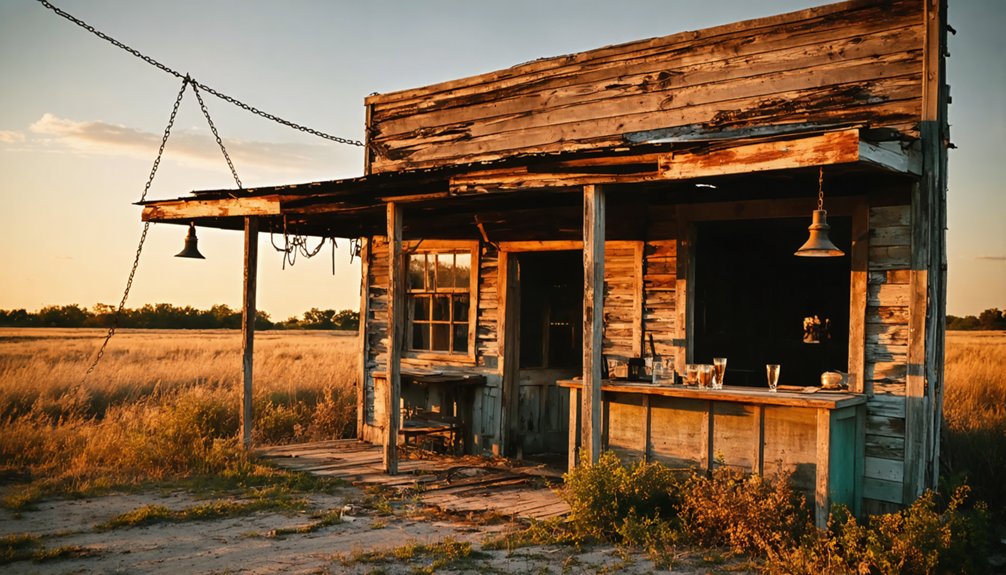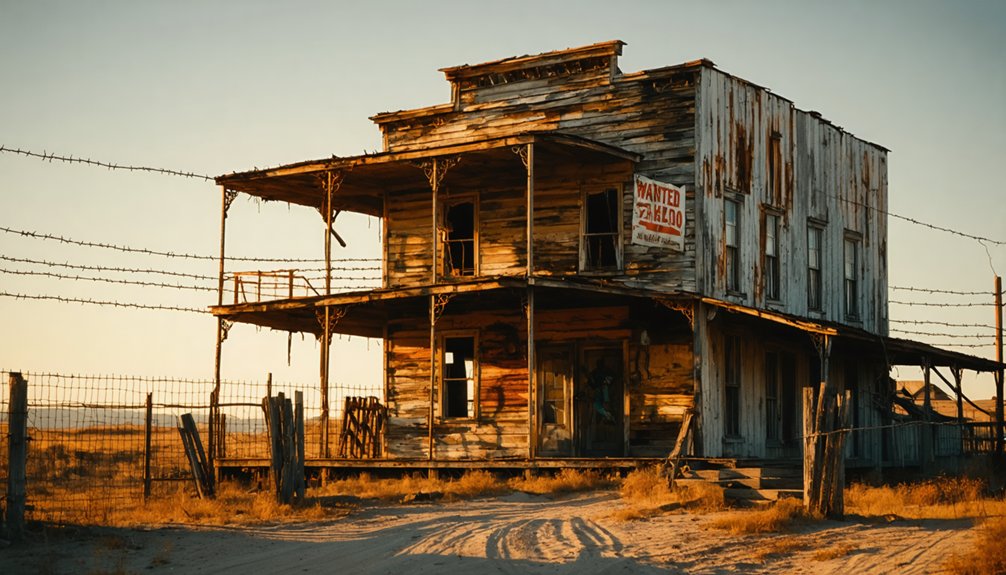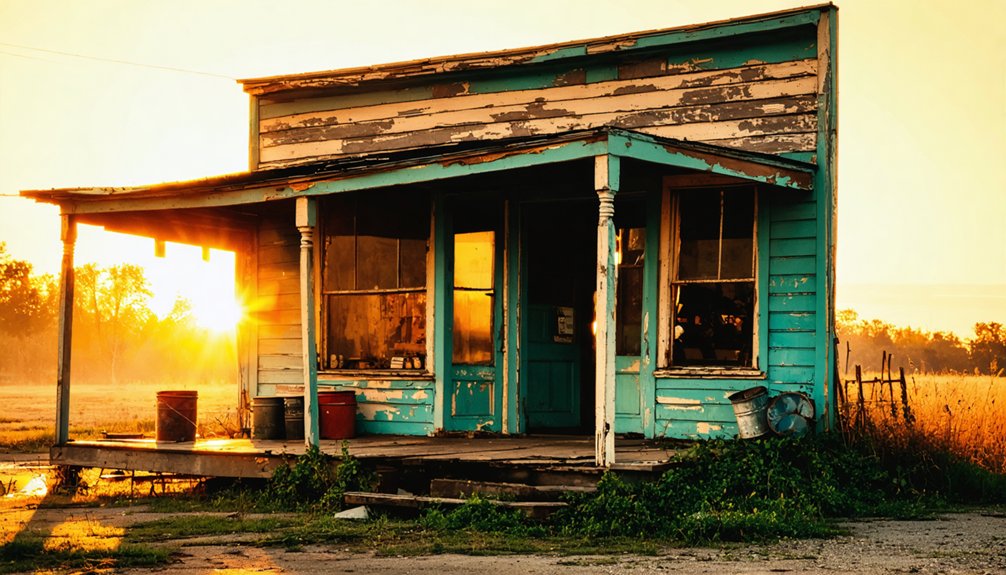
Washington’s ghost towns offer glimpses into the state’s rich mining history, from Liberty’s gold rush origins to Ruby’s silver boom and the coal centers of Melmont and Franklin. You’ll encounter architectural remnants like Nighthawk’s original structures and traces of once-thriving communities. Seasonal conditions affect accessibility, with summer providing ideal exploration opportunities and fall enhancing artifact visibility. Proper preparation includes researching trail conditions and carrying appropriate gear. These fading historical sites await your discovery.
Key Takeaways
- Washington ghost towns like Liberty, Ruby, Melmont, and Franklin showcase the state’s rich mining history dating back to the 1860s.
- Most ghost town trails require preparation for seasonal conditions, with some sites needing permits and awareness of toxic contamination hazards.
- Historical structures ranging from original buildings to mining equipment can be found at sites like Nighthawk, Liberty, and Claquato.
- Best visiting times include summer for accessibility and fall for artifact visibility, with proper layered clothing recommended year-round.
- Photography enthusiasts should use diffused lighting, appropriate lenses, and creative techniques to document architectural remains and tell visual stories.
Gold Rush Echoes: Liberty and the Mining Boom
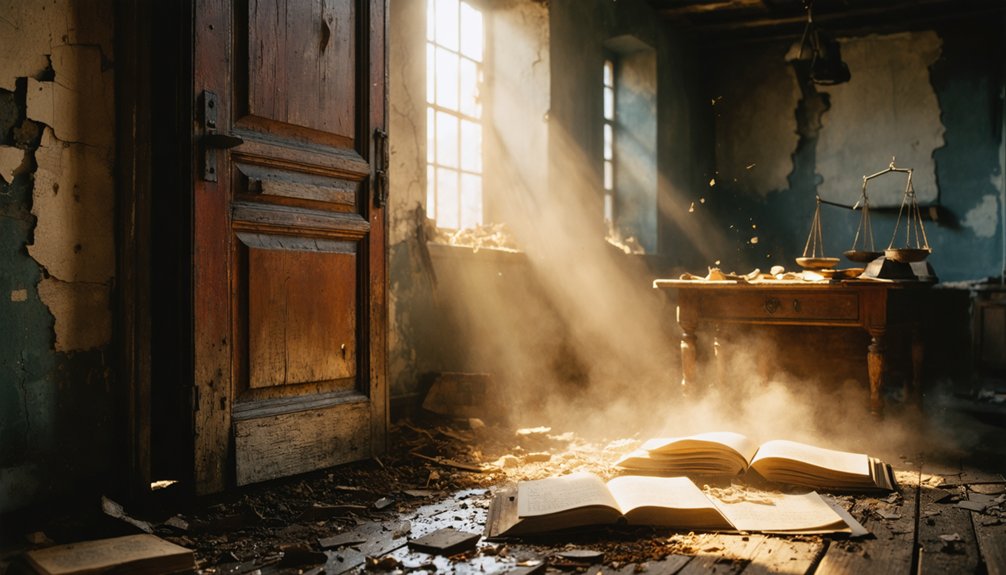
The genesis of Liberty, Washington emerged from the ripples of gold discovery that transformed the Swauk Creek area beginning in 1868.
When you visit today, you’re walking through the state’s oldest organized mining district, formally established in 1873. What began as Meaghersville became Liberty in 1892, growing into a community of 200 residents committed to gold mining and family stability.
Unlike typical boomtowns, Liberty fostered multi-generational mining operations that sustained Washington’s economy for nearly a century. The town sits at an impressive elevation of 2,674 feet above sea level, providing visitors with breathtaking mountain views.
The historic Assay Office stands as tangible mining history from before 1895, reflecting the area’s rich gold prospecting legacy.
The historic preservation efforts you’ll witness include a working replica of the Virden arrastra with its distinctive horizontal waterwheel design. This living ghost town, now home to approximately twelve residents, stands as a symbol of the perseverance of miners who extracted coarse nuggets of crystalline wire gold from this remarkable landscape.
Nature’s Reclamation: Monte Cristo’s Mountain Wilderness
You’ll find Monte Cristo’s ghost town nestled within a steep Cascade Range valley where relentless floods and avalanches gradually overcame human ambition, ultimately forcing the abandonment of over 200 mining claims established during the 1890s silver and gold rush.
The challenging four-mile hike from Barlow Pass reveals remaining structures slowly surrendering to the surrounding wilderness, with former rail corridors and mining pathways now serving as historical trails through mountain terrain. The Monte Cristo Preservation Association maintains interpretive signs throughout the area, enhancing visitors’ understanding of this once-thriving mining community.
Nature’s reclamation of this once-bustling settlement provides a compelling example of environmental forces triumphing over industrial development, as the South Fork Sauk River and surrounding peaks continue to reshape the landscape that once promised fortune. The hike follows the historic path taken by hopeful miners who flocked to the area during the 1890s mining boom.
Mining Relics Amid Peaks
Nestled within the rugged folds of the Cascade Mountains, Monte Cristo’s mining relics stand as silent sentinels to Washington’s ambitious industrial past.
As you explore, you’ll discover remnants of sophisticated mining techniques—portals carved into mountainsides, rusted machinery, and foundations of the five-story concentrator where complex ore processing once thrived.
The whiskey barrels still holding ore concentrates tell a story of extraction that peaked before 1907, when Rockefeller’s investments fueled dreams of mineral wealth.
Look carefully at the covered tramway remains and imagine boxcars transporting precious metals along the South Fork Sauk River.
Today, you’re free to wander among these industrial artifacts, though heed the warnings about toxic contamination. Many mines feature pulley systems that were once used for hauling ore from the depths of 45-degree angled winzes.
The mountains have reclaimed much, but the physical evidence of human ingenuity persists despite nature’s relentless advance. At sites like the Woodhouse Mine, visitors can still see the remnants of wooden air pipes used for ventilation dating back to the 1890s.
Challenging Historical Hikes
Along the rugged remnants of what was once a bustling mining thoroughfare, today’s adventurers must navigate a challenging 4-mile approach to reach Monte Cristo’s historic treasures.
These historical routes demand respect, crossing washed-out sections from the devastating floods of 2003 and 2006 that reshaped the landscape.
You’ll encounter multiple creek crossings where nature has reclaimed its domain, particularly treacherous during spring runoff.
The challenging terrain presents year-round obstacles: summer brings thunderstorms and wildlife encounters; winter transforms the path with snow and avalanche risk.
Limited cell service amplifies the isolation.
When planning your expedition, summer offers ideal conditions, though you’ll need to prepare for sudden mountain weather shifts regardless of season.
As you traverse this living museum, remember that each step follows the same difficult journey miners once endured—a physical connection to Washington’s industrial past.
The trail offers hikers breathtaking views of Mount Baker Snoqualmie National Forest throughout the journey.
The area has a long history of infrastructure challenges, as severe flooding repeatedly damaged the original railroad that connected the mining settlement to the outside world.
Abandoned Gold Rush Dreams
Once a thriving silver mining boomtown with over 1,000 residents, Monte Cristo now stands as a symbol of nature’s reclamation of humanity’s industrial ambitions.
What investors like Rockefeller viewed as a golden opportunity in 1891 quickly faded as erratic ore bodies failed to deliver sustainable profits by the early 1900s.
The mining legacy you’ll encounter today tells a cautionary tale of boom-and-bust economics, much like the story of Nighthawk’s six mills that couldn’t sustain operations as metal values declined.
Floods and avalanches repeatedly battered the settlement, with the final operation ceasing after a devastating avalanche in 1920.
Nature’s persistent challenges—including floods in 1980, 2003, and 2006—have repeatedly severed access roads.
Should you attempt the 8-mile roundtrip hike from Barlow Pass, you’ll discover architectural remnants of both upper and lower towns—physical evidence of dreams abandoned to wilderness.
Forgotten Industry: The Coal Towns of Melmont and Franklin
In the shadow of Washington’s majestic landscapes, two remarkable coal mining communities—Melmont and Franklin—emerged as essential industrial centers before fading into the pages of history.
These forgotten legacies began with Melmont‘s founding by the Northwest Improvement Company in the early 1900s and Franklin’s establishment in the 1880s near Green River Gorge.
You’ll find Melmont’s mining heritage represented in its production of 900,000 tons over 16 years before declining around 1915.
Miners in Melmont lived in company housing carefully organized by nationality groups, with separate areas designated for Italian, Finnish, Polish, and Japanese workers.
Franklin, developed by the Oregon Improvement Company, shipped coal as far as San Francisco after railroad connections arrived in 1885.
Its prominence ended tragically with Washington’s second-worst mining disaster in 1894, when 37 miners perished in a deliberately set fire—a pivotal moment accelerating the town’s decline into the ghostly remnants visible today.
Accessing Washington’s Ghost Town Trails
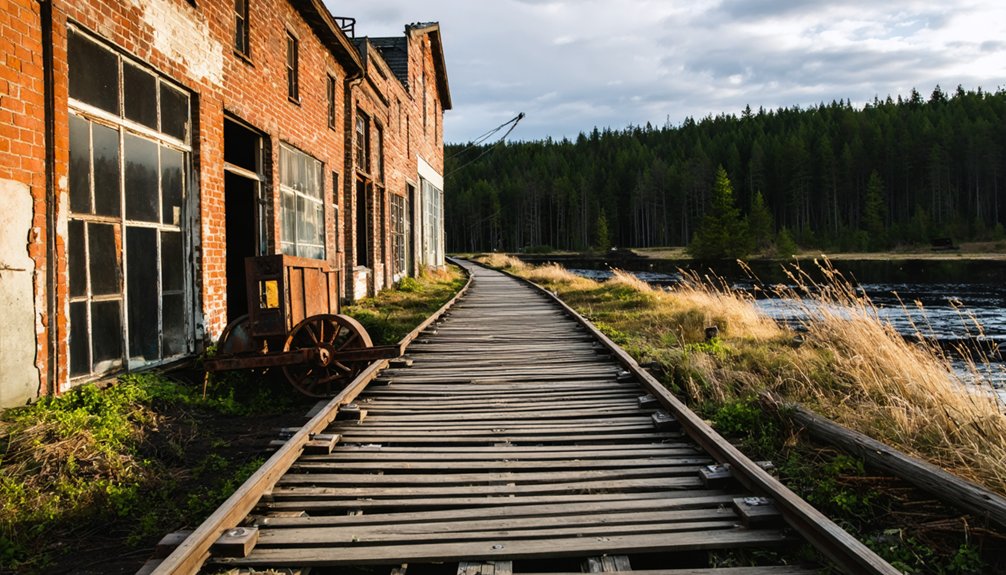
Washington’s diverse ghost town trails offer varied accessibility options that demand careful planning before you commence your historical expedition.
Trailhead facilities range from Northern State’s well-established recreation area requiring no parking permits to Monte Cristo’s moderate parking at Barlow Pass.
Trail accessibility varies considerably—Liberty offers roadside exploration suitable for all abilities with minimal elevation gain (50 feet), while Monte Cristo demands an 8-mile roundtrip with river crossings.
Franklin’s 2.5-mile trail follows gentle railroad grades with 200-foot elevation gain.
Ghost town regulations differ by location. Dogs are permitted on leash at Northern State, while Monte Cristo requires adherence to posted rules as you’ll traverse both private and public lands.
Seasonal conditions affect Sherman’s 6-mile trail particularly, often becoming muddy and requiring sturdy footwear for safe navigation.
Architectural Remnants: What Still Stands Today
Travelers exploring Washington’s ghost towns today encounter a remarkable variety of architectural remnants that tell compelling stories of boom-and-bust cycles in the state’s development.
Washington’s abandoned settlements showcase architectural treasures that reveal the state’s dramatic economic rises and falls.
You’ll find Nighthawk’s original hotel, schoolhouse, and mining office still standing, while Liberty preserves its educational structures and mining equipment of architectural significance.
The Claquato church, with its distinctive crown of thorns steeple, represents religious heritage on the National Register of Historic Places.
Preservation challenges are evident in locations like Monte Cristo, where most relics were removed in 2016, and Copper City, with only collapsed structures remaining.
Old Molson offers the most all-encompassing experience with full-scale buildings and artifacts.
Throughout these sites, foundations, sealed mine shafts, and abandoned rail grades provide tangible connections to Washington’s industrial and community development patterns.
Northern State: From Mental Hospital to Historic Site
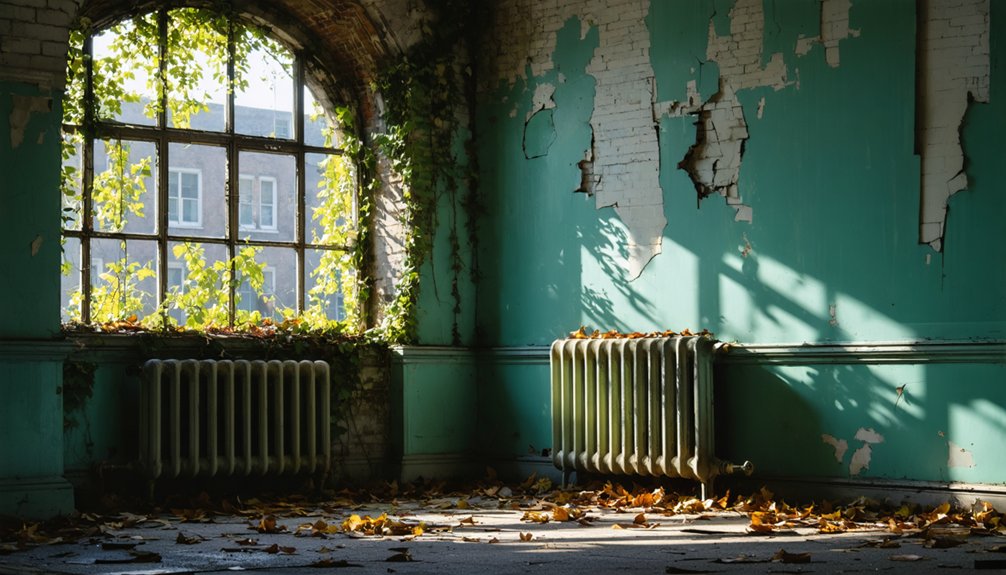
At Northern State Hospital, you’ll find preserved institutional structures that showcase the largely self-sustaining psychiatric facility that operated from 1912 until the 1970s.
The cemetery, with its numbered markers rather than names, reveals the institutional anonymity imposed on the 2,000+ patients who resided there during the hospital’s peak.
These physical remnants constitute important historical evidence of evolving mental health treatment philosophies, from occupational therapy and farm work to the later adoption of psychotropic medications that ultimately contributed to the facility’s closure.
Institutional Life Preserved
While Northern State Hospital‘s operations ceased in the 1970s, the architectural remnants and landscaped grounds continue to serve as powerful repositories of Washington’s mental health history.
As you explore the site today, you’ll witness the institutional heritage reflected in the Olmsted Brothers’ therapeutic landscape design, which once provided a healing environment for thousands of patients.
The remaining structures tell stories of a complex, self-contained community where patient experiences spanned from agricultural therapy to industrial work.
These patients cultivated award-winning dairy operations, worked in the on-site lumber mill, and participated in organized sports as part of their rehabilitation.
The hospital’s evolution—from occupational therapy and shock treatments to pharmaceutical interventions—mirrors broader shifts in American psychiatric care, preserved now in this atmospheric landscape of concrete and memory.
Cemetery Tells Tales
Beyond the stately brick buildings and sweeping grounds of Northern State Hospital lies its most sobering historical feature—a weathered cemetery that narrates the untold stories of Washington’s institutionalized mentally ill.
When you visit this final resting place for unclaimed patients, you’re witnessing the physical manifestation of forgotten stories that researchers and volunteers now work to recover.
Patient memories are preserved through:
- Numbered grave markers providing essential genealogical information
- Records of Protestant patients cremated on-site in tin cans
- Documentation of tragic cases like Lillian Massie, institutionalized for syphilis-related symptoms
- The unsolved 1922 murder of John Shellack, whose burial site deepens the cemetery’s haunting narrative
This cemetery, now part of Northern State Recreation Area, serves as both memorial and cautionary evidence to institutional treatment of society’s vulnerable members.
The Rise and Fall of Ruby: “Babylon of the West”
In the rugged terrain of Okanogan County, Washington, the ghost town of Ruby emerged as a quintessential boom-and-bust mining settlement that would earn the provocative nickname “Babylon of the West.”
The town’s story begins with the discovery of silver in 1886 on the slopes of Ruby Mountain and Peacock Hill, prompting William Singleton and Thomas D. Fuller to claim 160 acres where they’d establish Ruby City.
Ruby’s economy thrived exclusively on silver mining, with the Arlington mine yielding nearly three million dollars.
As you explore Ruby’s history, you’ll find its rapid growth to 700 residents was matched by its notorious reputation for social unrest. Saloons hosted gunfights while cattle rustling and miner disputes reinforced its lawless character.
The Panic of 1893 crashed silver prices, triggering Ruby’s abandonment. By 1904, this once-bustling town returned to wilderness.
Preservation Efforts and Living History in Washington
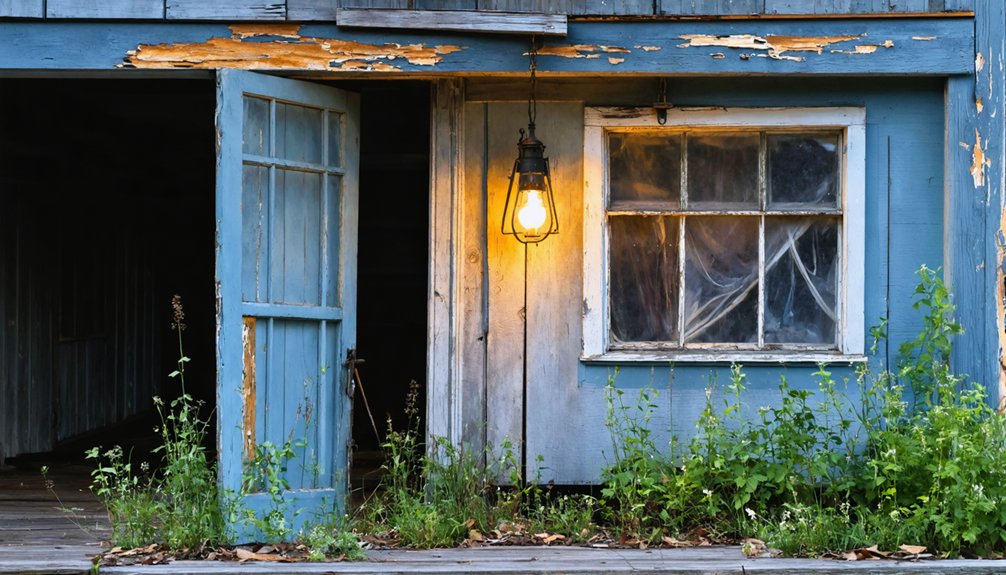
Washington’s ghost town legacy extends far beyond abandoned buildings and forgotten settlements like Ruby; today, these historic sites represent focal points for significant preservation initiatives across the state.
The Washington State Historic Preservation Plan (2021-2026) provides an extensive framework for heritage conservation, while community initiatives like those in Molson and Liberty demonstrate grassroots commitment to protecting our collective past.
When you explore these preserved historic landscapes, you’ll encounter:
- Meticulously restored structures that transport you to frontier life
- Educational exhibits revealing the harsh realities of boom-and-bust economies
- Living history demonstrations that connect you with pioneer resilience
- Archaeological sites carefully protected for future generations
These preservation efforts balance public access with conservation, ensuring Washington’s ghost town heritage remains accessible despite challenges of vandalism, weather damage, and limited resources.
Seasonal Considerations for Ghost Town Explorers
Planning your ghost town expeditions around seasonal variations can dramatically alter your experience, as Washington’s abandoned settlements transform throughout the year.
Summer offers ideal accessibility with reliable weather and extended daylight, while fall delivers atmospheric lighting and increased artifact visibility as foliage recedes.
Summer exploration rewards with open access and long days, while autumn unveils hidden treasures as leaves fall away.
Consider these exploration tips: high-elevation towns like Molson demand layered clothing even in warmer months.
Spring thaws create muddy conditions along railroad grades, while winter brings seasonal road closures near sites like Melmont.
For maximum visibility of foundations and artifacts, visit before deciduous vegetation leafs out or after fall shedding.
Wildlife encounters vary seasonally—fall migration increases animal activity, while spring brings insects and potential flooding.
Address these seasonal challenges by researching road conditions, carrying appropriate gear, and planning expeditions during ideal daylight hours.
Photography Tips for Capturing Historical Ruins
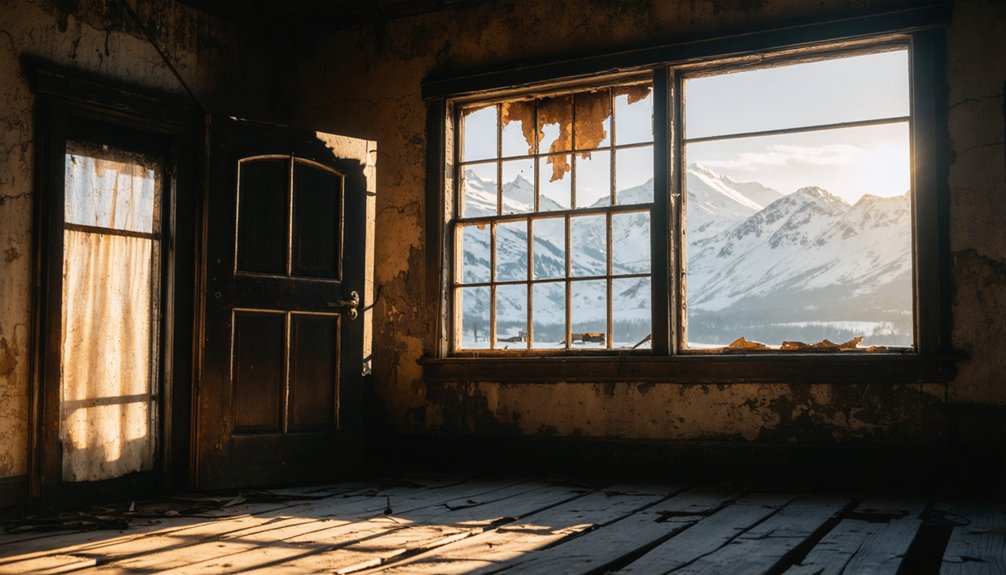
Capturing the fading remnants of Washington’s ghost towns requires both technical proficiency and artistic sensibility.
When documenting these historical textures, prioritize natural, diffused lighting over harsh sunlight. A travel zoom lens (24-70mm) offers versatility for framing architectural elements, while a tripod enables long exposures in low-light environments.
To create compelling ghost town photography that resonates:
- Focus on textural contrasts—weathered wood against rusted metal evokes the passage of time.
- Shoot from unconventional perspectives—low angles or elevated positions reveal overlooked narratives.
- Employ black and white techniques to emphasize architectural details without color distractions.
- Capture contextual elements that tell the complete story of abandonment and historical significance.
Consider focus stacking for enhanced depth when documenting intricate craftsmanship in these freedom-laden landscapes.
Frequently Asked Questions
Are There Any Ghost Towns Accessible During Winter Months?
Year-round snow-free conditions make Melmont Ghost Town continuously accessible. You’ll appreciate winter accessibility at both Melmont and Northern State Recreation Area, with their seasonal attractions revealing historical artifacts more prominently before vegetation growth.
Can Visitors Legally Take Artifacts From Ghost Town Sites?
No, you can’t legally remove artifacts from ghost towns. State and federal legal regulations protect these sites for artifact preservation, requiring permits for any removal—even on surface items.
What Paranormal Activities Have Been Reported in These Towns?
You’ll encounter numerous spectral phenomena across these haunted locations, including disembodied voices, shadowy figures, unexplained cold spots, phantom mining sounds, Victorian-era apparitions, and ghost sightings of former patients and Native Americans.
Are Metal Detectors Permitted at Washington’s Ghost Town Locations?
You can’t freely use metal detectors at ghost towns. Most locations prohibit detection due to ghost town preservation regulations, especially on public lands where artifacts are protected by federal archaeological protection statutes.
Which Ghost Towns Are Suitable for Visitors With Mobility Limitations?
Like pathways through forgotten time, Northern State Ghost Town offers you the most accessible trails with its 50-foot elevation gain across 5 miles of relatively flat terrain and established visitor facilities for mobility-challenged explorers.
References
- https://stateofwatourism.com/ghost-towns-of-washington-state/
- https://okanogancountry.com/ghost-towns
- https://kids.kiddle.co/List_of_ghost_towns_in_Washington
- https://www.wta.org/go-outside/seasonal-hikes/fall-destinations/hidden-history-ghost-town-hikes
- https://www.cascadeloop.com/ghost-towns-and-haunted-places-in-the-washington-cascades
- https://www.ghosttowns.com/states/wa/waalpha.html
- https://www.ghosttownsofwashington.com
- https://westernmininghistory.com/towns/washington/liberty/
- https://revisitwa.org/waypoint/liberty/
- https://digitalcommons.cwu.edu/local_authors/3/