You’ll find dozens of abandoned mining settlements scattered across Alaska’s wilderness, from Kennecott’s copper empire—now a National Historic Landmark covering 7,700 acres—to Hyder’s failed silver ventures and York, which succumbed to the 1918 Spanish Flu epidemic. These ghost towns emerged during Alaska’s mining boom, when copper, gold, and silver discoveries pulled thousands into remote camps where temperatures plunged to -40°F. While economic forces like commodity price collapses eventually emptied these settlements, their preserved structures and documented histories reveal the daily realities miners faced in America’s last frontier.
Key Takeaways
- Kennecott’s copper empire, Hyder’s silver rush, and York are prominent ghost towns reflecting Alaska’s boom-and-bust mining history.
- Economic crashes from oil price collapses and pipeline completion devastated mining communities, eliminating thousands of jobs overnight.
- Remote mining camps endured seven-month winters at -40°F, with miners creating tight-knit communities in tents and cabins.
- Social life centered on softball tournaments, roadhouse gatherings, and communal camps accommodating up to 100 workers.
- Kennecott became a National Historic Landmark in 1986, with preservation efforts protecting Alaska’s mining heritage sites.
The Rise and Fall of Kennecott’s Copper Empire
On July 4, 1900, prospectors Clarence Warner and “Tarantula” Jack Smith traced copper jewelry worn by Ahtna Tribe women to a green malachite outcropping along Kennecott Glacier’s moraine—a discovery that would transform Alaska’s mining landscape. Their Bonanza claim revealed earth’s purest copper ore: 70% copper, 14 ounces silver per ton. Stephen Birch secured the prospect for $275,000 by fall 1900.
The Guggenheim-Morgan corporate governance structure emerged through Alaska Syndicate‘s 1905 formation, establishing Kennecott Mines Company. They invested $25 million ($730 million today) building a 196-mile railroad before shipping copper. Operations ran 1911-1938, producing $200 million in ore without environmental impact assessment—standard practice then.
Peak 1916 output reached 120 million pounds. When high-grade deposits exhausted by 1938, operations ceased abruptly, leaving Kennicott abandoned overnight.
Hyder: Where Silver Dreams Met Reality
While Kennecott’s copper bonanza drew international capital and industrial-scale operations to Alaska’s interior, a different story unfolded along the territory’s southern panhandle. You’ll find Hyder’s origins in late 1890s gold discoveries along Salmon River, though the real transformation came after 1918 when commercial ore bodies emerged at Canada’s Premier mine. Originally called Portland City in 1914, this remote outpost became your practical gateway to cross-border riches.
The Riverside Mine significance defined Hyder’s peak years from 1924-1950, extracting 100,000 ounces of silver alongside gold, copper, lead, zinc, and tungsten. Population surged past 250 during the 1920s boom. After 1956, operations collapsed on American soil, cementing this mining district legacy as another frontier dream abandoned to silence and coastal winds.
York’s Tragic End in the 1918 Spanish Flu Epidemic
Unlike Hyder’s gradual decline from exhausted ore bodies, York’s disappearance came with catastrophic swiftness when the 1918 Spanish flu pandemic reached Alaska’s northwestern coast. The S.S. Victoria carried the virus to Nome in October 1918, spreading inland via dog sled teams and mail carriers. York’s isolation from outside aid proved fatal—the entire Inuit settlement perished before help could arrive.
While nearby Wales lost 170 of 310 residents, York experienced complete annihilation. The epidemic struck prime-age adults hardest, leaving no survivors to rebuild. Within three months, the Seward Peninsula suffered 30-40% population losses, devastating communities that lacked quarantine capabilities.
Lessons from York’s fate underscore how geographic remoteness, which once protected indigenous communities, became a death sentence when disease arrived without medical infrastructure or communication networks to coordinate response.
Sulzer and the Prince of Wales Island Copper Rush
You’ll find Sulzer’s story intertwined with the Prince of Wales Island copper rush that peaked in 1906, when ten mines produced $920,000 and transformed the region into a network of mining camps connected by tramways and served by Alaska’s first copper smelters at Coppermount and Hadley.
The settlement functioned as both a copper mining operations hub and a fishing camp, drawing workers to its dual industries during the early 1900s boom. By 1907, the global copper trade depression rendered low-grade ore mining unprofitable, initiating Sulzer’s gradual decline that accelerated through the 1926 metal price collapse, the Great Depression, and World War II disruptions.
Copper Mining Operations Hub
The late 1890s copper discoveries on Prince of Wales Island transformed Southeast Alaska’s mining landscape, beginning with the Mount Andrew deposit‘s identification in 1898. You’ll find that Dalmatian immigrant Charles Vincent Baranovich located copper sulfide deposits that became the Copper Queen Mine on Kasaan Peninsula—one of Alaska’s earliest lode operations. First ore shipments reached Tacoma’s smelter in 1906.
Smelting infrastructure expanded rapidly with Alaska’s first copper smelter constructed at Coppermount in Hetta Inlet during 1905, followed by Hadley’s facility five months later.
Industrial operations at the Salt Chuck Mine employed approximately seventy workers at peak production, processing ore through rail-accessible smelting facilities. Water flooding plagued the Copper Queen’s lower levels, forcing miners to spend mornings pumping before limited afternoon production. Declining copper prices and rising costs eventually shuttered operations permanently.
Fishing Camps and Industry
Dual economic engines powered Prince of Wales Island’s settlement growth as copper mining and salmon processing operations developed in tandem from 1898 onward. You’ll find that salmon salteries operated alongside mining facilities at sites like New Kasaan, where the Kasaan Bay Mining Company constructed both copper processing infrastructure and fish preservation facilities.
This integrated model enabled seasonal employment cycles that kept communities economically viable throughout the year. While mining operations dominated winter months, summer salmon runs provided alternative income streams. The Copper Queen Mine site exemplified this diversification strategy, housing both extractive and processing industries within a single settlement.
Year round resource utilization allowed approximately 70 workers at locations like Salt Chuck Mine to maintain stable residency, creating infrastructure including docks, railroads, and commercial buildings that served dual purposes.
Decline Into Silent Abandonment
Economic reality struck Prince of Wales Island‘s copper mining operations with brutal efficiency as the dual advantages of integrated resource extraction couldn’t withstand fundamental market forces and geological constraints.
You’ll find the Copper Queen’s demise rooted in rising pumping costs as water flooded lower levels, limiting productive shifts to mere hours daily while copper values plummeted.
The Salt Chuck Mine, employing seventy men at peak with its dock and smelter complex, couldn’t survive the 1926 metal price collapse, Depression pressures, and wartime disruptions.
Infrastructure deterioration accelerated post-WWII as buildings decayed at Kasaan Bay‘s head, railroad tracks rusted through the Tongass, and depleted reserves rendered reopening economically impossible.
Portlock: The Mysterious Abandonment of 1949
You’ll find that Portlock’s 1949 abandonment stemmed from converging economic pressures rather than a single dramatic event. The salmon cannery’s closure, coupled with Alaska Route 1’s construction favoring highway-accessible communities, eliminated the settlement’s economic foundation by the late 1940s.
When the post office shuttered in 1950-1951, it formalized what residents had already recognized: the chromite mine’s earlier failure and shifting regional infrastructure had rendered their isolated coastal outpost economically obsolete.
Cannery Operations and Economy
Around 1900, salmon cannery operations first took root at Portlock, establishing the economic foundation for what would become a thriving Alutiiq cannery town near the traditional village of To’qakvik. The Fidalgo Island Packing Company constructed cold storage facilities in 1915, targeting cod and halibut from Portlock bank.
A.N. Nilson built his cannery in 1928, while a post office opened in 1921, marking official recognition. Fisheries diversification expanded beyond salmon to include processing from fish traps at Flat Island, Point Naskowhak, and MacDonald Spit. Community demographics remained chiefly Alutiiq workers who staffed the facility.
After the original cannery burned in 1937-38, Port Chatham Packing Company rebuilt operations in 1940, deploying larger vessels across the Gulf of Alaska’s fishing grounds before post-WWII production declines triggered population shifts.
Complicated Reasons for Desertion
Yet supernatural explanations persist among descendants. Stories circulate about hunters who never returned from the mountains, mangled bodies, and massive bipedal footprints near death scenes.
Native Alaskans attributed these events to “Nantenuk,” avoiding the area entirely. No official missing persons records exist, though rumors claim dozens vanished over twenty years, leaving families divided on what truly drove them away.
Economic Forces Behind Alaska’s Mining Boom and Bust
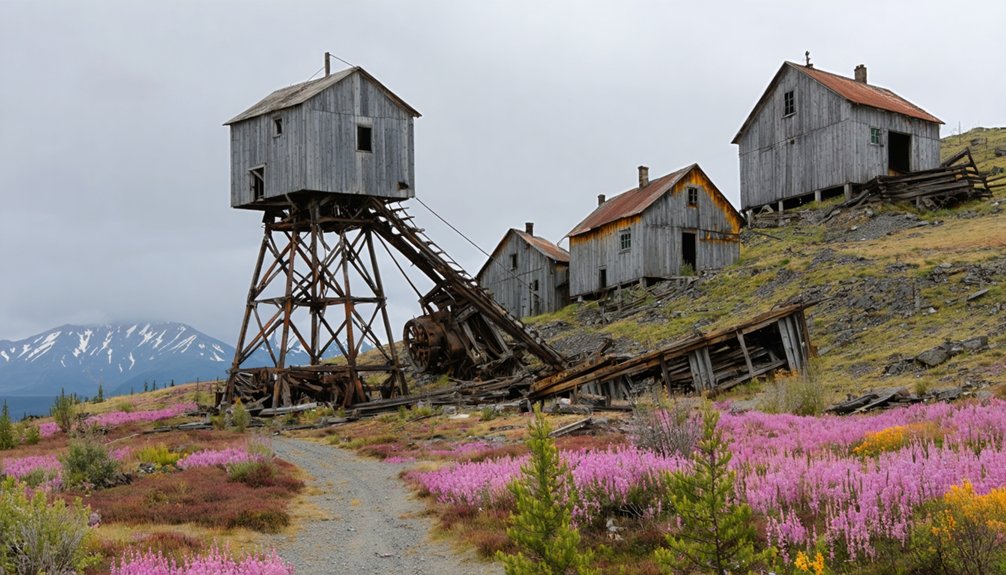
Since Alaska achieved statehood in 1959, its economy has fluctuated wildly with the fortunes of extractive industries—a pattern established long before oil dominated state revenues. You’ll recognize this boom-bust cycle from Nome’s gold rush, when population surged past 20,000 before collapsing, or Kennecott’s copper town, which vanished after ore exhaustion in 1938.
Alaska’s economy rides the extractive industry roller coaster—booming with discovery, busting when resources vanish or prices collapse.
The economic forces driving Alaska’s mining volatility:
- Pipeline completion (1976) eliminated 10,000 construction jobs overnight, triggering Alaska’s first recession despite initial 58 percent employment growth
- Oil price collapse (1985-1989) destroyed 44,000 jobs and drove unemployment to 11.2 percent
- Revenue dependence on global commodity prices creates vulnerability—oil revenues dropped 90 percent as production declined
- Mining’s minimal contribution—despite $4.5 billion production value, it generates under 1 percent of state revenues, offering limited employment prospects
Daily Life in Alaska’s Remote Mining Camps
Living in Alaska’s remote mining camps meant confronting seven-month winters where temperatures plunged to -40°F and isolation stretched for weeks between supply runs. You’d haul water every 10-12 days, chop firewood daily, and manage your own waste systems while rationing provisions stockpiled from infrequent trips to distant towns.
Despite these hardships, miners created tight-knit communities within their WeatherPort tents and log cabins, establishing social routines that sustained morale through the long dark seasons when camp populations swelled to over 200 workers and families.
Harsh Weather and Isolation
When rain soaked miners to the bone in Alaska’s remote camps, they couldn’t simply retreat to warm lodges—prolonged storms confined them to canvas tents for days while gear remained perpetually damp.
Isolation Realities at Remote Mining Operations:
- Access Limitations – Chititu mining camps required bush plane flights plus multi-day hikes, while heavy snow rendered the Alaska Highway impassable, forcing complete air supply dependence.
- Climate Change Impacts – Fairbanks now experiences five additional weeks of annual rainfall compared to the 1970s, with December 2021 bringing record temperatures alongside ice storms.
- Transportation Challenges – WWII-era bridges risked catastrophic failure, potentially isolating villages like Dot Lake indefinitely.
- Emergency Response Gaps – Adverse weather eliminated medical evacuation possibilities from fly camps, leaving miners vulnerable in bear country without immediate assistance.
Food Supply and Storage
Remote mining camps faced compounding difficulties beyond weather-related challenges—without roads or regular supply routes, miners developed elaborate systems to protect provisions from Alaska’s wildlife and climate extremes. You’ll find historical evidence of elevated caches suspended twelve feet above ground using spruce-pole ladders, storing staples like flour and sugar in glass jars beyond bear reach.
Permafrost cellars, excavated deep into frozen earth, functioned as natural freezers for meat stores. Off grid cooking techniques relied on traditional preservation methods including fat-packing cooked meat in rendered tallow, creating anaerobic seals that prevented spoilage. Dehydration preserved harvests without electricity, while canning extended the viability of fish and game.
These self-reliant systems enabled miners to survive months-long isolation, maintaining independence from external supply chains through resourceful adaptation.
Entertainment and Social Gatherings
- Softball tournaments at Woodchopper Creek brought together dozens of miners during the 1950s, with airplane arrivals timed to game schedules
- Roadhouse gatherings along the Valdez-Fairbanks trail served as social hubs following the 1902 gold strike
- Communal assemblies at Fletcher Hamshaw’s Bonanza Creek camp accommodated up to 100 workers in purpose-built structures
- Family social spaces at Independence Mine included schooling facilities and sixteen structures supporting over 200 residents during peak operations
These settlements weren’t just work camps—they were self-sufficient communities where freedom-seeking pioneers built lasting social bonds.
Preserving Alaska’s Mining Heritage as National Landmarks
Since the Historic Sites Act of 1935 established the National Historic Landmark program, the Department of the Interior’s National Park Service has identified and protected nationally significant places across the United States, with Alaska now hosting 50 designated landmarks.
You’ll find Kennecott Mines among them—designated in 1986 and covering 7,700 acres of copper mining operations. The NPS acquired portions in 1998 within Wrangell-St. Elias National Park, accessing the site via McCarthy Road or plane.
Preserving historic integrity here means balancing community needs, as active businesses operate alongside restoration efforts. Section 106 of the 1966 National Historic Preservation Act requires federal review of projects affecting landmarks.
Save America’s Treasures grants funded Recreation Hall rehabilitation and $325,000 in stabilization work. Remote locations demand vigilant stewardship—vandalism once cost one Alaska site its designation entirely.
The Geography of Abandoned Settlements Across Alaska
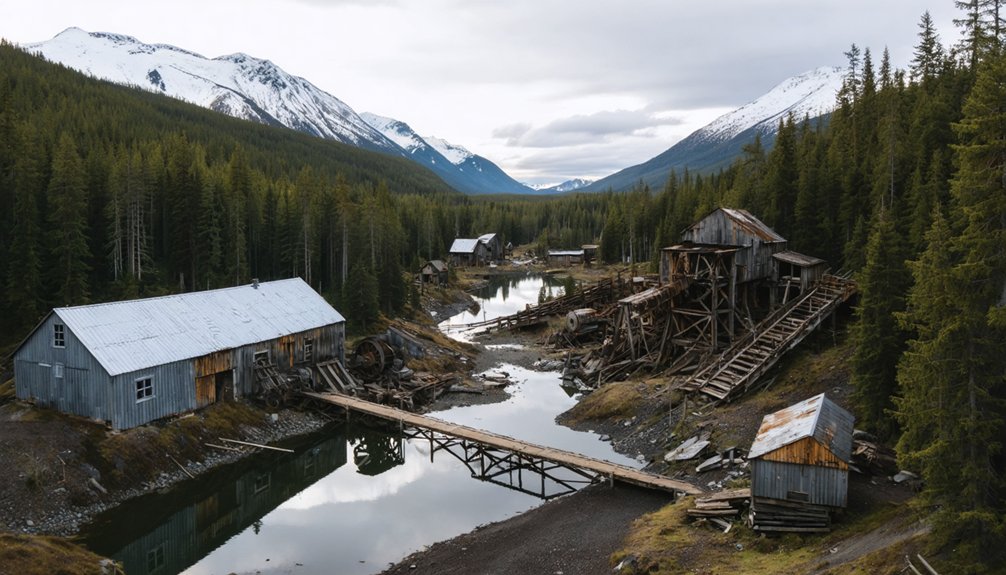
Alaska’s landscape harbors over 100 documented ghost towns and approximately 750 abandoned mine features on National Park Service lands alone, creating a vast archaeological record of frontier extraction industries. These settlements span from coastal beaches to interior mountains, distributed across distinct geological zones:
- Wrangell-St. Elias hard-rock operations exploited native copper deposits in Triassic Nikolai greenstone, with Kennecott’s 14-story concentrator dominating Bonanza Ridge
- Kantishna district (Denali) concentrated dozens of hard-rock and placer sites in mountainous terrain
- Coastal placer mining operations extracted gold from beach deposits along Alaska’s extensive shoreline
- Yukon River drainages hosted massive bucket-line dredges processing interior placer gravels
Permafrost and harsh northern climates gradually reclaim these sites, leaving you physical evidence of extraction-era independence.
Visiting Alaska’s Ghost Towns Today
Today’s visitors encounter Alaska’s ghost towns across a spectrum from completely wilderness-reclaimed to partially preserved National Historic Landmarks. You’ll find Kennicott, acquired by the Park Service in 1998, offering guided tours through its iconic 14-story red mill overlooking the glacier—accessible via McCarthy Road or bush plane.
Portage presents the easiest ghost town exploration: destroyed when the 1964 earthquake dropped ground six feet, you’ll spot foundations through marsh grass while driving the Seward Highway. Dyea’s forest-reclaimed trails mark where thousands staged their Klondike ascent. Tourism impacts vary—some sites receive active stabilization, while others surrender to nature.
For structured experiences, Juneau and Ketchikan’s Ghost Walks ($30, nightly 7 pm) blend eyewitness accounts with Gold Rush history, letting you explore haunted locations independently afterward.
Frequently Asked Questions
What Safety Equipment Did Miners Use in Early Alaska Mining Operations?
You’d find miners using Draeger respirators by 1909, kerosene lamps for illumination, and basic hand tools like sledgehammers. However, hardhat safety standards didn’t exist then—regulatory frameworks governing protective equipment weren’t established until decades later.
How Did Families Communicate With Relatives Outside Alaska’s Remote Mining Camps?
Bridging vast wilderness gaps, you’d rely on irregular postal routes over military roads, where mail delivery frequency depended on pack animals traversing/traversing/negotiating/maneuvering brutal terrain. Travel challenges meant months waiting, forcing families to embrace sporadic letters and returning miners’ secondhand news.
What Happened to Mining Equipment After Towns Were Abandoned?
You’ll find most equipment was simply abandoned in place, creating significant environmental impact from deteriorating machinery and chemical residues. Equipment disposal rarely occurred—flooded mines, collapsed tunnels, and rusting structures remain where operations ceased decades ago.
Are There Any Undiscovered Mineral Deposits Near Existing Ghost Towns?
You’ll find tantalizing possibilities near abandoned mining claims—Kennecott’s underground tunnels exploration reveals interconnected high-grade seams, while Chena’s unsurveyed post-1921 lands and Treadwell’s flooded shafts beyond Ready Bullion may conceal untapped veins awaiting your discovery.
Can Visitors Legally Remove Artifacts From Alaska’s Ghost Town Sites?
No, you can’t legally remove artifacts from Alaska’s ghost towns on federal or Native lands. Artifact preservation guidelines and historical artifact documentation require leaving items in place—only photographs are permitted under ARPA’s strict protections.