Kansas mining ghost towns reveal what happens when extractive industries abandon communities they’ve poisoned. You’ll find these remnants mostly in the southeastern corner of the state, where lead and zinc operations once boomed before collapsing under toxic contamination, market failure, and government intervention. Soil saturated with heavy metals made rebuilding impossible, forcing entire populations to relocate permanently. Treece stands as the starkest example — and its story is far from simple.
Key Takeaways
- Kansas mining ghost towns like Treece were abandoned due to toxic lead and zinc contamination making soil permanently uninhabitable.
- Treece, Kansas collapsed from 138 residents in 2010 to zero by May 2012 following a government buyout.
- The EPA classified Treece among America’s most environmentally devastated locations, designating it a Superfund site.
- Market collapses, the Dust Bowl, and industrial failure drove rapid population decline in Kansas mining communities.
- Lack of strict mining regulations allowed unchecked extraction, leaving taxpayers responsible for costly environmental cleanup efforts.
What Turned Kansas Mining Towns Into Ghost Towns
When the ore ran out, so did everything else. Kansas mining towns didn’t fade gradually — they collapsed under specific, identifiable pressures. You can trace each abandonment to a concrete cause: failed mining economics, toxic contamination, or federal eminent domain actions forcing residents out.
Lead and zinc operations in the Tri-State Mining District poisoned soil beyond recovery, stripping communities of any foundation for rebuilding. When markets dried up, so did community resilience. Towns that once housed thousands couldn’t sustain hundreds.
Lead and zinc poisoned the soil. Markets collapsed. Communities that once held thousands couldn’t sustain hundreds.
The Dust Bowl accelerated losses already set in motion by industrial decline. Government buyout programs finished what environmental devastation started.
You’re not looking at natural decay here — you’re looking at systematic collapse driven by extractive industry failure and its irreversible consequences on the land and people left behind.
Six Kansas Mining Ghost Towns That No Longer Exist
When you examine Kansas’s mining history, you’ll find towns that didn’t just shrink—they vanished entirely due to toxic contamination, economic collapse, and forced government relocation.
These six communities once supported thriving populations built around lead, zinc, and coal extraction, yet each succumbed to a distinct combination of environmental ruin and industry failure.
You’ll see how mining’s legacy didn’t just reshape the land; it erased the communities that depended on it.
Towns Lost To Mining
Kansas has a long history of mining ghost towns — communities that boomed, then collapsed almost overnight when industry markets failed or environmental devastation made continued habitation impossible.
You’ll find their Mining Heritage scattered across Cherokee County and beyond, where Economic Shifts erased entire populations within decades. Towns like Treece demonstrate how rapidly Community Resilience can fracture under toxic pressure — its population dropping from 138 residents in 2010 to absolute zero by 2012.
These sites carry profound Historical Significance, reminding you that unchecked industrial extraction carries permanent consequences. While Cultural Preservation efforts document what’s been lost, Environmental Restoration remains the harder challenge. Lead-contaminated soil doesn’t forgive quickly.
These abandoned communities aren’t failures — they’re warnings you can’t afford to ignore.
Environmental Collapse And Abandonment
Six Kansas mining ghost towns illustrate how environmental collapse — not economic misfortune alone — permanently erased communities from the map.
When lead and zinc contamination saturated the soil, no amount of community resilience could reverse the damage. You’re looking at a pattern where toxic legacies stripped residents of their fundamental freedom to stay.
- Treece dropped from 138 residents in 2010 to zero by May 2012
- EPA classified Treece among America’s most environmentally devastated locations
- Lead pollution from the Tri-State Mining District made soil permanently uninhabitable
- Government buyout programs relocated families from contaminated Kansas and Oklahoma towns
- Environmental awareness came too late for communities already poisoned beyond recovery
These weren’t slow declines — they were systematic erasures driven by irreversible contamination and government-mandated evacuations.
Treece: The Kansas Town Too Toxic to Survive
If you trace the collapse of Treece, Kansas, you’ll find a story defined by irreversible environmental destruction.
Lead and zinc mining operations left the soil so thoroughly contaminated with toxic waste that the EPA classified Treece as one of the most environmentally devastated places in the entire United States.
The contamination forced a government-funded buyout program that relocated every remaining resident, dropping Treece’s population from 138 in 2010 to absolute zero by May 2012.
Toxic Legacy Of Mining
Nestled in Cherokee County, Treece stands as one of Kansas’s most haunting examples of industrial negligence, where decades of lead and zinc extraction left behind a landscape so contaminated it became unlivable.
The toxic waste embedded in the soil destroyed what was once a thriving mining history community.
Key facts you should know:
- The EPA classified Treece as one of America’s most environmentally devastated locations
- Residents developed severe health conditions from contaminated backyards
- Population collapsed from 138 in 2010 to zero by May 2012
- Government buyout programs funded resident relocations to safer areas
- Lead pollution penetrated soil so deeply that remediation proved impossible
You’re witnessing what happens when industrial profits override human welfare—a community systematically poisoned, then abandoned by the very industries that built it.
Government-Funded Resident Relocation
When toxic soil makes an entire community uninhabitable, relocation isn’t optional—it’s the only viable response. The EPA’s government-funded buyout program in Treece addressed exactly this reality, systematically purchasing properties and relocating residents between 2010 and 2012.
You’d find the relocation challenges substantial—uprooting established lives, compensating fairly for contaminated properties, and dismantling infrastructure that once supported 138 residents. The program required coordinated federal, state, and local agency involvement to execute properly.
Community rebuilding became the harder, less visible task. Displaced Treece residents scattered across Kansas and Oklahoma, reconstructing their lives without the neighborhood framework they’d known. The government facilitated physical departure but couldn’t manufacture social continuity.
Treece’s complete evacuation by May 2012 stands as evidence that environmental accountability sometimes demands total community dissolution.
The Health Crisis Behind Kansas’s Ghost Town Evacuations
The lead and zinc mining operations that once drove economic prosperity across Cherokee County left behind a catastrophic public health emergency that ultimately erased entire communities from Kansas’s map.
The same mines that built Cherokee County’s wealth left a poison so profound it wiped towns off the map entirely.
You can trace the health risks directly to contaminated soil that poisoned residents across generations, undermining community resilience at its foundation.
Key health and environmental facts you should understand:
- EPA classified Treece as one of America’s most environmentally devastated locations
- Toxic backyards contained dangerous concentrations of lead mining waste
- Children faced elevated blood-lead levels from direct soil exposure
- Residents developed severe, long-term health complications from contamination
- Government-funded buyout programs became the only viable escape route
These weren’t gradual declines — they were forced evacuations driven by invisible, systemic poisoning that stripped residents of their freedom to safely inhabit their own homes.
How the Government Relocated Kansas Mining Town Residents
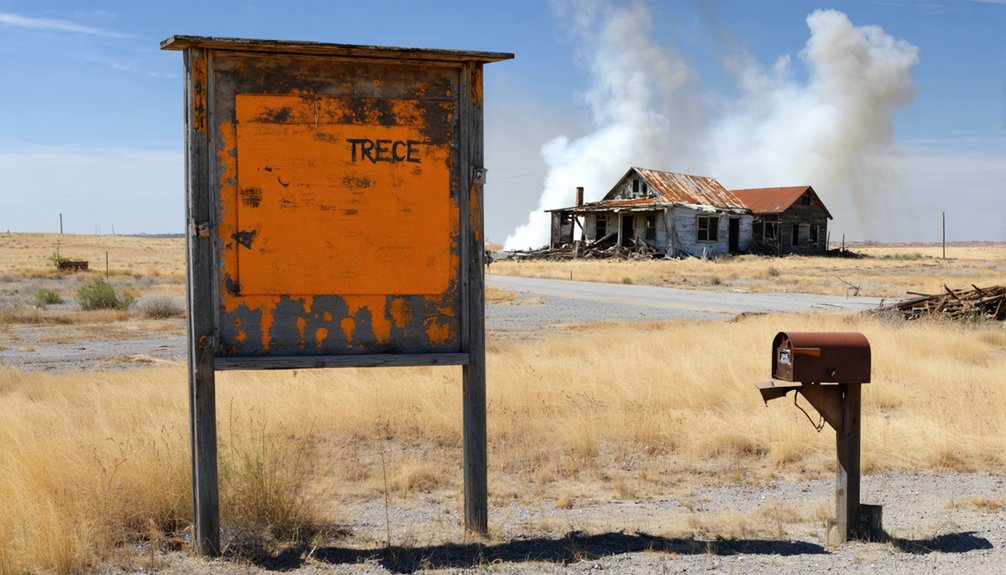
Facing an uninhabitable landscape, federal agencies didn’t leave displaced residents to navigate relocation alone — they built structured buyout programs that systematically moved entire communities out of contaminated zones. The U.S. EPA coordinated government-funded settlements, compensating residents in Treece and surrounding Tri-State Mining District towns before the last household departed by May 2012.
Relocation challenges weren’t merely logistical — they were deeply personal. You’re talking about families surrendering generational roots because soil beneath their homes carried lethal lead concentrations.
Yet community resilience defined how displaced residents rebuilt elsewhere, carrying their identity beyond contaminated borders.
The Army Corps of Engineers also exercised eminent domain for flood control infrastructure, accelerating additional abandonments. These coordinated government actions preserved lives while permanently erasing communities that once housed thousands of working families.
The Environmental Legacy Kansas’s Mining Towns Left Behind
Decades after the last resident left Treece, contamination doesn’t simply vanish — it compounds. Without strict mining regulations, industries extracted wealth and left you — the taxpayer — absorbing cleanup costs indefinitely.
The environmental legacy includes:
- Lead-saturated soil persisting decades beyond operational closure
- EPA-designated Superfund status requiring continuous environmental restoration efforts
- Groundwater contamination spreading beyond original mining boundaries
- Chat piles releasing toxic dust into surrounding ecosystems
- Long-term government spending replacing what private industry should’ve funded
You’re inheriting consequences from decisions made before you were born. Environmental restoration isn’t cheap — it demands sustained resources, accountability, and transparent oversight.
When mining regulations lack enforcement teeth, communities bear generational burdens. Kansas’s ghost towns aren’t just historical curiosities; they’re warnings about what unchecked extraction ultimately costs everyone.
Frequently Asked Questions
Which Kansas Mining Ghost Towns Can Still Be Legally Visited Today?
You can legally visit Galena and Treece, both rich in historical significance. They’re accessible tourist attractions where you’ll explore mining legacies, contaminated landscapes, and preserved artifacts that reveal Kansas’s complex industrial past.
Are There Any Ghost Town Preservation Societies Active in Kansas?
Yes, you’ll find active ghost town preservation societies in Kansas honoring historical significance amid crumbling ruins. They’re documenting forgotten communities, ensuring you can explore these abandoned landscapes while protecting their heritage before time erases what once thrived.
What Minerals Besides Lead and Zinc Were Mined in Kansas Ghost Towns?
You’ll find coal and iron ore were also extracted, carrying historical significance alongside lead and zinc. Copper deposits contributed economic impact, while varied mining techniques shaped communities that you’d recognize as once-thriving, now-abandoned Kansas ghost towns.
Did Any Kansas Mining Ghost Towns Ever Attempt Successful Revivals?
Can revival truly succeed against toxic legacies? You’ll find that most Kansas mining ghost towns haven’t achieved successful revivals due to overwhelming revival challenges, though community involvement occasionally sparks limited preservation efforts in historically significant locations like Galena.
How Do Kansas Ghost Towns Compare to Abandoned Mining Towns in Colorado?
You’ll find Kansas mining towns differ from Colorado ghost towns considerably—Kansas sites like Treece faced toxic lead contamination forcing evacuations, while Colorado’s abandonments typically resulted from silver and gold market collapses rather than environmental devastation.
References
- https://www.hhhistory.com/2019/05/ghost-towns-of-kansas.html
- https://www.youtube.com/watch?v=jHD-6b-syto
- https://en.wikipedia.org/wiki/Treece
- https://www.youtube.com/watch?v=8dtIPX7pIqI
- https://en.wikivoyage.org/wiki/Galena_(Kansas)
- https://www.humanitieskansas.org/get-involved/kansas-stories/places/mining-for-stories-in-a-kansas-ghost-town
- https://a-z-animals.com/blog/deserted-and-forgotten-towns-in-kansas/
- https://legendsofkansas.com/potosi-kansas/
- https://www.youtube.com/watch?v=zyj1rXAVIRM
- https://legendsofkansas.com/kansas-ghost-town-list/