Maine’s metal mining boom from 1879-1882 transformed coastal communities into thriving centers before an 1883 market crash created ghost towns almost overnight. You’ll find the most significant abandoned sites along the coastal volcanic belt from Blue Hill to Lubec, where mines like Douglass operated until 1918 and Harborside until 1972. Hurricane Island represents the most dramatic collapse—1,200 workers evacuated in 1914, leaving behind contaminated landscapes that eventually became Superfund sites and triggered Maine’s 47-year mining moratorium. The industry’s toxic legacy continues shaping the state’s environmental policies and economic development today.
Key Takeaways
- Maine’s metal mining industry peaked from 1879-1882, transforming coastal communities into mining centers before the 1883 price crash created ghost towns.
- Hurricane Island’s company town housed 1,200 workers until a 1914 catastrophe triggered immediate evacuation and systematic community dismantling.
- The coastal volcanic belt from Blue Hill to Lubec contained major mines like Douglass Mine and Harborside, operating until 1918 and 1972.
- Abandoned mining sites left toxic legacies including heavy metal contamination, flooded pits, and hazardous tailings requiring Superfund remediation.
- Capital investment shifts toward paper mills during 1880-1920 starved coastal mining communities, accelerating their abandonment and decline.
The Rise and Fall of Maine’s Metal Mining Industry (1879-1977)
Maine’s metal mining industry experienced a dramatic arc across nearly a century, marked by speculative fervor, economic collapse, and eventual exhaustion of commercially viable deposits.
You’ll find the 1879-1882 boom transformed coastal communities into mining centers targeting iron, silver, copper, lead, and zinc. However, the 1883 metal price crash decimated operations, creating ghost towns and ending cottage industry opportunities that had briefly flourished.
After a fifty-year hiatus, mid-century operations at Harborside and Black Hawk mines produced nearly two million tons of ore between 1968-1977. The industry’s final chapter saw production values double from $21.9 million to $43.2 million before complete cessation in 1977, leaving undiscovered mineral riches like the Bald Mountain deposit’s 36 million tons unexploited.
Economic Forces That Built and Abandoned Mining Communities
When maritime commerce dominated early 19th-century New England, coastal accessibility became the primary determinant of mining viability in the region. You’ll find that Maine’s 3,500-mile coastline enabled West Indies granite exports while supporting quarrying operations through shipbuilding infrastructure.
Maine’s coastal access transformed quarrying economics by linking granite extraction directly to Atlantic shipping routes and West Indies markets.
Capital investment strategies shifted dramatically during the 1880-1920 period, when industrial consolidation redirected resources toward river-based paper mills. The metal mining boom (1879-1882) collapsed within a year when prices dropped in 1883, demonstrating market vulnerability. Legislative policies favoring paper production monopolies—through tax rebates, land grants, and exclusive development rights—starved coastal mining communities of capital and labor, forcing extraction operations inland.
Economic dynamics that shaped Maine’s mining settlements:
- Maritime trade access determined initial quarrying locations
- Granite employment peaked at 3,500 workers across 152 quarries (1901)
- Metal price volatility triggered rapid boom-bust cycles
- Paper mill monopolies controlled hydroelectric resources
- Tax incentives redirected investment from coastal mining
Blue Hill to Lubec: Tracing the Coastal Volcanic Mining Belt
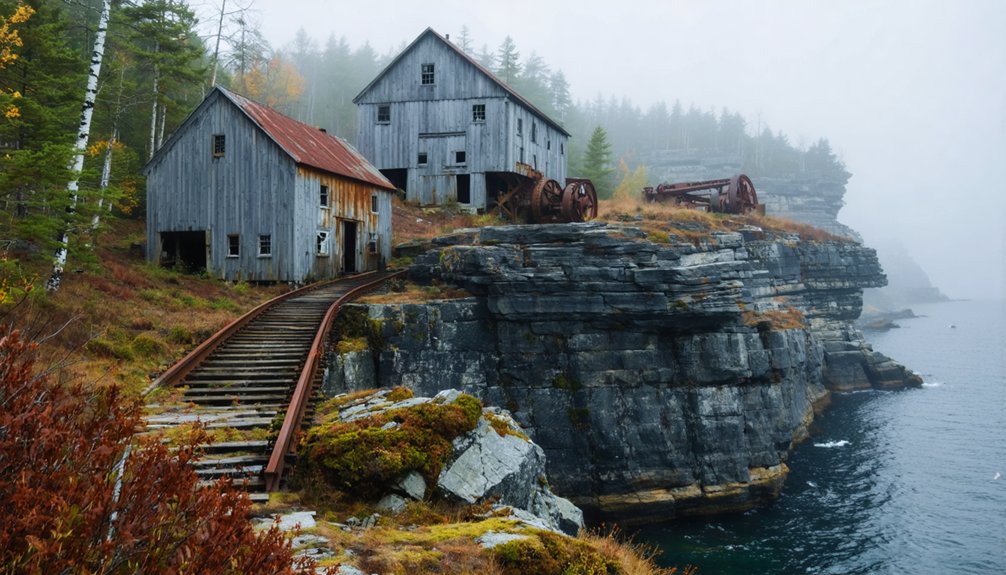
Stretching 175 kilometers from Blue Hill to Lubec, Maine’s coastal volcanic belt represents one of North America’s most economically significant Silurian-Lower Devonian mineral districts, where 8,000-meter-thick volcanic strata produced the copper-zinc deposits that sparked the 1879-1882 mining boom.
You’ll find volcanic succession characteristics revealing bimodal compositions—basaltic flows under 52% SiO2 alternating with rhyolitic ignimbrites from supervolcano-scale eruptions at 424 Ma.
Mantle intrusion processes during the Salinic-Acadian orogenies caused thermal swelling through 600-700 million-year-old Avalonian basement, creating the tholeiitic basalts hosting mineralization.
The Douglass Mine at Blue Hill operated until 1918, while Harborside’s open pit extracted concentrates until 1972. This extension-related volcanism established the geological framework that concentrated metals, ultimately determining where prospectors would stake claims and communities would rise.
Hurricane Island’s Overnight Evacuation and Vanishing Community
Unlike the volcanic mining districts along the coastal belt, Hurricane Island’s prosperity stemmed from a different geological bounty—Devonian-age granite plutons that crystallized beneath the volcanic cover rocks around 380 million years ago. General Davis Tillson’s 1870 operation housed 1,200 workers in a self-contained village where living conditions of quarry workers reflected industrial paternalism: company housing, multiple languages spoken daily, and complete dependence on corporate infrastructure.
Twelve hundred workers carved granite from 380-million-year-old plutons, living under industrial paternalism’s complete control in Tillson’s company town.
The 1914 catastrophe—a shipwreck followed by the foreman’s death—triggered immediate closure. You’ll find evidence of brutal efficiency: residents received hours’ notice for evacuation, abandoning photographs and dinner settings. This wasn’t gradual decline but erasure.
Long term community impacts:
- Systematic dismantling eliminated physical evidence
- Immigrant workforce dispersed across continents
- Regional granite economy collapsed permanently
- Cultural memory fragmented without generational continuity
- Archaeological sites remain inaccessible to descendants
Freeman’s Journey From Booming Sheep Town to Near-Ghost Status
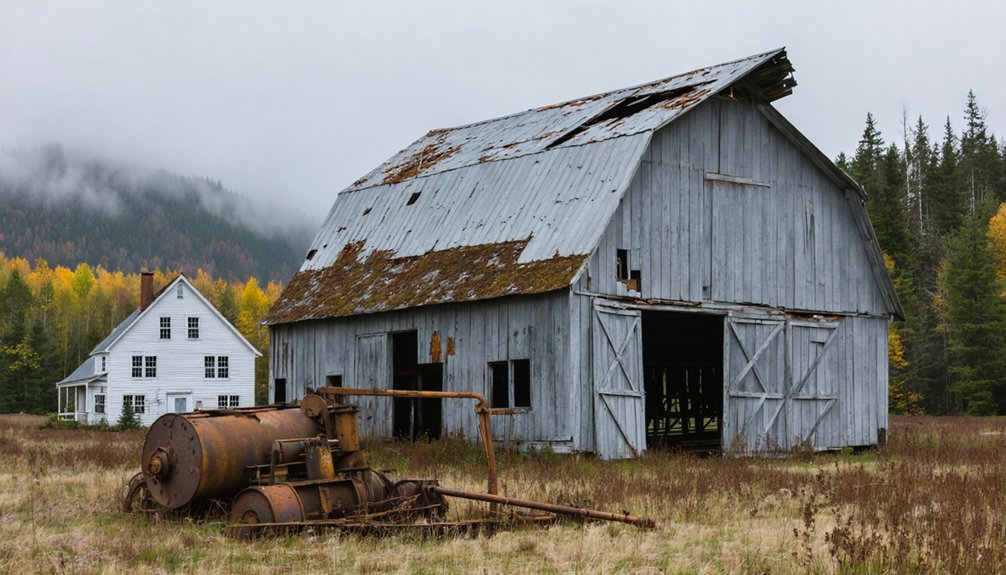
While Hurricane Island’s granite quarries vanished through corporate decree, Freeman’s metamorphosis into near-ghost status demonstrates how geological limitations and agricultural economics can doom a settlement more gradually. You’ll find Freeman peaked at 838 residents in 1840, when dwindling sheep farms still dominated thousands of cleared acres across Maine’s largest pastoral operations.
The township supported flour mills, woolen mills, and agricultural infrastructure that sustained this agrarian economy. Yet the Civil War and Industrial Age triggered systematic depopulation—dropping to 397 by 1900, then 219 by 1930. This economic shift from agrarian prosperity couldn’t sustain civic institutions. In 1937, Freeman surrendered its incorporated status, formally acknowledging what demographics had already proven: the colonial pastoral model couldn’t survive modernity’s industrial demands.
The Toxic Legacy: Superfund Sites and Environmental Costs
Key contamination characteristics include:
- Heavy metal leaching during precipitation events
- Flooded mine pit now filled with seawater after dam removal
- State-owned land beneath Goose Pond contaminated from mining operations
- Tailings requiring excavation and remediation
- Industrial remnants creating ongoing environmental hazards
Why Maine Banned Metallic Mining for Four Decades
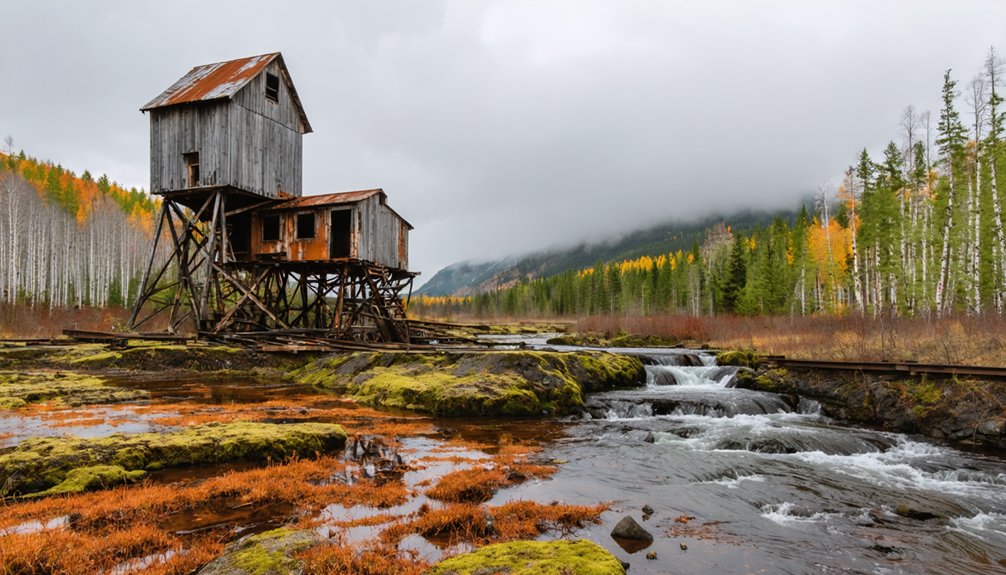
After the Black Hawk mine shuttered its operations near Blue Hill in 1977—processing its final tonnage of zinc-copper-lead ore after five years of extraction—Maine didn’t see another operating metal mine for over four decades. This de facto moratorium stemmed from stringent environmental regulations requiring drinking water quality standards for all mine discharges, making operations virtually impossible.
When Blackhawk Corporation expressed interest in Bald Mountain in 1991, legislators codified these prohibitions into law. The ban persisted until political factors converged in 2012: J.D. Irving’s ownership of the lucrative Bald Mountain deposit, rising global metal prices, and economic pressure catalyzed the Metallic Mineral Mining Act. This legislation transferred authority to DEP and streamlined permitting, finally dismantling regulatory barriers after forty-seven years.
Frequently Asked Questions
Can You Visit Abandoned Mine Sites in Maine Today?
You can’t freely visit abandoned mine sites without verifying current ownership and obtaining explicit permission. Permitted access levels depend on landowner agreements, while environmental regulations restrict entry to unmanaged locations, limiting your exploration options greatly.
What Happened to Workers Who Lost Jobs When Mines Closed?
When mines closed, you’d face significant income loss and community disruption. Workers often couldn’t find comparable employment locally, forcing migration. Data shows displaced workers experienced sectoral shifts, with many leaving mining entirely for construction or public administration roles.
Are There Any Preserved Buildings From Mining Boom Towns?
You’ll discover several preserved mining-era structures through historical preservation efforts, including Blue Hill’s 1847 Greek Revival homes and Deer Isle’s Granite Museum. These sites now offer local tourism opportunities, showcasing Maine’s industrial heritage while generating economic freedom.
How Do Maine Ghost Towns Compare to Western Ghost Towns?
You’ll find Maine’s ghost towns differ markedly from Western ones: they’re fewer (5 versus hundreds), featured diverse industries beyond mining, and lack the preserved mining town architecture and abandoned mine conditions that characterize iconic Western sites.
In contrast, exploring abandoned sites in New Jersey reveals a rich tapestry of history, from forgotten amusement parks to derelict factories that once thrived. Each location tells a story of change and decay, drawing in urban explorers and historians alike. The unique blend of urban and rural abandonment in this state offers a fascinating glimpse into its industrial past.
Could Metal Mining Return to Maine in the Future?
“Where there’s smoke, there’s fire”—you’ll likely see mining return if lawmakers balance potential economic benefits against rigorous environmental impact assessment, though Maine’s restrictive regulations currently prevent metallic mineral extraction despite significant documented reserves.