If you’re searching for mining ghost towns in Mississippi, you won’t find them — they simply don’t exist. Unlike western states, Mississippi never had gold, coal, or iron industries to drive frontier-style boom-and-bust cycles. Instead, the state’s abandoned towns collapsed under the weight of failed timber operations, shuttered textile mills, and displaced infrastructure projects. Mississippi’s ghost towns tell a different, equally compelling story of industrial decline that’s worth understanding more fully.
Key Takeaways
- Mississippi has no true mining ghost towns, as the state lacks history of gold, coal, or iron mineral extraction.
- Mississippi’s abandoned towns declined due to timber, textile, and infrastructure industries, not mineral resource depletion.
- Notable ghost towns like Rodney, Grand Gulf, and Fort Adams reflect agrarian-industrial collapse, not mining culture.
- Unlike western mining towns that collapsed after ore depletion, Mississippi towns faded through economic shifts and corporate relocation.
- Lesser-known sites like Baleshed and Arnot preserve authentic industrial decay, accessible via unmarked roads with minimal preservation efforts.
Did Mississippi Have Mining Ghost Towns?
While Mississippi contains over 50 documented ghost towns, few — if any — trace their origins directly to mining activity. Unlike western states where exhausted ore deposits left entire communities vacant, Mississippi’s abandoned settlements mainly reflect collapsed timber and textile industries.
You’ll find that towns like Bankston and Electric Mills arose from mill operations, not mineral extraction.
No documented iron, gold, or coal mining ghost towns exist within Mississippi’s borders. This distinction carries historical preservation implications — without mining heritage, these sites demand different frameworks for recognizing their cultural significance.
Understanding what *didn’t* drive Mississippi’s abandonment patterns matters as much as understanding what did. You’re examining a state whose ghost towns reveal economic vulnerability rooted in single-industry dependence on lumber and textiles rather than mineral resource depletion.
The Industries That Actually Shaped Mississippi’s Abandoned Towns
Timber and textiles — not mineral extraction — drove the economic cycles that built and ultimately erased dozens of Mississippi communities. When you examine towns like Electric Mills, founded by the Sumter Lumber Company, or Fernwood, established under the Fernwood Lumber Company, a clear pattern emerges: single-industry dependency created inherently fragile settlements.
Timber and textiles built Mississippi’s ghost towns — and single-industry dependency guaranteed their collapse.
Bankston followed the same trajectory, existing solely to serve its textile mill before collapsing once that industry declined.
These origins carry serious preservation challenges, since company towns rarely generated the civic infrastructure — courthouses, libraries, enduring institutions — that sustains cultural heritage over generations. Once the mill closed, residents left and structures deteriorated rapidly.
Understanding these industrial roots gives you a more accurate framework for evaluating Mississippi’s abandoned settlements than any mining narrative would allow.
Textile Mill Towns That Collapsed When the Work Dried Up
Bankston stands as the clearest Mississippi example of textile mill dependency producing total community collapse. When the Bankston Textile Mill ceased operations, the surrounding company town lost its singular economic rationale overnight.
You’ll notice this pattern reveals a structural vulnerability: single-industry towns carry no economic resilience when that industry contracts. Workers dispersed, infrastructure deteriorated, and community revitalization became virtually impossible without an alternative economic foundation.
Historical preservation efforts in Bankston remain minimal, reflecting broader Mississippi patterns where mill towns receive little institutional attention after abandonment. Unlike mining ghost towns, which sometimes attract heritage tourism, textile mill towns leave fewer dramatic physical remnants—machinery gets removed, buildings stripped.
You’re left examining a fundamentally avoidable collapse rooted in corporate town planning that prioritized industrial output over sustainable, diversified community development.
Lumber Company Towns Left to Rot After the Timber Was Gone
When you examine Mississippi’s lumber towns, you’ll find the same devastating pattern: a single company arrives, strips the land of timber, and abandons the settlement once profits collapse.
Electric Mills, established by the Sumter Lumber Company, and Fernwood, founded under the Fernwood Lumber Company, both exemplify how corporate timber interests created entirely dependent communities with no economic fallback.
You can still trace the overgrown remnants of these mills today, where infrastructure outlasts industry and forests slowly reclaim what the lumber barons once cleared.
Timber Boom Towns Abandoned
Once the last log was cut and hauled, lumber company towns across Mississippi didn’t just decline—they collapsed. You can trace this pattern through Electric Mills, established by the Sumter Lumber Company, and Fernwood, built under the Fernwood Lumber Company.
When timber reserves dried up, economic justification for these settlements vanished entirely.
Unlike western mining ghost towns that evolved into tourist attractions or benefited from historical preservation initiatives, Mississippi’s timber boom towns received neither. They were single-industry company towns, engineered for extraction, not endurance.
Once the industry left, residents followed.
What you’ll find today are overgrown lots, decaying structures, and fading street grids—evidence of communities that existed solely to serve corporate timber interests. Mississippi’s forests consumed them as quickly as they were built.
Single Industry Town Collapse
The collapse didn’t happen gradually—it happened the moment the corporate calculus shifted. When the Sumter Lumber Company exhausted Electric Mills’ timber, they didn’t negotiate an exit—they simply left. You’re looking at industrial decline operating as designed: extract, profit, abandon.
The Fernwood Lumber Company followed identical logic. These weren’t communities built for permanence; they were mechanisms for resource conversion.
Community displacement wasn’t incidental—it was structural. Workers had no equity in company towns, no legal recourse, no institutional memory worth preserving. Once the single industry collapsed, infrastructure became irrelevant overnight. Streets remained, buildings deteriorated, and populations scattered.
Understanding this pattern matters to you because it exposes corporate town models as fundamentally incompatible with genuine community sovereignty—engineered dependency that guaranteed abandonment the moment profitability ended.
Overgrown Mills Left Behind
After the Sumter Lumber Company stripped Electric Mills bare, they left behind a mill infrastructure with no functional purpose—buildings without workers, machinery without timber, streets without commerce. When you walk through what remains, you’re confronting the direct consequence of extraction economics: industry claimed the resource, then abandoned the community entirely.
Fernwood followed the same trajectory under the Fernwood Lumber Company. Once timber yields collapsed, corporate interests dissolved, leaving residents no economic foundation to sustain settlement.
You’ll find no meaningful historical preservation efforts protecting these sites, despite their cultural significance as evidence of how company towns exploited both land and labor.
These overgrown mills aren’t accidents—they’re predictable outcomes of single-resource dependency. Recognizing that pattern gives you the clearest argument for why preservation matters before the last structures disappear entirely.
Towns Bulldozed for the SSC Project and Never Rebuilt
Few ghost towns in Mississippi carry the weight of deliberate erasure quite like those bulldozed for the Superconducting Super Collider (SSC) facility. You’re looking at five communities — Gainesville, Logtown, Napoleon, Santa Rosa, and Westonia — systematically cleared to accommodate the project.
Authorities displaced roughly 700 families, dismantling entire social structures without meaningful historical preservation or community redevelopment plans. Streets remain overgrown, and a lone schoolhouse stands as a stark reminder of what institutional priorities cost ordinary people.
The SSC itself was eventually cancelled, meaning these communities sacrificed everything for a project that never materialized. You can still trace the ghost infrastructure beneath the vegetation — silent evidence that government-driven erasure doesn’t always serve the public interest it claims to protect.
Other Reasons Mississippi Communities Were Simply Abandoned

While forced displacement represents one form of community erasure, most Mississippi ghost towns died far less dramatically — through the slow collapse of single-industry economies. When timber was exhausted or mills shuttered, residents simply left, surrendering entire communities to overgrowth and decay.
Most Mississippi ghost towns didn’t die dramatically — they simply emptied, surrendering quietly to overgrowth when single industries collapsed.
You’ll recognize these patterns across abandoned settlements:
- Economic dependency on singular industries like lumber or textiles left towns structurally vulnerable to market shifts
- Cultural influences eroded community identity once institutional anchors — schools, churches, company stores — permanently closed
- Environmental impacts accelerated abandonment, as depleted resources rendered land economically unviable
These weren’t dramatic demolitions but quiet surrenders. Freedom-minded settlers who built these communities couldn’t sustain them without economic foundation.
Understanding these layered causes reveals how fragile single-industry towns truly were throughout Mississippi’s history.
What Physically Survives in Mississippi’s Ghost Towns Today
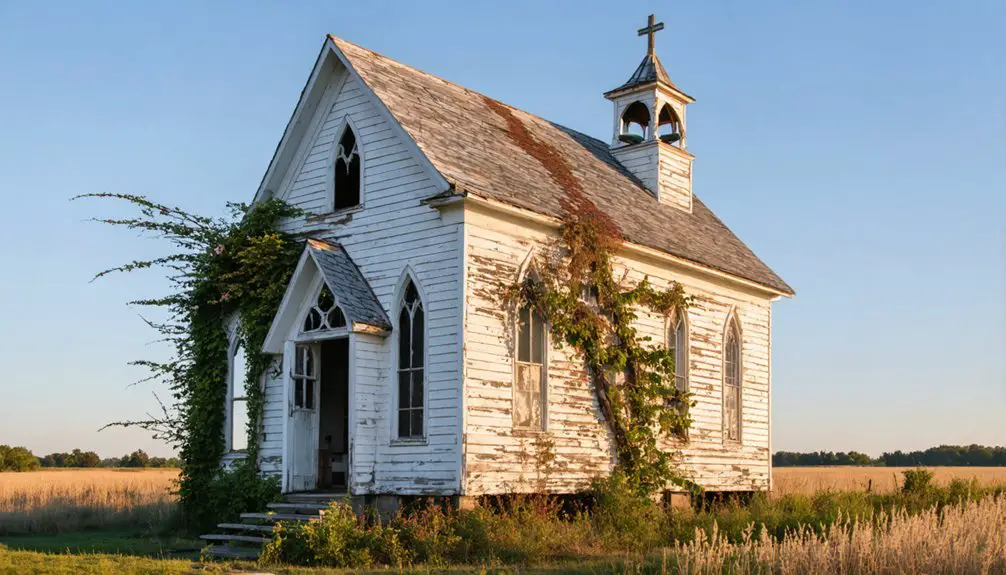
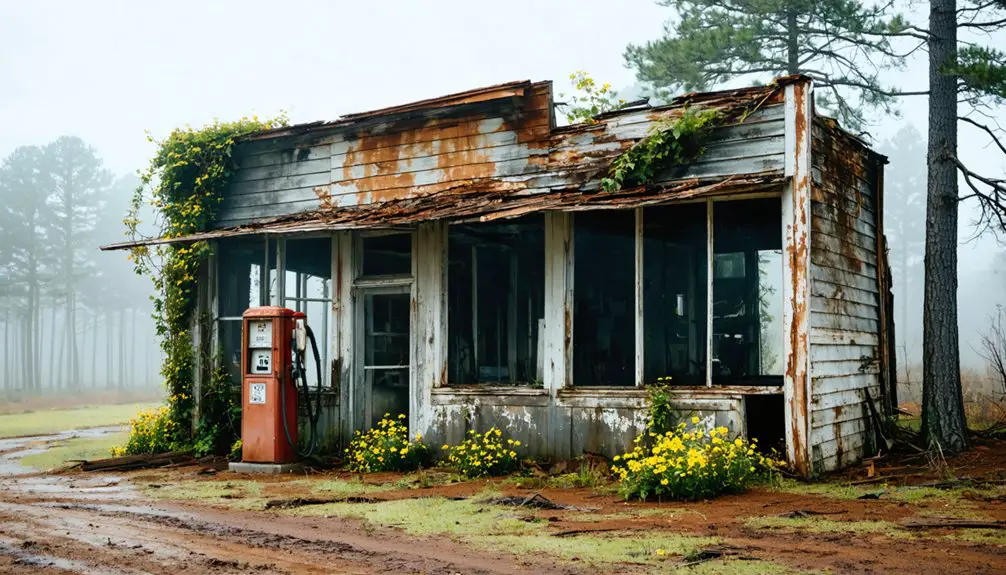
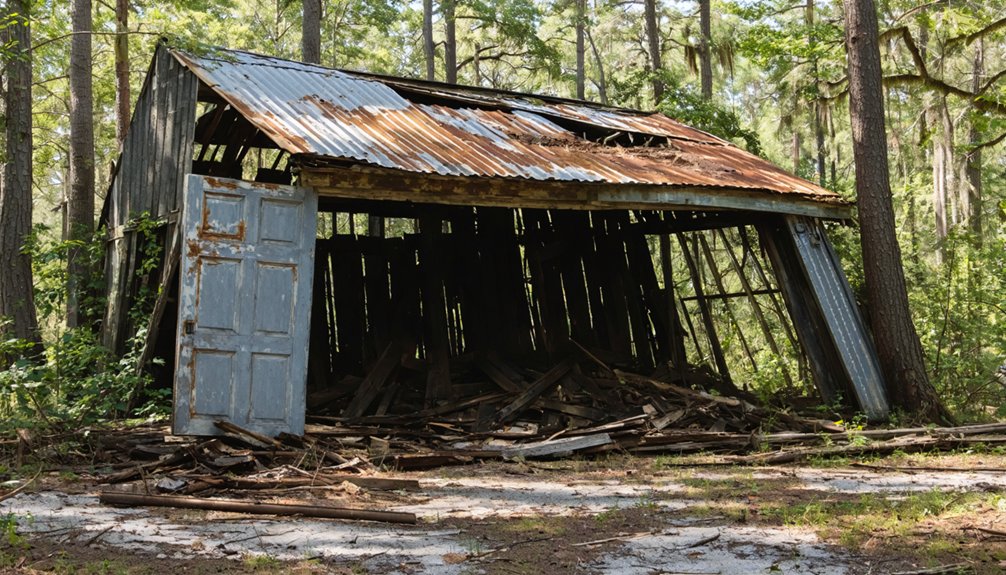
When you visit Mississippi’s ghost towns today, you’ll find a stark physical record of abandonment — deteriorating structures, overgrown streets, and scattered remnants that collectively document each settlement’s collapse.
In Rodney, for example, you can observe most buildings have vanished entirely, while those that remain stand in various states of disrepair.
The five communities displaced for the SSC facility present a particularly striking case, where you’ll encounter overgrown city streets and a surviving one-room schoolhouse — infrastructure that outlasted the 700 families once living there.
Surviving Structures And Buildings
Though Mississippi’s ghost towns vary widely in their historical origins, what physically survives across these abandoned settlements reflects a pattern of selective decay and infrastructural persistence.
You’ll find that historical preservation remains inconsistent, leaving structures vulnerable to neglect while community nostalgia sustains awareness of what once existed.
Across documented sites, three recurring physical remnants emerge:
- Overgrown street grids — SSC-displaced towns like Logtown retain readable road patterns beneath vegetation
- Isolated civic structures — a one-room schoolhouse stands among abandoned SSC-area communities
- Deteriorating buildings — Rodney’s remaining structures exemplify advanced disrepair without active restoration
These survivals aren’t accidental. Infrastructure outlasts inhabitants because materials resist time longer than economies resist collapse.
You’re witnessing what selective abandonment leaves behind — partial evidence of lives built, then surrendered.
Overgrown Streets And Infrastructure
Streets don’t disappear when towns do. When Mississippi displaced five communities — Gainesville, Logtown, Napoleon, Santa Rosa, and Westonia — to construct the SSC facility, the roads remained, slowly consumed by vegetation. You can still trace those overgrown grid patterns today, concrete and gravel holding their shape beneath decades of encroachment.
That persistence matters for historic preservation. Infrastructure outlasts institutions, offering physical evidence of community memories that official records can’t fully capture. A one-room schoolhouse still stands among these remnants, anchoring the landscape to its human past.
When you walk these forgotten corridors, you’re reading a spatial autobiography — 700 displaced families encoded into crumbling curbs and wild grass. Mississippi’s ghost town infrastructure doesn’t demand tourism infrastructure to communicate its significance; it simply endures, indifferent to neglect.
Rodney, Grand Gulf, and Abandoned Settlements Still Accessible
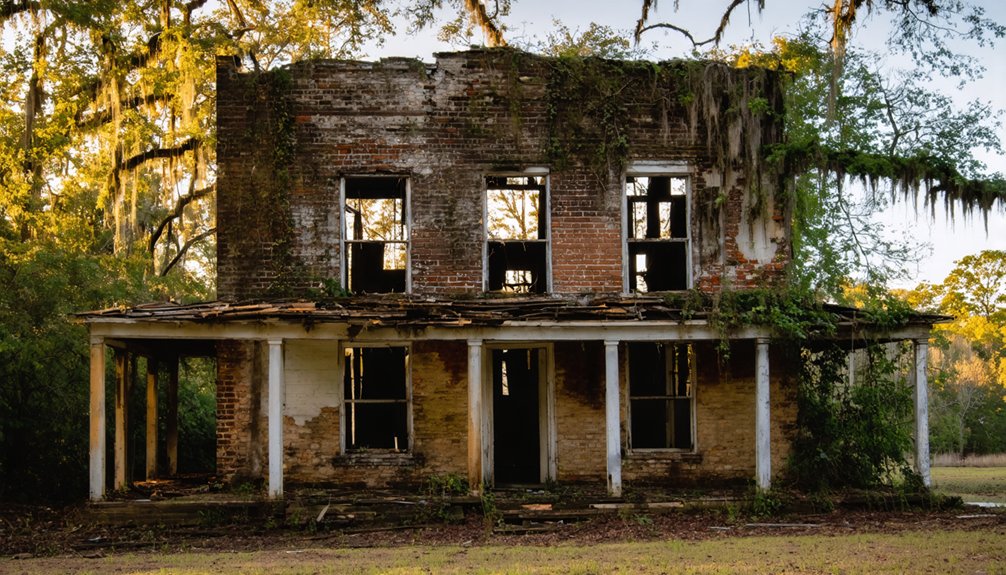
Among Mississippi’s most accessible ghost towns, Rodney and Grand Gulf stand out as historically significant sites that you can still visit today. Both settlements offer rare encounters with historical preservation outside institutional control, letting you explore on your own terms.
Key characteristics defining these accessible ghost towns:
- Rodney sits in Jefferson County with most buildings gone, yet remaining structures fuel community nostalgia among descendants of former residents.
- Grand Gulf carries significant historical weight, representing Mississippi’s river-influenced economic decline.
- Additional settlements like Fort Adams and Port Royal remain reachable, offering unfiltered access to abandoned infrastructure.
These sites don’t demand guided tours or admission fees. You’re free to examine decay firsthand, drawing your own analytical conclusions about industrial collapse and Mississippi’s broader economic transformation.
Which Mississippi Ghost Towns Are Worth the Drive
If you’re planning a trip through Mississippi’s abandoned settlements, Rodney and Grand Gulf stand out as the most analytically rewarding destinations, offering tangible remnants of antebellum commerce and river-trade infrastructure.
You’ll also find understated value in lesser-known sites like Bankston, where the skeletal legacy of the textile mill economy remains embedded in the landscape.
Weighing accessibility, historical density, and structural survival rates, you can build a focused itinerary that prioritizes sites yielding the clearest evidence of Mississippi’s industrial and commercial collapse.
Top Destinations Worth Visiting
Several Mississippi ghost towns stand out as genuinely worthwhile destinations, each offering a distinct historical narrative rather than mere structural ruins. You’ll find that historical preservation varies notably across sites, yet each rewards careful exploration.
- Rodney (Jefferson County): A river town frozen in post-Civil War decline. Its deteriorating church and bullet-scarred walls document real conflict.
- Grand Gulf: A strategically crucial port erased by natural forces. It offers military and economic context.
- Bankston: A textile company town illustrating corporate community revitalization patterns that ultimately failed workers.
These destinations demand your critical engagement rather than passive tourism. You’re not simply viewing ruins — you’re interpreting economic collapse, displacement, and industrial ambition. Each site functions as primary evidence of how single-industry dependence shaped, then erased, Mississippi communities entirely.
Hidden Gems To Explore
Beyond the well-documented sites, Mississippi harbors lesser-known ghost towns that reward the determined traveler willing to navigate unmarked roads and overgrown terrain. Towns like Baleshed, Artonish, and Arnot sit largely uncharted, offering you direct encounters with industrial-era remnants untouched by commercial tourism. Their cultural significance lies precisely in their rawness — no interpretive signs, no guided tours, just authentic decay that speaks honestly to Mississippi’s mill-driven economic past.
Historic preservation remains minimal here, which paradoxically keeps these sites genuine. You’ll find collapsed structures, reclaimed foundations, and silence that communicates more than any museum exhibit. Westville and Yale in southern Mississippi similarly reward patient exploration.
Bring detailed maps, expect no amenities, and approach each site with analytical curiosity. These hidden communities represent Mississippi’s unfiltered industrial history, fully accessible to those valuing authentic discovery over curated experience.
Mississippi Ghost Towns vs. True Mining Ghost Towns
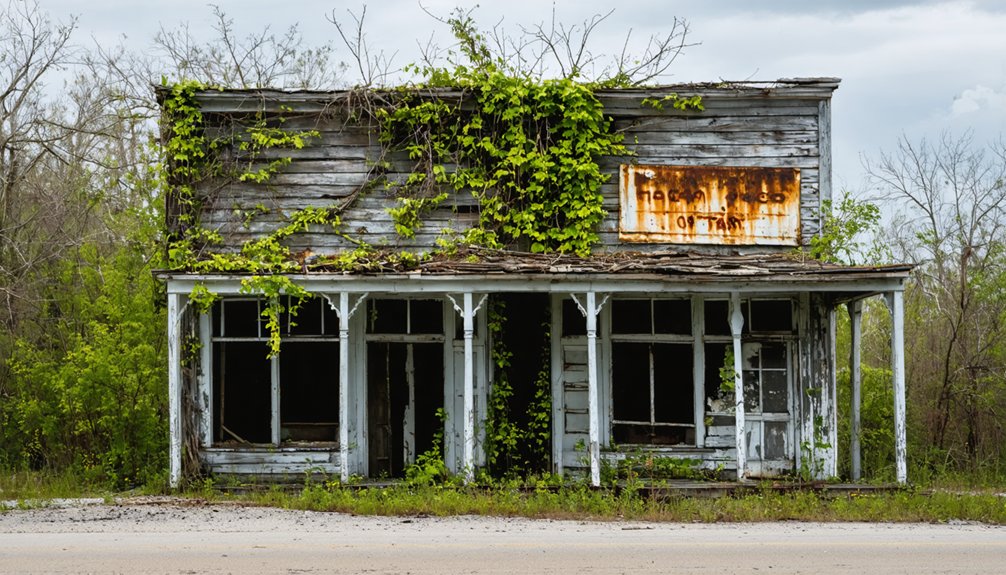
What distinguishes Mississippi’s ghost towns from true mining ghost towns is less a matter of abandonment than of economic origin. You’ll find that Mississippi’s deserted settlements grew from timber, textile, and infrastructure industries—not mineral extraction. True mining ghost towns collapse when ore depletes; Mississippi’s towns collapsed when lumber ran out or corporations relocated.
Consider these distinctions:
- Economic driver: Mining towns depended on extractable resources; Mississippi’s relied on lumber mills and company infrastructure
- Cultural Heritage: Mississippi’s abandoned towns reflect agrarian-industrial history, not frontier mining culture
- Preservation Challenges: Without romanticized mining narratives, Mississippi’s ghost towns attract fewer preservation advocates or tourism investments
You’re fundamentally examining two separate abandonment archetypes. Understanding this distinction sharpens your appreciation of what Mississippi’s ghost towns genuinely represent historically.
Frequently Asked Questions
How Many Total Ghost Towns Are Officially Documented in Mississippi?
You’ll find over 50 ghost towns officially documented in Mississippi, though the list remains incomplete. Historic preservation efforts and tourism development haven’t fully captured these abandoned settlements, leaving many sites unrecognized and understudied.
Which Mississippi Ghost Towns Are Located in Bolivar County?
Victoria stands alive in memory yet dead in presence — you’ll find it among Bolivar County relics, where abandoned settlement stories echo a thriving past now silenced, marking it as the documented ghost town in that county.
Were Any Mississippi Ghost Towns Abandoned Due to Natural Disasters?
You won’t find documented evidence linking Mississippi’s ghost town abandonment causes directly to natural disaster impacts; instead, you’ll discover industrial decline, resource depletion, and forced relocations mainly drove these towns’ desertion throughout the state’s history.
Did Any Mississippi Ghost Towns Ever Attempt Official Historic Preservation Programs?
Like forgotten whispers, Mississippi’s ghost towns face steep preservation challenges. You’ll find their historical significance largely unrecognized, as documented sources confirm no active official historic preservation programs currently protect these abandoned settlements from continued deterioration and neglect.
Are There Ghost Town Tourism Programs Currently Operating in Mississippi?
You won’t find active ghost town tourism programs operating in Mississippi today. Despite their cultural significance, these abandoned settlements haven’t attracted modern tourism infrastructure, leaving you to independently explore their historically rich, yet largely unpreserved, remnants.
References
- https://en.wikipedia.org/wiki/List_of_company_towns_in_the_United_States
- https://en.wikipedia.org/wiki/List_of_ghost_towns_in_Mississippi
- https://www.youtube.com/watch?v=n4IZqKxN1Ds
- https://nma.org/mining-museums-tours/bannack-state-park/
- https://en.wikipedia.org/wiki/Ghost_town
- https://en.wikipedia.org/wiki/Rodney