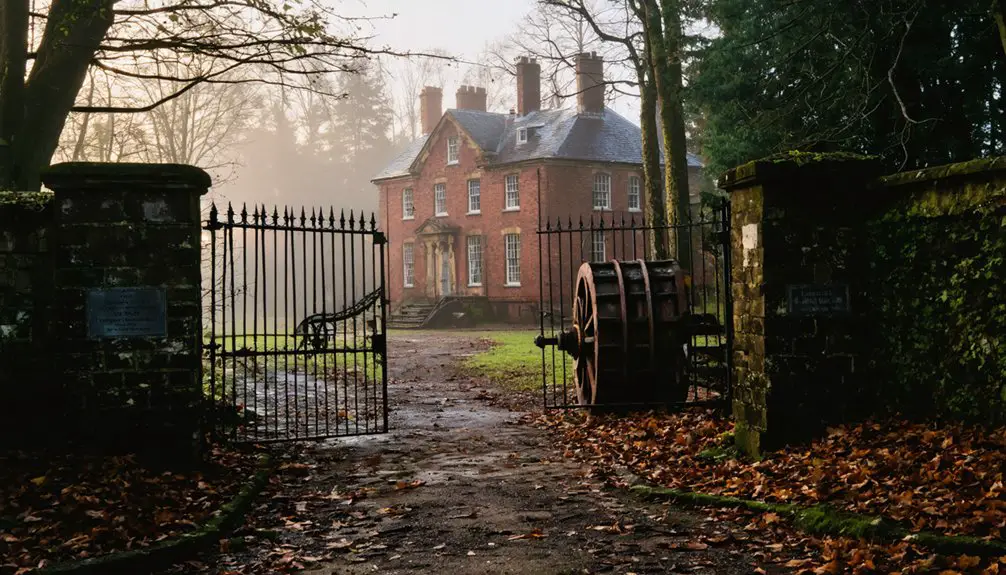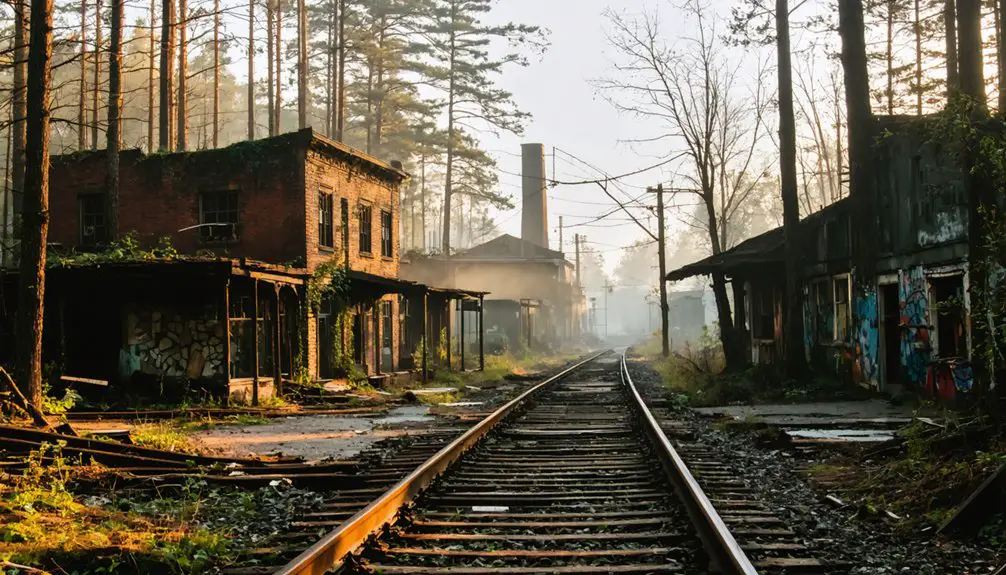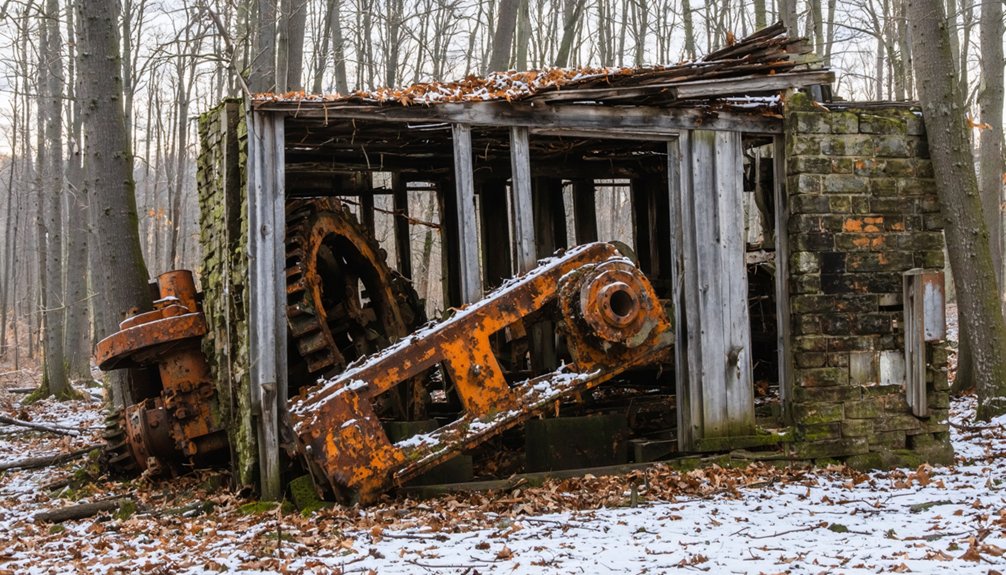
New Jersey’s Pine Barrens are home to ghost towns born from bog iron, paper mills, and glassmaking industries that once powered a young nation. You’ll find preserved settlements like Batsto Village (founded 1766) and Allaire Village (established 1822), which thrived before collapsing under cheaper Pennsylvania iron. Resource depletion and technological shifts emptied these communities almost overnight. Lesser-known ruins like Weymouth Furnace and Harrisville still stand silent in the pines, and there’s far more to uncover about each site’s remarkable rise and fall.
Key Takeaways
- Batsto Village, founded in 1766, is New Jersey’s most preserved ghost town, featuring 33 historic structures from its iron and glassmaking era.
- Allaire Village once housed 400 residents centered around Howell Iron Works before cheaper Pennsylvania iron caused rapid economic collapse and abandonment.
- Weymouth Furnace, abandoned in 1887, features grand stone arches and chimney stacks remnants of New Jersey’s once-thriving iron industry.
- Martha Furnace and Hampton Furnace are lesser-known ghost towns hidden within the Pine Barrens, accessible through dense cedar and pine corridors.
- Harrisville’s paper mill ruins and Whitesbog’s historic cottages offer additional glimpses into New Jersey’s abandoned industrial communities within Wharton State Forest.
How Iron, Paper, and Bog Industries Created New Jersey’s Ghost Towns
Before the age of steel mills and modern manufacturing, New Jersey’s Pine Barrens and surrounding regions harbored thriving industrial communities built entirely around bog iron, paper production, and agricultural processing.
The iron industry transformed villages like Batsto and Allaire into self-sufficient settlements supporting hundreds of workers. Paper production sustained Harrisville until 1891, when mill closures triggered immediate abandonment.
Iron-dependent villages like Batsto thrived for generations — until industry collapsed, triggering swift and total abandonment.
Bog farming operations extended community lifespans after primary industries collapsed.
You’ll recognize a pattern across these sites: resource depletion and technological advancements consistently dismantled economic foundations faster than communities could adapt.
Cheaper Pennsylvania iron devastated local furnaces almost overnight. Community shifts followed predictably — residents relocated, buildings emptied, and forests reclaimed what industry built.
Understanding these industrial cycles reveals why New Jersey harbors so many remarkably preserved ghost town remnants today.
Why New Jersey’s Iron Towns Boomed: Then Emptied Almost Overnight
During the late 18th and early 19th centuries, New Jersey’s iron towns didn’t simply grow — they exploded into existence, driven by an almost perfect convergence of natural resources, geographic advantage, and wartime demand.
Iron production fueled entire self-sufficient ecosystems. Allaire Village swelled to roughly 400 residents by the 1830s, supporting schools, stores, and workers’ housing. Community dynamics thrived when iron thrived.
Then Pennsylvania’s cheaper iron entered the market, and everything collapsed. You’d witness thriving settlements empty almost overnight, workers relocating with startling speed, leaving behind furnaces, mansions, and mills mid-operation.
What built these towns — singular industrial dependency — ultimately destroyed them. Their rapid rise and catastrophic fall reflects a broader American pattern: resource-driven freedom creates prosperity, but that same dependency can strip it away just as fast.
Batsto Village: New Jersey’s Best-Preserved Ghost Town
Of all the iron towns that boomed and collapsed across New Jersey, Batsto Village stands apart — not because its story differs dramatically from Allaire’s or Weymouth’s, but because so much of it survived.
Founded in 1766, Batsto’s Ironworks Legacy stretches from casting cannonballs for Washington’s Continental Army through a later shift into glassmaking.
Today, 33 historic structures remain standing — the Batsto Mansion, gristmill, sawmill, general store, workers’ homes, and post office among them.
You can walk through a functioning cross-section of 18th and 19th-century industrial life, something few sites anywhere can offer.
That’s the Batsto Heritage at its core: not a reconstructed impression, but an authentic, preserved record of how iron-dependent communities actually lived, worked, and ultimately declined when cheaper Pennsylvania iron made their labor obsolete.
Allaire Village and the Howell Iron Works Story
While Batsto’s story unfolds gradually across centuries, Allaire Village rose and collapsed with striking speed. James P. Allaire constructed the Howell Iron Works in 1822, and within a decade, the community swelled to roughly 400 residents.
Allaire history reflects a classic industrial boom cycle: workers, families, and supporting businesses clustered around a single productive enterprise. The village produced household goods and stoves, diversifying beyond raw iron output.
Workers, families, and businesses once clustered around a single enterprise — a boom cycle written in iron and ambition.
Yet cheaper Pennsylvania iron gutted the market, and Allaire emptied almost overnight. You can still walk among 13 preserved historic structures today, each one a tangible record of how quickly prosperity can unravel.
The Iron Works story isn’t just local history — it’s a warning about economic dependence on a single industry’s survival.
Pine Barrens Ghost Towns Worth Visiting Today
The industrial collapse that hollowed out Allaire echoes across dozens of sites deeper in New Jersey’s Pine Barrens, where bog iron furnaces, paper mills, and farming communities once thrived before falling silent.
You’ll find ghost towns of remarkable historical significance scattered throughout Burlington and Atlantic counties. At Batsto Village, you can walk among 33 preserved structures, including the mansion, gristmill, and workers’ cottages.
Martha Furnace’s ruins reveal community life that once supported a stamping mill, school, and hospital. Weymouth Furnace‘s grand stone arches and chimney stacks showcase extraordinary architectural features.
Preservation efforts by Wharton State Forest keep these sites accessible. Whitesbog offers a unique contrast, where cranberry bogs still operate alongside standing cottages, connecting past and present agricultural heritage.
Weymouth Furnace, Harrisville, and the Ghost Towns Most Visitors Miss
Beyond the well-trodden paths of Batsto and Allaire, you’ll find New Jersey’s most atmospheric ghost town remnants waiting in near-obscurity.
Weymouth Furnace, abandoned in 1887 and situated along the Great Egg Harbor River in Atlantic County, rewards your visit with grand stone arches, towering chimney stacks, and moss-covered foundations that historians have called “one of the most hauntingly beautiful ghost town sites in the state.”
A few miles away, Harrisville’s paper mill ruins—abandoned in 1891 after the mill ceased operations—offer equally evocative remnants, though fenced perimeters restrict direct access to preserve the deteriorating structures.
Weymouth Furnace’s Haunting Beauty
Tucked along the Great Egg Harbor River in Atlantic County, Weymouth Furnace stands as perhaps the most hauntingly beautiful ghost town site in New Jersey, distinguished by its grand stone arches, towering chimney stacks, and moss-covered foundations that have slowly surrendered to the surrounding forest.
The Weymouth Aesthetics speak for themselves — nature and industry locked in a quiet, centuries-long negotiation. Abandoned in 1887 after its iron works and paper mill operations collapsed, the site carries an undeniable atmospheric weight that fuels Ghostly Legends among locals and history enthusiasts alike.
You’ll find no velvet ropes or guided tours here, just raw, unfiltered remnants of industrial ambition reclaimed by wilderness. That freedom to explore authentically is precisely what makes Weymouth unforgettable among New Jersey’s overlooked ghost town destinations.
Harrisville’s Paper Mill Ruins
Few ghost towns in New Jersey carry the melancholy weight of Harrisville, where the ruins of a once-flourishing paper mill village stand fenced off along the banks of the Oswego River, frozen in a state of controlled decay.
Harrisville History stretches back through decades of productive industry before the mill’s closure forced abandonment in 1891, emptying a community that once supported hundreds of residents.
The Industrial Legacy here isn’t romantic — it’s sobering. You’ll find evocative stone remnants that speak directly to how quickly economic collapse unravels entire communities.
The fencing preserves what little remains, so you can observe but not touch. That boundary itself delivers a quiet message: these structures survive only because someone chose to protect them from both time and foot traffic.
Hidden Pine Barrens Sites
Harrisville represents just one entry point into a broader network of Pine Barrens ghost towns that most visitors never find, largely because they don’t appear on standard tourist maps and require deliberate navigation through the region’s dense cedar and pine corridors.
Martha Furnace, operating from 1793-1845, once supported a stamping mill, blacksmith shop, school, and hospital—forgotten stories embedded in moss-covered foundations you’ll only discover by seeking them deliberately.
Hampton Furnace, established along the Batsto River, shifted from bog iron smelting to cranberry operations before abandonment claimed it entirely.
These hidden treasures demand that you embrace genuine exploration rather than curated tourism.
Wharton State Forest manages access to these sites, offering you direct, unmediated engagement with industrial history that mainstream itineraries consistently overlook.
Ruins, Preserved Buildings, and Living History at These Abandoned Towns
Although New Jersey’s ghost towns exist on a spectrum of preservation, they collectively offer a striking material record of the state’s industrial past.
Whether you’re exploring iron industry ruins or paper production remnants, each site carries undeniable historical significance.
You’ll encounter:
- Batsto Village – 33 preserved structures including a mansion, gristmill, and workers’ cottages
- Allaire Village – 13 surviving buildings reflecting community decline after cheaper Pennsylvania iron arrived
- Harrisville Ruins – evocative architectural remnants of a paper mill, fenced for preservation
- Weymouth Furnace – grand stone arches and chimney stacks defining one of the state’s most compelling archaeological sites
These destinations transform visitor experiences into direct encounters with industrial collapse.
You’re not merely reading history—you’re walking through it.
Hours, Access, and What to Know Before You Visit
Before you plan your trip to any of New Jersey’s mining ghost towns, you’ll need to confirm site-specific hours, as Batsto Village, Allaire Village, and Whitesbog operate under state park schedules that shift seasonally.
Most sites charge minimal admission fees or require a parking pass, so you should check the New Jersey State Park Service website for current pricing and any reservation requirements.
Once on-site, you’ll find designated parking areas with marked trail access, though certain ruins—such as Harrisville’s fenced paper mill remains—restrict close approach to protect both visitors and fragile historic structures.
Site Hours And Admission
Each of New Jersey’s preserved ghost town sites operates under its own set of access rules, hours, and admission requirements, so you’ll want to research your destination before heading out.
Site accessibility varies considerably across locations:
- Batsto Village charges a parking fee; grounds are open daily, though building tours follow seasonal schedules.
- Allaire Village operates within a state park requiring a seasonal parking fee on weekends.
- Whitesbog Village offers free entry with open grounds year-round.
- Weymouth Furnace remains freely accessible within Atlantic County parkland.
Visitor amenities differ just as sharply—some sites provide restrooms, interpretive signage, and guided tours, while others offer little infrastructure.
Check each site’s official park or municipal website for current hours, closures, and fee structures before you go.
Visitor Rules And Restrictions
Whether you’re planning a casual afternoon drive or a dedicated historical excursion, understanding each site’s rules and restrictions will save you frustration and guarantee a respectful visit.
Visitor etiquette matters greatly at preserved sites like Batsto and Allaire Villages — removing artifacts, climbing deteriorating structures, or straying beyond marked paths risks both your safety and irreplaceable historical resources.
Safety guidelines at locations like Harrisville Ruins exist precisely because fenced-off structures present genuine collapse hazards. You must stay on designated trails at Wharton State Forest properties and respect posted signage throughout.
Pets require leashes at most sites. Photography remains generally permitted, though commercial shoots often require advance authorization.
Always verify current restrictions directly with each managing authority before arriving, as policies change seasonally and without widespread public notice.
Parking And Trail Access
Parking availability and trail access vary considerably across New Jersey’s ghost town sites, so planning ahead prevents unnecessary complications. Each location enforces distinct parking regulations, and trail conditions shift seasonally, particularly within the Pine Barrens’ sandy terrain.
Key considerations before you visit:
- Batsto Village charges seasonal parking fees within Wharton State Forest; arrive early during summer weekends.
- Allaire Village offers free parking within Allaire State Park, with clearly marked trailheads throughout.
- Weymouth Furnace provides limited roadside parking along the Great Egg Harbor River; high-clearance vehicles handle unpaved access roads better.
- Whitesbog Village maintains free parking near the general store, with flat, accessible trails connecting preserved structures.
Always verify current trail conditions through the New Jersey State Park Service before departing, as seasonal flooding and maintenance closures occur unpredictably.
Batsto vs. Allaire vs. Weymouth: The Best Ghost Town for Your Visit
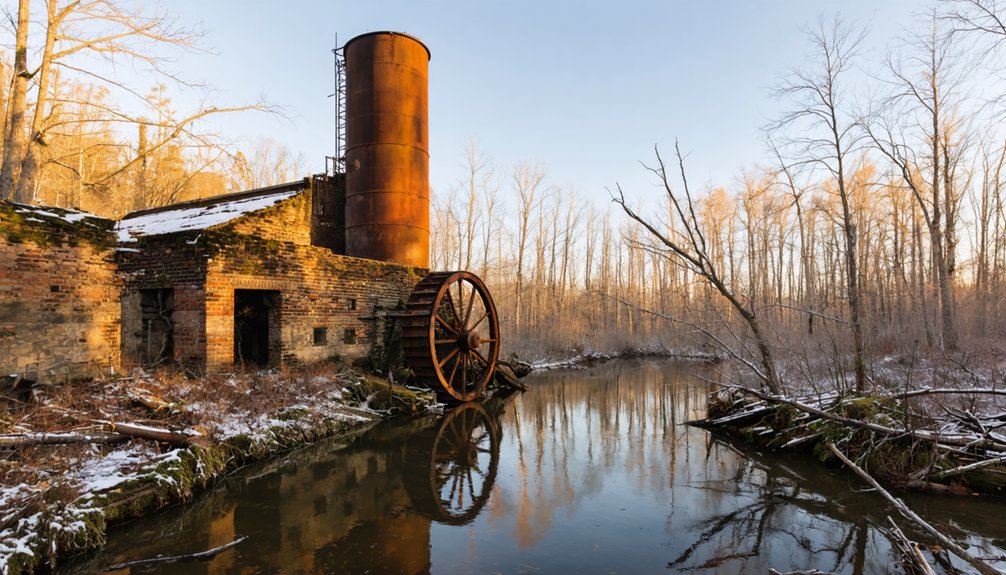
Choosing among Batsto Village, Allaire Village, and Weymouth Furnace ultimately depends on what kind of historical experience you’re after.
If you want maximum ghost town exploration with the broadest historical significance, Batsto’s 33 preserved structures—spanning ironworks, glassmaking, and domestic life—deliver unmatched depth.
Allaire suits visitors drawn to rapid industrial collapse; its 13 structures illustrate how Pennsylvania’s cheaper iron emptied a 400-person community almost overnight.
Weymouth offers something entirely different: fewer intact buildings but arguably the most atmospheric setting, where grand stone arches and moss-covered foundations create a haunting, contemplative experience along the Great Egg Harbor River.
Each site rewards a specific curiosity.
Prioritize Batsto for breadth, Allaire for social history, and Weymouth for raw, unfiltered industrial ruins that demand your full attention.
Frequently Asked Questions
Are New Jersey Ghost Towns Safe for Children and Family Visits?
You’ll find most New Jersey ghost towns safe for family visits when you practice proper ghost town etiquette. Respect fenced areas like Harrisville’s ruins, supervise children near foundations, and you’re ensuring everyone’s family safety throughout your exploration.
Can You Metal Detect or Collect Artifacts at These Ghost Town Sites?
Like sacred ground, these sites prohibit metal detecting and artifact collection. You must respect strict metal detecting guidelines and artifact preservation laws — removing items carries legal penalties, ensuring history’s integrity remains protected for future generations to freely explore and appreciate.
Are Pets Allowed at Batsto Village, Allaire, or Weymouth Furnace?
Pet policies aren’t covered in the available knowledge, but you’d want to contact each site directly. Their historical significance as preserved ghost towns means visitor rules, including pet access, vary by management authority.
Do Any New Jersey Ghost Towns Offer Guided Tours or Educational Programs?
You’ll find guided explorations at Batsto Village and Allaire Village, where knowledgeable rangers walk you through structures steeped in historical significance, letting you freely uncover iron-forging legacies and educational programs that illuminate New Jersey’s industrial past.
Is There an Admission Fee to Visit These Historic Ghost Town Sites?
You’ll find that admission policies vary across these sites. Batsto and Allaire Villages don’t charge entry fees, letting you freely explore their historic significance, though some guided tours or special programs may require nominal fees.
References
- https://nj1015.com/new-jersey-ghost-towns/
- https://jerseydigs.com/ghost-towns-in-nj/
- https://en.wikipedia.org/wiki/List_of_ghost_towns_in_New_Jersey
- https://www.youtube.com/watch?v=ZIp3AYb0ulw
- https://www.youtube.com/watch?v=P0aFAgcr79E
- https://pinelandsalliance.org/learn-about-the-pinelands/pinelands-history-and-culture/ghost-towns-of-the-pine-barrens/
- https://dep.nj.gov/wp-content/uploads/njgws/maps/ofmap/ofm12.pdf