You won’t find New York’s mining ghost towns on any official registry, but you’ll recognize them by their crumbling furnaces, sealed shafts, and overgrown foundations. Sites like Tahawus, Benson Mines, Hammondville, and Doodletown are scattered across Adirondack wilderness and state parks, each marking where industrial communities rose and collapsed within decades. Economic failure, ore-processing limits, and government absorption erased these towns from the map—and what remains tells a more complicated story than you’d expect.
Key Takeaways
- Tahawus, founded in 1826, is New York’s best-preserved mining ghost town, featuring intact industrial ruins from failed iron and titanium smelting operations.
- Benson Mines and Hammondville are notable abandoned iron mining sites, featuring rusted equipment, collapsed terrain, and deteriorating structures scattered across the Adirondacks.
- Most mining ghost towns lack official designation and are identified by remaining foundations, mine shafts, furnaces, and industrial ruins.
- Economic collapse, technological limitations, and geographic isolation were primary causes of mining town abandonment across New York State.
- Visiting these sites carries legal and safety risks, including trespassing laws, unstable structures, open shafts, and chemical residues.
What Qualifies as a Ghost Town in New York State?
Although New York doesn’t officially designate ghost towns through any formal registry, historians and urban explorers generally apply the term to communities that once sustained permanent populations but no longer function as active settlements. You’ll find these places scattered across the state, each carrying layers of urban legends and folklore that obscure the harder archival truths.
A qualifying ghost town typically shows evidence of former infrastructure — roads, foundations, industrial ruins — while lacking current residents or civic function. Some sites disappeared through economic collapse, others through deliberate government acquisition.
New York’s regional geography shapes these classifications profoundly; an Adirondack mining settlement differs sharply from a Hudson Valley hamlet absorbed by a state park. Recognizing these distinctions helps you interpret what you’re actually standing in when you explore them.
Why New York’s Mining Boom Left So Many Towns Behind
When you trace New York’s mining history, you’ll find a pattern of rapid settlement followed by equally rapid collapse. Towns like Tahawus didn’t fade gradually — they broke under the weight of ore too rich in titanium to smelt and terrain too rugged to conquer.
The mountains that once promised fortune became walls that sealed these communities’ fates, leaving behind only ruins and empty land swallowed by the Adirondack forest.
Boom To Bust
New York’s mining boom didn’t collapse all at once — it unraveled town by town, each for its own stubborn reason. Outdated mining technology, shifting markets, and impossible terrain conspired against communities that once ran on iron and ambition. The economic impacts hit hard and fast, leaving little room to adapt.
Three patterns drove most closures:
- Ore processing failures — Tahawus couldn’t smelt titanium-saturated ore, killing operations before workers could pivot.
- Geographic isolation — Mountain terrain made supply lines costly and unsustainable.
- Government acquisition — Towns like Doodletown were absorbed into state parkland, displacing residents permanently.
You’ll find these patterns repeated across Essex and Sullivan Counties. Each abandoned street and collapsed furnace tells you exactly where the system broke down.
Ore Too Rich
Tahawus didn’t fail because the ore ran out — it failed because there was too much of it. The iron deposits buried deep in Essex County’s wilderness were so saturated with titanium that 19th-century ore processing technology couldn’t handle them. Smelters choked. Yields collapsed. The Adirondack Iron & Steel Company, founded in 1826, couldn’t engineer its way past the mountain’s chemistry.
You’d think richer ore means greater profit. Here, it meant abandonment.
Mining technology of that era simply wasn’t built for titanium-heavy deposits. The terrain compounded every problem — remote, unforgiving, expensive to supply. Workers left. Furnaces went cold. The forest reclaimed what industry couldn’t hold.
Tahawus wouldn’t stir again until WWII demand for titanium dioxide made that same “cursed” ore suddenly worth fighting for.
Mountains Blocked Progress
Even if the ore had been processable, the Adirondack terrain would’ve strangled the industry anyway. These mountains didn’t yield to 19th-century ambition. Tahawus sat deep in Essex County wilderness, where moving equipment, fuel, and workers demanded extraordinary cost and effort.
Ore smelting requires massive infrastructure — infrastructure the mountain terrain simply wouldn’t accommodate.
Three geographic realities killed Tahawus’s momentum:
- No navigable routes connected the mines to viable markets or processing centers.
- Brutal elevation changes made transporting heavy ore nearly impossible without modern machinery.
- Dense wilderness isolated workers from supply chains essential to sustained ore smelting operations.
You’d have needed to conquer the Adirondacks themselves to make it work. The mountains won.
Why Tahawus Collapsed: and Why It Came Back
Founded in 1826 by the Adirondack Iron & Steel Company, Tahawus collapsed under two brutal realities: the ore was so loaded with titanium they couldn’t smelt it, and the mountain terrain made large-scale industrial operation nearly impossible.
Early mining techniques simply couldn’t separate the titanium content efficiently, rendering the ore commercially useless. The environmental impacts of operating deep within the Adirondacks compounded every logistical problem — supply lines broke down, costs soared, and the town quietly emptied.
Then WWII changed everything. Suddenly, titanium dioxide wasn’t a nuisance — it was a wartime necessity. Tahawus came back, briefly but intensely, as federal demand pulled workers back into those same impossible mountains.
Tahawus Today: New York’s Best-Preserved Mining Ghost Town
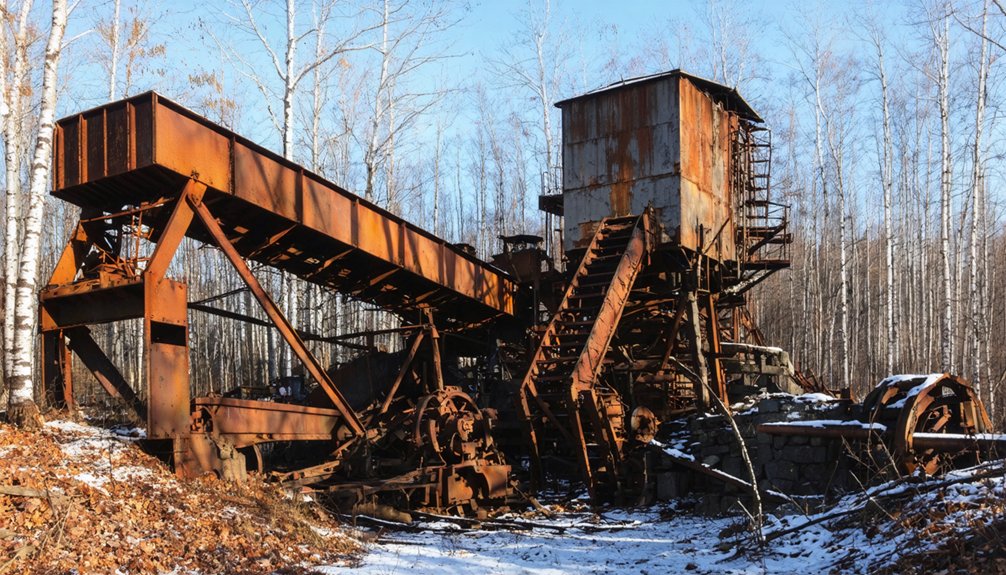
If you make the trek down Essex County Route 25 on foot — the road’s closed to vehicles — you’ll find Tahawus standing in remarkable, if fragile, defiance of its own abandonment.
Most of the original structures remain upright, including the iron ore mine and furnace, though you shouldn’t enter any of them; the buildings are in dangerously poor condition.
What you’re walking through is considered New York’s finest example of a mining ghost town, a tight cluster of industrial ruins swallowed by the dense Adirondack forest.
Ruins Still Standing Today
Though decades of abandonment have taken their toll, Tahawus still stands as New York’s most intact mining ghost town. It earns its reputation as the state’s best example of industrial-era ruins.
You’ll find surviving structures that document both the mining technology and environmental impact of iron and titanium extraction across Essex County.
Three key ruins remain standing today:
- The original iron ore mine, still intact within the Adirondack wilderness
- The 1830s-era furnace, preserved despite harsh mountain conditions
- Several original buildings, standing but structurally unsafe to enter
Essex County Route 25 gets you close, though the road closes before reaching the site. You’ll walk the final stretch through dense Adirondack forest, approaching ruins that time hasn’t fully reclaimed.
Accessing Tahawus By Foot
Reaching those ruins requires planning before you set foot on Essex County Route 25. The state closes the road to vehicle traffic, so you’re walking in — no shortcuts, no exceptions. That restriction isn’t arbitrary; it’s tied directly to historical preservation and the fragile condition of structures dating to the 1830s.
You’ll move through dense Adirondack forest before the site opens up around you. Conservation efforts have kept the area from being fully cleared or redeveloped, which means the original iron ore mine and furnace remain intact for those willing to make the trek.
Most standing buildings aren’t safe to enter, so document from the outside. Carry a map, respect posted boundaries, and understand that this wilderness corridor doesn’t accommodate careless visitors.
Hammondville and the Iron Villages of Essex County
Nestled west of Crown Point on the western shore of Lake Champlain, Hammondville stands as one of Essex County’s forgotten iron villages, classified today as a Class C ghost town. Once driven by iron extraction, the settlement’s collapse reflects both failed mining technology and the environmental impact of industrial overreach.
Hammondville — an iron village swallowed by its own ambition, now a ghost town forgotten on Champlain’s western shore.
Before you explore, understand what remains:
- Collapsed ground makes navigation treacherous and unpredictable
- A few deteriorating buildings still reportedly stand amid the ruins
- No formal preservation protects the site from further decay
You’re entering land that Essex County hasn’t reclaimed or restored. The iron that once defined Hammondville couldn’t sustain it, and nature has steadily reasserted control.
Approach with caution, respect the terrain, and recognize this village for what it truly was — a community swallowed by economic collapse.
Benson Mines: Ghost Town and Industrial Ruin in the Adirondacks
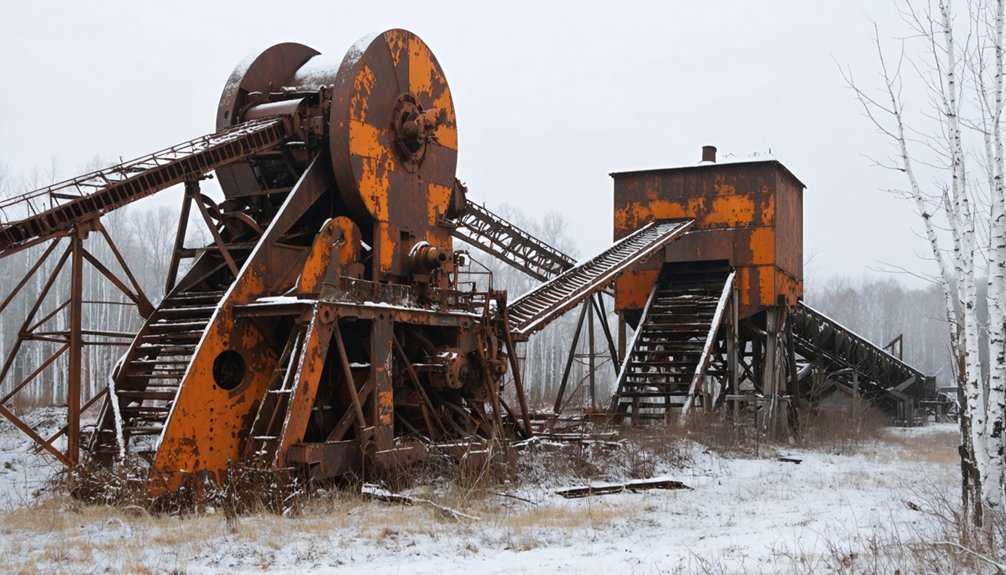
If you venture into the Adirondacks seeking Benson Mines, you’ll find a site that once anchored iron production across St. Lawrence County. Now, it is reduced to a scattered collection of abandoned buildings and industrial ruins.
The mine’s iron legacy runs deep, having sustained local economies and supply chains before economic forces rendered it obsolete.
What you’ll encounter today is a stark archival record written in rusted steel, collapsed structures, and overgrown land.
Benson Mines’ Iron Legacy
Deep in the St. Lawrence County wilderness, Benson Mines once drove iron production through cutting-edge mining technology that reshaped the regional economy. You can still trace its iron legacy through what remains:
- Industrial Scale – Benson Mines operated as one of the Adirondacks’ most significant iron extraction sites, employing hundreds and anchoring local commerce.
- Economic Impacts – Its closure sent ripple effects through surrounding communities, erasing jobs and destabilizing St. Lawrence County’s resource-based economy.
- Physical Remnants – Abandoned buildings and industrial ruins now stand as archival evidence of iron’s grip on the region.
Walking through the site today, you’ll confront a landscape frozen in industrial time — a precise record of ambition, extraction, and the inevitable cost of economic collapse.
Current Ruins And Remains
What remains at Benson Mines isn’t subtle — collapsed structures, rusted industrial equipment, and gutted buildings cut a stark profile against the Adirondack treeline.
You’re looking at a site that processed iron ore for decades, then walked away, leaving industry’s skeleton exposed to the elements.
Historical preservation hasn’t touched much here. What you find is largely what time and weather left behind — raw, unmediated, and honest about industrial decline. That authenticity carries weight.
The environmental impact lingers too. Decades of mining activity altered drainage patterns and soil composition throughout the surrounding landscape.
You can read that history in the land itself, not just the ruins.
Benson Mines doesn’t ask for your sympathy. It simply stands there, accountable to what it was.
Jville, Doodletown, and Other Forgotten Mining Ghost Towns in New York
Beyond the well-documented ruins of Tahawus and Benson Mines, New York harbors quieter ghost towns that rarely make it onto any explorer’s map. You’ll find these overlooked settlements scattered across forgotten counties, each carrying local legends and crumbling mining equipment long swallowed by wilderness.
Three sites worth noting:
- Jville – A Sullivan County mining hamlet established in 1850, now virtually erased from the landscape.
- Doodletown – Pre-Revolutionary Rockland County community absorbed into Bear Mountain State Park during the 1960s.
- Hammondville – An abandoned iron village west of Crown Point, classified as a Class C ghost town with collapsed ground making exploration dangerous.
These places represent communities that state decisions, economic failure, and nature itself quietly dismantled without ceremony.
What Survives at Each Ghost Town: Ruins, Structures, and Sealed Mines
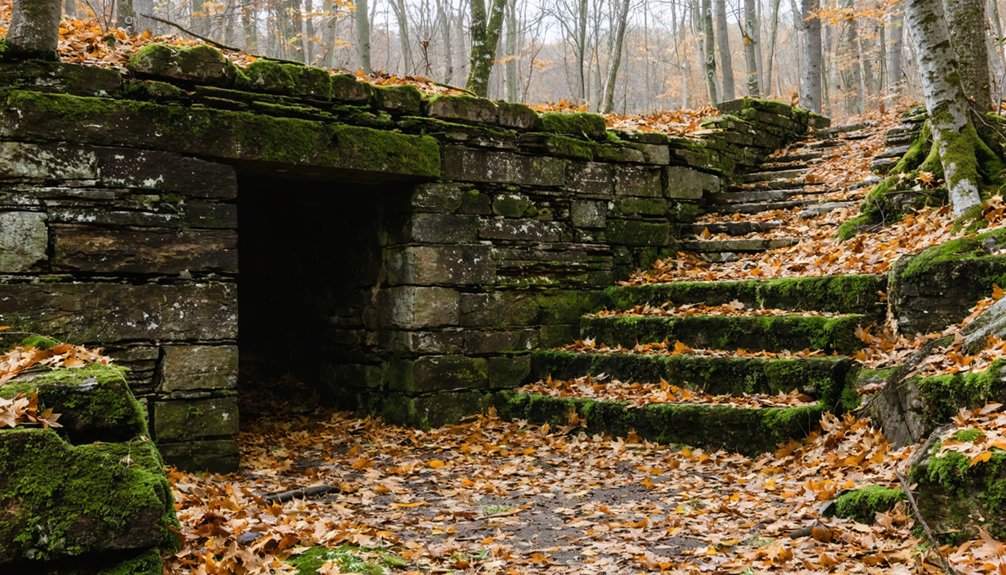
Though each of New York’s mining ghost towns has surrendered to abandonment in its own way, what remains at each site tells a different story.
At Tahawus, you’ll find the original iron ore mine and furnace still intact — monuments to both mining technology and community resilience, though most structures are dangerously unsound.
At Tahawus, an intact mine and furnace stand as monuments to industry — remarkable survivors, though dangerously unsound.
Benson Mines leaves you with scattered industrial ruins and abandoned buildings, quiet witnesses to Adirondack iron extraction.
Hammondville’s collapsed ground makes exploration risky, yet a few buildings reportedly still stand west of Crown Point.
At Doodletown, nature has largely reclaimed what state acquisition didn’t erase.
Each site preserves fragments of lives once built around extraction — sealed mines, crumbling walls, and overgrown foundations that reward the careful, independent explorer willing to read what the land remembers.
Can You Actually Visit New York’s Mining Ghost Towns?
Knowing what survives at these sites is one thing — getting there’s another. New York’s mining ghost towns aren’t packaged tourist attractions — they’re raw, scattered, and demand real effort.
- Tahawus sits on Essex County Route 25, closed to vehicles but open to foot travel through Adirondack State Park.
- Hammondville features collapsed ground that makes exploration genuinely dangerous — you’ll enter at your own risk.
- Doodletown in Rockland County is accessible via Bear Mountain State Park trails, making it the most visitor-friendly option.
Historical preservation efforts remain minimal across most sites. You won’t find guided tours or maintained paths.
What you’ll find is dense forest, industrial silence, and structures the state hasn’t cleared or restored. Prepare accordingly before you go.
Safety Rules and Legal Risks Before You Explore
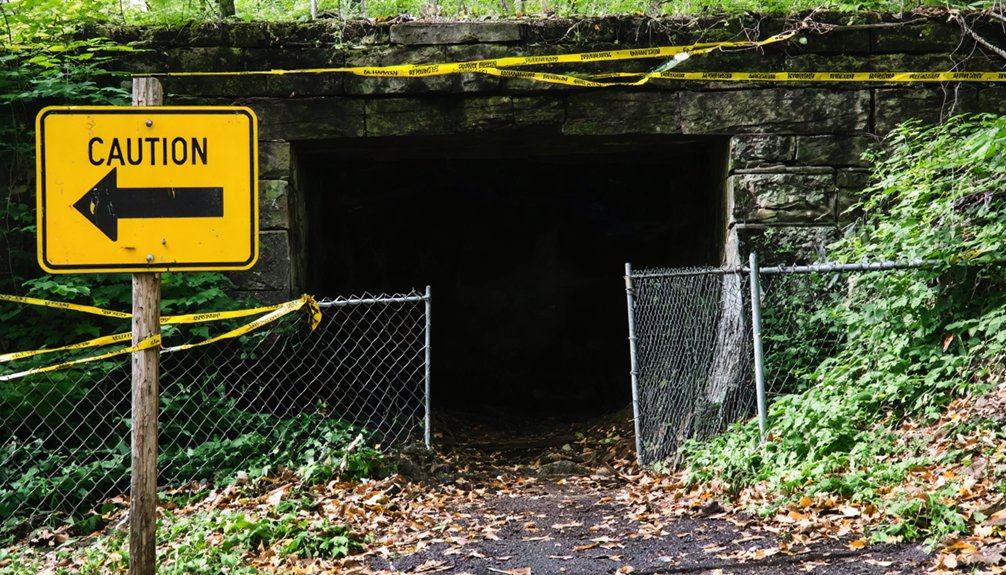
Exploring these sites carries real consequences — legal and physical — that you need to understand before you set foot on any of them. Most of these properties fall within New York State jurisdiction, meaning trespassing charges are real and enforceable.
Trespassing charges are real and enforceable — know the legal consequences before you set foot on these properties.
Tahawus sits inside Adirondack State Park — access beyond the closed road requires permission. Hammondville’s collapsed ground makes physical injury a serious risk.
Preservation challenges complicate entry further. Structures weakened by decades of freeze-thaw cycles and old mining techniques — open shafts, unstable timbering, chemical residue — create hazards that aren’t always visible.
Don’t enter any building rated unsafe, and don’t remove artifacts. Doing so violates state preservation law.
Carry a map, tell someone where you’re going, and respect every posted boundary you encounter.
Frequently Asked Questions
Were Any New York Mining Ghost Towns Ever Proposed for Historical Landmark Status?
You’ll find that Tahawus has been considered for landmark status, given its intact mining infrastructure. Geological surveys and early mining techniques preserved there make it a strong archival candidate worth your independent exploration today.
Did Any Famous or Notable People Ever Live in Tahawus?
History’s quiet chapters don’t always name their players, but you’ll find that Tahawus’s famous residents and notable inhabitants remain largely unrecorded in surviving archival evidence, though its industrial founders from the Adirondack Iron & Steel Company certainly shaped its legacy.
Are There Any Active Preservation Groups Working to Protect These Ghost Towns?
You’ll find that preservation efforts for these sites aren’t well-documented, but community engagement through local Adirondack historical societies and New York State preservation groups can connect you to ongoing archival and protective initiatives for these forgotten ruins.
Have Any Films or Documentaries Ever Been Filmed at These Abandoned Sites?
You’ll find these abandoned structures have attracted filmmakers drawn to their raw authenticity. Tahawus and similar filming locations across New York’s Adirondack wilderness have appeared in regional documentaries exploring industrial heritage and the state’s forgotten communities.
Did Any Mining Ghost Town Residents Ever Attempt to Legally Reclaim Their Properties?
You won’t find many successful legal disputes over property ownership in these abandoned Adirondack settlements. Once the state acquired land or companies folded, former residents rarely reclaimed their rights through archival court records.
References
- https://www.youtube.com/watch?v=g-4d4ZvtAXg
- https://www.youtube.com/watch?v=ix47jfCRl88
- https://www.youtube.com/watch?v=jmCNSv4yq2g
- https://www.youtube.com/watch?v=bsfZI9LppnY
- https://www.youtube.com/watch?v=O-OmHS7L7l0
- https://cnyartifactrecovery.wordpress.com/2013/11/24/ghost-towns-in-ny/