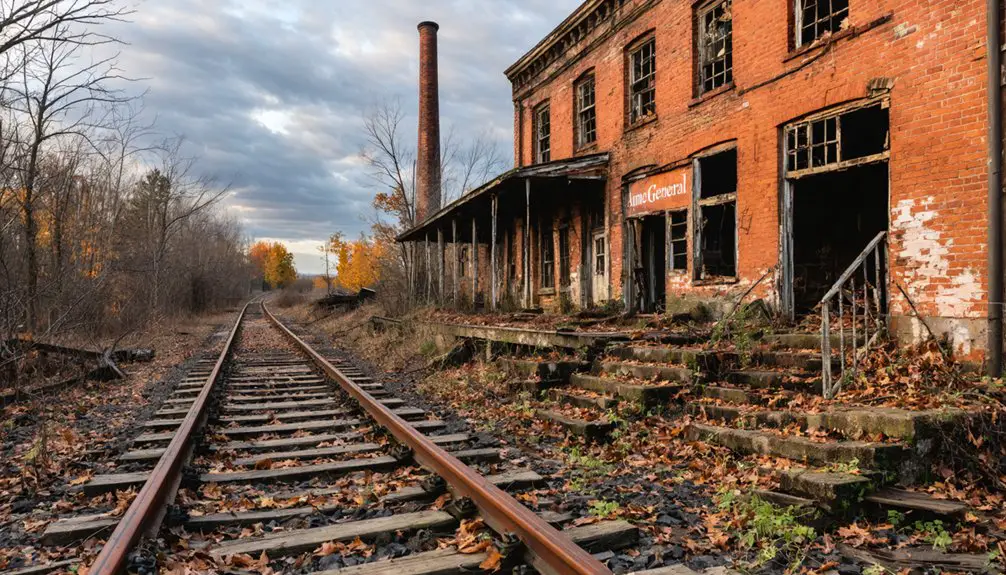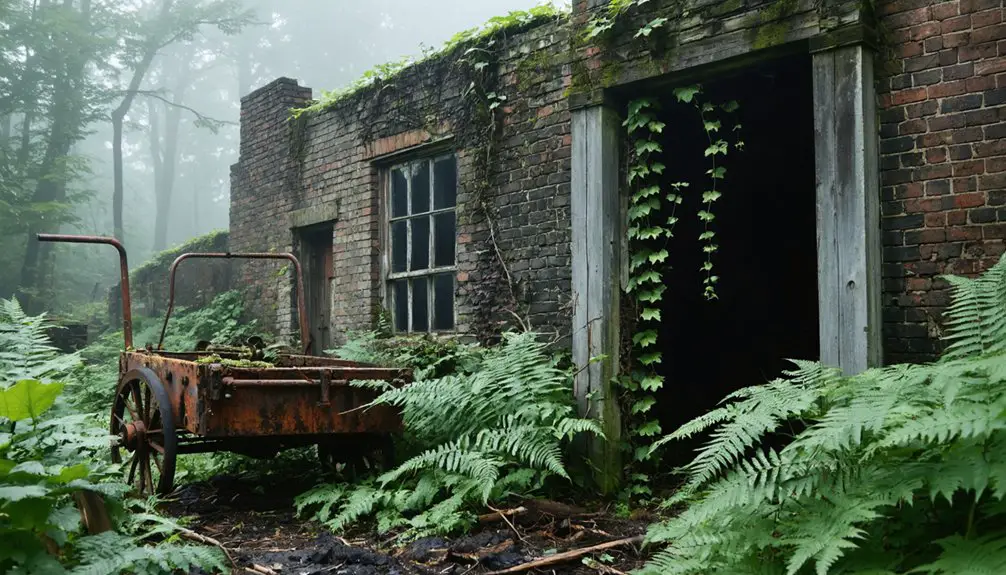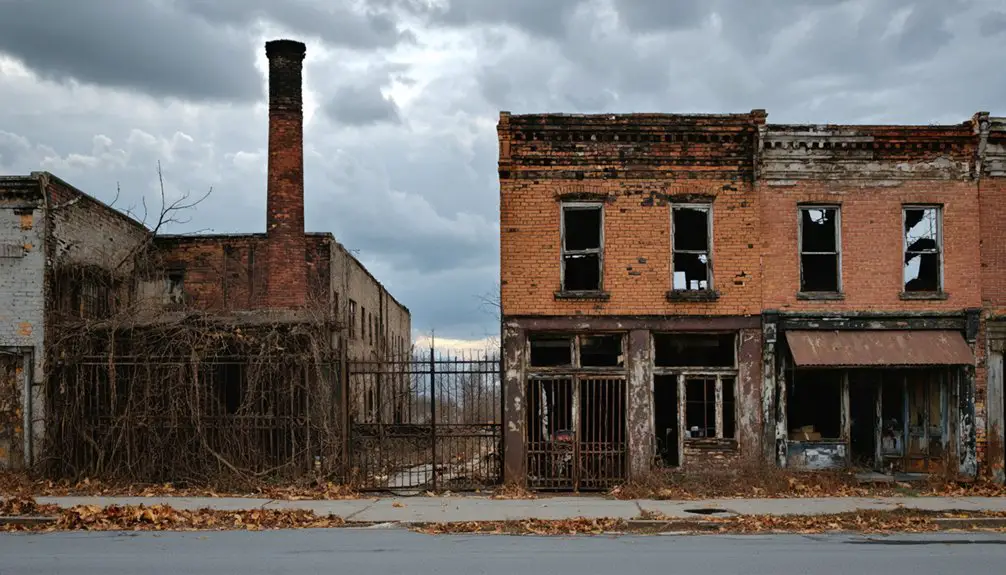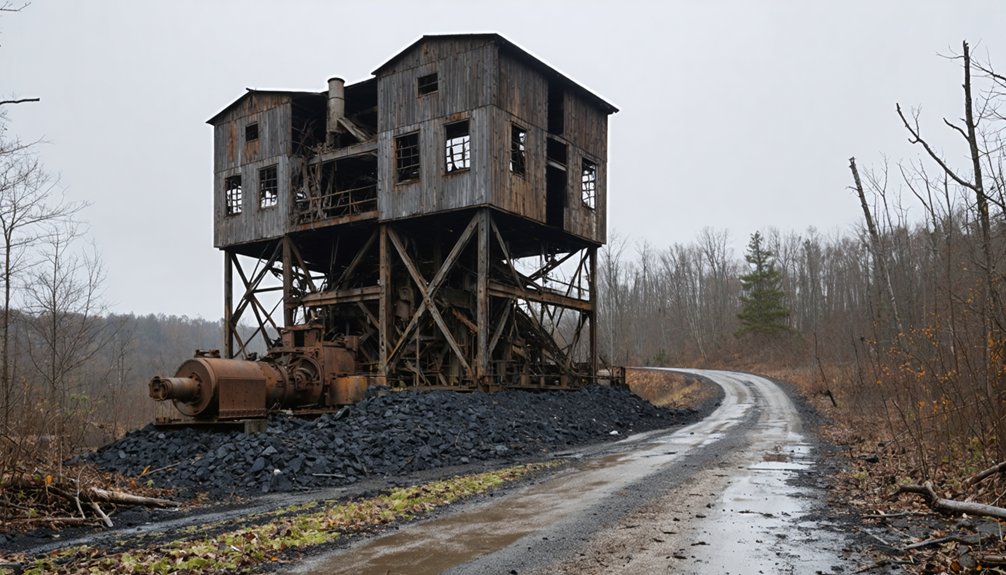
Pennsylvania’s abandoned coal patches tell a story you won’t find in textbooks. You’ll discover towns like Centralia, still burning beneath cracked streets since 1962, and Rausch Gap, which housed 1,000 residents before vanishing entirely by 1910. Some communities sank beneath reservoirs; others surrendered to forest. Resource depletion, mechanization, and corporate abandonment erased dozens of once-thriving patches almost overnight. The full scope of what’s been lost—and what’s still discoverable—runs far deeper than you’d expect.
Key Takeaways
- Centralia, PA, is a famous mining ghost town with an underground coal fire burning since 1962, causing evacuation and erasure of its ZIP code.
- Rausch Gap grew to 1,000 residents by 1828 but completely vanished by 1910, leaving only stone foundations behind.
- The 32-mile Ghost Town Trail passes through at least eight abandoned coal towns built on a former railroad grade in western Pennsylvania.
- Towns typically collapsed after coal seams were exhausted, with forests rapidly reclaiming sites like Scotia and Peale over time.
- Eckley Miners’ Village survives as a living museum, while some towns like Cokeville are now submerged beneath reservoirs.
Pennsylvania’s Most Famous Mining Ghost Towns
Pennsylvania harbors dozens of mining ghost towns, but a handful stand out for their remarkable histories and eerie remnants. Centralia in Columbia County exemplifies how extractive industry and outdated mining technology can permanently erase a thriving community; a 1962 coal seam fire still burns beneath its nearly empty streets today.
Rausch Gap in Lebanon County grew to 1,000 residents by 1828, yet vanished entirely by 1910, leaving only foundation stones to anchor your community nostalgia.
Cokeville now rests submerged beneath Conemaugh River Lake, while Chester in Westmoreland County survives only in historical records bearing its mine owner’s name.
Each site invites you to confront what remains when coal runs out and economic purpose dissolves — silence, moss-covered ruins, and an enduring archive of lives once lived.
Why These Coal Towns Disappeared Overnight
When coal seams ran dry or became economically unviable, entire communities collapsed within years — sometimes months — because their existence depended entirely on a single extractive resource.
You’ll find three recurring catalysts across Pennsylvania’s abandoned mining settlements:
- Resource depletion — Once seams exhausted, operators shuttered operations without warning, stripping residents of income overnight.
- Advances in mining technology — Mechanization eliminated labor-intensive jobs, rendering large worker populations economically unnecessary.
- Labor strikes — Prolonged work stoppages accelerated corporate decisions to permanently close marginally profitable mines.
Towns like Wehrum and Peale vanished because no diversified economy existed to absorb the shock.
Workers had no independent economic footing — company-controlled housing, wages, and commerce ensured total dependence.
When operators left, residents followed, leaving only foundations reclaimed by forest.
Centralia: The Pennsylvania Ghost Town Still on Fire
Unlike most Pennsylvania ghost towns that succumbed to economic collapse, Centralia in Columbia County carries a far more volatile legacy — a coal seam fire ignited in 1962 that’s still burning today.
What began as a landfill fire ignited an anthracite vein beneath the town, creating underground hazards that made continued habitation unconscionable. Toxic gases, subsidence risks, and compromised fire safety forced a government-backed relocation effort spanning decades.
Experts warn the fire could burn for centuries. You’ll find near-empty streets, smoke venting through cracked asphalt, and only a handful of defiant residents remaining.
Centralia’s streets were officially vacated, its zip code erased. It now stands as Pennsylvania’s most vivid warning — that what burns underground doesn’t stay underground, and freedom from danger sometimes demands leaving everything behind.
Every Ghost Town Along the Ghost Town Trail
If you venture into western Pennsylvania’s old railroad corridors, you’ll find the Ghost Town Trail, a 32-mile hiking and biking path built on a former rail grade that once served the region’s coal industry.
Along this trail, you can trace the remnants of at least eight abandoned coal mining communities—including Claghorn, Bula, Lacawana, Scott Glenn, Webster, and Armerford—each of which collapsed once its coal seams were exhausted.
Nature has since reclaimed much of what these towns left behind, reducing once-populated settlements to scattered foundations and ruins swallowed by woodland growth.
Trail History And Overview
Stretching 32 miles through western Pennsylvania’s former coal country, the Ghost Town Trail follows an old railroad grade that once carried coal and coke out of the region’s most productive mining communities.
Trail development transformed this industrial corridor into a public resource for historical preservation and outdoor access.
As you walk or bike the trail, you’re tracing infrastructure that sustained entire economies.
Three foundational facts orient your journey:
- The trail passes through at least eight abandoned coal mining communities
- It follows a former railroad grade once used by the coal industry
- It connects Cambria and Indiana Counties through reclaimed landscape
These communities collapsed when coal ran out, leaving foundations, ruins, and silence — all now accessible to anyone willing to explore Pennsylvania’s raw industrial past on their own terms.
Eight Abandoned Coal Towns
Eight abandoned coal towns line the Ghost Town Trail, each one a community that collapsed once the seams ran out. You’ll encounter Claghorn, Bula, Lacawana, Scott Glenn, Webster, Armerford, and their neighboring settlements as you traverse this 32-mile corridor through western Pennsylvania’s reclaimed railroad grade.
Advances in mining technology initially made these towns viable, drawing workers and families into what became self-contained industrial communities. However, the economic impact of depleted veins proved catastrophic — payrolls vanished, populations dispersed, and infrastructure crumbled without maintenance.
What remains are foundations embedded in forest undergrowth, silent evidence of communities built entirely around a single extractable resource. Walking this trail, you’re reading a compressed economic history of industrial rise and collapse, preserved not in documents but in stone and earth.
Nature Reclaims The Trail
As you walk the Ghost Town Trail today, nature has already written the final chapter for every settlement that coal built along this corridor. Forest regeneration has swallowed foundations at Bula, Claghorn, Lacawana, and beyond, returning corporate extraction zones to unmanaged wilderness.
Three observable transformations now define these sites:
- Wildlife habitats have reestablished across former industrial footprints, hosting deer, fox, and migratory birds
- Canopy closure has buried structural remnants beneath decades of organic accumulation
- Soil recovery continues reclaiming compacted ground once hardened by foot traffic and industrial use
You’re witnessing ecological reclamation that no government program engineered. These corridors now belong to natural succession, not corporate ledgers.
The trail preserves your access to this unscripted record of industrial collapse and biological resilience.
Iron and Steel Ghost Towns That Boomed Then Collapsed
While coal dominated Pennsylvania’s ghost town narrative, iron and steel forged their own trail of boom-and-bust communities across the state. Scotia, near State College, pioneered iron industry innovation before Carnegie Steel’s modernization efforts briefly revived it. Today, State Game Lands 176 in Centre County has reclaimed Scotia’s grounds entirely. You’ll find no streets, no storefronts — just wilderness swallowing former industrial ambition.
Brownsville, once essential to shipbuilding and steel, faded into quiet obscurity as steel mill modernization bypassed it. Monessen followed a sharper trajectory, plummeting from 20,000+ residents to semi-ghosted streets once steel collapsed. These communities didn’t simply decline — they were structurally abandoned by an industry that outgrew them.
Recognizing their history means acknowledging that economic freedom built them, and economic indifference erased them.
Pennsylvania’s Strangest Company Towns Built to Fail
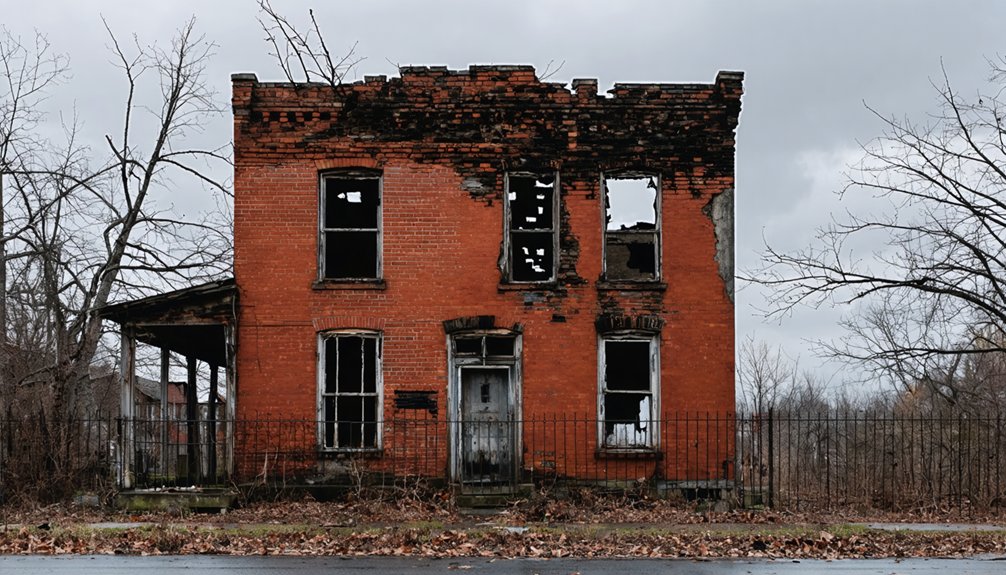
If you think coal towns failed simply because the coal ran out, Pennsylvania’s strangest company towns will challenge that assumption entirely.
You’ll find that Concrete City in Luzerne County — 20 duplexes built by the Delaware, Lackawanna & Western Railroad — proved so cold, damp, and structurally miserable that workers abandoned it within years, and a 1924 demolition attempt couldn’t even bring it down.
Yellow Dog Village in Armstrong County tells a slower story, persisting into the early 2000s long after its mines closed, a lingering ruin of a settlement that, like Concrete City, was compromised from the start by poor design and misplaced corporate ambition.
Concrete City’s Doomed Design
Though built with every intention of permanence, Concrete City in Luzerne County stands as one of Pennsylvania’s most ironic architectural failures. The DL&W Railroad constructed 20 duplex units using reinforced concrete architecture, housing 40 select worker families.
Yet residents abandoned the settlement within years, fleeing cold, damp, miserable conditions the rigid structure trapped inside.
Three documented failures sealed Concrete City’s fate:
- Concrete’s thermal mass made interiors brutally cold and perpetually damp
- Workers rejected the controlled company-town model, choosing personal freedom over assigned housing
- Demolition attempts in 1924 paradoxically proved its structural resilience — crews couldn’t bring it down
You can visit the ruins today. The walls still stand, defying the wrecking ball, monuments to a design that succeeded structurally but failed completely as a place worth inhabiting.
Yellow Dog Village’s Slow Decline
Concrete City’s rapid abandonment unfolded over just a few years, but Yellow Dog Village in Armstrong County tells a slower, stranger story — one that stretched across nearly a century.
Built in the early 20th century to house miners working nearby operations, the village outlasted its original economic purpose by decades. When the mines closed, economic decline should’ve emptied the settlement immediately — yet it didn’t.
Community resilience kept Yellow Dog Village alive, with residents choosing independence over relocation long after institutional support vanished. You can trace that stubborn persistence through the village’s continued habitation into the early 2000s, an anomaly among Pennsylvania’s abandoned company towns.
Company Towns Built Poorly
Some company towns weren’t built to last — they were built to fill a labor gap as cheaply and quickly as possible, with workers’ comfort treated as an afterthought. Poor company town planning and substandard construction quality defined these settlements from the start.
Concrete City in Luzerne County illustrates this perfectly:
- DL&W Railroad erected 20 concrete duplexes for 40 selected worker families.
- Residents quickly found the structures cold, damp, and deeply miserable.
- When demolition crews arrived in 1924, the concrete was too strong to bring down.
You can still visit these hulking ruins today. The irony is stark — buildings constructed with minimal regard for human dignity outlasted the very corporation that imposed them.
Which Pennsylvania Mining Ghost Towns You Can Still Visit
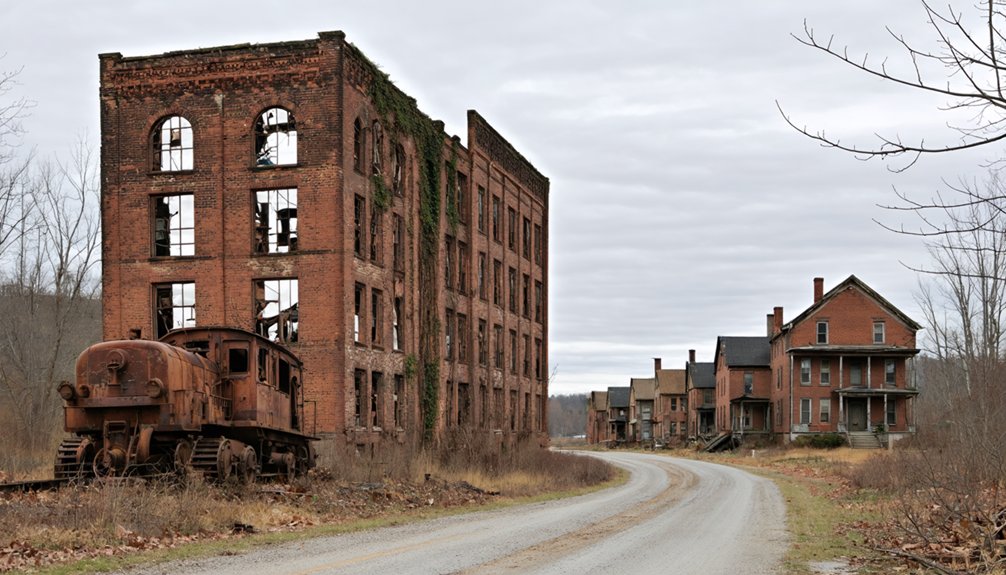
While many of Pennsylvania’s mining ghost towns have been swallowed entirely by forest or reservoir, a surprising number remain accessible to visitors today. You can walk Centralia’s cracked, smoke-venting streets, where local legends of underground fire still draw the curious.
Many of Pennsylvania’s mining ghost towns remain accessible today — swallowed by forest, yes, but never entirely lost.
The Ghost Town Trail’s 32-mile corridor lets you explore foundations of Claghorn, Bula, and adjoining settlements at your own pace.
Eckley Miners’ Village preserves mining memorabilia within a living residential museum, offering structured archival access.
Scotia’s reclaimed land within State Game Lands 176 remains open to the public.
Wehrum and Peale survive as foundation ruins quietly embedded in woodland.
Each site demands respectful, independent exploration — no guided hand required — making them ideal for those who value unmediated access to history on their own terms.
What Survives at Pennsylvania’s Abandoned Mining Sites
Though nature has reclaimed much of Pennsylvania’s mining landscape, you’ll find that physical remnants persist across several categories of survival.
At sites like Wehrum and Peale, mossy foundations mark where company homes once stood. Eckley Miners’ Village preserves its original streetscape through active stewardship, housing roughly 20 resident families today.
Three primary survival categories define what you’ll encounter:
- Structural remnants — stone foundations, coke ovens, and concrete shells like those at Concrete City, which resisted demolition in 1924
- Mining equipment — scattered machinery and rail infrastructure embedded along the Ghost Town Trail’s 32-mile corridor
- Environmental evidence — Centralia’s smoking vents, subsidence cracks, and fractured roads document an underground fire still burning since 1962
These remnants offer unfiltered access to Pennsylvania’s industrial past.
How Nature Swallowed Pennsylvania’s Lost Mining Communities
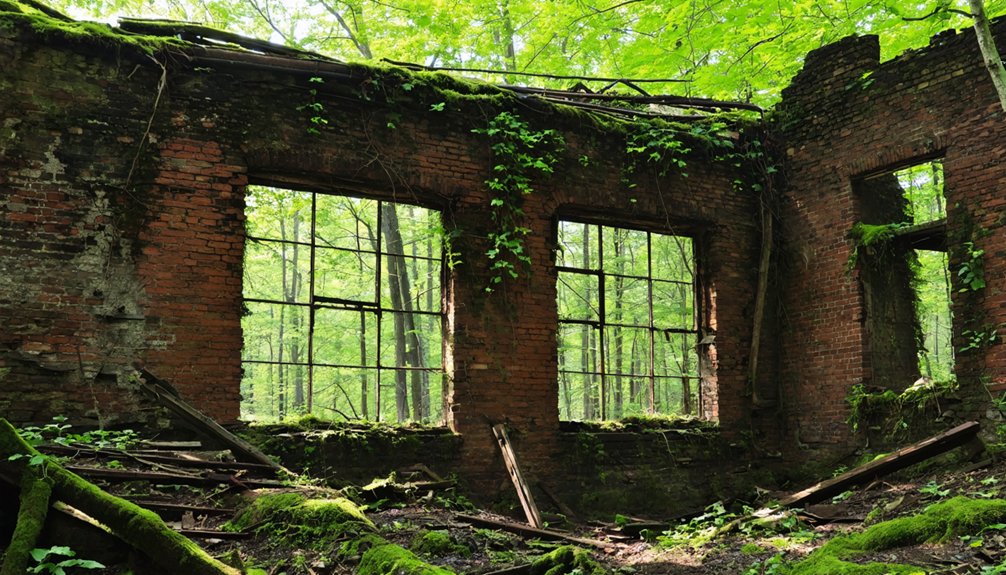
Once Pennsylvania’s coal and iron industries collapsed, nature moved in with surprising speed and thoroughness. If you visit Scotia today, you’ll find forest regrowth has consumed nearly every trace of Carnegie Steel’s former operations, with the land now absorbed into State Game Lands 176.
At Peale and Wehrum, mossy foundations sink deeper into woodland soil each decade. You’ll notice wildlife resurgence wherever extraction ceased — deer trails cross old rail grades, and saplings split apart stone foundations.
The Ghost Town Trail itself threads through communities where timber and coal once stripped landscapes bare, yet dense canopy now dominates. Nature doesn’t negotiate; it reclaims on its own schedule.
These vanished towns stand as evidence that ecosystems, given sufficient time and freedom from industrial pressure, restore themselves with quiet authority.
Frequently Asked Questions
Which Pennsylvania Mining Ghost Towns Are Submerged Underwater Today?
You’ll find Cokeville, also known as Broad Fording, in Westmoreland County submerged beneath Conemaugh River Lake. It’s one of Pennsylvania’s most compelling submerged settlements, inviting underwater exploration of its coal and Pennsylvania Canal heritage.
Did Any Experimental Company Towns in Pennsylvania Actually Succeed Long-Term?
Like seeds on concrete, experimental community models rarely took root — you won’t find long-term success stories here. Both Concrete City and Yellow Dog Village ultimately failed, abandoned due to poor conditions or economic collapse following mine closures.
How Many Residents Once Lived in Pennsylvania’s Largest Mining Ghost Towns?
You’ll find Centralia once thrived with thousands, Monessen’s abandoned infrastructure housed 20,000+ residents, and Rausch Gap reached 1,000 by 1828—mining history’s peaks now echoing through Pennsylvania’s eerily silent, reclaimed ghost town landscapes.
Are There Any Ghost Towns Still Partially Inhabited in Pennsylvania?
Yes, you’ll find Centralia and Eckley Miners’ Village still partially inhabited. Centralia’s abandoned buildings and haunted legends persist as a few residents remain amid smoking vents, while Eckley houses roughly twenty families preserving its archival mining heritage.
Which Pennsylvania Ghost Towns Were Demolished Versus Naturally Abandoned Over Time?
Like night and day, you’ll find Concrete City faced failed demolition in 1924, while abandoned mining sites like Wehrum and Peale naturally faded away—ghost town preservation reveals nature’s quiet reclamation over forced erasure.
References
- https://en.wikipedia.org/wiki/List_of_ghost_towns_in_Pennsylvania
- https://uncoveringpa.com/ghost-towns-in-pa
- https://www.worldatlas.com/cities/6-old-timey-mining-towns-in-pennsylvania.html
- https://www.youtube.com/watch?v=fm3wxSOqlYM
- https://www.youtube.com/watch?v=J8cgAdVe5ZA
- https://www.youtube.com/watch?v=yxFuqGq-FJ8
- https://www.youtube.com/watch?v=XsDBuJYgQyw
- https://scenicstates.com/ghost-towns-in-pa/
- https://www.youtube.com/watch?v=A7T3jMEh_5M
- https://decorhint.com/abandoned-pennsylvania-coal-towns-worth-discovering/