Planning a ghost town road trip to Ash Valley, Kansas, starts in Larned, where you’ll head northwest about 12 miles into Pawnee County’s flat, open plains. There are no signs, paved roads, or standing structures waiting for you — just overgrown prairie and a lone weathered gravestone marked “A.D.” Bring water, offline maps, and sturdy boots, since cell service fades fast out here. Spring and early fall offer the best conditions, and there’s much more to uncover before you go.
Key Takeaways
- Ash Valley is located 12 miles northwest of Larned, Kansas, accessible via rural highways through open plains with unreliable cell service.
- The town was established in 1877, peaked at over 100 residents, and was fully abandoned by 1941 due to economic decline.
- No standing structures remain; the only notable artifact is a weathered gravestone inscribed with the initials “A.D.”
- Visit in spring or early fall for the best weather, wildflower scenery, and atmospheric golden plains photography conditions.
- Pack water, sturdy boots, a paper map, and an offline GPS, as the site has no infrastructure or signage.
What Is Ash Valley and Why Does It Still Draw Visitors?
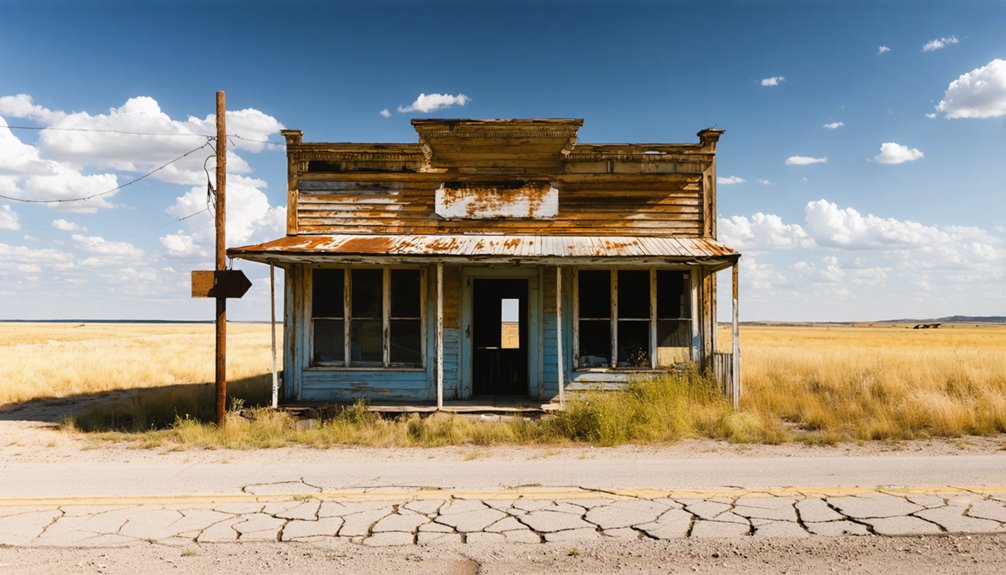
Tucked into the flat expanse of Pawnee County, Kansas, Ash Valley is an unincorporated ghost town sitting roughly 12 miles northwest of Larned in the Ash Creek Valley. Established in 1877, it once supported over 100 residents before fading into silence by 1941.
Its historical significance lies in how ordinary economic forces — farming mechanization, migration, shifting priorities — quietly erased an entire community without a single dramatic event.
That slow, honest decline is exactly what draws visitors today. You won’t find polished museums or guided tours here. Instead, you’ll find raw stillness, an old gravestone marked “A.D.,” and a ghost railroad stretching across open Kansas plains.
For travelers who crave unfiltered history and wide-open freedom, Ash Valley delivers something manufactured destinations simply can’t — authenticity.
Where Exactly Is Ash Valley in Pawnee County?
If you’re mapping out your route, you’ll find Ash Valley tucked into the Ash Creek Valley of Pawnee County, roughly 12 miles northwest of Larned, Kansas.
The surrounding terrain is classic central Kansas — flat, open, and shaped by generations of agricultural use.
Use Larned as your base point, and you’ll have no trouble orienting yourself toward the site.
Ash Valley’s Exact Coordinates
Ash Valley sits at the heart of Pawnee County, Kansas, roughly 12 miles northwest of Larned within the flat, open expanse of Ash Creek Valley. If you’re planning your route, you’ll want to lock in the geographic coordinates before hitting the road, as no maintained trails or signage guide you there.
The town’s historical significance ties directly to its placement within the broader central Kansas plains system, where agricultural communities once thrived along creek valleys and railroad lines. You’re fundamentally navigating toward a forgotten grid point on the prairie.
Use GPS coordinates aligned with Ash Creek Valley’s northwest corridor from Larned, and cross-reference satellite maps to identify the sparse remnants still visible on the landscape. Freedom-seekers will appreciate the raw, unmarked quality of this destination.
Proximity To Larned
Once you’ve got your GPS locked onto Ash Creek Valley’s northwest corridor, understanding Ash Valley’s relationship to Larned gives you a clearer mental map of the drive. Larned sits roughly 12 miles southeast, making it your best practical base camp before heading out. Stock up there — fuel, water, and supplies — because Ash Valley offers nothing in the way of modern conveniences.
Larned also connects you to regional historical preservation efforts, including the Santa Fe Trail Center, which frames the broader pioneer story shaping communities like Ash Valley. That context enriches your visit considerably.
Keep visitor safety in mind as you leave Larned’s paved infrastructure behind. Rural roads can shift dramatically with weather, and cell service thins out fast. Know your route before you go.
How Do You Drive to Ash Valley From Larned?
If you’re starting your road trip from Larned, you’ll head northwest along the rural highways that cut through central Kansas’s flat, open plains.
The drive covers roughly 12 miles, taking you through agricultural landscapes that hint at the region’s farming history.
Keep your eyes on the road signs, as the unmarked terrain can make it easy to miss the quiet, overgrown area where Ash Valley once stood.
Starting Point In Larned
Larned serves as your natural jumping-off point for reaching Ash Valley, sitting roughly 12 miles southeast of the ghost town. Its historical significance makes it more than just a waypoint — it’s a living contrast to the abandoned silence waiting northwest of town. Let your visitor curiosity fuel the drive as you leave civilization behind.
Before you head out, picture what awaits:
- Flat Kansas plains stretching endlessly toward the horizon, broken only by fence lines and sky
- Grain elevator silhouettes fading in your rearview mirror as Larned shrinks behind you
- Gravel roads cutting through agricultural fields, quiet and unhurried
- An old gravestone marked “A.D.” standing alone where a community once breathed
You’re not just driving — you’re crossing into forgotten history.
Route Northwest To Ash Valley
Heading northwest out of Larned, you’ll follow a straightforward path across the flat central Kansas plains toward Ash Creek Valley, roughly 12 miles out. The drive itself is simple — open roads, wide skies, and uninterrupted terrain that gives you time to appreciate the region’s quiet historical significance.
This land once supported a thriving agricultural community from 1877 onward, and you’re literally tracing the same corridor those early settlers traveled. Keep your eyes on rural route markers, as GPS coverage can be inconsistent in this remote stretch.
Preservation challenges mean no signage guides you to the exact site, so download offline maps before leaving Larned. The flat landscape makes navigation intuitive, but arriving prepared guarantees you spend your time exploring rather than searching.
What Happened to Ash Valley Kansas Over the Decades?
Although Ash Valley never vanished overnight, its story unfolded across decades of quiet erosion. Established in 1877, it breathed life into Pawnee County’s plains before machinery quietly replaced the hands that built it.
Here’s what reshaped the valley you’re now exploring:
- Farmers traded manual labor for machines, hollowing out the need for a tight-knit workforce
- Young residents drifted toward cities, leaving behind weathered homes and fading community memory
- By 1941, economic logic had made Ash Valley functionally invisible to regional development
- A lone gravestone marked “A.D.” now stands as the sole anchor of historical preservation
You’re walking through a place that didn’t burn or flood — it simply became unnecessary, surrendered to time one quiet season after another.
What Physical Remains Will You Actually Find at Ash Valley?
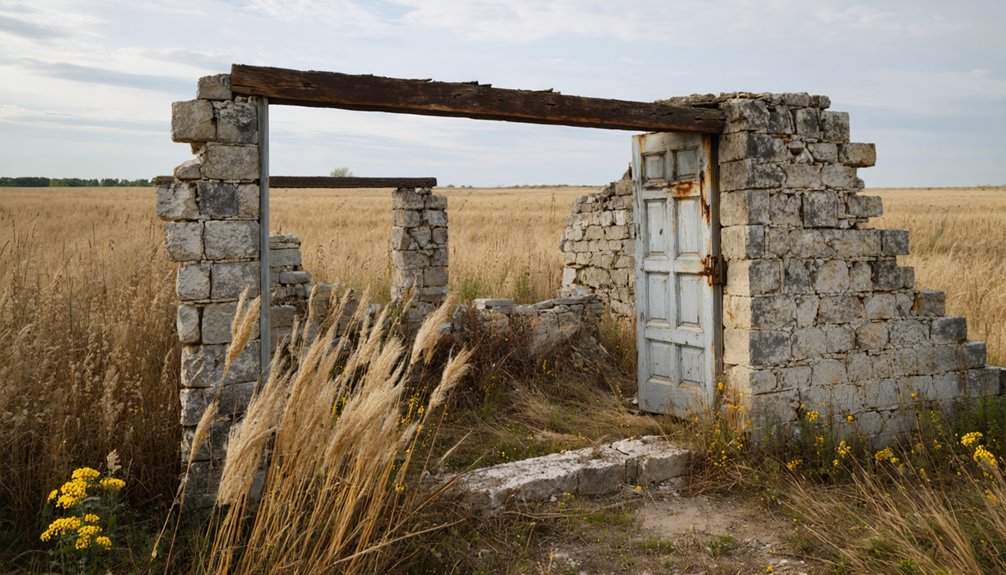
When you arrive at Ash Valley, don’t expect standing buildings, paved roads, or any recognizable town structure — they’re all gone. Your most striking discovery will be a lone gravestone inscribed with “A.D.,” a quiet reminder that real people once called this place home.
The site’s accessible, but you’ll find no markers, no trails, and no signage guiding your way, so come prepared to explore on your own terms.
The Lone Gravestone
If you’re expecting crumbling storefronts or rusted machinery, Ash Valley will humble you fast. The most significant historical artifact you’ll encounter is a lone gravestone etched with the initials “A.D.” It stands quietly in the Kansas wind, a small but powerful testimony to lives once rooted here. Cemetery preservation hasn’t touched this spot — nature’s reclaimed everything around it.
Picture what you’ll find:
- A weathered gravestone rising from overgrown prairie grass
- Flat, empty land stretching endlessly toward the horizon
- Wind moving through silence where voices once carried
- No fence, no marker, no visitor trail — just open ground
You’re standing inside history without a guide. That raw, unfiltered access is exactly what makes Ash Valley worth the detour.
Vanished Buildings And Roads
Beyond the lone gravestone, Ash Valley offers almost nothing else to the eye. The abandoned structures that once shaped this community have completely disappeared, reclaimed by Kansas wind, weather, and time. You won’t find crumbling walls, collapsed rooftops, or rusted doorframes here. The buildings are simply gone.
The roads that once connected neighbors and carried wagons have dissolved back into the flat prairie earth. No pavement, no gravel, no visible tracks remain.
Historical artifacts are scarce to nonexistent above ground, leaving you standing in an open field that betrays almost no evidence of human settlement.
What you’ll experience instead is absence itself — a quiet, vast emptiness that communicates the town’s story more powerfully than any standing structure ever could. That silence is Ash Valley’s most honest remnant.
Accessible But Unmarked Site
Though Ash Valley sits on accessible land, you won’t find a single sign, marker, or designated entrance pointing you toward it. No preservation efforts exist here — just open Kansas plains and whatever time has left behind. Its historical significance lives in the silence, not in curated displays.
When you arrive, expect to encounter:
- Windswept grassland stretching flat in every direction, unmarked and unbothered
- An aged gravestone bearing the initials “A.D.,” half-swallowed by earth and weather
- No maintained trails, just raw terrain you’ll navigate on your own terms
- Absolute quiet, broken only by wind moving through the valley
You’re standing where over 100 people once built lives. Nothing guides you here — and somehow, that makes it more powerful.
What Does the Ash Valley Gravestone Reveal About Its Past?
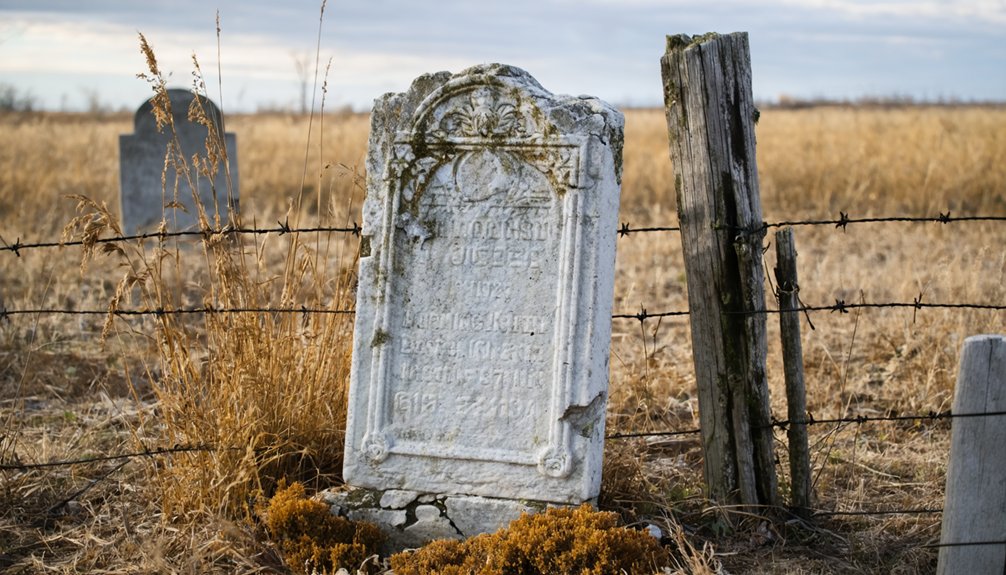
Among the few remnants that mark Ash Valley‘s existence, an old gravestone stands as the site’s most tangible connection to its past. Its inscription, “A.D.”, raises more questions than it answers. Who was this person? What brought them to this remote Kansas valley?
A solitary gravestone marked only “A.D.” — a mystery carved in stone, silently guarding Ash Valley’s forgotten past.
The burial site carries deep historical significance, quietly confirming that real people once built lives here, raised families, and expected permanence.
You won’t find a marked cemetery or maintained path leading you there. The gravestone simply exists, weathered and solitary, surrounded by flat Kansas plains. It’s a raw, unfiltered encounter with history that no museum could replicate.
When you stand before it, you’re confronting the reality that Ash Valley wasn’t just a dot on a map — it was someone’s home.
When Is the Best Time to Visit Ash Valley Kansas?
Timing your visit to Ash Valley can make the difference between a memorable experience and a miserable one. Kansas weather is unpredictable, so plan strategically to uncover historical artifacts and hear local legends without battling the elements.
- Spring (April–May): Wildflowers frame the abandoned landscape, offering stunning contrast against forgotten remnants.
- Early Fall (September–October): Crisp air and golden plains create cinematic, hauntingly beautiful scenery perfect for exploration.
- Avoid midsummer: Brutal heat and violent storms make wandering exposed terrain genuinely dangerous.
- Winter visits: Frost-covered ground adds eerie atmosphere, but icy rural roads can trap you miles from help.
You’re free to roam year-round, but arriving during mild seasons lets you fully absorb Ash Valley’s quiet, ghostly atmosphere without nature fighting you every step.
Which Kansas Ghost Towns Pair Well With an Ash Valley Trip?
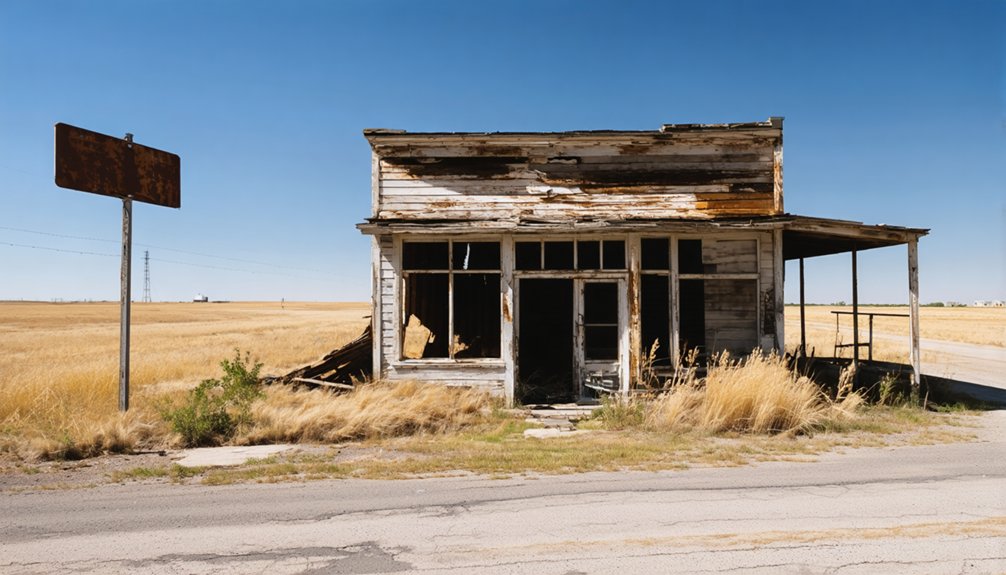
Since Ash Valley sits in central Kansas, you’re perfectly positioned to string together a ghost town road trip that covers some of the state’s most haunting abandoned communities.
Head toward Saffordville, where floods erased an entire town, leaving behind scenic viewpoints and raw, emotional landscape.
Swing through Ulysses, abandoned during the Dust Bowl and rebuilt miles away, giving you two distinct historical layers to explore.
Valley Brook, Bonita, and Morse each disappeared gradually through economic pressure, much like Ash Valley itself.
These sites offer scattered historical artifacts that reward curious, independent travelers willing to wander off marked paths.
Together, these communities paint a vivid portrait of Kansas resilience and loss, making your road trip far richer than any single stop could deliver alone.
What Should You Bring Before Driving Out to Ash Valley?
Before you drive out to Ash Valley, pack smart because the site offers no maintained trails, facilities, or infrastructure of any kind. You’re venturing into open Kansas plains where local legends linger and historical artifacts quietly wait beneath the soil.
Come prepared, come curious, and come ready to explore on your own terms.
- Water and snacks to sustain you across flat, exposed terrain with zero shade cover
- A camera to capture the weathered gravestone bearing its mysterious “A.D.” inscription
- Sturdy boots for walking uneven, unmarked ground surrounding the former townsite
- A paper map or downloaded offline GPS since cell service across rural Pawnee County is unreliable
You’re not visiting a curated museum. You’re stepping into a forgotten world that rewards only the well-prepared.
How Do You Photograph Ash Valley Kansas for Maximum Impact?
Photographing Ash Valley rewards patience and timing, so you’ll want to arrive at golden hour when the low Kansas sun stretches long shadows across the flat terrain and adds dramatic contrast to the weathered gravestone.
Shoot low angles to emphasize the isolation and historical significance of the remaining artifacts against the wide Kansas sky. Use a wide-angle lens to capture the vast emptiness surrounding the site, reinforcing the story of abandonment.
For close-up photography techniques, focus tightly on the “A.D.” inscription to convey intimate human history.
Overcast days also work well, softening harsh light and revealing subtle textures in the stone.
Always bracket your exposures to preserve detail in both highlights and shadows, giving yourself flexibility during editing to produce compelling, evocative images.
Frequently Asked Questions
Is Ash Valley Located on Any Privately Owned Land Requiring Permission?
The knowledge doesn’t confirm whether Ash Valley sits on private property. You’ll want to research local land ownership before visiting, as permission required rules may apply, ensuring you’re free to explore without legal complications.
Are There Any Local Guided Tours Available for Ash Valley Visits?
Like a lone tumbleweed, Ash Valley rolls without structure — no local tour operators currently offer guided exploration here. You’re free to chart your own adventure through this hauntingly quiet ghost town on your own terms.
Does Ash Valley Have Any Legal Protections as a Historical Site?
Ash Valley doesn’t hold formal legal protections under preservation laws, but its cultural significance keeps history alive. You’re free to explore its remnants, though you should respect the land and its quiet, storied past.
Can Visitors Legally Remove Artifacts or Items Found at Ash Valley?
You shouldn’t remove anything you find at Ash Valley. Artifact theft carries serious legal restrictions, even at unprotected sites. Respect the history, leave remnants untouched, and you’ll preserve the experience for every future explorer who follows your path.
Has Ash Valley Ever Appeared in Any Films or Television Shows?
There’s no documented evidence that Ash Valley’s ghost town history has attracted filming locations for movies or TV shows. You won’t find it on Hollywood’s radar, but its raw, untouched beauty rivals any cinematic landscape.
References
- http://kansasghosttowns.blogspot.com/2012/10/ash-valley-pawnee-county-old-gravestone.html
- https://legendsofkansas.com/pawnee-county-extinct-towns/
- https://www.youtube.com/watch?v=dy7nLwjHkbY
- https://en.wikipedia.org/wiki/Ash_Valley
- https://www2.ljworld.com/news/2011/apr/15/little-remains-defunct-pawnee-county-ghost-town/
- https://en.wikipedia.org/wiki/Ash_Grove
- https://www.youtube.com/watch?v=KBXINX0xqnU