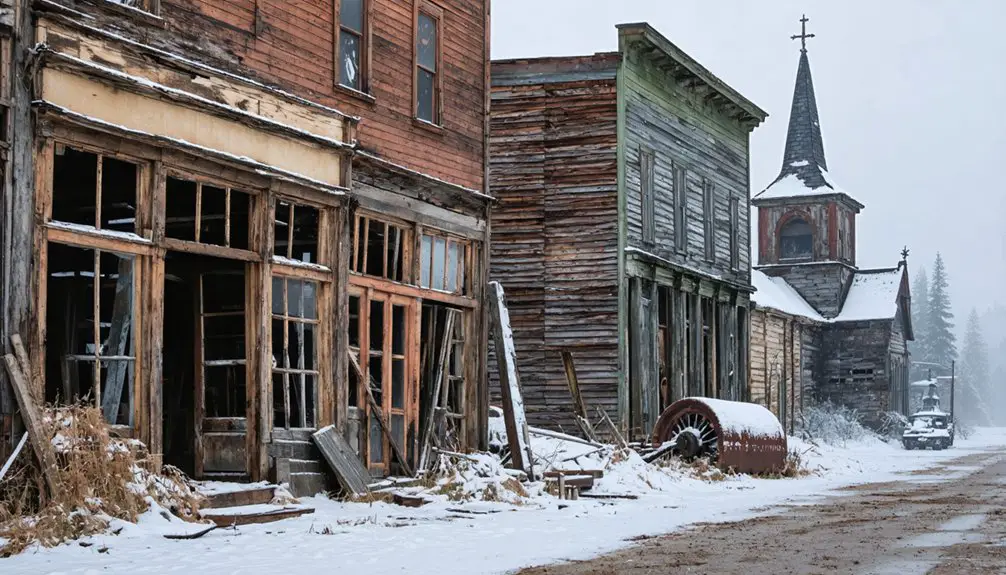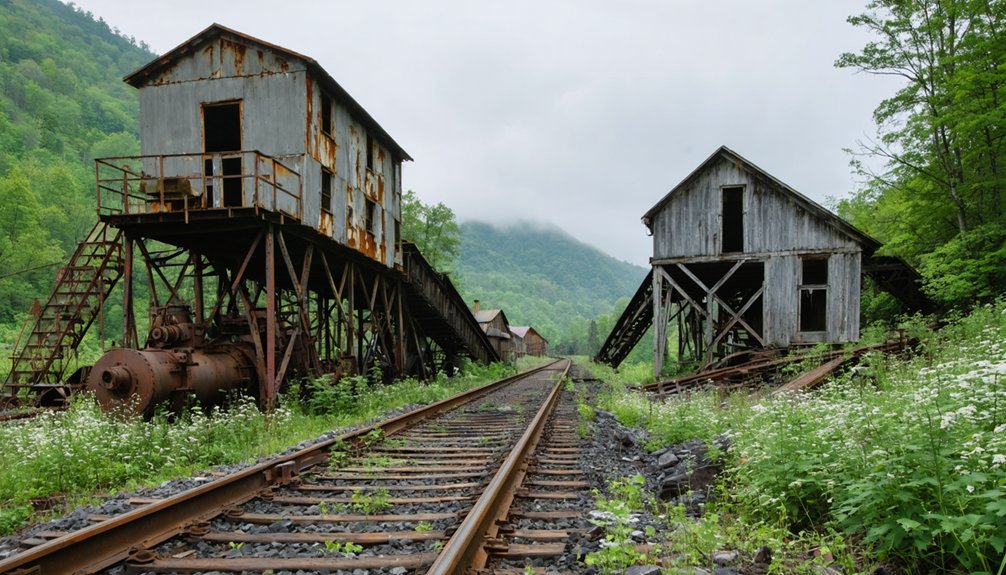
West Virginia’s mining ghost towns preserve the physical legacy of coal extraction that shaped Appalachia from the 1870s through the mid-20th century. You’ll find Thurmond, once generating more railway revenue than Cincinnati, now frozen in time along the C&O mainline. Kaymoor’s 821-step staircase leads to abandoned coke ovens, while Nuttallburg’s complete mining complex stands as a National Register site. These settlements—built, populated, and ultimately abandoned by coal companies—offer tangible evidence of an industry that employed over 53,000 workers before mechanization and market forces triggered widespread collapse.
Key Takeaways
- Kaymoor extracted over 16 million tons from 1900 to 1935, featuring 202 beehive ovens and an 821-step staircase today.
- Thurmond generated more revenue than Cincinnati and Richmond combined by 1910 before railroad operations declined after 1949.
- Nuttallburg began in 1870 with land purchased at $1 per acre, now preserved as a complete National Register mining complex.
- Coal towns thrived between 1917-1940 as self-contained economies with company housing, stores, and churches near railroad lines.
- Mechanized surface mining and market decline stripped coal towns of their economic foundation, creating widespread ghost towns.
The Rise of Coal Mining in West Virginia
While fur traders and early explorers traversed West Virginia’s rugged terrain in search of game and passage, they stumbled upon black rock seams that would reshape the region’s destiny. John Peter Salley’s 1742 discovery along the Kanawha River tributary marked the beginning. You’ll find Washington himself documented a burning coal hill in 1770, recognizing its potential.
Artisan coal mining emerged by 1810 when Conrad Cotts opened the first commercial operation near Wheeling. Salt manufacturers like David Ruffner turned to coal in 1817 after depleting timber reserves.
Railroad expansion through Baltimore and Ohio’s 1853 Wheeling connection transformed production from 490,000 tons in 1867 to nearly 4.9 million by 1889. State mining regulations began in 1883 with Oscar Veazey’s appointment as first inspector.
Peak Production and Employment in the Coal Industry
The coal industry’s meteoric growth through the late nineteenth century set the stage for West Virginia’s twentieth-century dominance in American energy production. You’ll find that historical production peaked during the 1940s, when the state extracted over 150 million tons annually.
West Virginia’s coal empire rose from nineteenth-century expansion to extract over 150 million tons by the 1940s peak.
A modern cyclical high arrived in 2008 at 158 million short tons, supporting thousands of mining families across Appalachia.
Peak Production Milestones:
- 2008 marked the modern production apex at 158 million tons
- 36,249 coal jobs generated $3.7 billion in compensation by 2024
- Marshall County led 2023 production with 13.9 million short tons
- Productivity declines reduced Southern underground operations from 3.8 to 1.9 tons per miner hour
- Market export dynamics drove 53 percent of 2024 production overseas
These numbers represent communities built on mineral wealth—before abandonment transformed them into ghost towns.
Kaymoor: A Town Built on Black Gold
You’ll find Kaymoor’s story etched in the landscape itself—821 stairs carved into the gorge connect the two camps where 560 residents once lived, while the mine’s horizontal drift entrances still mark the cliffside 560 feet above New River.
At its operational height, this company town shipped thousands of long tons annually, fed 101 coke ovens until 1935, and outlasted most coal communities by surviving 62 years before closure in 1962. The physical remnants document a complete industrial ecosystem where every structure, from the dual inclines to the 130 workers’ houses, served the singular purpose of extracting coal from West Virginia’s black seam.
Massive Coal Production Output
From 1899 to 1962, Kaymoor’s mines extracted over 16 million tons of coal from the rich Sewell Seam—a production volume equivalent to filling 18 Empire State Buildings.
Statistics on coal production reveal the mine’s inaugural shipment of 58,900 pounds departed on August 23, 1900, with annual output exceeding 64,000 long tons that first year.
Details on coke production showcase the operation’s industrial scale:
- Initial 120 beehive ovens expanded to 202 during World War I demand
- Processed one million tons of coke throughout operational lifespan
- 101 ovens remained active until 1935
- Obsolete ovens repurposed as refuse dumps after steel factories adopted larger designs
- Most coal converted to coke under Low Moor ownership
This autonomous enterprise demonstrated how independent extraction operations shaped Appalachian industrial heritage before mechanization transformed mining economics.
The 821-Stair Challenge
While Kaymoor’s production figures document its industrial significance, the physical remnants scattered across the gorge’s steep terrain tell an equally compelling story of adaptation and endurance.
You’ll confront the site’s remote accessibility through an 821-step staircase built by the National Park Service, descending from the upper trail to the lower mining complex. This journey mirrors the physical challenges miners faced daily on the steam-powered inclines that once transported workers down the 1,000-foot slope at a 30° angle.
The NPS has stabilized structures and installed interpretive signs, preserving this multi-level complex where you can still spot coal fragments and examine intact mining buildings. Track remnants and equipment mark where double- and single-track inclines operated until 1962.
Peak Population and Prosperity
Between 1899 and 1924, Kaymoor transformed from a startup venture into an industrial powerhouse that supplied both the Low Moor Iron Company’s blast furnaces in Virginia and the nation’s expanding steel infrastructure. At its zenith, this remote canyon settlement employed 1,500 men who extracted more than 16.9 million tons of coal over six decades. The population density in the two camps—Kaymoor Top and Bottom—supported close to 130 houses crammed along narrow benches carved from unforgiving terrain.
Peak Operations Snapshot:
- 202 coking ovens processed one million tons of coke during WWI expansion
- Workforce demographics included segregated housing and separate schools for Black and white miners
- Hand-cut coal exceeded 64,000 long tons in 1900 alone
- Company infrastructure provided stores and recreation but deliberately excluded churches or saloons
- Railroad access enabled unprecedented productivity in New River Coalfield’s Sewell Seam
Thurmond’s Railway Dominance and Decline
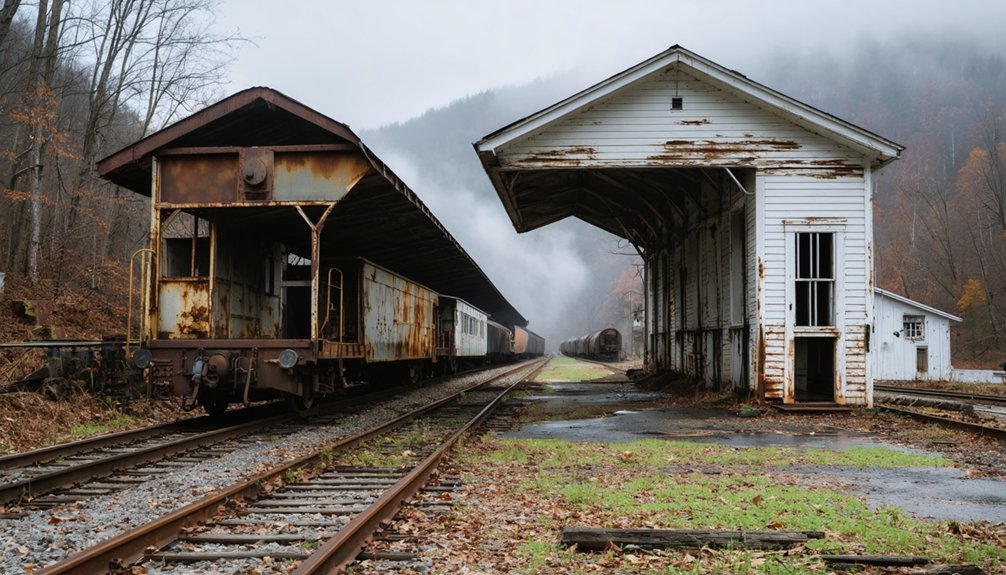
When the C&O Railway extended its mainline through the New River Gorge in 1873, it laid the foundation for what would become one of the most profitable freight operations in American railroad history. You’ll find Thurmond generated more revenue than Cincinnati and Richmond combined by 1910, handling 95,000 passengers yearly with fifteen daily trains. The 1915-1916 railroad bridge featured a cantilevered automobile road, though corporate monopolistic practices kept the town rail-dependent for decades.
Competition arrived when Virginian Railway emerged in 1909, challenging C&O’s dominance. Roads spread after 1917, accelerating passenger rail service decline. Devastating fires struck in 1922 and 1930. C&O’s 1949 shift to diesel engines eliminated steam repair operations, while mechanized mining displaced workers, dropping Thurmond’s population from 462 to virtually nothing.
Nuttallburg’s Brief Era of Prosperity
A single dollar per acre transformed Keeney Creek into one of West Virginia’s most profitable coal ventures when English immigrant John Nuttall purchased land along the New River Gorge in 1870. By 1873, his operation became the gorge’s second mine shipping high-grade smokeless coal via the Chesapeake & Ohio Railroad. The four-foot-thick seam produced exceptional fuel for America’s factories, generating immediate profits that eliminated royalty requirements by 1894.
Nuttallburg’s prosperity attracted a diverse workforce of immigrants and freed African Americans to 110 company houses stretching half a mile. Technological innovations enabled the mine to project 500 tons daily production, supporting 125 miners by 1874.
Key features that defined Nuttallburg’s success:
- High-carbon, low-waste coal perfect for industrial applications
- 342 residents by 1890 in company-owned housing
- Family-managed operations spanning three decades
- Complete mining complex preserved as National Register site
- Instant profitability upon railroad access
Stotesbury and the Segregated Mining Community
While Nuttallburg exemplified early entrepreneurial mining ventures, the coal operations that emerged decades later reflected the industrial-scale extraction and rigid social hierarchies that characterized twentieth-century Appalachian coalfields.
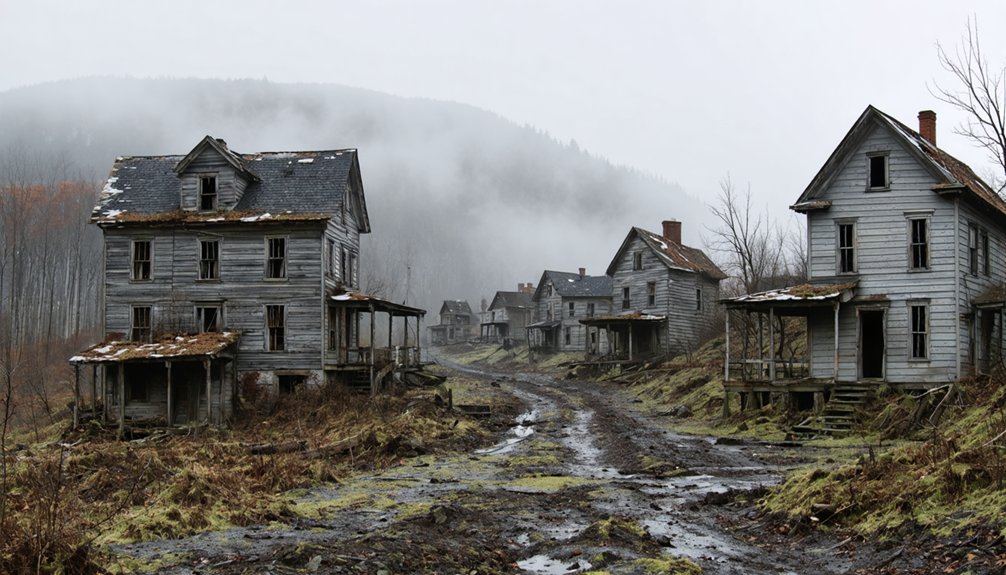
Stotesbury, named after Beaver Coal Company president Edward T. Stotesbury, thrived through the 1930s as operators extracted Beckley and Pocahontas seams. You’ll find typical coal camp infrastructure here—company housing, stores, churches—but underlying these visible structures were segregated housing patterns that divided Black and white miners.
Social structures in coal camps throughout Winding Gulf enforced separation in residences, schools, and worship spaces. Senator Robert C. Byrd’s childhood here coincided with Jim Crow’s coalfield influence.
After mining ceased in 2002, ending ninety years of extraction, Stotesbury’s remaining foundations preserve evidence of this controlled, stratified existence.
Tragic Mine Disasters That Shaped Safety Regulations
On December 6, 1907, the ground above Monongah’s twin mine shafts erupted with such force that debris scattered across Marion County farmland, marking what remains America’s deadliest mining disaster. The explosion claimed 361 miners—victims of mining industry neglect where open flames met methane gas. You’ll find this tragedy catalyzed the 1910 Federal Bureau of Mines, though it lacked enforcement teeth.
Major Disasters Revealing Coal Companies’ Responsibility:
- Eccles No. 5 (1914): 183 deaths from preventable gas ignition
- Benwood (1924): 119 killed during record-breaking 686-fatality year
- Farmington (1968): 78 miners lost despite “improved” standards
- Upper Big Branch (2010): 29 deaths after documented violations
- Century-long pattern: Zero coal owners convicted before 2010
Each disaster exposed regulatory gaps that freedom-seeking workers paid for with their lives.
The Transformation From Boom to Abandonment
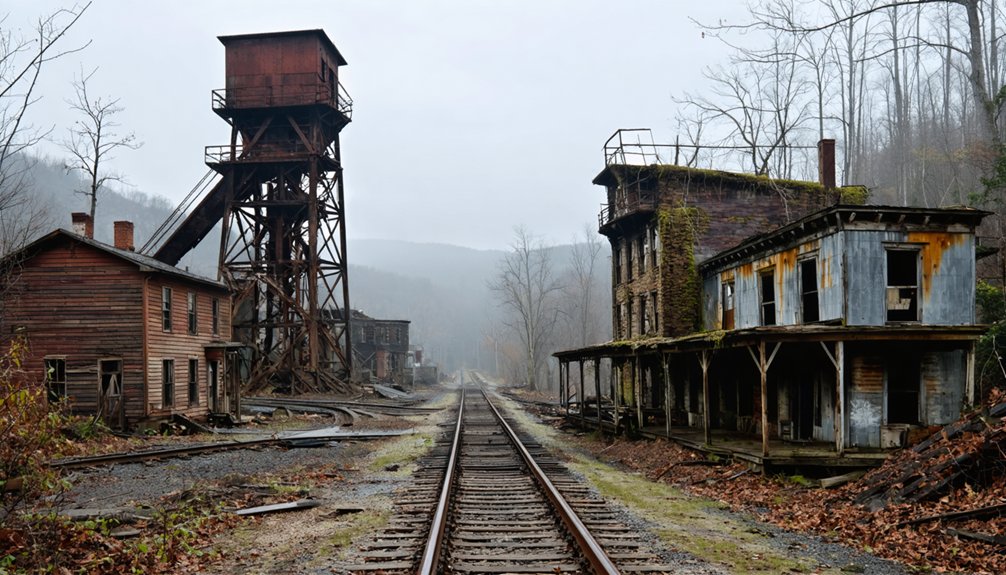
You’ll find West Virginia’s coal towns reached their zenith between 1917 and 1940, when production topped 89 million tons and employment swelled beyond 130,000 workers who sustained entire communities built around mine operations. These company-constructed settlements thrived near railroad lines, complete with stores, schools, and housing that created self-contained economies dependent on continuous extraction.
The industry’s shift from labor-intensive underground methods to mechanized surface mining after 1942, combined with boom-and-bust cycles and eventual market decline, stripped these towns of their economic foundation and left behind the skeletal remains you see preserved in the landscape today.
Peak Employment and Prosperity
The coal industry’s golden era transformed West Virginia into an economic powerhouse, with employment reaching its modern zenith in 2012 when 53,934 workers extracted black diamonds from Appalachian seams. Production peaked at 129.5 million tons that year, generating unprecedented wealth accumulation through $16.4 billion in economic activity.
Peak Prosperity Indicators:
- Miners earned $112,800 annually—nearly double the state’s private sector average
- Central Appalachia counties saw coal employment comprising 7% of total workforce
- Operations spanned 21 of 55 counties, creating widespread opportunity
- Independent contractors numbered 29,375, supporting entrepreneurial ventures
- Four of America’s top 10 underground mines operated within state borders
Despite this prosperity, regional economic disparities persisted between northern and southern coalfields, foreshadowing the uneven decline ahead.
Economic Collapse and Decline
Within just six years of reaching its 2012 apex, West Virginia’s coal empire fractured under compounding pressures that rendered entire operations economically unviable. You’ll find production plummeted 38 percent since 2008, while prices collapsed 71 percent—a dual assault that devastated mining communities.
Boone County’s personal income crashed below 70 percent of its 2011 level, with Mingo falling to 67 percent. The decline in property values mirrored this erosion: Mingo County lost 30 percent of coal real property valuations, Boone dropped 17 percent.
As mining employment sank below 21,000—its lowest since 1895—small business closures rippled through counties that had thrived for generations. Power plant shutdowns accelerated the collapse, eliminating markets for locally-mined coal and severing the economic lifeline these communities depended upon.
Visiting West Virginia’s Mining Ghost Towns Today
Exploring West Virginia’s mining ghost towns offers visitors rare access to remarkably intact industrial archaeology from the state’s coal boom era. You’ll find these sites preserve mining operations history while demonstrating the natural environment impact of extractive industries.
Kaymoor’s 821-stair trail leads to massive mining complexes producing nearly 17 million tons from 1900-1962. Thurmond remains the gorge’s best-preserved railroad hub, while Nuttallburg offers complete coal processing remnants accessible by car. Dun Glen sits 700 feet above New River, largely unreachable without hiking since 1935.
Essential experiences at these preserved sites:
- Examine original safety warning signs on Kaymoor’s historic structures
- Walk among Nuttallburg’s building foundations with interpretive signage
- Explore Thurmond’s deserted railroad station and crumbling homes
- Discover segregated miners’ churches at Stotesbury
- View exposed mining equipment throughout abandoned operations
Frequently Asked Questions
What Happened to the Miners’ Families After the Towns Were Abandoned?
Miners’ families faced severe economic hardship and relocation struggles, scattering by the thousands from abandoned company towns. You’ll find they sought work elsewhere, leaving behind communities that’re now preserved as poignant reminders of their displacement and resilience.
Are There Any Preserved Artifacts or Museums Dedicated to Mining Culture?
You’ll find preserved mine equipment and local mining history archives at several dedicated museums, including the Exhibition Coal Mine in Beckley, West Virginia Mine Wars Museum in Matewan, and Bituminous Coal Heritage Foundation in Madison, safeguarding miners’ stories.
Can You Explore Inside the Abandoned Mine Shafts and Buildings?
While exploring mining equipment sounds thrilling, you can’t legally enter abandoned mine shafts—they’re sealed and fenced for safety. Avoid hazardous structures with deadly gases, unstable walls, and collapse risks. Unauthorized entry violates state mining laws protecting your freedom to stay alive.
Were There Schools and Hospitals in These Mining Communities?
Yes, mining communities maintained schools and company-funded medical facilities. You’ll find evidence of teacher housing, classroom buildings serving as community centers, and clinic structures—though most survived only as long as coal production sustained these isolated towns.
How Did Miners Spend Their Leisure Time in These Isolated Towns?
Miners spent leisure time through community gatherings at churches and company stores, plus recreational activities like attending fashion shows, car events, and social functions. You’ll find these spaces preserved authentic communal bonds that sustained isolated coal camp life.