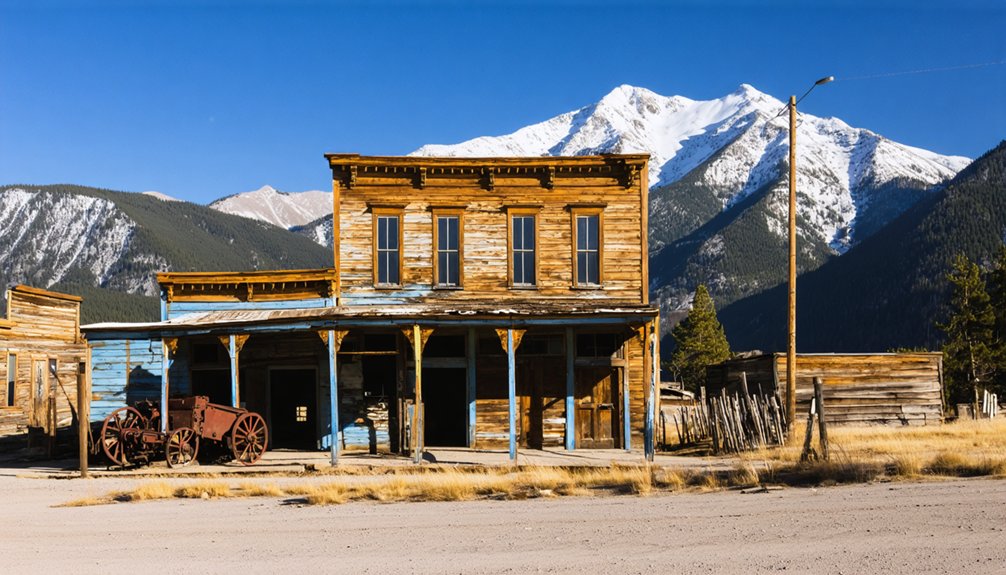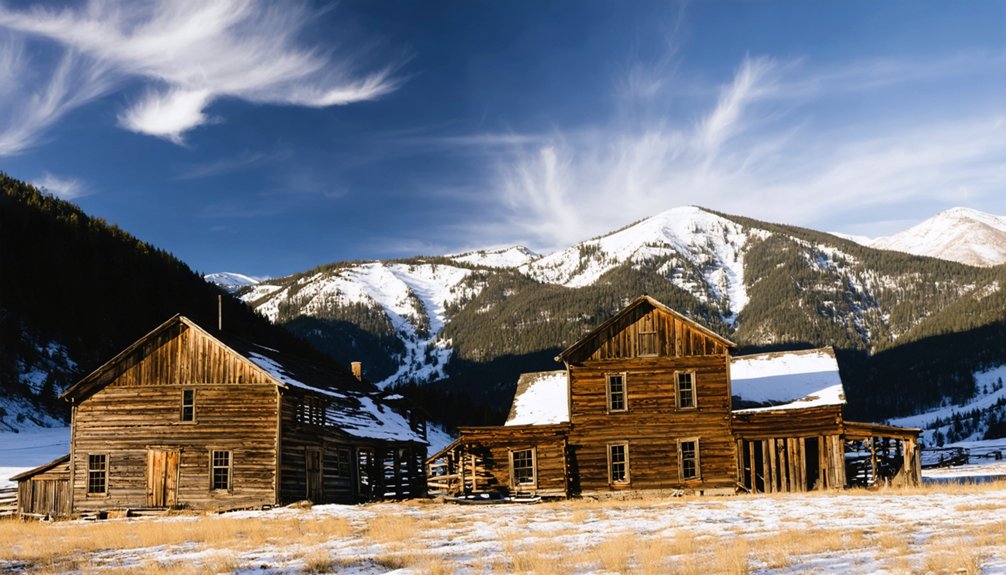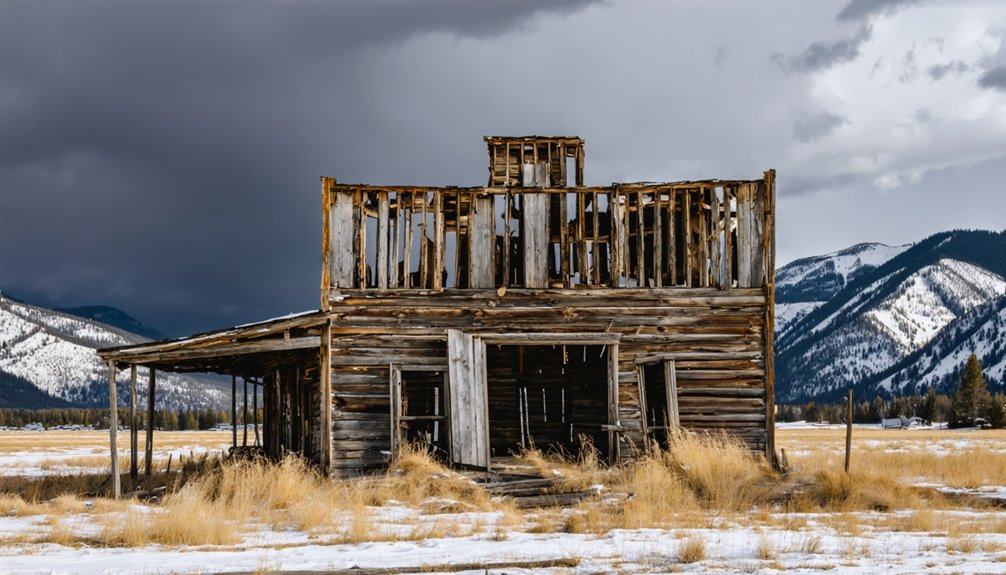
Monarch Ghost Town sits near Monarch Pass in Colorado’s Rocky Mountains, and it’s got a story worth knowing. Founded in 1879 after Nicholas Creede struck ore, it quickly grew to over 3,000 residents, complete with hotels, saloons, and the productive Madonna Mine. The Silver Panic of 1893 devastated the economy, and most residents left by the early 1900s. Today, only five structures remain standing. Keep exploring, and you’ll uncover everything this forgotten boomtown still has to tell.
Key Takeaways
- Monarch Ghost Town, near Monarch Pass in Colorado, was founded in 1878 after Nicholas Creede discovered ore in the region.
- The town, originally called Chaffee City, grew to over 3,000 residents with hotels, saloons, and the productive Madonna Mine.
- The Silver Panic of 1893 devastated Monarch’s economy, causing mass departure and leaving the town largely abandoned by the early 1900s.
- Today, only five structures remain standing, including a stone house, old fences, and visible foundations from the mining era.
- Visitors can access the ghost town via Monarch Spur RV Park, traveling US-50 West from Salida toward Monarch Pass.
The Story Behind Monarch Ghost Town
Tucked into the heart of Colorado’s Rocky Mountains near Monarch Pass, the ghost town of Monarch carries a history rooted in mineral ambition and economic collapse. Nicholas Creede struck ore in Chaffee County in 1878, sparking rapid settlement.
The town cycled through names—Chaffee City, then Camp Monarch in 1879—as prospectors flooded the region chasing silver and gold.
At its peak, Monarch’s population exceeded 3,000 residents. Hotels, saloons, and gambling halls defined its character. The Madonna Mine anchored its mining legacy as a significant gold and silver producer.
However, the 1893 Silver Panic gutted the economy. Mineral prices collapsed, residents departed, and structures crumbled.
Today, this ghost town retains only scattered foundations, old fences, and a striking stone house—tangible evidence of Colorado’s volatile frontier ambitions.
How Monarch Grew From a Mining Camp to a Boomtown
When Nicholas Creede struck ore in Chaffee County in 1878, he set in motion one of Colorado’s most dramatic mining booms.
You can trace Monarch’s rapid growth from a simple mining claim to a bustling settlement of over 3,000 residents, complete with hotels, saloons, and gambling halls.
The town’s infrastructure expanded quickly to support the influx of prospectors, with major operations like the Madonna Mine driving both population growth and economic vibrancy.
Nicholas Creede’s Initial Discovery
In 1878, prospector Nicholas Creede struck ore in Chaffee County, Colorado, setting off a chain of events that would transform a modest mining claim into a thriving boomtown. Creede’s Discovery began when he staked his initial claim, naming it the Monarch mine.
You can trace how his find drew prospectors from across the region, each applying their own Mining Techniques to extract valuable minerals from the rugged Rocky Mountain terrain. The settlement that emerged was first called Chaffee City, reflecting the county’s identity.
Rapid Population and Infrastructure Growth
Monarch’s transformation from a rugged mining camp into a full-fledged boomtown unfolded with remarkable speed. You can trace the population dynamics clearly: once prospectors confirmed abundant mineral resources, thousands flooded the settlement, pushing resident numbers past 3,000 at peak activity.
That kind of growth demanded immediate infrastructure development. Hotels rose quickly to house the constant influx of miners and visitors. Saloons and gambling halls multiplied, reflecting the raw, independent culture miners carried with them.
The nearby Madonna Mine emerged as the region’s dominant producer of gold and silver, anchoring the local economy with real productive capacity. Monarch wasn’t simply growing—it was organizing itself around serious extraction work. Every structure built and every business opened reflected a community betting heavily on mineral wealth.
From Camp to Thriving Boomtown
What began as a rough-edged prospector’s camp transformed into a structured boomtown once Nicholas Creede struck ore in Chaffee County in 1878.
You can trace Monarch’s rapid evolution through its expanding infrastructure—hotels, saloons, and gambling halls emerged as the population surpassed 3,000 residents.
Miners arriving from diverse regions brought distinct mining techniques, accelerating ore extraction and fueling economic momentum. The nearby Madonna Mine became a cornerstone producer of gold and silver, anchoring the town’s financial identity.
This convergence of ambition, labor, and resource created a cultural heritage unique to Colorado’s Rocky Mountain settlements.
Monarch wasn’t simply a camp anymore—it became a functioning community, a stage stop, and a social hub reflecting the independent spirit that defined the American mining frontier.
What the Silver Panic of 1893 Did to Monarch Ghost Town
When you look at what ended Monarch’s boom, the Silver Panic of 1893 stands as the defining blow, collapsing mineral prices and gutting the town’s economic foundation almost overnight.
You can trace the rapid population decline directly to this financial crisis, as miners and merchants abandoned the settlement in droves once silver’s value plummeted.
Silver Panic Economic Devastation
The Silver Panic of 1893 effectively dismantled Monarch’s economic foundation almost overnight. When the silver market collapsed, Monarch couldn’t escape the economic ripple that devastated mining communities across Colorado.
You’d have watched a thriving town transform into an empty shell within years.
The fallout hit Monarch on multiple fronts:
- Silver prices plummeted, making extraction financially unviable
- Miners abandoned claims, triggering mass population departure
- Businesses closed as consumer spending evaporated completely
Monarch’s Rapid Population Decline
Once the Silver Panic of 1893 struck, Monarch’s population of over 3,000 residents collapsed with startling speed. Economic factors, particularly the devastating drop in silver prices, dismantled the community dynamics that had sustained the town.
Mining trends shifted dramatically, rendering operations unprofitable and forcing workers to seek opportunity elsewhere.
You can trace the population shifts through the early 1900s, when the majority of residents had already departed. Abandoned structures began crumbling without maintenance, leaving only foundations and remnants behind.
The Madonna Mine persisted as the final operational holdout, but even that couldn’t reverse Monarch’s trajectory.
What the Silver Panic exposed was a fundamental vulnerability: single-industry towns live and die by commodity markets. Monarch’s rapid decline stands as a documented, analytical case study in frontier economic fragility.
What Remains of Monarch Ghost Town Today
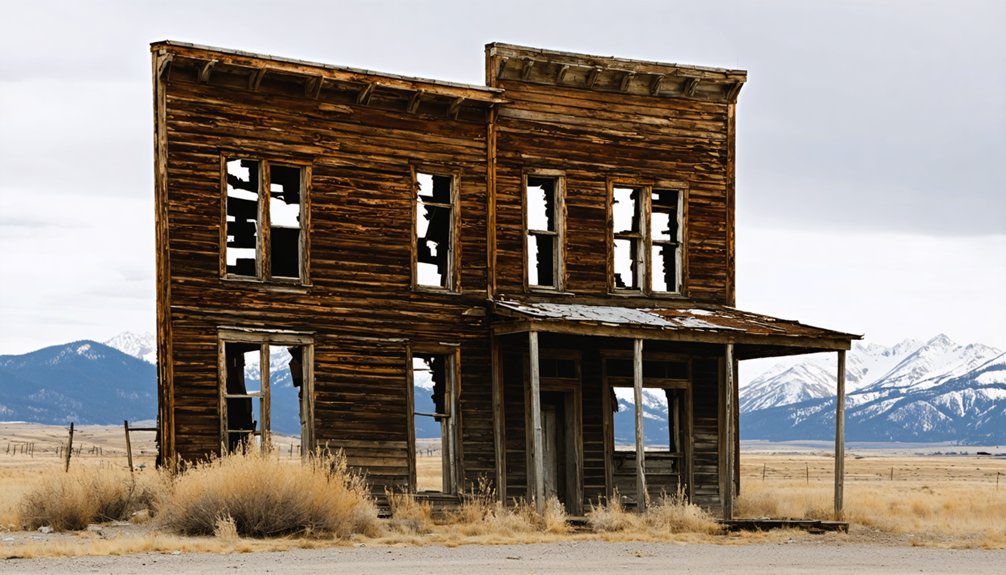
Remnants of Monarch ghost town are sparse but telling. You’ll find ghost town remnants that speak directly to the settlement’s vibrant past, including notable architectural features worth examining closely.
Key surviving elements include:
- A magnificent stone house standing as the most prominent architectural feature on site
- Old fences and traces of the main drag still visible along the ground
- Collapsed structures and several foundations marking former building locations
Only five structures reportedly remain standing today.
You can access the site through the Monarch Spur RV Park, formerly owned by Elsie Gunkel Porter. The location, sometimes referenced as Arbourville, sits near Monarch Pass in Colorado’s Rocky Mountains.
What’s left rewards careful observation, offering tangible connections to the mining era that once sustained over 3,000 residents.
Why Monarch Ghost Town Is Worth Visiting for History Lovers
Beyond what physically remains, Monarch ghost town offers history lovers a rare, layered encounter with Colorado’s mining past.
You’ll walk ground where over 3,000 residents once built an economy from ore and ambition, only to watch it collapse under the 1893 Silver Panic. That arc — boom, crisis, abandonment — defines Colorado’s Mining Heritage more honestly than any museum exhibit can.
Boom, crisis, abandonment — Monarch’s arc defines Colorado’s mining heritage more honestly than any museum exhibit can.
Ghost Towns like Monarch let you read history directly from the landscape.
You’ll trace the old main drag, examine surviving foundations, and study a standing stone house that outlasted everything around it. Each detail connects you to real economic forces and human decisions.
If you value unfiltered historical evidence over curated displays, Monarch delivers that experience with striking clarity and authenticity.
How to Get to Monarch Ghost Town
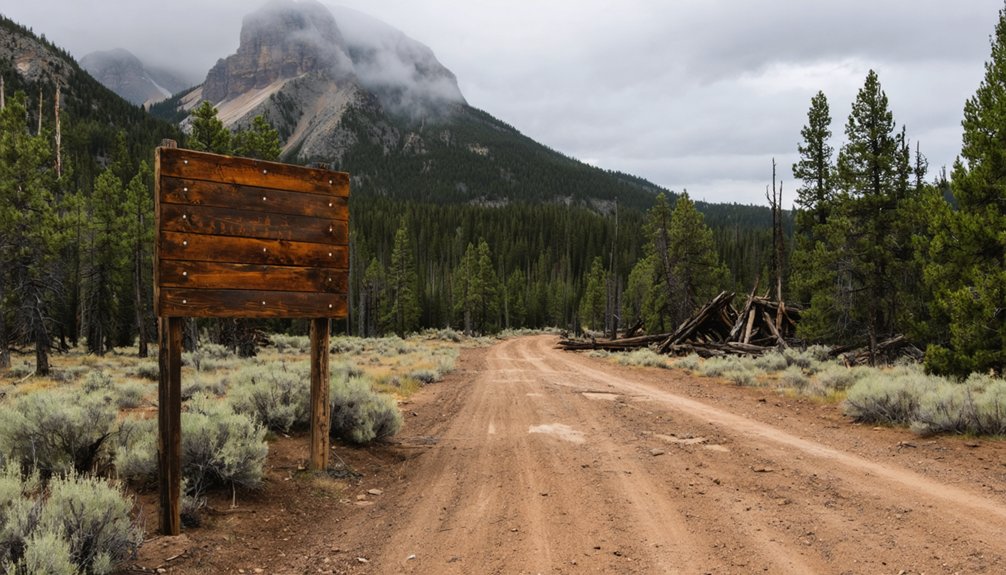
Reaching Monarch ghost town is straightforward if you know where to aim. Located near Monarch Pass in Chaffee County, Colorado, the site sits in the heart of the Rocky Mountains, accessible via US-50.
Your best entry point for ghost town exploration is through the Monarch Spur RV Park, which formerly belonged to Elsie Gunkel Porter. From there, you’ll navigate directly into what remains of this mining history landmark.
Key navigation points to note:
- US-50 West from Salida leads you toward Monarch Pass
- Monarch Spur RV Park serves as the primary access point to the site
- GPS coordinates for Chaffee County’s Monarch Pass area guarantee accurate routing
You’ll find old fences, foundations, and standing structures once you arrive on-site.
Frequently Asked Questions
Who Was Elsie Gunkel Porter and What Was Her Connection to Monarch?
You’ll find Elsie Gunkel Porter’s Monarch Legacy documented through her ownership of the Monarch Spur RV Park, the site granting you access to explore the ghost town’s remaining structures tied to Elsie Gunkel’s historical connection.
What Distinguishes Monarch Ghost Town From the Submerged Monarch in Lake Granby?
You’re exploring two distinct sites: Monarch ghost town’s historical significance lies in its Rocky Mountain location near Monarch Pass, while Lake Granby’s submerged Monarch rests in Grand County—local legends and documented records confirm they’re entirely separate places.
What Specific Minerals Were Extracted From the Madonna Mine Near Monarch?
You’ll find the Madonna Mine’s historical significance lies in its gold and silver extraction, though specific mining techniques aren’t fully documented. These minerals drove Monarch’s economy until the 1893 Silver Panic accelerated the town’s decline.
Why Is the Remaining Area Sometimes Referred to as Arbourville Today?
With only 5 structures remaining, you’ll find Arbourville History tied to Name Origins reflecting the area’s surviving architectural remnants. Locals and historians actively use “Arbourville” to distinguish the ghost town’s remaining cluster of standing buildings from the broader Monarch site.
What Was the Peak Population of Monarch During Its Mining Boom Years?
You’d find Monarch’s peak population surpassed 3,000 residents during its mining boom, where advanced mining techniques drove significant economic impact, transforming a rugged Rocky Mountain settlement into a thriving, documented hub of Colorado’s silver rush era.
References
- https://www.skyhinews.com/news/grand-history-the-town-that-sits-beneath-lake-granby/
- https://www.facebook.com/groups/CoMinesHistory/posts/1807375109941904/
- https://www.facebook.com/groups/CoMinesHistory/posts/946825049330252/
- https://www.theguardian.com/us-news/2019/jul/17/black-monarch-haunted-hotel-colorado-the-shining
- https://grandlakehistory.org/grand-lake-history/places/monarch-karose/
- https://stories.grandcountyhistory.org/article/monarch-grand-countys-city-atlantis
- https://therazormag.com/articles/life-and-death-on-halloween/
- https://gunnisoncrestedbutte.com/blog/town-profiles-whitepine/
- https://www.coloradocentralmagazine.com/24667-2/
- https://www.atlasobscura.com/places/black-monarch-hotel