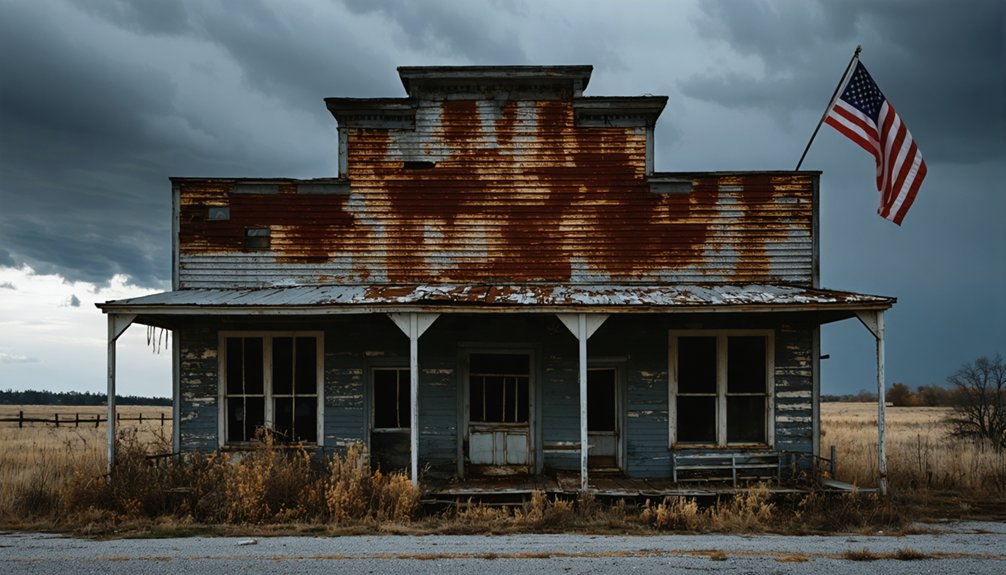
The Midwest’s most terrifying ghost towns blend paranormal activity with dark history. You’ll find spine-chilling encounters at Squirrel Cage Jail’s rotating cells in Iowa and Edinburgh Manor’s haunted corridors. Picher, Oklahoma stands abandoned due to toxic mining waste, while Cairo, Illinois harbors racial violence‘s ghostly echoes. Ardmore, South Dakota tells a tale of technological obsolescence and environmental hardship. These forgotten places offer a glimpse into America’s haunted heartland.
Key Takeaways
- Picher, Oklahoma features toxic mining waste and collapsing tunnels, forcing complete evacuation after environmental contamination deemed it uninhabitable.
- Cairo, Illinois houses abandoned buildings haunted by racial violence history, including the notorious 1909 lynching of Will James.
- Ardmore, South Dakota became a ghost town after railroads switched to diesel engines, leaving only decaying infrastructure and a defunct water tower.
- Winona’s industrial ruins showcase the stark contrast between preserved Victorian downtown and decaying factory infrastructure from the 1920s.
- The Squirrel Cage Jail in Council Bluffs, Iowa, though not a ghost town, features documented deaths and paranormal activity in its historic rotating cells.
The Haunted Rotating Cells of Squirrel Cage Jail
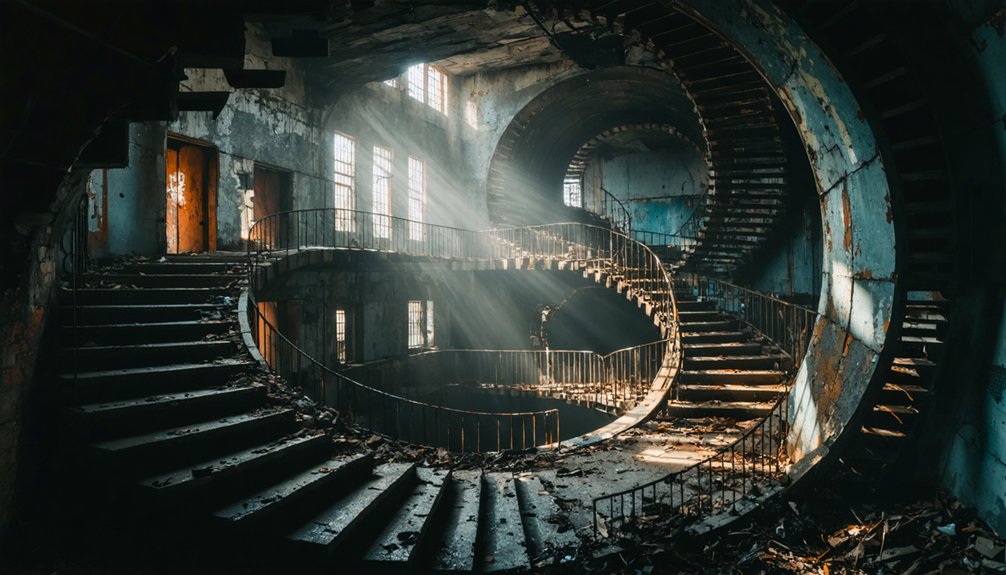
Nestled in Council Bluffs, Iowa, the Squirrel Cage Jail stands as a chilling memorial to 19th-century incarceration innovation. This three-story rotating jail, built in 1885 for $30,000, features pie-shaped cells arranged around a hand-cranked central hub—the only three-story rotary design among 18 built nationwide.
The facility’s haunted history includes four documented deaths and numerous paranormal encounters. Former staff reported inexplicable footsteps, self-opening doors, and disembodied whispers. The jailer even refused to live in the fourth-floor apartment due to mysterious noises. The original jail in Gallatin, Missouri was constructed in 1889 and remained in use until 1975, representing historical approaches to incarceration. Many visitors have captured EVP recordings during overnight paranormal investigations that are available throughout the year.
Now a National Historic Landmark museum, the structure preserves prisoner signatures etched into walls and original cells from its 1969 closure.
As one of only three remaining rotating jails in America, you’ll experience a rare glimpse into an era when innovation meant minimizing human contact while maximizing confinement.
Edinburgh Manor: Where the Mentally Ill Still Roam
You’ll discover Edinburgh Manor offers overnight paranormal tours where you can witness the spectral remnants of its hundred-year operation as a poor farm and mental health facility.
Visitors consistently report encounters with shadow figures, disembodied voices, and unexplained physical interactions throughout the deteriorating 1912 structure.
The most active paranormal experiences typically occur around 3 a.m., when some guests have documented being forcibly removed from rooms by unseen entities who once called this Jones County institution home. Originally, the property transitioned to a poor farm because of poor farming conditions in the area. With no heat or running water available, guests must bring their own bedding for the immersive overnight experience.
Overnight Paranormal Tours
For those brave enough to confront the lingering presence of former residents, Edinburgh Manor offers immersive overnight paranormal tours that have garnered considerable attention among ghost hunting enthusiasts throughout the Midwest.
You’ll join waitlisted visitors seeking authentic ghostly encounters in this imposing Victorian structure. During your stay, you might hear a child’s laughter, feel the notorious basement entity‘s choking grasp, or encounter the aggressive “shadow man” that forces many to flee.
The facility coordinator balances haunted history with respectful storytelling about the building’s former inhabitants—the poor, elderly, and mentally ill who lived here until 2010.
Surrounded by isolated farmland down gravel roads, the 12,000-square-foot manor’s remoteness intensifies the paranormal atmosphere, providing an uncensored window into the afterlife for freedom-seeking adventure travelers. Visitors frequently report seeing a woman in white wandering the second floor before she mysteriously disappears.
The property has been featured on popular Travel Channel shows including Ghost Adventures and Destination Fear, drawing diverse visitors from across the country.
Documented Spectral Encounters
Edinburgh Manor’s reputation extends far beyond its guided tours, with a substantial catalog of documented spectral encounters that have transformed this former asylum into one of the Midwest’s most compelling paranormal hotspots.
You’ll encounter numerous ghostly sightings throughout the building, particularly on the second floor where shadowy figures materialize and vanish. The property served as a poor farm for the indigent and mentally ill beginning in 1850 after the county seat relocated.
The basement harbors a malevolent entity known for physically grabbing visitors. Meanwhile, a playful girl’s spirit interacts with toys and emits childlike laughter.
These spectral phenomena aren’t merely visual—you’ll experience sudden temperature drops, unexplained footsteps, and disembodied voices calling out names.
Most disturbing are the emotional imprints left behind—overwhelming sensations of dread in suicide locations and inexplicable sadness in patient rooms where over 150 deaths occurred during the Manor’s century-long operation from 1910 to 2010.
The 12,000 square foot facility sits isolated in rural Scotch Grove, Iowa, creating an eerie ambiance that amplifies the paranormal activity reported by urban explorers.
Quincy Mine’s Dark Underground Passages
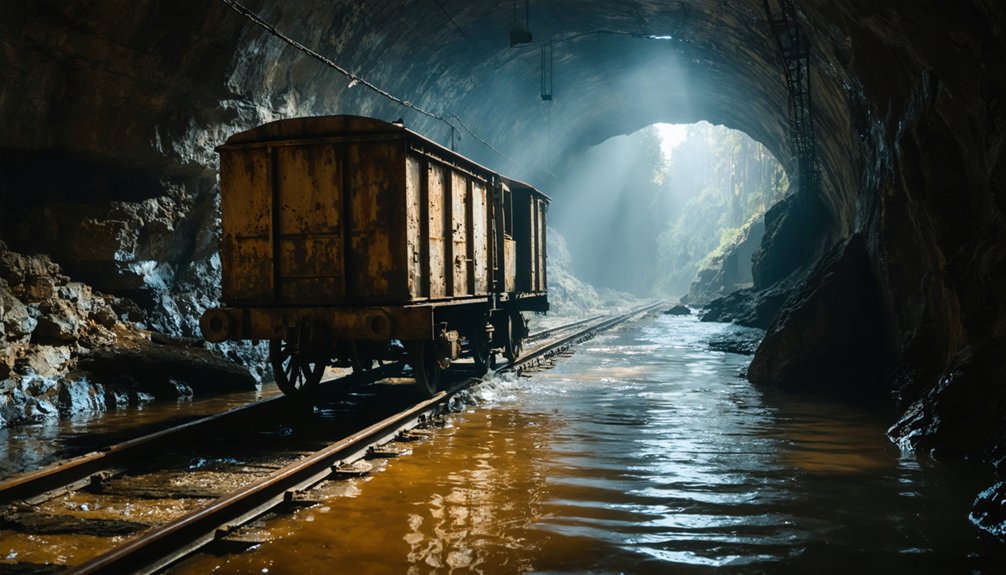
Descending into the labyrinthine passages of Quincy Mine reveals one of America’s most impressive underground engineering marvels, where darkness once enveloped miners for grueling 10-hour shifts more than a mile beneath Michigan’s surface.
You’ll witness the remnants of a 9,260-foot shaft—once the world’s longest—where underground legends persist of ghostly miners who perished among timber-supported stopes.
The mine’s 92 levels plunge over 6,200 feet vertically, with passages illuminated only by flickering candles and carbide lamps.
Over 200 documented deaths occurred here, with countless others succumbing to the “widow maker” pneumatic drills’ deadly dust.
Today, you can traverse the seventh level via an adit, experiencing firsthand the cold, damp conditions where amygdaloid mining techniques extracted copper from ancient lava flows along the Hancock Fault.
The dramatic landscape visible today was created when miners followed normal fault lines to extract the precious mineral deposits that made the region famous.
Known as Old Reliable, the Quincy Mine paid consistent dividends to its shareholders for an impressive 53 consecutive years, despite the dangerous conditions that workers endured.
Ardmore: The Railroad Stop That Time Forgot
If you’re standing amid Ardmore’s decaying structures today, you’ll find yourself in a ghost town that wasn’t abandoned in panic but through a slow death caused by technological progress and environmental hardship.
The shift from steam to diesel locomotives eliminated the town’s purpose as a water stop, while persistent drought conditions defeated even experimental dry farming attempts, gradually driving residents away until the 1980s population fell to just 16 people.
What remains now is a haunting collection of deteriorating buildings and empty homes that serve as a rusted time capsule of early 20th-century frontier life, frozen at the moment when progress simply passed it by.
Sudden Deadly Abandonment
While many ghost towns faded gradually over decades, Ardmore experienced a sudden and dramatic decline that effectively erased it from the map within a few short years.
When the New Burlington Railroad switched from steam to diesel engines in the late 1920s, the town’s purpose vanished overnight. You can still witness the abandoned infrastructure – remnants of a water stop suddenly rendered obsolete by technological progress.
This technological shift coincided with devastating drought conditions, creating a perfect storm of environmental decline.
Even President Coolidge’s 1927 visit to the experimental farm couldn’t save Ardmore from its fate. By 1936, photographers were already documenting its decay.
What you’ll find today is a haunting reflection of how quickly prosperity can vanish when both natural resources and economic purpose disappear simultaneously.
Rusted Time Capsule
Walking through Ardmore today offers visitors a glimpse into a perfectly preserved moment of early 20th-century Midwestern life. This South Dakota ghost town, abandoned after losing its purpose as a railroad water stop, stands frozen in time just north of the Nebraska border.
You’ll find timber-framed structures slowly succumbing to nature, creating a tableau of abandoned architecture that photographers find irresistible. The eerie nostalgia intensifies as you observe the decaying water tower and vehicles, untouched since residents departed seeking reliable water sources.
Once visited by President Coolidge during its brief agricultural fame, Ardmore now evokes an ultra-creepy atmosphere. After steam engines gave way to diesel, the town’s purpose vanished.
What remains is a rusted time capsule where freedom-seeking pioneers once gambled on dry farming—a haunting monument to frontier ambition defeated by harsh environmental realities.
The Toxic Legacy of Picher, Oklahoma

Once a thriving mining community at the heart of the Tri-State Lead and Zinc District, Picher, Oklahoma stands today as America’s most toxic ghost town.
When you visit this former boomtown—which peaked at 14,000 residents in 1926—you’re witnessing the devastating environmental impact of unregulated industry.
Mountains of chat, mining waste piles reaching 200 feet high, dominate the landscape, releasing lead-laden dust that poisoned generations of residents.
Below ground, a honeycomb of unstable tunnels created sinkholes that swallowed homes and businesses.
The toxic legacy culminated in a federal buyout program, with the town officially disincorporating in 2009 after a deadly 2008 tornado delivered the final blow.
Old Joliet Prison’s Paranormal Cell Blocks
When you step into the Warden’s Control Room at Old Joliet Prison, you’ll feel the oppressive energy that once dominated this 16-acre limestone structure where Officer Brown’s ghostly footsteps still echo through the halls.
Death Row’s gallows area produces an unmistakable sense of dread, with visitors reporting apparitions of executed prisoners and disembodied whispers that carry chilling final pleas.
In the solitary confinement cells, particularly infamous numbers 245 and 246 in the West Cell House, you’re likely to encounter shadowy figures and unexplained physical sensations—many visitors report being pushed or touched by unseen entities in these disciplinary spaces where countless inmates suffered.
Warden’s Notorious Control Room
Situated within the imposing administration building of Old Joliet Prison, the Warden’s Control Room stands as a chilling nexus of power where prison officials once maintained their iron grip over more than 1,000 inmates housed in two massive, poorly ventilated cell blocks.
During the infamous 1975 riot, Warden Finkbeiner used the intercom system to negotiate with Black P. Stone Nation members who held hostages after murdering Herbert “Cadillac” Catlett. The Warden’s authority extended through every barred cell via electric lighting systems and strict communication restrictions.
Today, you’ll find the control room at the epicenter of paranormal activity. Control room ghosts manifest as unexplained voices through the vintage intercom, cold spots, and shadowy figures.
These hauntings echo the overcrowding, punishment, and violence that once emanated from this command center of a notorious Midwest penitentiary.
Death Row Whispers
Wandering through the decaying cell blocks of Old Joliet Prison’s death row, you’ll encounter an atmosphere thick with paranormal energy where the final moments of condemned men still echo in spectral whispers.
Hundreds of executions on these grounds have created one of the Midwest’s most haunted locations.
The main cell block harbors the most intense ghostly encounters, with visitors reporting sudden temperature drops, shadowy figures, and the sensation of being touched by unseen hands.
Electronic devices malfunction as disembodied cries and whistling emanate from empty cells.
Paranormal investigators have captured EVPs of tormented voices while documenting unexplained phenomena.
You might even glimpse “Old Jim” smiling from the infirmary or hear the footsteps of Officer Brown patrolling his eternal beat through these forsaken corridors of the damned.
Solitary Confinement Hauntings
Beyond the ghostly voices of death row, Joliet’s solitary confinement cells harbor the prison’s most disturbing paranormal manifestations. When you visit these claustrophobic chambers, you’ll encounter the psychological hauntings that linger within their crumbling walls.
The notorious “Old Jim” has been spotted waving at visitors from his eternal post in the infirmary, while batteries inexplicably drain in these charged spaces.
Former inmates confined to these brutal isolation cells experienced extreme psychological trauma, their anguish now manifesting as disembodied wails and shadowy figures.
You’ll feel sudden oppressive sensations as you traverse the narrow corridors—many report being touched or pushed by unseen hands.
These solitary confinement experiences have transformed from historical punishment to paranormal phenomenon, with countless visitors documenting unexplained whistling and singing emanating from supposedly empty cells throughout the Midwest’s most haunted prison.
Empire’s Mining Boom and Ghostly Bust
When Douglass Houghton, Michigan’s first state geologist, discovered copper in 1840, he inadvertently sparked America’s first mineral rush, transforming the Upper Peninsula’s landscape virtually overnight.
Fortune-seekers flooded the Keweenaw region, establishing bustling communities complete with hotels, saloons, and churches.
You can still walk these forgotten streets where copper wealth once flowed abundantly—producing ten times more riches than the California Gold Rush.
Central Mine, established in 1854, became the region’s first profitable copper operation in its inaugural year, exemplifying the area’s extraordinary mining legacy.
Cairo: River Town of Spectral Encounters

At the convergence of America’s two mightiest rivers—the Mississippi and Ohio—lies Cairo, Illinois, a town whose spectral presence today belies its once-thriving past. Founded in 1817 and named after Egypt’s Cairo, this strategic settlement evolved from French pioneer outpost to Civil War fort under Grant’s command.
Cairo’s history encompasses both promise and darkness:
- Underground Railroad tunnels beneath city streets once harbored escaped slaves seeking freedom.
- The brutal 1909 lynching of Will James, whose mutilated body was paraded through town.
- Decades of Illinois’ highest crime rates, fueled by gambling, bootlegging, and corruption.
- Population collapse from 15,000 to barely 2,000 as racial tensions and economic decline consumed the town.
Today, abandoned buildings stand silent witness to Cairo’s turbulent past, where river commerce and racial violence shaped America’s heartland.
Winona’s Abandoned Industrial Ruins
Winona’s abandoned industrial ruins tell a tale of two distinct histories converging along the Mississippi River’s edge.
You’ll discover the stark contrast between the city’s National Register-listed downtown—with thirteen blocks of preserved Victorian splendor—and the decaying industrial infrastructure that once powered this riverboat hub’s economy.
The 1920s turbine mill along Rocky Creek stands as a prime destination for urban exploration, its stone foundation defying decades of abandonment.
This industrial decay represents the fading legacy of a strategic settlement that European immigrants established in 1851 atop thousands of years of Dakota history.
While modern Winona embraces reconciliation through Unity Park and the Great Dakota Gathering, these abandoned ruins serve as haunting reminders of the boom-and-bust cycle that defined frontier expansion and Midwest industrial development.
Overnight Stays in the Midwest’s Most Haunted Ghost Towns
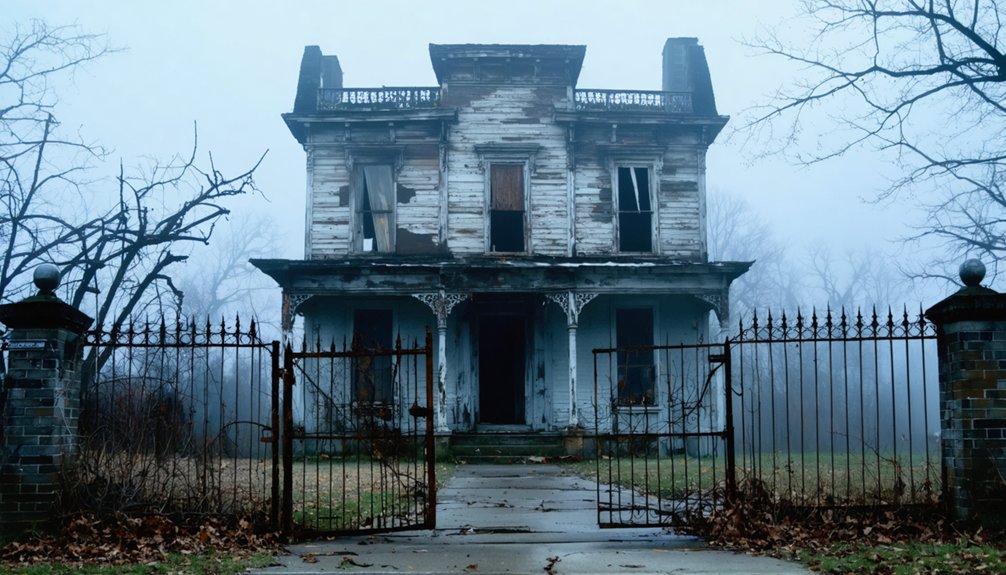
For those seeking immersive paranormal experiences beyond daytime exploration, several Midwest ghost towns offer overnight accommodations where you’ll confront the region’s spectral residents on their own terms.
Stay in a historic inn or a restored hotel that echoes with the stories of the past, making your visit to ghost towns in the Midwest an unforgettable adventure. As night falls, prepare for guided ghost tours that delve into the chilling tales that have haunted these locations for decades. Whether you encounter an apparition or simply enjoy the eerie atmosphere, these experiences will leave you with plenty of spine-tingling memories.
These haunted accommodations provide both historical context and chilling experiences for paranormal enthusiasts.
- Randolph County Asylum (Indiana) – Experience a 16-hour investigation from dusk till dawn, beginning with a historical tour before you’re left alone with whatever entities inhabit the former prison and care facility.
- Villisca Axe Murder House (Iowa) – Sleep where eight victims were murdered in 1912, amid reports of disembodied voices and moving objects.
- Historic Wolf Hotel (Kansas) – Book vintage rooms in this Airbnb with access to underground tunnels and a weekend speakeasy.
- Jailer’s Inn (Kentucky) – Rest within three-foot-thick stone walls of this former county jail, now offering breakfast and paranormal encounters.
Frequently Asked Questions
Do Children Experience More Paranormal Activity in These Locations?
Like moths to flame, children’s sensitivity often attracts more ghostly encounters in these locations. You’ll find particularly strong connections at the Villisca house, where visitors report hearing spectral children’s voices throughout the property.
What Safety Equipment Should Urban Explorers Bring to Ghost Towns?
You’ll need thorough safety gear including N95 masks, steel-toe boots, headlamps with backup lighting, first aid kits, and protective clothing. Always mark exploration paths and inform someone of your whereabouts beforehand.
Are Any Midwest Ghost Towns Completely Off-Limits to Visitors?
Like moths facing a closed lantern, you’ll encounter strict off-limits regulations at privately-owned Midwest ghost towns. Some mining settlements and hazardous industrial sites enforce complete ghost town access restrictions through trespassing laws and physical barriers.
Which Ghost Towns Have Documented Deaths From Paranormal Encounters?
No Midwest ghost towns have scientifically verified deaths from paranormal encounters, despite abundant ghost sightings and haunted history claims. You’re free to investigate these legends independently at accessible locations.
Can Visitors Take Artifacts or Souvenirs From These Locations?
Like taking a family photo from someone’s home, removing artifacts violates souvenir ethics. You shouldn’t take any items from Midwest ghost towns—it’s illegal and undermines artifact preservation for future generations.
References
- https://khak.com/creepiest-abandoned-places-midwest-tours/
- https://www.geotab.com/ghost-towns/
- https://www.youtube.com/watch?v=lfj6aeZEVJY
- https://twifc.substack.com/p/what-are-the-midwests-coolest-ghost
- https://www.atlasobscura.com/lists/abandoned-places-midwest
- https://en.wikipedia.org/wiki/Lists_of_ghost_towns_in_the_United_States
- https://www.youtube.com/watch?v=15KsasKUnQ8
- https://battlegroundhistory.com/american-midwest/
- https://www.atlasobscura.com/places/squirrel-cage-jail-gallatin
- https://www.unleashcb.com/blog/a_haunted_history_of_the_squirrel_cage_jail/