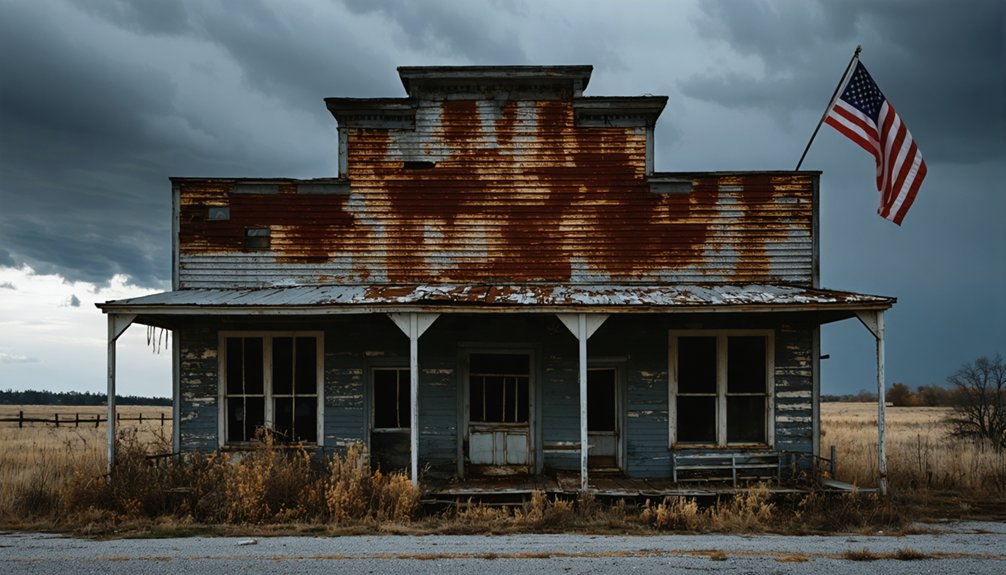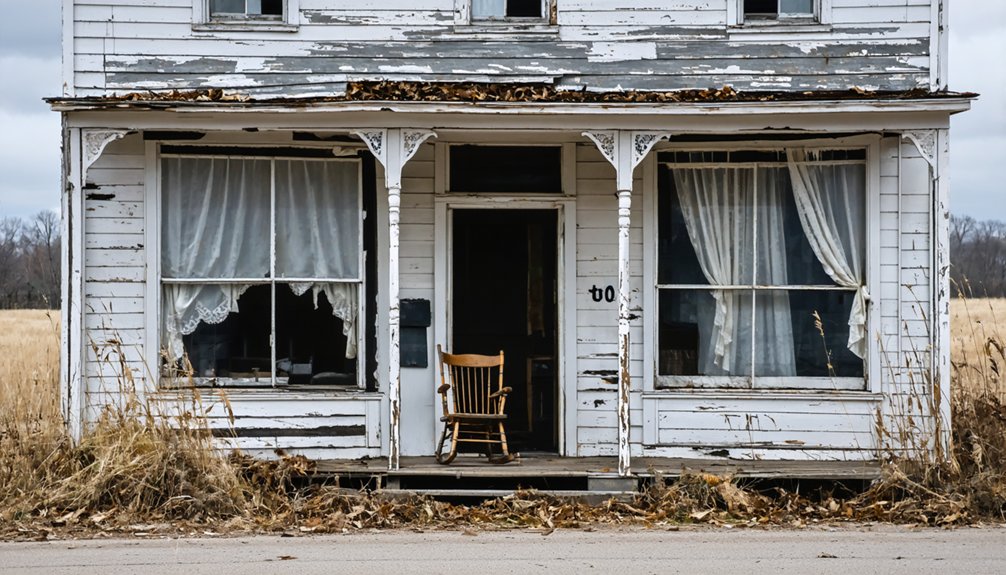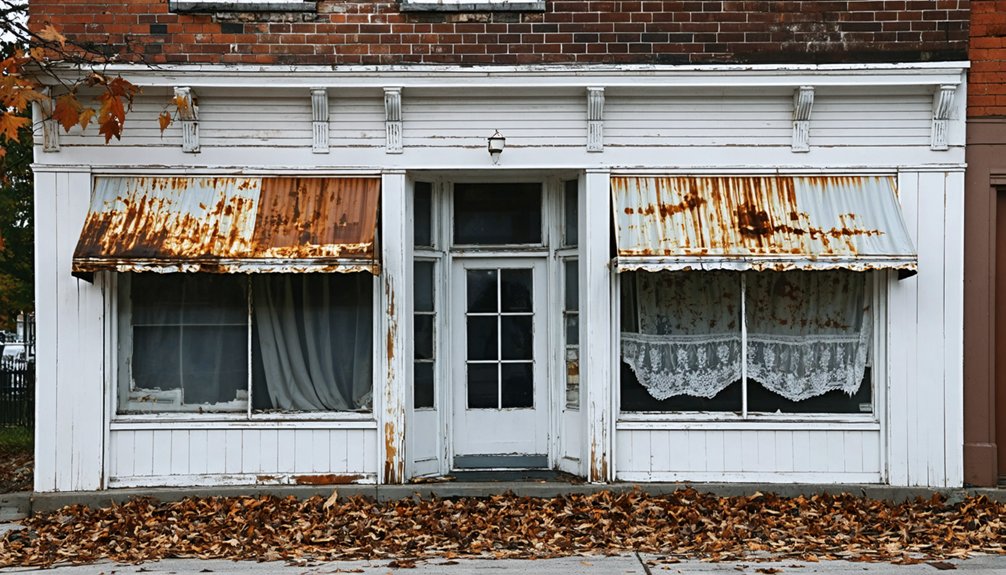
The Midwest hides spectral treasures waiting for your discovery. Visit St. Deroin, Nebraska, where Joseph Deroin’s ghost wanders through the reconstructed buildings. Experience overnight terror at Villisca’s Axe Murder House or walk the haunted corridors of Missouri State Penitentiary. Don’t miss Michigan’s copper ghost town Freda or Iowa’s rotating Squirrel Cage Jail. Bring your camera and respect for the past as you venture where forgotten souls linger in these abandoned havens.
Key Takeaways
- Villisca Axe Murder House offers paranormal tours and overnight stays where visitors report phantom footsteps and children’s whispers.
- Missouri State Penitentiary, known as America’s most haunted prison, provides ghost tours featuring spirits of former inmates.
- Edinburgh Manor in Iowa features the hostile Shadow Man entity and reports of poltergeist activity throughout its 12,000 square feet.
- St. Deroin, Nebraska includes a haunted cemetery with rich ghostly legends and a reconstructed general store in Indian Cave State Park.
- Freda, Michigan showcases copper mining ruins reclaimed by nature, with abandoned railroad tracks and massive stamp sands along Lake Superior.
The Eerie Remains of St. Deroin, Nebraska
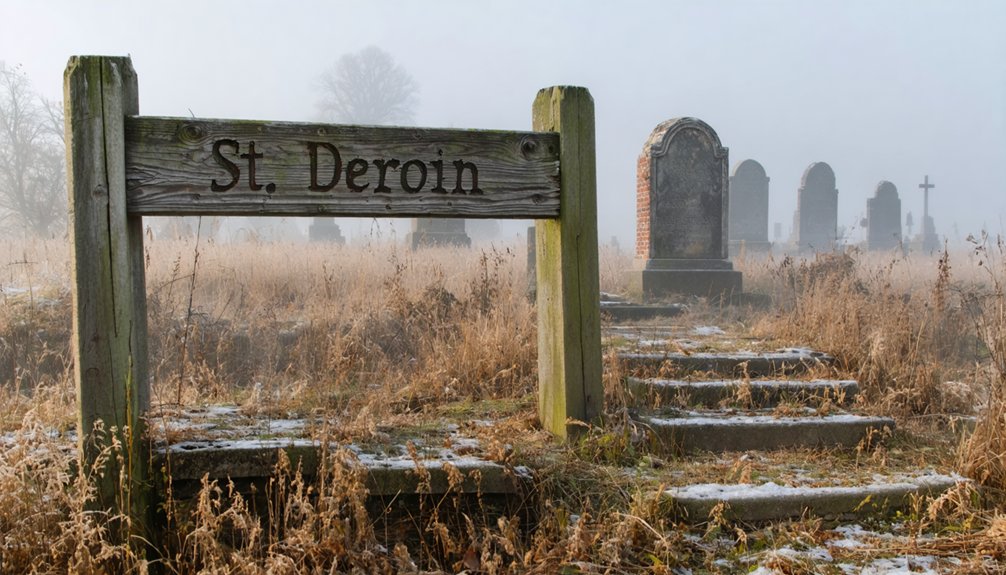
Nestled along what was once the bustling Missouri River, St. Deroin’s haunting remains tell a tale of ambitious beginnings and mysterious endings. Founded in 1854 by Joseph Deroin, a mixed-heritage entrepreneur, this former ferry hub thrived with 230 residents before nature reclaimed it.
Time swallowed St. Deroin whole, leaving only whispers of a river town’s ambitious dream.
Wander through Indian Cave State Park and you’ll discover the reconstructed general store and the relocated schoolhouse—silent sentinels of a community that vanished after the devastating 1911 flood. By 1920, St. Deroin existed only in memory.
The cemetery holds the richest St. Deroin history and ghostly legends. Listen for phantom hoofbeats from Joseph Deroin’s ghost, reportedly buried atop his favorite horse. The town reached its peak in the 1870s with nearly 300 residents before beginning its slow decline. The ancient sandstone caverns of Indian Cave State Park still contain historical petroglyphs depicting wildlife and figures from a bygone era.
Or watch for the spirit of A.J. Ritter, eternally searching for his severed arm on moonless nights—grim souvenirs from a town that refused to die completely.
Villisca’s House of Horrors: Where Murder Echoes Through Time
You’ll feel a chill run down your spine when you enter Villisca’s infamous 1912 murder house, where eight victims—including six children—were brutally slain with an axe while they slept.
The killer, who waited in the attic and covered all mirrors after the bloodshed, was never caught despite multiple suspects and trials, leaving behind only ghostly whispers and unexplained phenomena for today’s visitors.
Standing perfectly preserved as it was on that fateful June night, this unassuming white farmhouse draws paranormal enthusiasts and history buffs who swear the victims’ spirits remain trapped within its walls, forever seeking justice that never came. The modern owners meticulously restored the house to its 1912 condition after purchasing it in 1995, removing modern renovations to maintain its historical authenticity. Originally built in 1868 as a modern farmhouse for George Loomis, the property would later become the site of one of America’s most notorious unsolved crimes.
Overnight Murder Mystery
Darkness shrouds the modest white frame house in Villisca as you approach, the weight of unspeakable tragedy hanging in the air like a fog that never lifts.
Inside these walls, eight souls met their fate on that June night in 1912, their lives violently extinguished as they slept.
You’ll walk where the killer stalked—past covered mirrors and through rooms where he wielded his axe with methodical precision. The murderer meticulously covered all windows before departing the crime scene.
The murder investigation was botched from the start; curious townsfolk trampled through the scene, destroying vital evidence. Yet the eerie atmosphere remains undisturbed by time.
As night falls, you’ll understand why some claim to hear phantom footsteps or children’s whispers.
The now-famous house offers tours and overnights for those brave enough to confront its tragic history.
Will you brave an overnight stay where the Moores and Stillinger girls drew their final breaths?
Few mysteries haunt the Midwest like Villisca’s unsolved massacre.
Lingering Supernatural Presence
Three distinct knocks often greet visitors to the Villisca Axe Murder House, though no living hand makes these sounds.
You’ll find yourself immersed in one of America’s most notorious haunted locations, where disembodied giggles echo through hallways and furniture shifts without explanation.
When the train passes—marking the time of the gruesome murders—an otherworldly fog creeps between rooms, chilling the air around you.
Your haunting experiences might include sudden cold spots or phantom touches, while EVPs capture voices from beyond.
Brave souls who’ve spent the night report spectral sightings of shadow figures and ghostly children, especially in the basement and upstairs bedrooms where eight victims were found in their beds in 1912.
The dollhouse-like museum preserves not just history, but a supernatural legacy that draws thrill-seekers nationwide.
For 428 dollars, up to six people can book an overnight stay in this paranormal hotel, though you’ll need to bring your own sleeping bag.
Will you sense the eyes watching from empty corners?
Unsolved Gruesome Crime
While many ghost towns hold their secrets close, Villisca’s darkest mystery still haunts its weathered walls over a century later.
On that fateful June night in 1912, eight souls—including six children—were brutally murdered with an axe as they slept. You’ll feel a chill walking through the infamous Moore home where mirrors remain covered, echoing the killer’s ritualistic motives. The children had attended a Presbyterian children’s program at church earlier that day, returning home unaware of the horror awaiting them.
The Villisca murders represent more than just an unsolved crime.
Standing in rooms where a murderer meticulously arranged bacon beside the bloody axe, covered every reflective surface, and left bowls of bloody water untouched creates an unsettling connection to the past. A distinctive lamp without chimney was positioned at each crime scene, marking the killer’s signature across multiple murder sites.
Despite numerous suspects and theories, the killer’s identity vanished like morning fog—leaving behind only whispers, theories, and the palpable weight of unresolved violence.
Behind Bars With Spirits: Missouri State Penitentiary
Rising from the banks of the Missouri River like a stone sentinel, the Missouri State Penitentiary stands as America’s most haunted prison, its limestone walls still echoing with the tortured souls of those who lived and died within.
You’ll walk the same grounds that once earned the nickname “the bloodiest 47 acres in America,” where ghostly encounters await at every turn.
Infamous inmates like James Earl Ray and “Pretty Boy” Floyd once called these cells home.
The violent 1954 riot that left four dead still resonates in the prison’s eerie corridors.
As you explore death row and the gas chamber, you’ll feel the weight of prison history spanning 168 years until its 2004 closure.
For thrill-seekers, paranormal tours offer a chance to connect with spirits who never truly escaped these haunted walls.
Copper and Ghosts: Exploring Michigan’s Freda and Central
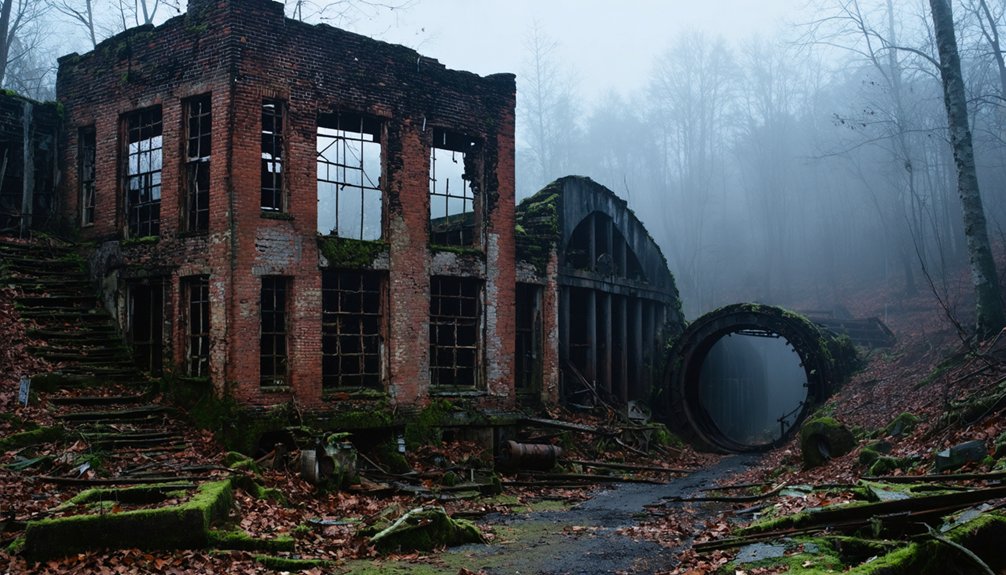
You’ll marvel at the skeletal concrete foundations of Freda’s Champion Copper Mill, where wilderness slowly reclaims what was once Michigan’s industrial heartbeat.
As you wander among the crumbling structures beneath the looming smokestack, echoes of the 500 souls who built lives around copper’s promise seem to linger in the lake breeze.
The ruins stand as ghostly monuments to the boom-and-bust cycle that created and ultimately abandoned these Upper Peninsula communities when the copper veins ran dry in 1967.
Abandoned Mining Glory
Tucked along the foggy western shores of Michigan’s Keweenaw Peninsula, Freda stands frozen in time, a memorial to the boom-and-bust cycle of America’s copper mining rush.
As you explore this haunting landscape, you’ll witness the ghostly remnants of the Champion Mill that once processed 3,500 tons of copper ore daily using revolutionary electric-powered crushers.
Wander through what was once a thriving community of 500 souls, where nature now reclaims buildings that housed miners and mill workers.
The abandoned Copper Range Railroad tracks, torn up in 1971, once brought vacationers to Freda Park, now silent like the mill itself.
The massive stamp sands along Lake Superior are stark reminders of both industrial innovation and environmental cost.
Here, history whispers through empty doorways and rusted machinery.
Wilderness Reclaiming Industry
In the decades since the Champion Mill ceased its thundering operations, nature has waged a silent, relentless campaign to reclaim what humans abandoned in Freda.
You’ll witness firsthand the remarkable ecological resurgence as vegetation pushes through cracked concrete foundations and winds around rusted machinery.
Walk carefully along the perimeter of fenced ruins where Lake Superior’s waves slowly erode what remains of Michigan’s copper legacy.
The black stamp sands beneath your feet blend with beach glass—industrial decay transformed into natural art.
Follow former railroad beds, now verdant corridors where wildlife roams freely.
The mill’s smokestack stands as a silent sentinel while seasonal storms and freeze-thaw cycles accelerate nature’s reclamation project.
This haunting industrial skeleton offers you a rare glimpse of wilderness triumphantly returning to claim its rightful place.
Copper Boom’s Ghostly Legacy
Whispers of prosperity and subsequent decline echo through the crumbling foundations of Freda, where copper’s gleaming promise once attracted hundreds of hopeful workers to Michigan’s Upper Peninsula.
As you wander this copper mining ghost town, the past materializes before your eyes, offering a haunting glimpse into America’s industrial heritage.
- Stand where massive electric-powered impact crushers once processed thousands of tons of copper daily
- Feel the ghostly remnants of a once-thriving community that housed 500 souls, now reduced to dozens
- Trace the vanished Copper Range Railroad lines that connected this remote outpost to civilization
- Witness how nature reclaims the land, while stamp sands continue their slow migration into Lake Superior
- Explore the abandoned mill site where innovative flotation techniques briefly revitalized operations before final silence fell in 1967
Rotating Cells and Restless Souls at Iowa’s Squirrel Cage Jail

Standing as a macabre tribute to 19th-century prison innovation, Iowa’s Squirrel Cage Jail might make your skin crawl with its rotating pie-shaped cells and lingering spirits.
Built in 1885, this three-story mechanical nightmare trapped inmates in a cylindrical cell block with only one entry point.
As you wander through this National Register landmark, you’ll feel the haunted history in every creak of its notorious rotating mechanism—the same one that mangled limbs and trapped a dead prisoner for two days in the 1960s.
Listen closely for unexplained footsteps and whispers from former residents—murderers, petty thieves, and the infamous Charles Noel Brown, Iowa’s last hanged man.
Four documented deaths feed the jail’s paranormal reputation, attracting ghost hunters who’ve captured EVPs and shadowy figures in this failed experiment in incarceration.
The Abandoned Corridors of Edinburgh Manor
Three hours east of the Squirrel Cage Jail’s rotating cells, Edinburgh Manor looms over the rolling farmlands of Scotch Grove, Iowa—a Victorian ghost beckoning you into its troubled past.
Built in 1911 to replace the Jones County Poor Farm, this 12,000-square-foot asylum harbors spectral sightings that’ll chill your blood.
You’ll encounter:
- The Shadow Man who stalks visitors with unmistakable hostility
- A malevolent basement entity known for physically attacking guests
- Playful child spirits whose laughter echoes through abandoned rooms
- Poltergeist activity—doors slamming and objects hurling across rooms
- Oppressive energies in the “suicide room”
When you walk these abandoned corridors, you’re treading through haunted history—where “inmates” of the poor farm labored until 1910, and where troubled souls lingered until the facility’s closure in 2010.
Ardmore: When the Trains Stopped Coming
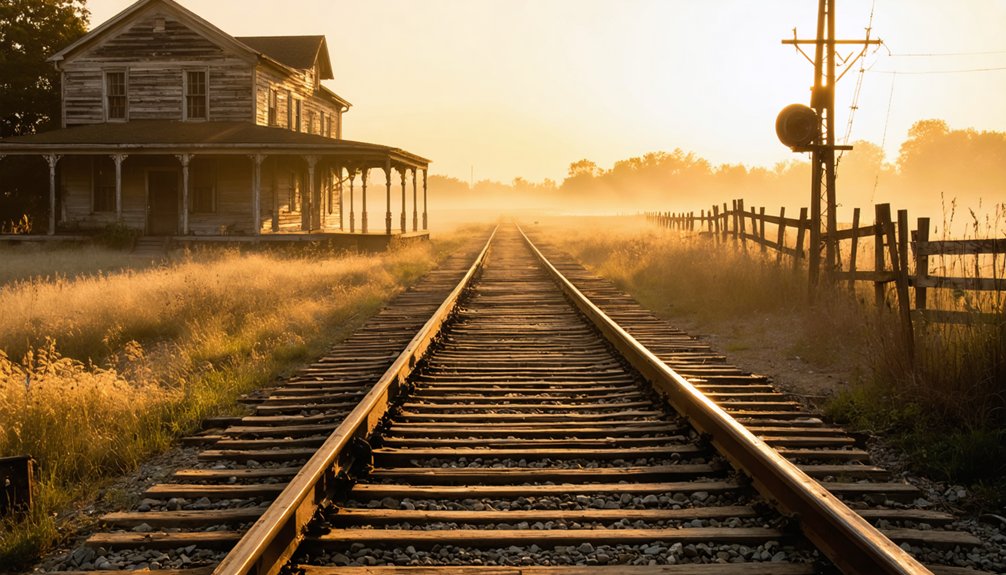
Nestled along the South Dakota-Nebraska border, Ardmore’s skeletal remains tell a haunting tale of railroad prosperity turned to dust. Founded in 1889 as a frontier water stop for steam engines, this once-thriving community’s ghost town history is written in its 15-25 abandoned structures frozen in time.
You’ll feel eyes watching as you explore what’s left of a town that President Coolidge once visited. Ardmore’s fate was sealed when diesel engines replaced steam, eliminating the railway impact that had been its lifeblood.
Despite government dry farming experiments and residents’ determination to survive without welfare during the Depression, nature won. The acidic creek water proved undrinkable, and drought finished what the railroad’s departure started.
Today, photographers and adventure seekers wander among decaying reminders of frontier dreams.
Planning Your Midwest Ghost Town Road Trip
While Ardmore’s haunted structures now silently crumble into the prairie, your own ghost town adventure awaits planning. The Midwest’s forgotten settlements beckon those brave enough to venture where others have abandoned.
Ghost town logistics require careful consideration, especially when exploring Michigan’s copper country or Route 66’s forgotten waypoints.
- Choose between Route 66’s accessible specters or Michigan’s Upper Peninsula with nearly 100 mining ghost towns
- Time your journey during summer for accessibility, or brave autumn for enhanced eerie atmosphere
- Pack for unpaved roads and limited cell service—your normal rules don’t apply here
- Consider weekday exploration when phantom towns reveal themselves without tourist crowds
- Balance remote destinations with nearby accommodations, as seasonal considerations affect availability of services
Capturing the Paranormal: Photography Tips for Ghost Towns
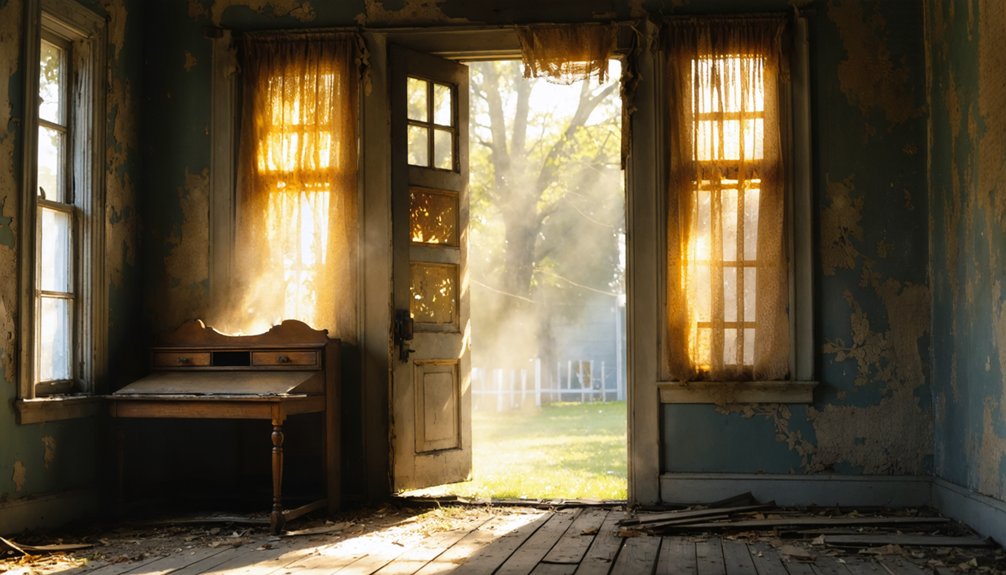
Ever noticed how ordinary photographs fail to capture the spine-tingling essence of abandoned places? To document the supernatural aura of Midwest ghost towns, you’ll need more than just point-and-shoot techniques.
Unearth ghostly tales from Colorado’s past and let their eerie stories guide your lens. Each shadowy corner and crumbling facade holds whispers of those who once inhabited these forgotten spaces. Embrace the thrill of unraveling their mysteries as you wander through time-worn streets, capturing the haunting beauty of abandonment.
Bring essential gear: a manual camera, tripod, wide-angle lenses, and flashlights. Shoot during golden hour when shadows stretch eerily across decaying structures. Master long exposure techniques (10-30 seconds) to transform moving clouds into ethereal streaks above abandoned buildings.
Try light painting to selectively illuminate interior sections, creating mysterious glowing effects that suggest paranormal presence. Composition matters—include silhouettes of crumbling architecture, document weathered details, and consider positioning a human subject for scale.
For truly haunting images, experiment with multiple exposures that overlay transparent figures against desolate backgrounds, suggesting spirits frozen in time.
Respectful Ghost Hunting: Etiquette for Haunted Historic Sites
As you step into the hallowed grounds of a Midwest ghost town, your conduct matters just as much as your courage. Proper ghost hunting etiquette guarantees both your safety and the preservation of these spectral sanctuaries for future explorers.
- Always obtain permission before investigating private property—written consent is your shield against legal troubles.
- Whisper your intentions to the spirits upon arrival, introducing yourself and explaining why you’ve come.
- Leave everything exactly as you found it—these sites are fragile time capsules deserving protection.
- Bring a companion on every adventure—solo ghost hunting invites danger rather than discovery.
- Research the location’s history thoroughly—understanding the past enhances both respect and results.
Frequently Asked Questions
Are Children Allowed on Paranormal Overnight Stays?
You’ll find most ghost tours enforce age minimums for overnight paranormal stays. Children 7+ are typically allowed with parent supervision, though family guidelines vary by location. Some adventures require teens 13+ only.
What’s the Best Season to Experience Paranormal Activity?
Fall reigns supreme for paranormal encounters. You’ll wander through vibrant fall foliage while eerie spirits emerge from thinning veils. October ghost tours offer your best chance to witness otherworldly phenomena firsthand.
Do Any Locations Offer Private or Exclusive Ghost Hunting Tours?
Like moths drawn to flame, paranormal enthusiasts flock to exclusive experiences. You’ll find private ghost hunting tours at Missouri State Penitentiary, Haunted Castle House, Ghost City Tours, Small Town Ghost Tours, and Chaos Haunted Tours.
Can I Bring My Own Paranormal Investigation Equipment?
Yes, you can bring your own ghost hunting equipment! Pack EMF detectors, spirit boxes, and cameras to capture evidence of the unknown. Just make certain you’ve secured proper permission beforehand.
Are There Accommodations Near These Remote Ghost Towns?
You’ll find accommodations scattered near these spectral sites, from the historic Miners Cottage in Keweenaw to hotels in towns bordering Sleeping Bear Dunes. Embrace nearby camping for an untethered paranormal adventure under starlit skies.
References
- https://www.splashtravels.com/destinations/midwest-ghost-towns-and-ruins-welcome-curious-visitors
- https://www.travelawaits.com/2702819/most-haunted-places-midwest/
- https://khak.com/creepiest-abandoned-places-midwest-tours/
- https://www.frrandp.com/p/ghost-towns-map.html
- https://thetravelingwildflower.com/hauntedplacestovisit/
- https://www.youtube.com/watch?v=lfj6aeZEVJY
- https://www.atlasobscura.com/lists/abandoned-places-midwest
- https://en.wikipedia.org/wiki/Lists_of_ghost_towns_in_the_United_States
- https://www.nebraskalife.com/blog/post/saint-deroin-ghost-town
- https://www.nebraskalife.com/printpage/post/index/id/95