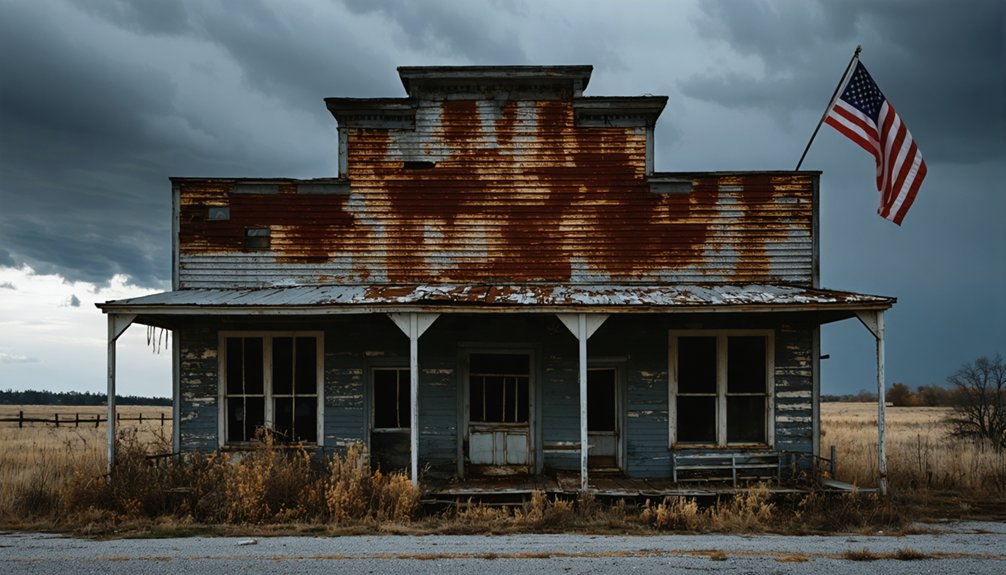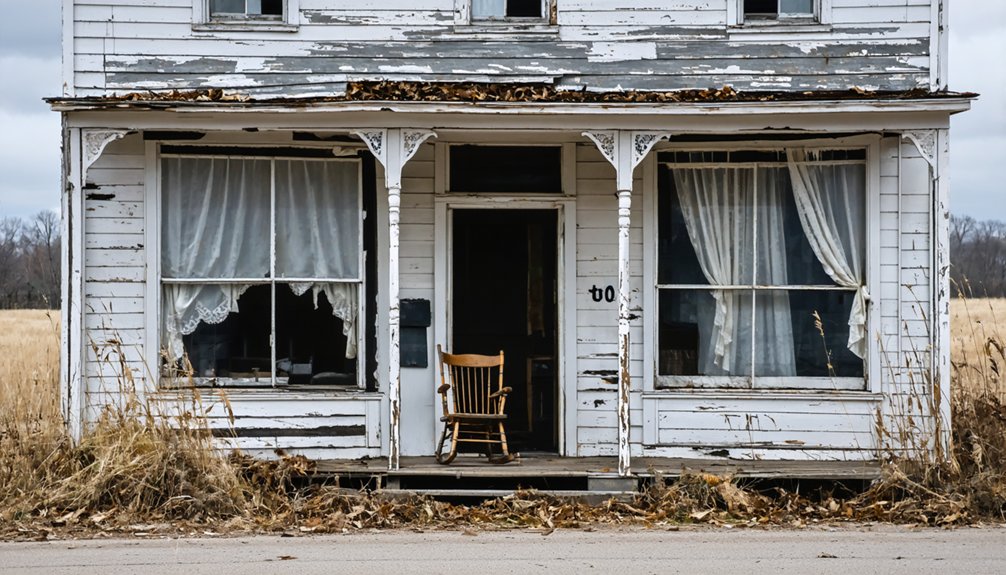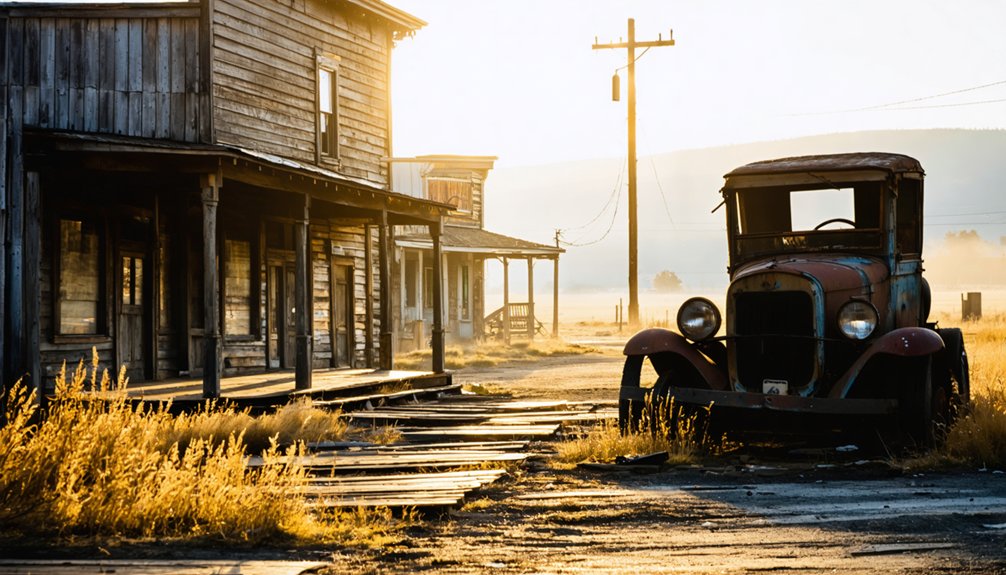
The Midwest’s most haunting ghost towns include South Dakota’s Ardmore, where acidic water and abandoned homes create an eerie atmosphere where former residents still gather. In Indiana, Weisburg offers preserved facades and reported paranormal activity near Locust Grove Cemetery, while Bonnell showcases a rare 1864 stone arch culvert amidst near-complete abandonment. Don’t miss Brushy Prairie, site of a failed utopian experiment where spirits of communal idealism linger in the emptiness. These forgotten settlements hold secrets that whisper through the silence.
Key Takeaways
- Ardmore, South Dakota features eerie abandoned homes, vehicles, and a silent water tower with a haunting atmosphere.
- Weisburg, Indiana is a Level 4 ghost town with preserved facades, including a silent general store and reportedly haunted cemetery.
- Bonnell, Indiana showcases near-complete disappearance with only two homes and an 1864 stone arch culvert remaining.
- Brushy Prairie represents failed communal idealism with no remaining structures but powerful historical significance.
- These Midwest ghost towns offer unique experiences from acidic water stops to railroad commerce centers frozen in time.
Ardmore, South Dakota: Where Steam and Spirits Coexist
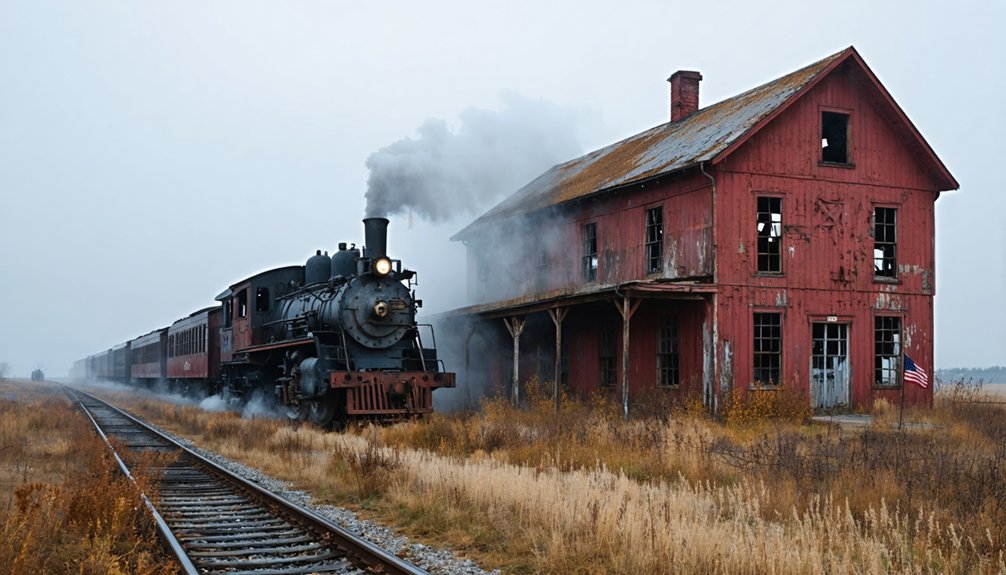
Nestled along the South Dakota-Nebraska border, Ardmore stands as a haunting memorial to the relentless forces of nature and progress that can unmake even the most hopeful frontier settlements. Founded in 1889 as a water stop for steam locomotives, Ardmore’s Achilles’ heel was always its acidic, undrinkable water.
You’ll find decaying wooden homes and brick structures marked with “no trespassing” signs, abandoned vehicles scattered like time capsules, and the silent water tower that once served thirsty trains.
Even Calvin Coolidge visited in 1927, before diesel engines eliminated the town’s purpose. The town established an experimental dry farm in 1911 to combat the persistent drought conditions. The town is located at Highway 71 coordinates, making it accessible for adventurous explorers.
Though no specific ghostly encounters are documented, the eerie atmosphere created by suddenly abandoned belongings will raise the hair on your neck.
Former residents still gather at the fire station—proof that Ardmore’s spirit lives on.
Weisburg, Indiana: Preserved Facades With Paranormal Activity
What remains when a town’s lifeblood has drained away, leaving only skeletal structures to mark its existence? In Weisburg, Indiana, you’ll find the answer etched across preserved facades of a bygone era.
Once thriving with railroad commerce since 1858, this Lawrence County settlement now stands as a Level 4 ghost town. You can walk among the silent general store and blacksmith shop while St. John’s Catholic Church watches from its hillside perch—a symbol of historical preservation amid decay. This church now remains alone as the sole witness to the town’s historical significance and former vitality. Wiseburg exemplifies towns where commercial buildings still stand but all businesses have permanently closed.
For those drawn to spectral encounters, nearby Locust Grove Cemetery pulses with paranormal activity. Ghost stories tell of Tippecanoe soldiers whose phantom marches echo through the grounds.
As you navigate the quiet backroads to this haunted hamlet, you’re experiencing not just abandonment, but a physical timeline of Midwestern decline.
Bonnell, Indiana: The Vanishing Settlement’s Lingering Presence
Between the crumbling stone arches and overgrown railroad beds of southeastern Indiana lies Bonnell, a vanishing symbol of America’s rail-driven past.
This Level 3 ghost town retains only two homes, with all commercial structures now erased from the landscape.
You’ll discover the town’s most impressive historic remnant—a rare 1864 stone arch culvert spanning 30 feet—silently testifying to Bonnell’s once-thriving railroad economy.
As you explore the deteriorating abutments along Tanner’s Creek, you might sense the ghostly encounters that draw paranormal enthusiasts to this forgotten junction.
Unlike more intact abandoned settlements, Bonnell’s near-complete disappearance creates an especially haunting atmosphere.
The few physical traces that remain stand on private property—silent sentinels to a community that flourished with the railroads and vanished when they did.
The town was originally called Kennedy before its name was changed to honor a railroad official in the late 1800s.
The culvert is showing significant deterioration with upper portions failing, putting this unique historical structure at risk of complete collapse.
Brushy Prairie: The Failed Utopia’s Supernatural Legacy
Once thriving with communal idealism, Brushy Prairie now exists merely as a ghostly footnote in LaGrange County’s history.
This Level 1 ghost town marks the site where the LaGrange Phalanx—an 1840s utopian experiment based on the Fourier System—attempted to create paradise through shared labor and resources.
Though no buildings remain and no specific hauntings are documented, the emptiness itself speaks volumes.
If you’re drawn to places where dreams dissolved into wilderness:
- Bring historical context—without it, you’ll see only empty fields where thirty families once built their communal vision
- Feel the eerie silence that replaced the industry councils’ ambitious planning
- Contemplate how the “spirits” of failed idealism linger even without physical remains
The site offers freedom-seekers a poignant reminder of utopian aspirations consumed by reality. The community was one of over 30 similar experiments across America that collapsed after just a few years. Like many haunted locations across Indiana, visitors should obtain property owners’ permission before exploring these historically significant but privately owned lands.
Beyond the Midwest: Comparing Haunted Towns Across America
While the Midwest offers its fair share of haunted destinations, America’s spectral landscape stretches far beyond its central plains into territories where different historical forces have shaped unique paranormal legacies.
Among these eerie ghost towns in the Midwest, stories of abandoned buildings and lost lives echo through the desolate streets. Visitors often report strange occurrences, as if the past clings tightly to the remnants of once-thriving communities. Each town has its own haunting tale, revealing a glimpse into a time long forgotten.
In the West, gold-rush towns like Bodie, California and Bannack, Montana showcase frontier violence that fuels ghostly encounters today. Visitors to Bodie can observe abandoned kitchens with tables still set for meals that were never eaten.
The South offers distinctive historical hauntings at sites like Cahaba, Alabama, where spectral orbs drift through the ruins of the state’s first capital. These ghostly orbs are often reported near the cemetery and former slave quarters by paranormal enthusiasts.
Meanwhile, the Northeast contributes the infamous Lizzy Borden House, where America’s most notorious axe murders still echo through creaking hallways.
Each region’s haunted locations reflect their distinctive histories—from mining disasters in Kennicott, Alaska to the bizarre architectural maze of Winchester Mystery House designed to confuse vengeful spirits.
Frequently Asked Questions
Are There Guided Ghost Tours Available in These Midwest Towns?
Yes, you’ll find diverse guided ghost tours across the Midwest, from Villisca’s overnight axe murder house investigations to Missouri Penitentiary’s haunted walks, offering powerful ghostly encounters and unforgettable tour experiences.
What Paranormal Investigation Equipment Should I Bring to Ghost Towns?
Pack your telegraph—wait, smartphone—along with EMF detectors, spirit boxes, thermal cameras, audio recorders, and flashlights. You’ll reveal whispers from crumbling saloons and spectral miners in these forsaken frontier outposts.
When Is the Best Season to Experience Ghostly Activity?
Autumn’s ghostly embrace awaits you when crisp fall foliage rustles underfoot. During spooky season, thinning trees reveal hidden secrets while chilly nights heighten your senses, making spectral encounters dramatically more probable after sunset.
Do Any Towns Restrict Overnight Visits or Paranormal Investigations?
Like phantom chains binding restless spirits, overnight restrictions exist in most haunted Midwest sites. You’ll need paranormal permits for places like Villisca Axe Murder House and Missouri State Penitentiary—book official tours to explore legally.
Have Indigenous Spirits Been Reported in These Abandoned Settlements?
Yes, you’ll encounter indigenous folklore at places like Whitefish Point, where a Native American girl’s spirit wanders, and St. Deroin, where spiritual encounters echo ancestral connections to lands once thriving with indigenous presence.
References
- https://www.travelawaits.com/2702819/most-haunted-places-midwest/
- https://thetravelingwildflower.com/hauntedplacestovisit/
- https://khak.com/creepiest-abandoned-places-midwest-tours/
- https://www.geotab.com/ghost-towns/
- https://www.youtube.com/watch?v=lfj6aeZEVJY
- https://www.atlasobscura.com/lists/abandoned-places-midwest
- https://en.wikipedia.org/wiki/Lists_of_ghost_towns_in_the_United_States
- https://hiddenmidwest.com/midwest-ghost-towns-a-hikers-guide-to/
- https://www.onlyinyourstate.com/experiences/south-dakota/ardmore-ghost-town-sd
- https://www.atlasobscura.com/places/ardmore-ghost-town