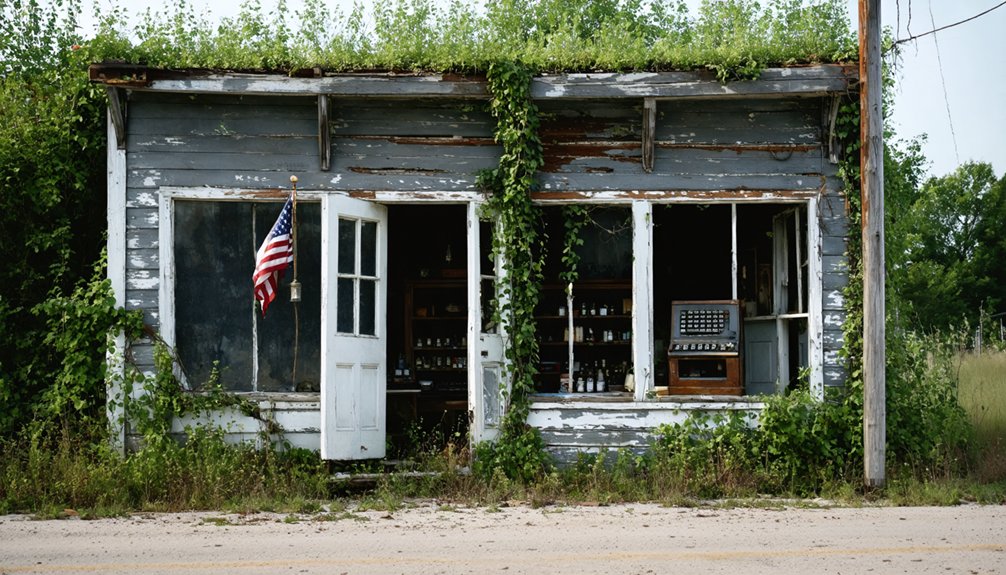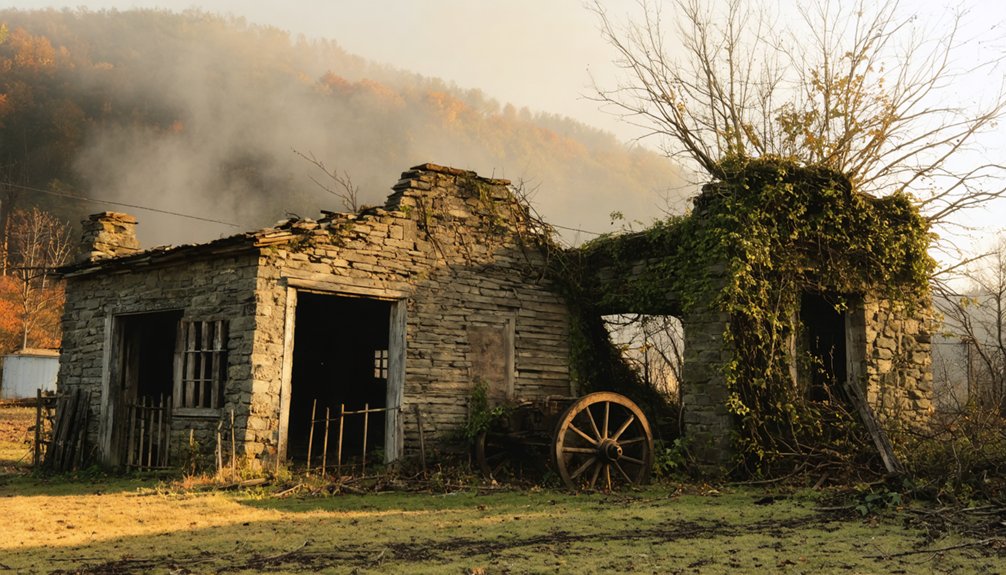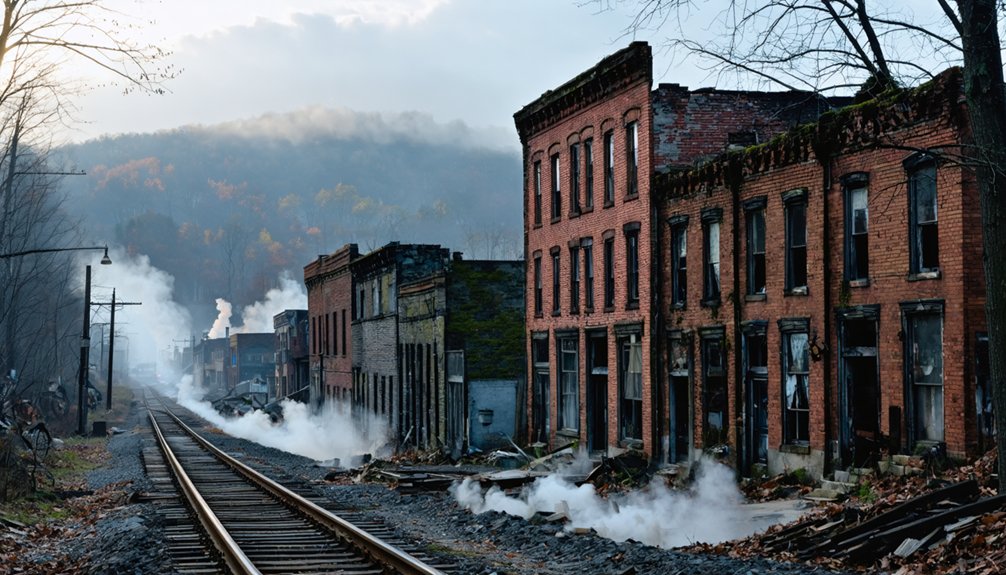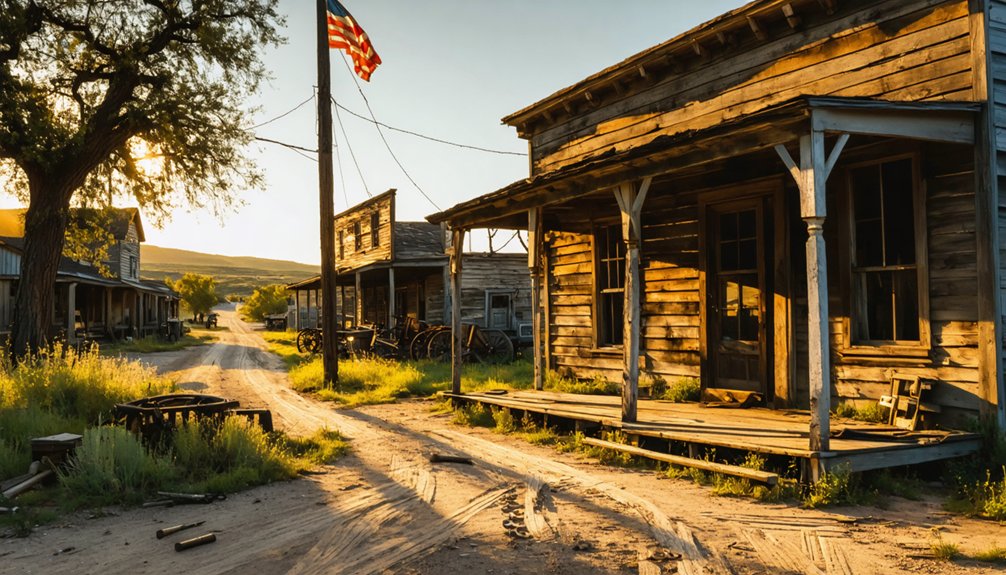
America’s mysterious Civil War-era ghost towns offer haunting glimpses into our past. You’ll find Cahawba, Alabama’s first capital that became a Union prison camp before devastating floods sealed its fate. In Bodie, California, 200 structures remain in “arrested decay” after the Gold Rush boom collapsed. At Elko Tract, a fake decoy town built during WWII stands eerily abandoned. These forgotten places, often marked by paranormal activity, hold secrets only their empty streets can tell.
Key Takeaways
- Cahawba, Alabama’s former state capital, became a Confederate prison camp before devastating floods in 1866-1868 led to its complete abandonment.
- Many Civil War ghost towns like Gettysburg report phantom soldier formations and spectral regiments, indicating unresolved historical trauma.
- Bodie, California produced over $38 million in gold before declining, leaving 200 structures preserved in “arrested decay” with reported apparitions.
- Lost Cove thrived during the Civil War era due to geographic isolation before railroad introduction around 1910 led to economic decline.
- Natural disasters often delivered the final blow to struggling Civil War-era communities, transforming once-thriving towns into historical ruins.
Cahawba: Alabama’s First Capital Turned Civil War Prison
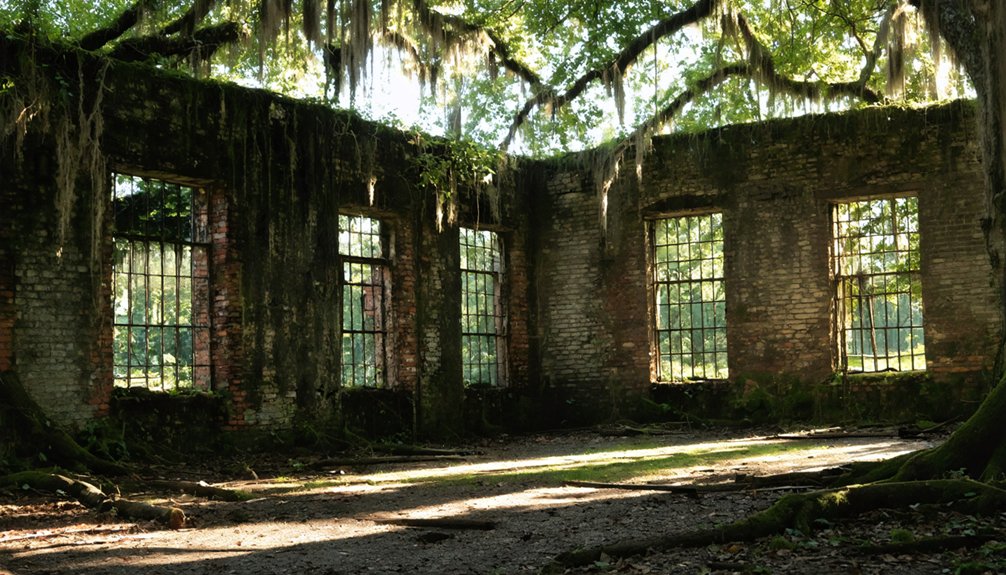
Nestled at the confluence of the Alabama and Cahaba Rivers in Dallas County, Cahawba once stood as Alabama’s inaugural state capital from 1820 to 1826.
After the capital relocated to Tuscaloosa, the town gradually declined until the Civil War repurposed it. In 1863, Confederate forces established Castle Morgan, converting a cotton warehouse into a prisoner-of-war camp for Union soldiers. The warehouse’s 14-foot high walls enclosed approximately 15,000 square feet of space for the prisoners.
From capital to cotton warehouse, Cahawba’s transformation into Castle Morgan exemplified the South’s wartime adaptability.
Despite Cahawba’s architecture being repurposed for confinement, the prison achieved the lowest mortality rate of any Civil War camp. The facility, designed for 500 men, eventually housed over 3,000 prisoners in just six square feet per person. In March 1865, inmates endured a devastating flood that left them standing knee-deep in water for days.
Colonel Henderson and Dr. Whitfield’s management kept deaths below 250 despite severe overcrowding.
Cahawba’s Civil War legacy ended in 1865 when prisoners were released, many boarding the ill-fated Sultana steamboat.
Today, only archaeological remnants mark this once-thriving capital.
Bodie: Gold Rush Town Frozen in Time
While Cahawba represented Alabama’s Civil War legacy, a different abandoned community emerged over 2,000 miles away in California’s eastern Sierra Nevada Mountains.
In 1859, William “Bill” Bodey discovered gold near what would become Bodie, though he perished in a blizzard that same year.
Initially a small mining camp with only 20 miners, Bodie’s history transformed dramatically in 1876 when the Standard Company discovered a profitable gold vein.
By 1879, this Gold Rush boomtown exploded to nearly 10,000 residents with 65 saloons, brothels, and gambling halls.
The wild settlement earned its reputation through frequent shootings and lawlessness.
Located at an elevation of 8,379 feet, Bodie faced harsh conditions that contributed to its challenging living environment and eventual abandonment.
After producing over $38 million in precious metals, Bodie declined rapidly in the 1880s.
Visitors seeking specific information about Bodie should note that the name refers to multiple topics requiring disambiguation in historical research.
Today, you’ll find 200 structures preserved in “arrested decay,” offering an authentic glimpse into America’s mining past.
Military Deception at Elko Tract: The Ghost Town That Never Was
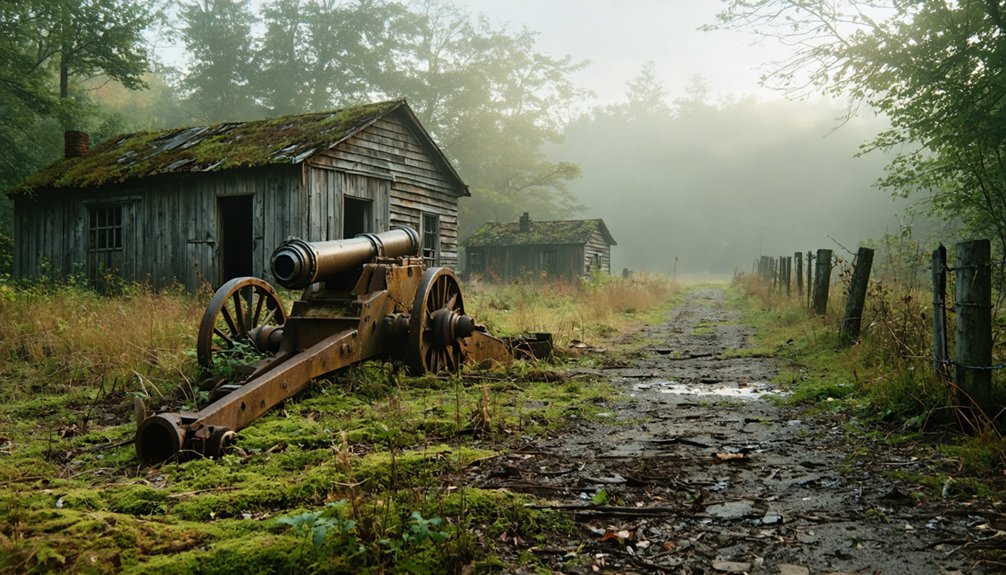
Unlike traditional ghost towns, Elko Tract emerged as a deliberate military phantom during World War II, constructed by the U.S. Army as an exact replica of Richmond’s military airport to divert enemy bombers.
You’ll find that this 2,200-acre installation featured plywood airplanes, imitation buildings, and functional infrastructure designed solely for aerial deception rather than habitation.
Though never tested in battle as Richmond avoided bombing during the war, Elko’s elaborate wartime deception strategy represents an ingenious yet little-known chapter in American defensive tactics. The 1896 Engineer Aviation Battalion constructed the decoy airfield in 1943 to protect the real operations at Byrd Field from potential aerial attacks. The strategic plan involved turning off Richmond’s power while illuminating Elko Tract to mislead enemy aircraft during potential attacks.
Phantom Airfield Tactics
Among the most fascinating aspects of Elko Tract’s history is its role in American military deception during the mid-20th century. Following WWII precedents established by the Ghost Army, military strategists transformed this location into an elaborate phantom airfield designed to mislead enemy reconnaissance.
You’d have witnessed an impressive array of deceptive tactics: inflatable hangars, wooden aircraft mock-ups, and simulated radio traffic creating the illusion of active operations. These 500-pound speaker systems broadcasted convincing military sounds that could be heard up to 15 miles away. These elements generated false signatures while actual assets remained concealed through careful suppression techniques.
The operational impact proved significant. Enemy commanders frequently redirected attacks toward these decoys, wasting resources while creating vital time buffers for authentic military positions. This approach perfectly aligned with the principles that all war is based on deception, as articulated by ancient military strategist Sun Tzu.
These strategies weren’t merely theatrical—they represented sophisticated military deception that saved countless lives by diverting enemy firepower from genuine targets to phantom installations.
Wartime Deception Legacy
The Elko Tract stands as perhaps the most elaborate American ghost town created entirely for wartime deception. In 1942, the federal government seized farmland near Richmond, Virginia, where the U.S. Army’s 936th Camouflage Battalion constructed a convincing decoy airfield designed to mislead German bombers.
You’d be fascinated by the sophisticated deceptive tactics employed—plywood aircraft resembling P-47 fighters, canvas buildings, and wooden trucks arranged to simulate partial concealment efforts.
These installations reflected deep understanding of wartime psychology, specifically how trained enemy pilots identify military targets. The site even included illumination systems mimicking an active base during Richmond blackouts. The tract contained fake runways and hangars that were meticulously designed to appear realistic from the air. The surrounding brush was strategically trimmed to create P-47-shaped silhouettes for enhanced deception effectiveness.
Though never tested against actual German raids, the Elko Tract later became a Cold War bombing practice target before failed attempts to develop it into a segregated mental hospital, leaving behind an eerie legacy of infrastructure abandoned to time.
Lost Cove: Appalachia’s Moonshine Haven
Hidden deep within the rugged terrain of the Pisgah National Forest, Lost Cove emerged as an extraordinary manifestation of Appalachian resilience during the tumultuous Civil War era.
Straddling the North Carolina-Tennessee border, this settlement began when Morgan Bailey reportedly acquired the land for $10 and a shotgun from a Native American.
The community’s frontier resilience shaped its evolution from agricultural self-sufficiency to a thriving moonshine legacy by 1898. Geographic isolation—with steep mountains and the wild Nolichucky River—created perfect conditions for illicit distilling, while jurisdictional ambiguity between states deterred law enforcement.
Though the railroad introduced timber jobs around 1910, economic opportunities eventually dwindled.
The railroad’s promise of prosperity through timber work proved fleeting, as isolation gradually reclaimed Lost Cove’s economic future.
The last family departed on January 1, 1958, ending nearly a century of continuous habitation, leaving behind only whispers of a community defined by self-reliance, neighborly support, and fierce independence.
Natural Forces and Abandonment: How Floods and Fires Claimed Towns
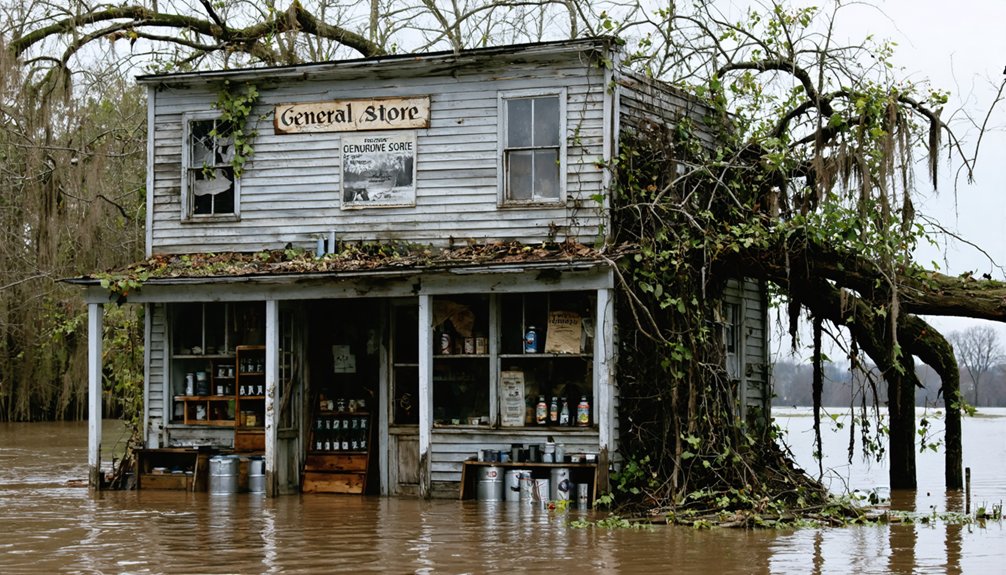
While Civil War battles claimed countless lives, natural disasters silently conquered entire communities throughout post-war America. The historical impacts of these environmental forces permanently altered the American landscape, erasing settlements that might otherwise have flourished.
The hidden gems of Civil War history reveal how these calamities intertwined with human struggles and resilience. By uncovering these lesser-known stories, we gain a deeper understanding of the profound ways in which nature shaped the narratives of survival and loss during this tumultuous time. Each site holds echoes of the past, offering invaluable lessons about community and endurance in the face of adversity.
- Cahawba, Alabama, once the state’s capital, succumbed to devastating floods in 1866 and 1868, leaving only archaeological remnants visible today.
- St. Elmo, Colorado’s prosperity ended when fires ravaged its essential infrastructure, accelerating its transformation into the preserved ghost town you can visit.
- Harrisburg, Utah repeatedly battled both drought and flooding, with Interstate 15 now running through what remains of the repeatedly relocated settlement.
These natural disasters often delivered the final blow to communities already weakened by economic shifts and post-war challenges, transforming thriving towns into historical footnotes.
Walking Among Spirits: Paranormal Tales From America’s Abandoned Towns
Stand at the edge of Cahawba’s ruins or Alton’s empty streets after dusk, and you’ll witness the ethereal movements of soldiers who never departed these now-abandoned settlements.
In Gettysburg and Vicksburg, numerous witnesses report spectral regiments maintaining their eternal watch, with documented sightings of uniformed apparitions marching in perfect formation through town squares and along forgotten roads.
You’ll find these persistent hauntings most concentrated in towns that served as field hospitals or prisoner encampments, where the collective trauma of war appears to have embedded itself into the very landscape.
Moonlit Whispers Linger
As twilight descends upon America’s abandoned Civil War-era towns, the veil between past and present grows thin, revealing spectral inhabitants who’ve never truly departed.
These moonlit encounters have transformed places like Cahawba, Alabama—once a thriving state capital—into epicenters of paranormal activity where disembodied voices echo near crumbling courthouses.
The ghostly tales persist across America’s forgotten landscapes:
- In Bodie, California, visitors witness apparitions in windows of buildings preserved in “arrested decay”
- St. Elmo, Colorado harbors the lingering spirit of one of its last residents, whose presence manifests in the general store
- Cahawba’s history as a Civil War prison camp contributes to frequent reports of cold spots and electronic voice phenomena
Your journey through these haunted ruins reveals America’s spiritual undercurrents, where history refuses to rest.
Phantom Soldiers March
Beyond the crumbling facades and weathered clapboard of America’s forgotten Civil War towns, a more unsettling phenomenon awaits those brave enough to visit after dark.
You’ll witness phantom formations at historic battlefields like Gettysburg, where spectral soldiers march in perfect unison across Little Round Top and Pickett’s Charge areas.
At Fort Sumter, Daniel Hough’s apparition appears alongside other Union soldiers, often accompanied by the distinct scent of gunpowder.
Fort Leavenworth’s parade grounds host pale figures in period uniforms that vanish upon approach, leaving cold spots in their wake.
Fort Monroe’s tunnels echo with Jefferson Davis’s chains, while whispers follow visitors along the seawall.
Even at Fort McAllister, now a state park, Confederate spirits conduct spectral reenactments, maintaining their eternal watch.
These manifestations represent unresolved historical trauma, forever tied to these hallowed grounds.
Frequently Asked Questions
Were Women and Children Allowed to Remain in Prison Camp Towns?
You’ll find prison camp demographics varied greatly. While some women accompanied Confederate officer husbands, most faced family separation policies. Children born in camps were rare, with families typically released earlier than combatants.
How Did Ghost Towns Handle Burials and Maintain Cemeteries After Abandonment?
After abandonment, you’ll find ghost towns’ burial customs faded as cemeteries fell to nature’s reclamation. Community organizations later stepped in for cemetery preservation, clearing vegetation and honoring forgotten veterans’ graves through memorial services.
Did Any Ghost Towns Successfully Revitalize After Their Initial Decline?
Yes, you’ll find many ghost towns achieved successful revitalization through historical preservation efforts. Significantly, Virginia City, Nevada and Deadwood, South Dakota transformed their abandoned landscapes into thriving tourist destinations honoring their frontier heritage.
What Happened to Personal Property When Residents Fled These Towns?
You’ll find many personal belongings were left behind intact, as property rights became unclear during rapid evacuations. Items remained preserved in dwellings, creating the time-capsule effect historians document today.
Were Indigenous Communities Displaced During Ghost Town Establishments?
Yes, many ghost towns were established on lands where you’d find indigenous displacement occurred first. This colonial pattern created profound cultural impact as Native communities lost traditional territories to mining, railroads, and settlements.
References
- https://www.blueridgeoutdoors.com/go-outside/southern-ghost-towns/
- https://www.mentalfloss.com/geography/american-ghost-towns-can-still-walk-through
- https://www.geotab.com/ghost-towns/
- https://www.christywanders.com/2024/08/top-ghost-towns-for-history-buffs.html
- https://www.visittheusa.com/experience/5-us-ghost-towns-you-must-see
- https://www.mythfolks.com/haunted-us-ghost-towns
- https://en.wikipedia.org/wiki/Lists_of_ghost_towns_in_the_United_States
- https://carte-urbex.com/tr/blogs/infos/top-10-abandoned-places-in-the-usa
- https://www.youtube.com/watch?v=inRD6vYBy8M
- https://encyclopediaofalabama.org/article/cahaba-federal-prison/