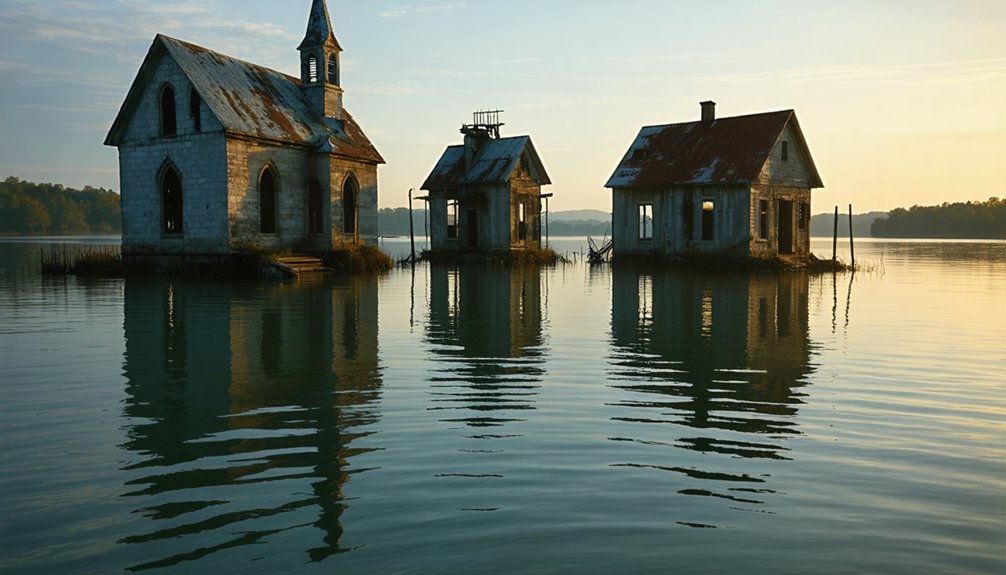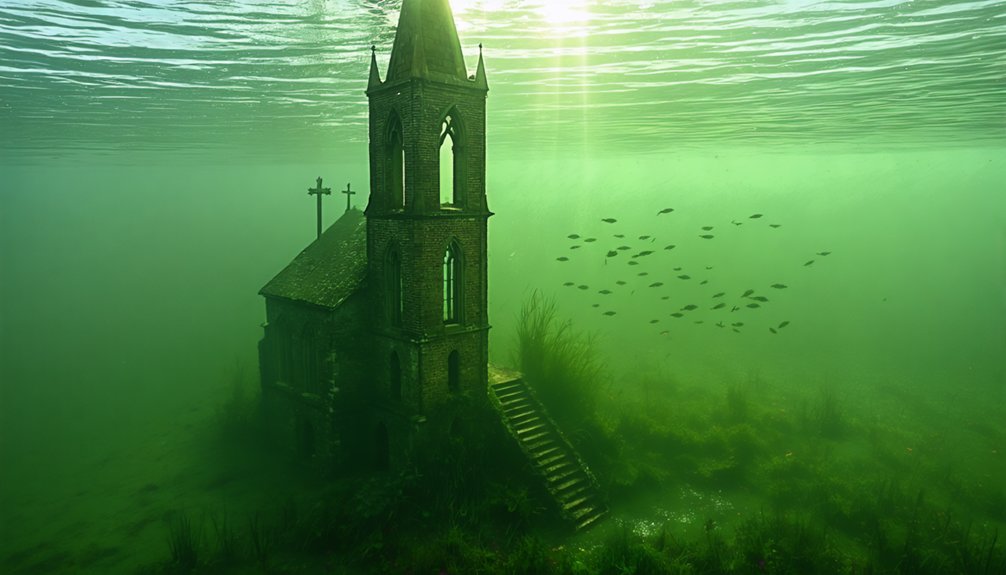
America’s reservoirs conceal hundreds of communities intentionally submerged during 19th-20th century dam construction. You’ll find towns like Robinette, Detroit, and Celilo sacrificed for hydroelectric power, irrigation, and flood control. These submersions disproportionately impacted Indigenous and minority communities, with inadequate compensation for displaced residents. During droughts, structural foundations resurface, revealing archaeological evidence of these systematic erasures. Modern digital techniques now document these subaqueous settlements, illuminating the complex political decisions behind their inundation.
Key Takeaways
- Hundreds of American towns were submerged for dam projects, creating “American Atlantis” communities like Robinette, Detroit, and Celilo.
- Dam construction disproportionately displaced Indigenous and minority communities, causing loss of sacred sites and generational wealth.
- Federal agencies systematically erased communities through destruction and legal disincorporation for hydroelectric power and irrigation priorities.
- Severe droughts reveal submerged foundations and artifacts, while digital archaeology uses LiDAR and sonar to document these lost places.
- Compensation for displaced families was often inadequate, with political calculations determining which communities would be sacrificed.
The American Atlantis: Mapping Submerged Communities

While many Americans remain unaware, the landscape beneath numerous U.S. reservoirs, lakes, and dams contains a rich tapestry of submerged communities collectively known as the “American Atlantis.”
These underwater settlements—including Robinette and Detroit in Oregon, Gad in West Virginia, Concord in Texas, and Celilo in Oregon—once functioned as vibrant population centers with established infrastructure such as schools, churches, post offices, and commercial districts before their inundation. The flooding of Celilo Falls resulted in the devastating loss of ancestral fishing grounds that had sustained Native American communities for thousands of years. Many of these towns were originally established near rivers to secure reliable water access, following the same settlement patterns that have guided human civilization for millennia.
Specialized historical mapping initiatives like the Atlas of Drowned Towns now document these lost communities, preserving their submerged heritage through geographic coordinates and historical narratives.
During drought periods, you’ll find exposed remnants of streets and building foundations temporarily visible, offering rare glimpses into America’s drowned past—physical evidence of entire communities sacrificed for infrastructure development.
Waters of Progress: Dam Construction and Community Sacrifice
You’re examining one of America’s most profound infrastructure dilemmas: the calculated flooding of established communities to enable massive dam projects that promised regional economic transformation.
The engineering priorities of agencies like the Bureau of Reclamation systematically prioritized hydraulic efficiency and power generation over the preservation of towns like Detroit, Oregon, where displacement constituted an unquantifiable cultural cost.
The devastation of Johnstown after the South Fork Dam collapsed in May 1889 stands as one of the deadliest infrastructure failures in American history, killing thousands when a wall of water obliterated the thriving industrial town.
These submerged municipalities—now preserved only in archival photographs and oral histories—represent the complex calculus of American modernization, where progress required specific communities to bear disproportionate sacrifice.
Communities Sacrificed for Progress
Throughout America’s quest for water management and energy production, the profound transformation of river ecosystems into reservoir systems has demanded extraordinary sacrifices from hundreds of communities.
You’ll find the evidence across the West—over 500,000 acres of agricultural land submerged beneath Missouri River reservoirs, dozens of towns deliberately razed and flooded along the Snake and Columbia Rivers.
Federal agencies methodically erased these communities through calculated destruction: buildings burned, orchards uprooted, towns legally disincorporated.
The erasure extends beyond physical structures to cultural foundations, particularly devastating Indigenous fishing economies at sites like Celilo Falls. An example of this systematic relocation occurred in 1925 when the Bureau of Reclamation relocated American Falls, Idaho, to make way for the American Falls Dam.
In 1953, the construction of Garrison Dam forced the displacement of 325 Hidatsa families from their established community of Elbowoods, North Dakota.
This systematic displacement represents a pattern of historical amnesia where community resilience faces overwhelming federal power.
The narrative of “progress” deliberately obscures these sacrifices, leaving submerged towns as powerful symbols of communities deemed expendable for national water infrastructure development.
Engineering Versus Human Displacement
The engineering marvels that transformed America’s river systems into regulated reservoirs reflect a stark tension between technological ambition and human displacement.
You’re witnessing the consequences of a national calculus where engineering ethics were subordinated to utilitarian progress—dams like Brownlee (1957) and Detroit (1949-1953) prioritized hydroelectric generation and irrigation while forcing thousands from ancestral lands.
The technical parameters favored reservoirs over communities: 735 families evacuated from Watauga’s 458 square miles, compensation often inadequate at $125/acre.
Indigenous populations suffered disproportionately, losing cultural sites like Celilo Falls. Meanwhile, engineers meticulously orchestrated deforestation, building demolition, and cemetery relocation.
This historical pattern reveals the fragility of community resilience when confronted with infrastructural imperatives—your freedom to remain rooted perpetually contingent upon distant bureaucratic decisions. The Toledo Bend Reservoir, built in the early 1960s, became the largest human-made lake in the South after submerging numerous communities by 1966. Adamsville, Alabama represents another tragic example where a community never recovered after being largely destroyed by flood, demonstrating how natural and man-made water disasters permanently alter settlement patterns.
Forgotten Underwater Legacies
Beneath America’s engineered waterways lie the submerged remnants of once-thriving communities—sacrificed in a decades-long campaign of national infrastructure development.
These forgotten legacies manifest physically when drought reveals foundations at Lake Mead, or archaeologically through documented submerged histories in the “Atlas of Drowned Towns.”
You’re witnessing the resurgence of erased narratives when low water levels expose St. Thomas, Nevada or when preserved dedication stones from Youghiogheny communities stand as silent witnesses to government-mandated displacement.
The submersion of Indigenous sites like Celilo Falls represents more than physical loss—it’s cultural erasure that remains inadequately compensated.
Between the 1920s and 1970s, dozens of communities throughout the Snake and Columbia River basins were systematically eliminated, their orchards uprooted, buildings bulldozed or burned, all to facilitate water impoundment that privileged distant urban beneficiaries over local autonomy.
The Human Cost of Hydroelectric Power
You’re witnessing the significant anthropological impact of America’s hydroelectric ambitions through the lens of “sacrifice zones,” where hundreds of communities were permanently submerged beneath reservoirs during the mid-20th century.
These displaced populations—from Oregon’s Detroit to Pennsylvania’s Kinzua—experienced profound socio-cultural disruption, with inadequate compensation failing to address the severance of generational connections to place and heritage. During droughts, eerie reminders emerge as old street signs and gravestones become visible in many of these flooded areas.
These haunting remnants often lead adventurers to explore abandoned towns in California, where history and nature intertwine. As the landscape shifts, the stories of those who once called these places home linger in the air. Such explorations not only reveal the past but also invite reflections on resilience and transformation in the face of change.
The destruction of landmarks like Celilo Falls represents a particularly troubling pattern where indigenous communities bore disproportionate burdens, losing not just homes but irreplaceable cultural sites central to their identity and subsistence. The 1948 flood that destroyed Vanport, Oregon and displaced 18,000 residents later became a justification for building additional dams that would create more of these sacrifice zones.
Displaced Communities’ Untold Stories
While hydroelectric dams powered America’s mid-century industrial expansion, they simultaneously inflicted devastating, often overlooked human costs on countless communities across the nation’s riverways.
You’ll find displacement narratives particularly poignant among indigenous populations, where the Pick-Sloan Plan submerged over 350,000 acres across seven reservations.
These projects didn’t merely inundate physical spaces—they drowned centuries of cultural heritage, economic systems, and community frameworks. The collaborative initiative documents these losses while preserving the stories of affected communities for future generations.
Detroit, Oregon and American Falls, Idaho exemplify systematic community erasure: buildings burned, orchards uprooted, cemeteries relocated.
Despite catastrophic disruption, community resilience manifested through preservation efforts.
The Atlas of Drowned Towns now documents these submerged histories, highlighting the disproportionate burden placed on tribal nations whose river-based economies and ancestral connections were sacrificed for industrial progress.
Sacrifice Zones Reconsidered
The concept of “sacrifice zones”—areas deliberately surrendered for presumed greater economic gain—finds no clearer illustration than in America’s hydroelectric dam projects of the mid-20th century.
You’re witnessing the aftermath of calculated decisions where entities like the TVA designated entire communities as expendable for regional electrification.
The disproportionate burden fell on Indigenous populations, exemplified by the Seneca Nation’s loss of 10,000 acres and nine communities to the Kinzua Dam.
This pattern reveals how sacrifice zones systematically targeted communities with diminished economic viability or limited political capital.
Today’s reconsideration of these zones involves critical examination of community resilience in the face of displacement.
Modern dam removal efforts represent a paradigm shift—acknowledging that what once seemed like necessary sacrifice now appears as avoidable cultural and ecological devastation.
Erased Heritage: Cultural Losses Beneath the Surface
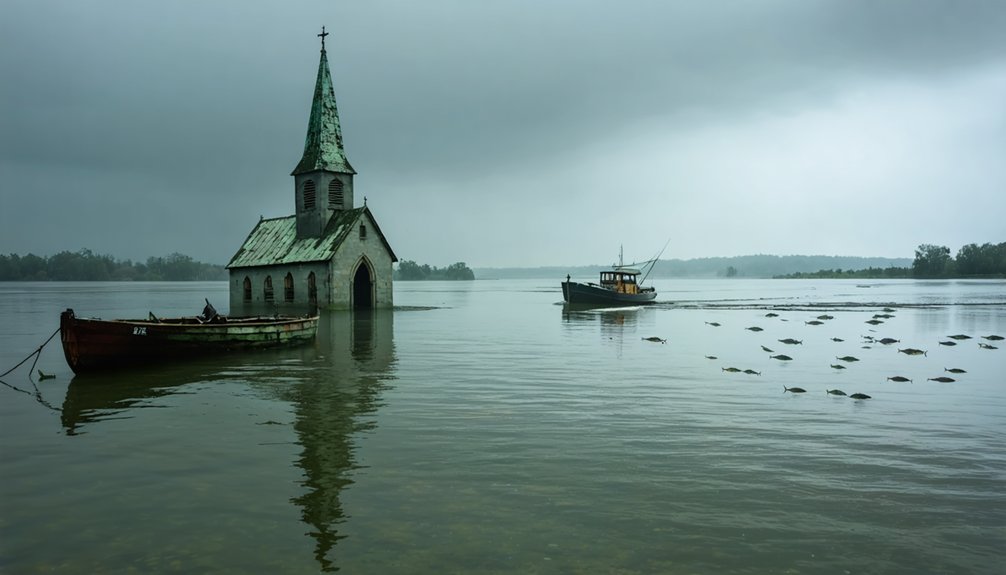
Beneath the placid waters of America’s engineered reservoirs lies a profound cultural catastrophe, as dam construction has permanently submerged over 1.13 million acres of tribal land—an area exceeding Rhode Island’s total size.
This systematic cultural erasure has obliterated sacred indigenous sites like Celilo Falls, where centuries-old fishing traditions vanished during the 1957 Dalles Dam flooding. You’ll find underwater relics of demolished churches and community centers that once anchored rural settlements, now preserved only through documentation efforts like the Atlas of Drowned Towns project.
Archaeological heritage faces particularly devastating consequences, with over 90 percent of American Indian sites already compromised.
The submersion of these irreplaceable cultural landmarks—from bottomland forests reduced to 5-20 percent of their original extent to entire riverport towns—represents not merely economic displacement but the permanent destruction of humanity’s shared cultural record.
Untold Stories: Minority Communities and Displacement
Disproportionately impacted by America’s reservoir construction, Black communities faced systemic displacement through mid-20th century federal dam projects that submerged entire towns without adequate compensation or relocation assistance.
These displacement narratives remain largely unacknowledged in mainstream historical accounts—communities like Oscarville, Georgia and Vanport, Oregon experienced violent evictions, with property seizures often executed at gunpoint or through deliberate flooding.
You’ll find that approximately 18,500 families nationwide lost their homes to these projects, with Black families comprising over one-third of those displaced.
The resulting fragmentation destroyed generational wealth, communal infrastructure, and agricultural economies.
Despite this devastation, cultural resilience persists as descendants work to reclaim their heritage and seek reparations for communities erased beneath America’s waterways—histories intentionally submerged alongside their physical remnants.
Drowning History: Cemetery Relocations and Sacred Spaces

You’ll find numerous instances where cemetery relocations for reservoir projects remained incomplete, leaving human remains submerged beneath artificial lakes across the United States.
Archaeological surveys have identified unmapped burial sites during drought conditions when water levels recede, revealing the limitations of historical documentation and relocation efforts.
These underwater interments represent both logistical failures in grave identification and deliberate decisions based on cost-benefit analyses that prioritized development timelines over thorough exhumation protocols.
Underwater Graves Remain
When manmade lakes submerged entire towns across the United States, cemetery relocations became a critical ethical concern in the reservoir planning process. Yet numerous burial sites were ultimately left beneath the rising waters. These underwater graves represent a submerged heritage of forgotten ancestors that continues to resonate culturally.
During construction of reservoirs across America, authorities made inconsistent decisions about grave sites:
- Small family cemeteries on abandoned farms were frequently left undisturbed if no descendants came forward.
- At Lake Texoma, submerged gravestones reappear during drought periods, physical reminders of burial grounds below.
- Lake Red Rock in Iowa preserved only one cemetery above water level.
- Documentation quality varied considerably between projects, creating historical gaps.
During droughts when water levels recede, you’ll occasionally glimpse these underwater monuments—tangible evidence of communities sacrificed for development.
Sacred Land Underwater
The submersion of sacred spaces beneath reservoir waters represents one of the most profound ethical challenges in American infrastructure development, as cemetery relocations demanded both technical precision and cultural sensitivity.
You’ll find that sacred site preservation wasn’t universally achieved—approximately 10 burial grounds vanished beneath Toledo Bend’s waters due to insufficient identification efforts.
While Sabine River Authority meticulously transferred exhumed remains into pine boxes, replicating original cemetery layouts for community remembrance, other projects like Lake Redrock left most burial grounds submerged.
When examining these infrastructural transformations, it’s essential to recognize that community involvement greatly influenced outcomes. Local knowledge helped identify graves, while descendants often participated in ceremonial reinterments.
The technical complexity of relocating 1,200 bodies for the Neversink project demonstrates how preservation efforts struggled against construction timelines, resulting in an imperfect archaeological record of America’s submerged sacred heritage.
Resurfacing Memories: When Droughts Reveal the Past
Despite their watery graves beneath America’s reservoirs, numerous historic river towns periodically resurface during severe drought conditions, offering glimpses into communities abruptly abandoned decades ago.
These reemergent sites create profound emotional resonance and cultural connections as descendants encounter tangible remnants of their heritage.
Drought-induced archaeological revelations typically include:
- Structural foundations from towns like Old Detroit, Oregon (submerged 1953) and St. Thomas, Nevada (abandoned 1938)
- Transportation artifacts including 19th-century wagons and the North Alabama steamboat hull
- Domestic remnants such as Lemoyne’s root cellars that evoke powerful familial memories
- Infrastructure elements revealing town planning and architectural styles frozen at submersion
Climate change-intensified drought cycles continue to expose these hydrologically-concealed historical strata, creating temporary windows into America’s submerged past while challenging preservation efforts.
The Politics of Submersion: Decision-Making and Power Dynamics

Behind every submerged American river town lies a complex web of political calculations that determined which communities would survive and which would disappear beneath reservoir waters.
The consolidation of executive power, exemplified by Coolidge’s creation of a quasi-governmental commission during the 1927 Mississippi River flood, established precedents for federal oversight in water management decisions.
You’ll find that political negotiations between river basin representatives often determined community fates, with regional interests competing for federal resources while displacement consequences received inadequate consideration.
The Jones-Reid Flood Control Act’s $325 million appropriation ($3.7 billion modern equivalent) shifted responsibility from local to national government, prioritizing navigation and flood control over preservation of riverside communities.
This power realignment enabled decisions like the Dalles Dam construction that submerged cultural sites without adequate compensation mechanisms for displaced populations.
Ecological Transformations: From Riverbed to Reservoir
When river towns submerge beneath reservoir waters, profound ecological transformations occur as complex riverbed ecosystems convert to fundamentally different aquatic environments.
These changes fundamentally alter ecological resilience mechanisms established over millennia, as flowing water systems give way to lentic conditions.
The primary ecological consequences include:
The primary ecological consequences transform entire ecosystems, severing ancient connections and replacing specialized adaptations with fundamentally altered survival mechanisms.
- Native riverine adaptations become disadvantageous as still-water specialists outcompete flowing-water species.
- Sediment dynamics shift dramatically, creating hypoxic zones through increased siltation and stratification.
- Terrestrial habitat inundation eliminates ecosystem services provided by riparian vegetation and soil structures.
- Migration pathways fragment, severing evolutionary connections and reducing genetic exchange.
You’re witnessing not merely a flooding event but a complete ecological regime shift that continues to evolve decades after submergence, with greenhouse gas emissions, invasive proliferation, and downstream hydrological alterations extending impacts beyond the reservoir boundaries.
Digital Archaeology: Preserving Sunken Towns in Virtual Space
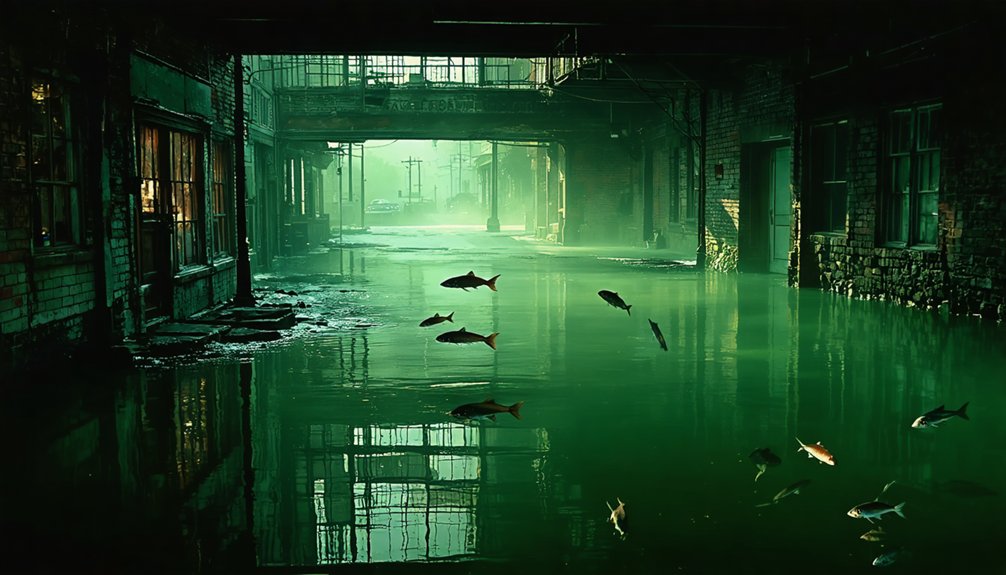
While the ecological metamorphosis of submerged towns represents physical loss, digital archaeology offers a powerful countermeasure through virtual preservation techniques.
You’ll find underwater LiDAR, sonar mapping, and photogrammetry now enable high-precision documentation of submerged structures without disturbing fragile sites—a cornerstone of archaeological ethics.
The integration of GIS technology with historical maps creates extensive spatial analysis opportunities, while open-source databases like the Atlas of Drowned Towns democratize access to this submerged heritage.
Virtual and augmented reality reconstructions transform raw archaeological data into immersive historical experiences, liberating these narratives from their watery confines.
Despite challenges of turbidity, legal access restrictions, and technical limitations, digital preservation techniques continue evolving, allowing you to explore America’s drowned communities while ensuring their protection for future generations.
Frequently Asked Questions
Can Modern Technology Help Recover Artifacts From Sunken Towns?
You’ll find advanced underwater archaeology technologies revolutionize artifact recovery from submerged sites. ROVs, 3D photogrammetry, and specialized conservation techniques enable precise documentation and extraction of historical materials.
How Did Displaced Residents Maintain Community Connections After Relocation?
You’ll observe relocated communities sustaining connections through local churches, civic organizations, community events, and historical reunions. These social networks function as resilience mechanisms, enabling cultural continuity despite geographic displacement. Community support systems preserved collective memory.
What Legal Precedents Emerged From Forced Community Relocations?
You’ll find that eminent domain precedents from forced relocations established minimal displacement rights, prioritizing federal interests over communal autonomy, while creating legal pathways for resistance through compensation challenges and procedural requirements.
Did Any Communities Successfully Resist Submersion Plans?
Like salmon swimming upstream, you’ll find community activism rarely succeeded. Despite historical preservation efforts, legal challenges typically failed, with resistance yielding only minor project modifications or improved compensation terms, not complete victory.
How Do Former Residents’ Descendants Connect With Their Submerged Heritage?
You’ll find descendants preserving their submerged heritage through oral histories, reunion events, digital archives, and cultural identity initiatives—systematically documenting ancestral narratives while asserting their freedom to reclaim underwater historical landscapes.
References
- https://travelnoire.com/black-american-towns-hidden
- https://clui.org/newsletter/spring-2005/immersed-remains-towns-submerged-america
- https://www.neh.gov/article/atlas-drowned-towns
- https://www.nwcouncil.org/reports/columbia-river-history/chronology/
- https://www.kcur.org/history/2023-07-27/how-missouri-made-the-lake-of-the-ozarks-crimes-sunken-homes-and-dreams-of-a-midwest-oasis
- https://en.wikipedia.org/wiki/Floods_in_the_United_States_(1900–1999)
- https://www.youtube.com/watch?v=uZmv-5p5KPQ
- https://idahohumanities.org/the-atlas-of-drowned-towns/
- https://offbeatoregon.com/1406e.lost-cities-oregon-atlantis.html
- https://www.livescience.com/real-life-atlantis-settlements.html