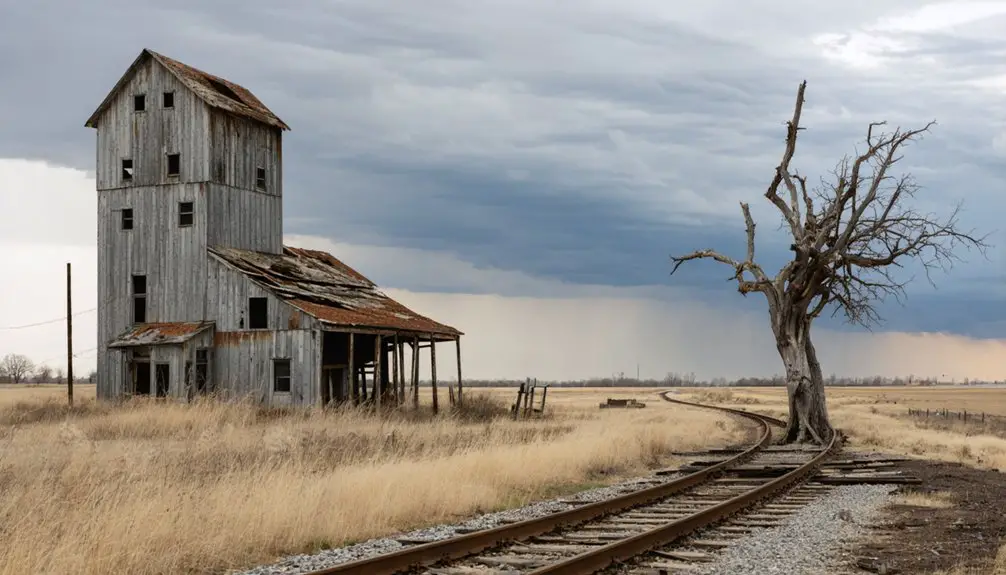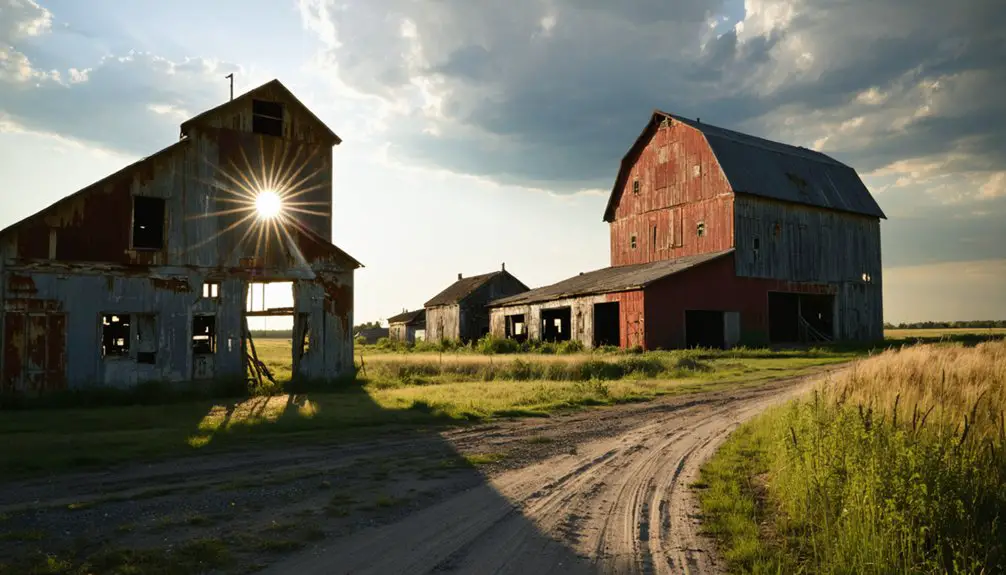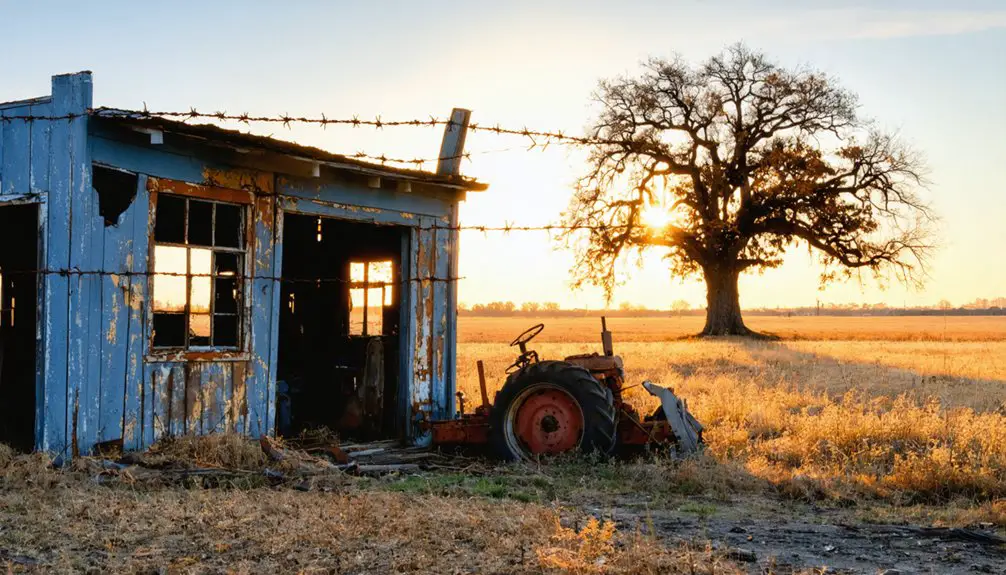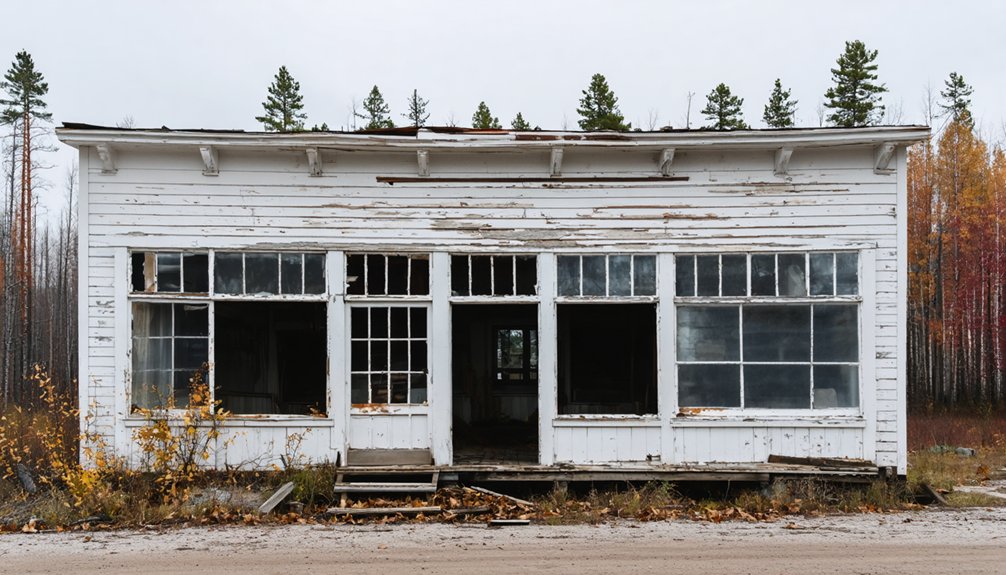
Northern Minnesota’s ghost towns emerged and vanished with the region’s extractive industries—you’ll find abandoned mining settlements in the Keweenaw Peninsula, where operations once produced three-quarters of America’s copper by 1850, and logging communities like Forest Center, which housed 250 residents before timber depletion. Along Lake Superior’s North Shore, company towns like Taconite Harbor rose in the 1950s and were dismantled by the 1990s, while Chippewa City’s 100 families disappeared after Highway 61’s construction. These forgotten places reveal how boom-and-bust cycles shaped the region’s communities and landscape.
Key Takeaways
- Northern Minnesota ghost towns emerged from collapsed copper mining, timber, and taconite industries spanning the 1830s through 1990s.
- Keweenaw Peninsula copper mines produced 75% of America’s copper by 1850 before labor strikes and closures created abandoned communities.
- Timber industry settlements flourished along rivers until forest exhaustion and agricultural failures led to widespread abandonment by 1900s.
- Taconite Harbor was built in the 1950s as a company town and completely dismantled by the 1990s.
- Chippewa City thrived with 100-200 Ojibwe families before Highway 61 construction, fires, and the 1918 flu epidemic decimated it.
The Rise and Fall of Lake Superior’s Mining Communities
Long before the industrial thunder of stamp mills echoed across Lake Superior’s shores, Indigenous peoples understood the land’s copper wealth intimately. The Ojibwe worked these lands for millennia before the 1842 Treaty of La Pointe transferred mineral rights to Washington’s control.
You’d have witnessed remarkable transformation by 1850—Michigan’s Keweenaw Peninsula produced three-quarters of America’s copper. The Cliff Mine alone returned $2.5 million before closing in 1870. Towns like Gay sprouted around operations like Mohawk and Wolverine, where immigrant families built communities. The Quincy Mining Company formed in 1846 when the Portage Mining Company and Northwestern Mining Company merged operations.
But freedom came with costs. Labor unrest erupted in 1946’s 104-day strike. The environmental impact proved devastating—25 million tons of stamp sand dumped lakeside, creating legacies that outlasted the mines themselves. By the Depression, most operations had shuttered. Mining companies maintained substantial worker housing at low rents to attract dependable laborers throughout the copper region.
Timber Industry Settlements in the Northwoods
Nobody suspected that a few troops cutting pine along the Rum River in the 1820s would trigger Minnesota’s timber empire.
You’d watch entire communities spring up around timber processing facilities, like Gull River’s pioneering mill in the 1830s or Marine on St. Croix’s operations floating lumber downstream.
By 1875, sophisticated timber transportation networks—steamboats, railroads, and river rafts—moved Minnesota pine from New York to Denver. Towns like Duluth exploded, gaining 80% population in five years before 1905. The Alger-Smith mill alone processed over a million board feet annually.
Logging camps evolved from primitive Maine-style shanties to balloon-frame structures covered with tarpaper by 1915, reflecting the industry’s technological advancement.
But you couldn’t sustain such aggressive harvesting. By the 1920s, exhausted forests and agricultural failures left these once-thriving settlements abandoned, their timber transportation networks rusting into silence across the cutover landscape. White pine’s superior workability made it the most coveted timber from Maine to Minnesota, driving the rapid expansion of logging operations.
Ghost Towns Along the North Shore
You’ll find the North Shore’s ghost towns clustered in two counties—Lake and Cook—where mining booms and lumber operations once sustained thriving communities of families. Taconite Harbor housed power plant workers in the 1950s with full streets and a basketball court, while Chippewa City peaked at 100 families in the 1890s before Highway 61 construction literally erased homes from the landscape.
Today, you can still walk overgrown paved roads lit by forgotten streetlights at Taconite Harbor, or explore the 20 abandoned cabins remaining at Chippewa City, the most accessible ghost town along Lake Superior’s shoreline. Forest Center once thrived with 250 residents along Lake Isabella’s southern shore before the lumber industry collapsed due to its proximity to the BWCA. Other ghost towns like Samm, Minnesota have joined this list of forgotten communities scattered throughout the region.
Mining Towns and Ports
Along Minnesota’s North Shore, the ghost town of Taconite Harbor stands as the region’s newest abandoned community—a company town built entirely from scratch in the 1950s and completely dismantled by the early 1990s. Erie Mining Company constructed twenty homes, a school, and recreational facilities to house workers shipping 10 million tons of taconite pellets annually. You’ll find remnants of their basketball court and crumbling streetlights where families once thrived.
The environmental impact of mining—relentless dust and noise pollution—drove residents away during the 1970s. When the 1982 industry collapse slashed the workforce to 100 employees, the town’s fate was sealed. In 1986, residents received offers to purchase their homes for $1 and relocate them elsewhere. By 1988, everyone had left. Just south, Silver Bay faced similar environmental battles when Reserve Mining Company was accused of dumping waste rock into Lake Superior in 1972, leading to a five-year legal trial. Today, overgrown streets offer outdoor recreation opportunities for those exploring Iron Range history, a stark reminder of industry’s impermanence.
Chippewa City Near Grand Marais
Just a mile northeast of Grand Marais, the ghost town of Chippewa City tells a story drastically different from the mining communities that dot Minnesota’s Iron Range. This lakeside settlement flourished with 100-200 Ojibwe families during the 1880s lumber boom, only to vanish completely by the 1930s.
The Ojibwe population decline resulted from:
- Highway 61 expansion (1901) – Homes demolished for road construction
- 1907 fire – Multiple dwellings destroyed
- 1918 flu epidemic – Devastating death toll
- Great Depression – Final exodus of remaining families
You’ll find St. Francis Xavier Church still standing—a commemoration of church architectural history. Built in 1895 by Ojibwe carpenter Frank Wishkop using hand-hewed dovetailed timber, it’s now listed on the National Register of Historic Places, representing this community’s enduring legacy. While exploring this ghost town location, consider staying at nearby Cascade Lodge between Grand Marais and Lutsen, where you can base yourself for further North Shore adventures.
Grand Marais itself experienced a similar decline, with its population dropping after the lumber boom ended in 1911, though unlike Chippewa City, it managed to reinvent itself as an arts community and tourist destination.
Industrial Remnants and Structures
Few ghost towns reveal the boom-and-bust cycle of Minnesota’s industrial age as starkly as Taconite Harbor. When you visit today, you’ll find post demolition infrastructure scattered across the landscape—cracked basketball court pavement, empty street grids, and a solitary streetlight marking where Main Street once began.
The nature reclamation process has transformed this former company town into something hauntingly beautiful. Twenty-two pastel homes that housed families from 1957 to 1988 vanished after residents received eviction notices and $1 buyout offers. Erie Mining Company dismantled everything by 1991, trucking structures to Silver Bay and beyond.
Yet the safe harbor, boat launch, and outdoor machinery museum remain, drawing explorers seeking tangible connections to the 10-million-ton taconite operation that once defined this shore.
When the Railroad Changed Its Course
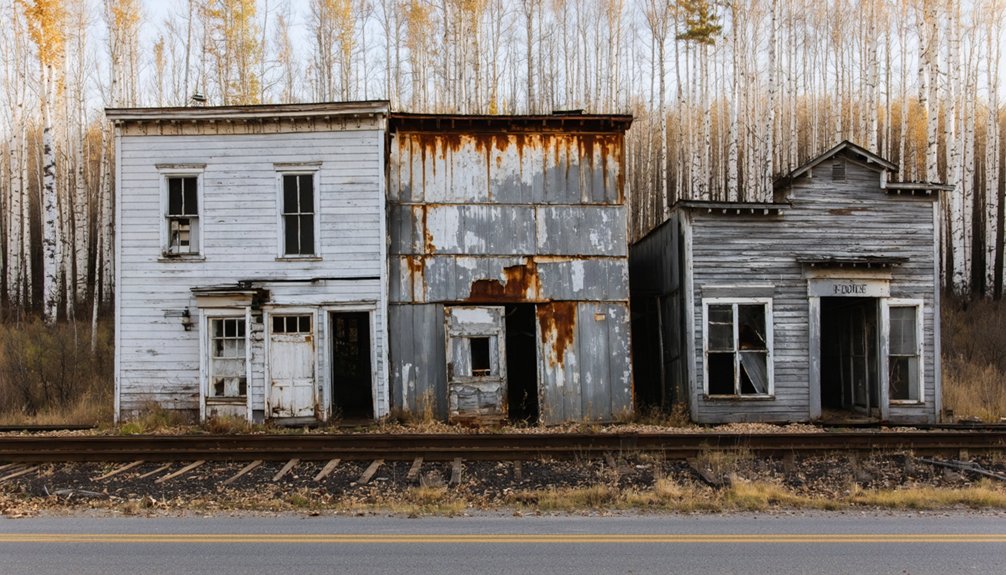
When the Eastern Minnesota Railway carved its “Bee Line” cutoff through Cambridge in 1899, the railroad fundamentally signed death warrants for towns along the original Elk River-Milaca corridor. You’ll find this pattern repeated across Northern Minnesota—efficiency always trumped loyalty to established settlements.
How rail network changes destroyed communities:
- Speed over service – Companies prioritized faster routes, abandoning towns that had built entire economies around depot locations
- Gradual starvation – Communities didn’t vanish overnight; they withered as passenger counts dropped and freight trains stopped calling
- No recourse – Towns had zero leverage once corporations decided profitability mattered more than people
- Community population shifts – Families relocated to new rail hubs, leaving empty storefronts and abandoned homes behind
The railroad giveth, and the railroad taketh away.
Communities Lost to War and Migration
Unlike the slow economic strangulation that killed railroad towns, some Northern Minnesota communities vanished through sudden violence and forced displacement. The U.S.-Dakota War of 1862 devastated Fort Ridgely, leaving 34 dead and destroying 141 of 190 structures.
This conflict triggered massive Native American displacement—approximately 6,000 Dakota people lost their homes, with 1,700 women, children, and elders interned at Fort Snelling where 300 died during the brutal 1862-63 winter.
Wasioja’s story differs but carries equal tragedy. Young men enlisted for the Civil War, creating wartime civilian casualties back home as the town slowly bled out its future. When those volunteers didn’t return, growth halted abruptly.
Today you’ll find seminary ruins standing as monuments to communities that couldn’t survive their members’ absence—whether through forced removal or distant battlefields.
Exploring Accessible Abandoned Sites Today
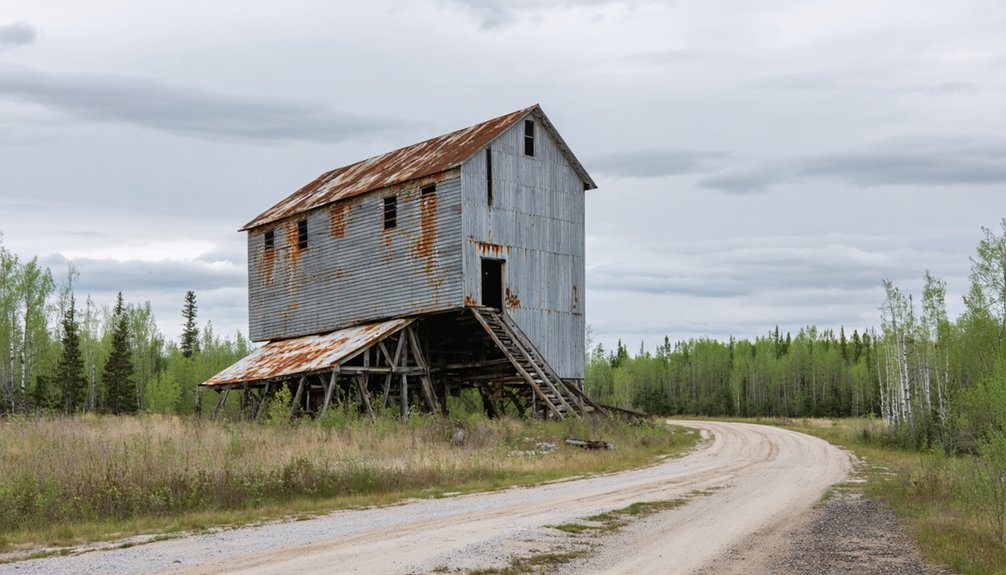
You’ll find Taconite Harbor easily accessible along your Lake Superior drive, though few physical remnants mark where workers and families once filled this mid-20th century company town before it emptied almost overnight.
When you visit these sites, wear sturdy shoes like the ones recommended for the Elcor Mining Remnants—crumbling foundations and scattered artifacts demand respect for both your safety and the site’s integrity.
Local preservationists stress that touching or removing any materials destroys the historical record these abandoned places hold for future generations who’ll want to understand how quickly a thriving community can vanish.
Chippewa City Access Routes
The journey to Chippewa City ranks among the simplest ghost town expeditions you’ll undertake in northern Minnesota. You’ll find this vanished settlement along Highway 61, just 1.5 miles northeast of Grand Marais—no off-road vehicles required, just straightforward paved access that respects your independence.
Key landmarks you’ll encounter:
- St. Francis Xavier Church (1895)—featuring hand-hewed dovetailed timber church architecture demonstrating the historical importance of site through its National Register listing
- The cemetery—one-eighth mile north on a dirt road, marking graves of founding families like Beargrease and Wishcop
- Cook County Home Center—occupying the former community core
- Modern residences—dotting both roadsides where pioneers once settled
Navigate using coordinates 47°45′35″N 90°18′07″W. The church remains open for exploration, maintained by the Cook County Historical Society.
Taconite Harbor Site Features
Where Highway 61 curves toward Lake Superior roughly twenty miles southwest of Grand Marais, a winding access road descends to what remains of Taconite Harbor—a company town that thrived for three decades before Erie Mining shuttered operations in 1989.
You’ll find street foundations tracing the two-block layout where twenty-two prefabricated homes once stood, erected in just two hours each back in 1957. The basketball court still marks the former town center, while mowed lawns reveal empty residential plots with stunning lake views.
Though harbor development challenges and demolished ore storage facilities left minimal industrial traces, the outdoor museum displays taconite samples and mining equipment. The public boat launch remains open, and nearby Cross River Heritage Center preserves the community’s story.
Safety and Preservation Guidelines
Before you venture onto any abandoned site in northern Minnesota, understand that these locations demand both respect for their history and awareness of real dangers. Your freedom to explore comes with responsibility for site assessment and preservation.
Essential practices for responsible exploration:
- Research property status beforehand – confirm public access or secure landowner permission to avoid trespassing charges
- Leave artifacts untouched – take only photographs to maintain historical integrity for future visitor engagement
- Avoid entering structures – view collapsed buildings from safe distances, watching for unstable ruins and debris
- Pack proper gear – bring sturdy footwear, water, first aid supplies, and inform others of your itinerary
Metal detecting faces fines up to $800 in many areas. Your careful approach protects both Minnesota’s archaeological heritage and your personal safety.
The Legacy of Northern Minnesota’s Vanished Towns
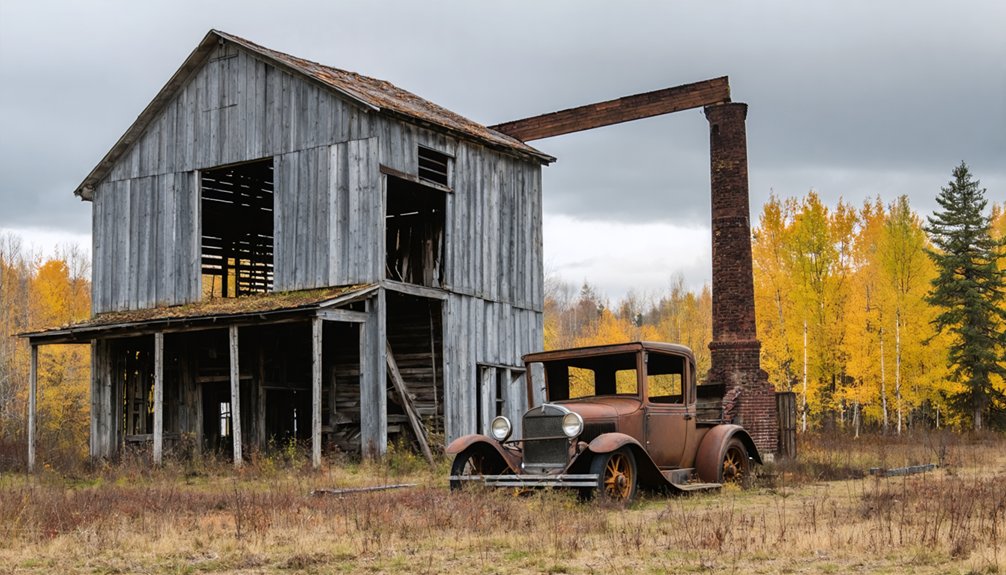
Across Minnesota’s northern landscapes, abandoned foundations and overgrown streets tell stories of communities that once buzzed with miners, loggers, and frontier families chasing prosperity. These ghost towns represent more than failed economic ventures—they’re monuments to human ambition and adaptation.
Among these forgotten places are ghost towns near Duluth Minnesota, where remnants of structures stand silently as reminders of life once lived. Each site holds its own unique history, inviting exploration and reflection on the people who shaped these communities. As visitors wander through the crumbling remains, they uncover tales of resilience and the relentless pursuit of a better life.
Places like Elcor and Calumet thrived when iron ore seemed limitless, while Old Crow Wing’s decline followed the forced removal of Ojibwe residents to White Earth in 1868. You’ll find displaced native communities’ histories intertwined with abandoned farmsteads and mining camps throughout the region.
Sites like Forestville’s living history park now preserve what railroads and resource depletion couldn’t completely erase. Each crumbling structure reminds you that even the most promising settlements faced forces beyond their control—market crashes, transportation shifts, and resource exhaustion that reshaped Minnesota’s map.
Frequently Asked Questions
Are There Any Safety Concerns When Visiting Ghost Town Sites?
You’ll face potential structural hazards like unstable foundations and collapsing roofs requiring sturdy boots. Wildlife encounters are common in overgrown areas. Environmental contamination, illegal activities, and trespassing laws also threaten your safety, so research access beforehand.
Can Artifacts Be Legally Collected From Abandoned Ghost Town Locations?
You can’t legally collect artifacts from ghost towns due to ownership disputes and trespassing concerns. Even abandoned sites have landowners, and removing historical items violates preservation laws. Always seek permission and respect our shared cultural heritage.
Which Ghost Towns Have the Best Preserved Buildings Still Standing?
Like a time capsule frozen in place, you’ll find Forestville State Historic Site offers the best preserved historical structures—including the fully stocked Meighen General Store—creating exceptional local tourism opportunities for exploring authentic 1890s Minnesota community life.
What Is the Best Season to Visit Northern Minnesota Ghost Towns?
You’ll find fall offers the best balance—stunning photogenic conditions with vibrant foliage, ideal seasonal accessibility to most sites, and comfortable exploration weather. Though weekdays work better for avoiding crowds, you’re free to roam these abandoned communities peacefully.
Do Any Former Ghost Town Residents Hold Annual Reunion Gatherings?
You’ll find West Union’s spirit lives on through community events like their 1928 Pioneer Reunion, where former residents gathered twenty years after initial settlements. While northern Minnesota’s local legends fade, southern towns actively preserve these cherished connections through documented gatherings.
References
- https://en.wikipedia.org/wiki/List_of_ghost_towns_in_Minnesota
- https://exploringnorthshore.com/north-shore-ghost-towns/
- https://goodhuecountyhistory.org/learn/county-history/ghost-towns/
- https://www.youtube.com/watch?v=Naciyj05E1Y
- https://www.carvercountyhistoricalsociety.org/ghost_towns.php
- https://thievesriver.com/blogs/articles/ghost-towns-in-minnesota
- https://www.minnesotahistory.org/post/a-complete-guide-to-the-ghost-towns-of-hennepin-county
- https://quickcountry.com/minnesotas-abandoned-ghost-towns/
- https://pbsnorth.org/show/minnesotas-lost-mining-towns/
- https://www.exploreminnesota.com/seasons/fall/spookiest-places-minnesota