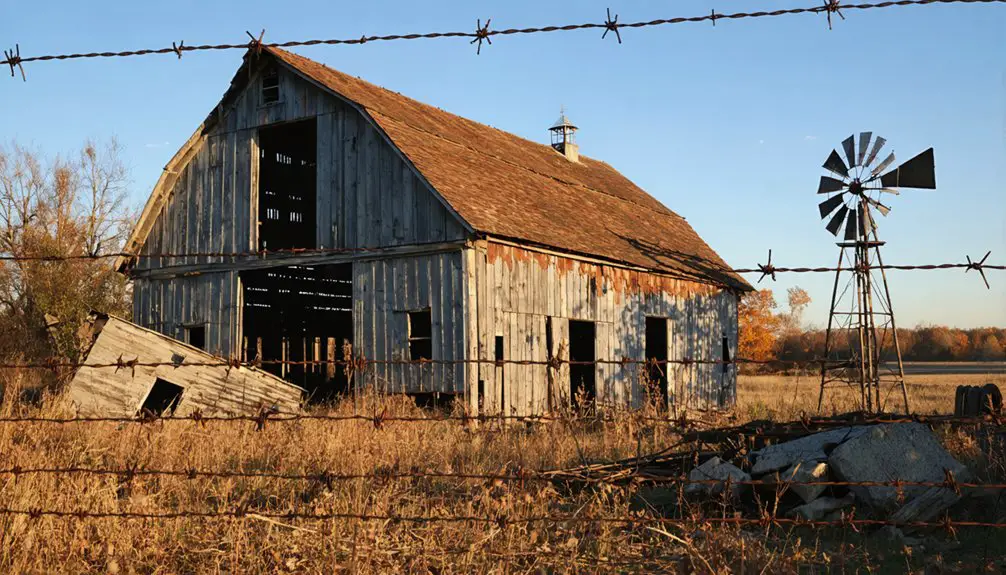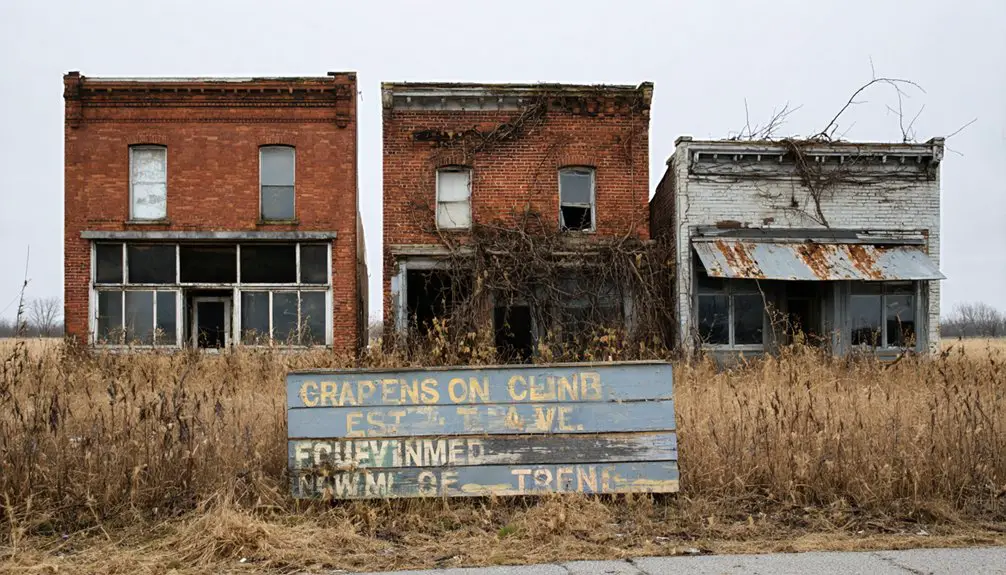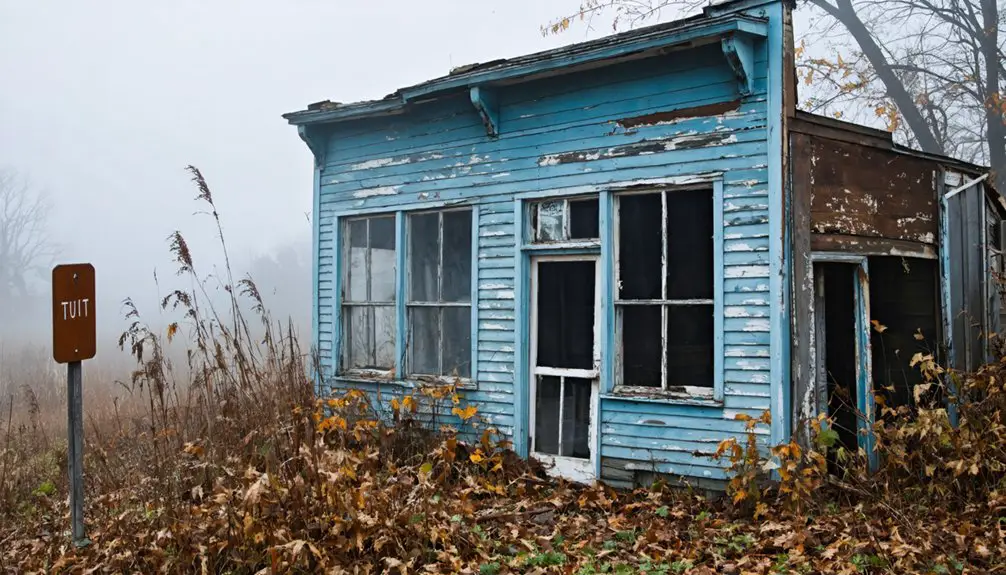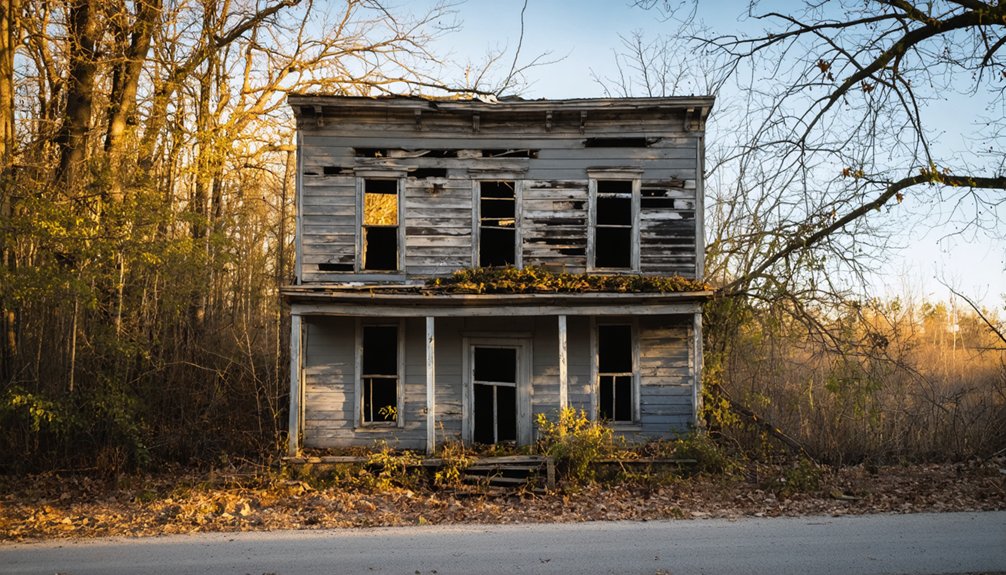
Ohio’s ghost towns aren’t myths—they’re real, documented places where coal mines shut down, canals went dry, and entire communities simply ceased to exist. You can still find physical remnants like Moonville’s nearly intact railroad tunnel, Fallsville’s stone mill foundations, and Sprucevale’s visible canal locks. These sites don’t require complete abandonment to qualify; collapsed economies and lost purpose define them. Keep exploring to uncover which of these forgotten towns are still accessible today.
Key Takeaways
- Moonville, abandoned in 1947, features the nearly intact Moonville Tunnel in Zaleski State Forest, known for ghost legends and photography opportunities.
- Fallsville, founded in 1848 and emptied by 1893, retains stone foundations and mill ruins near a scenic waterfall along Clear Creek.
- Sprucevale preserves visible canal locks, while Haydenville showcases industrial-era architecture from its history as a company-owned town.
- Ohio ghost towns are defined by economic collapse and population loss, though complete abandonment isn’t always required for classification.
- The Ohio Ghost Town Exploration Co. documents forgotten sites, supporting public access through field guides and collaborative preservation efforts.
What Qualifies as a Ghost Town in Ohio?
When most people hear “ghost town,” they picture a completely abandoned western settlement frozen in time, but Ohio’s definition is more nuanced.
Ghost town criteria here typically include significant population loss, collapsed economic function, and visible urban decay — though complete abandonment isn’t always required.
You’ll find that Ohio’s ghost towns often retain physical remnants: foundations, tunnels, cemeteries, or mill ruins.
Some sites hold scattered residents while the original community structure no longer functions.
Others were fully swallowed by reservoir projects, forest land, or infrastructure changes.
Researchers and local history groups generally classify a settlement as a ghost town when its founding purpose — mining, milling, canal commerce, or railroad activity — has permanently collapsed.
That economic death, not simply low population, defines the designation in Ohio’s documented historical record.
Ohio’s Most Recognized Ghost Towns and What Remains
When you explore Ohio’s most recognized ghost towns, two sites stand out for the physical remnants they’ve preserved: Moonville in Vinton County and Fallsville in Highland County.
Moonville’s nearly intact tunnel on the old rail bed gives you direct, tangible evidence of its coal-mining and railroad origins, while Fallsville’s stone foundations and mill ruins near Clear Creek document its mid-nineteenth-century agricultural economy.
Both sites demonstrate how surviving structures anchor a ghost town’s historical identity and sustain its presence in regional memory.
Moonville’s Tunnel Legacy
Among Ohio’s ghost towns, few leave as lasting a physical impression as Moonville, a coal mining and railroad settlement in Vinton County that operated from 1856 until its abandonment in 1947.
You’ll find its most enduring remnant inside Zaleski State Forest, where the nearly intact Moonville Tunnel still stands along the old rail bed.
When you visit, you’ll encounter:
- Tunnel Mysteries carved into weathered brick arches that once carried coal-era freight
- Ghost Legends tied to documented rail accidents and persistent local folklore
- A preserved corridor connecting independent explorers to raw, unfiltered industrial history
The tunnel’s survival makes Moonville uniquely accessible.
Hiking trails follow the original roadbed, letting you trace the town’s documented past without institutional interference or curated tourism.
Fallsville’s Milling Ruins
Fallsville, founded in 1848 in Penn Township, Highland County, tells a quieter story than Moonville’s tunnel drama, yet its milling ruins carry equal documentary weight.
By 1893, the settlement had emptied, leaving behind a stone house and grist mill near Clear Creek as evidence of its agricultural economy. You can still examine the structural remnants and recognize how milling technology shaped the town’s original layout and purpose.
The site’s ghost town architecture reflects deliberate construction choices — stone over timber, water-proximity over convenience — decisions that defined operational efficiency in mid-19th-century Ohio mills.
Trails near Careytown Road give you direct access to these remains. What you’re walking through isn’t decay; it’s a documented record of how rural communities built, functioned, and ultimately dissolved when their economic foundation disappeared.
Moonville: Ohio’s Most Haunted Abandoned Town
Nestled deep in Zaleski State Forest in Vinton County, Moonville stands as Ohio’s most recognized ghost town, its history rooted in coal mining and railroad operations that took shape after its founding in 1856.
By 1947, the settlement sat abandoned, leaving behind documented Moonville legends and reported ghostly encounters that continue drawing independent explorers today.
When you walk the old rail bed, you’ll encounter:
- The nearly intact Moonville Tunnel, carved through solid rock
- Scattered foundations marking where residents once lived and worked
- A landscape where dense forest has slowly reclaimed the settlement
Hiking guides, local history groups, and social media have preserved Moonville’s documented record.
You’re exploring a site where industrial collapse, railroad abandonment, and isolation combined to erase an entire functioning community.
Fallsville and Ohio’s Lost Rural Mill Towns
While Moonville reflects Ohio’s industrial ghost town pattern, rural mill towns followed a quieter but equally complete arc of decline.
Fallsville, founded in 1848 in Highland County’s Penn Township, built its identity around a grist mill and stone house near Clear Creek. By 1893, it was gone.
Fallsville history shows you how mill town heritage depended entirely on agricultural commerce. When regional farming economies shifted and transportation networks bypassed small waterway settlements, communities like Fallsville lost their economic reason to exist.
Mill town survival depended on agricultural commerce. When farming economies shifted, small waterway settlements lost their reason to exist.
Today, Careytown Road hiking trails give you direct access to what remains — foundations, a waterfall setting, and a readable historic landscape.
No single disaster erased Fallsville. Market forces and migration did the work slowly, leaving behind a site that documents rural Ohio’s quiet disappearances precisely.
Ohio Coal Towns That Boomed and Then Vanished
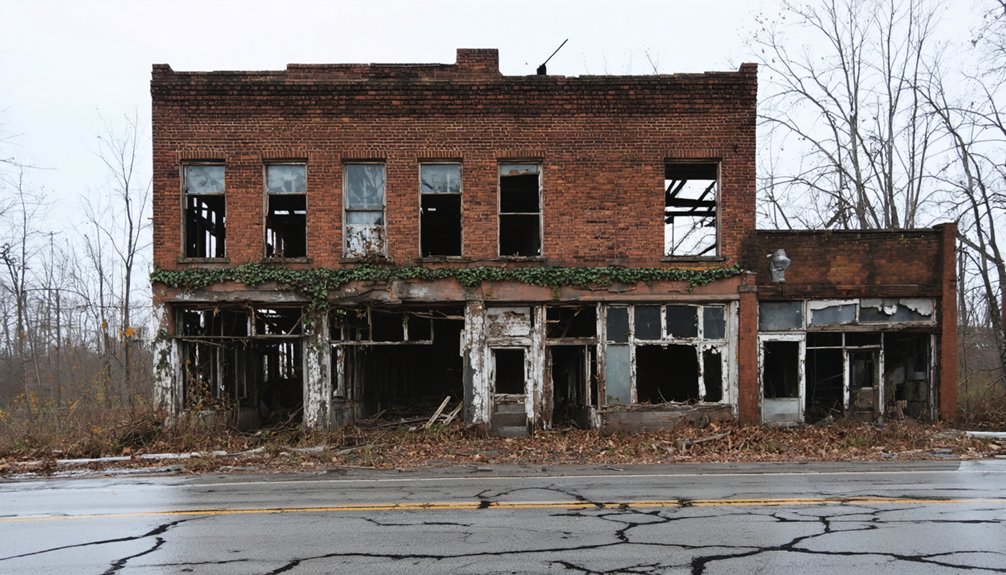
Coal towns in Ohio followed a sharper boom-and-bust cycle than mill towns, rising fast on extraction and collapsing just as quickly when the resource ran out or labor conditions made operations unsustainable.
Resource depletion and labor movements accelerated economic decline, leaving abandoned infrastructure across Vinton, Hocking, and Perry counties. You’ll find these sites carry real historical significance worth understanding.
Sites like San Toy and Moonville reveal what community memory looks like when industry vanishes:
- Crumbling company-owned structures reclaimed by dense forest
- Rusted rail beds cutting through hollow terrain
- Scattered foundations marking where families once built full lives
Preservation efforts and ghost town tourism now carry cultural heritage forward. You can walk these sites and read the collapse directly from the landscape itself.
The Canal and Railroad Towns Ohio Quietly Abandoned
When canals and railroads shaped Ohio’s economy in the 1800s, entire towns materialized around them—and dissolved just as completely when those systems became obsolete.
Canal decline gutted communities like Sprucevale, where visible locks remain as remnant structures marking what urban migration and economic collapse erased.
Railroad shifts produced similar fates—stations closed, routes rerouted, populations scattered.
You’ll find these losses documented through heritage trails that preserve cultural significance and community memory where buildings no longer stand.
Lost industries left behind more than empty lots; they restructured regional geography permanently.
Historic preservation efforts now recover what records and physical evidence survive.
If you walk these sites, you’re reading Ohio’s economic history through absence—a powerful, factual record of what infrastructure builds and what its removal destroys.
What You Can Still Find at Ohio’s Abandoned Towns
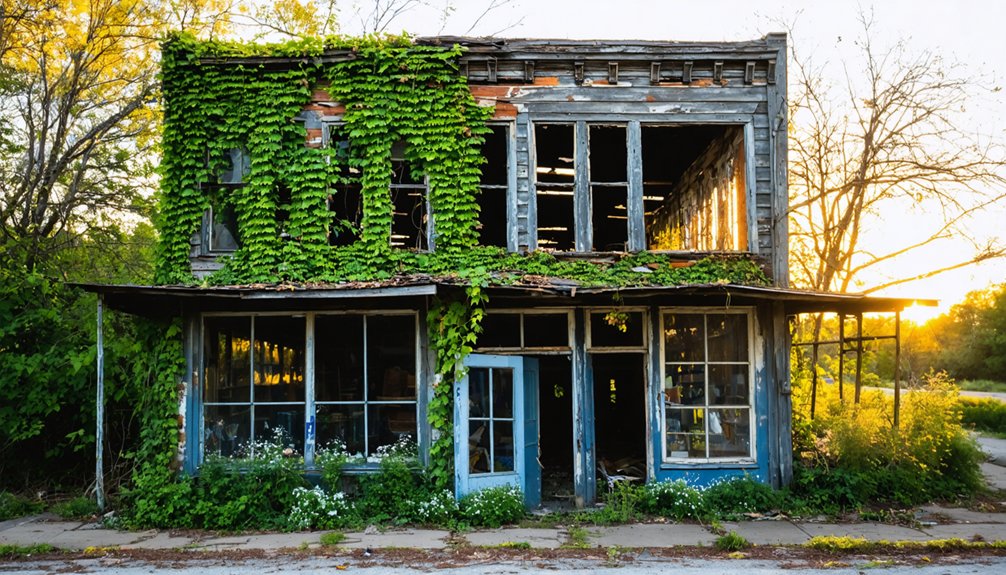
Visiting Ohio’s abandoned towns means encountering physical evidence that outlasts the populations who left it. Ghost town artifacts carry real historical significance, anchoring each site to its economic origin.
You’ll find tangible remnants across multiple locations:
- Moonville Tunnel — a nearly intact brick-lined passage through Zaleski State Forest, still walkable along the original rail bed.
- Sprucevale’s canal locks — stonework infrastructure that once moved commercial freight before rail routes rendered canals obsolete.
- Fallsville’s mill landscape — a stone house and grist mill foundation near Clear Creek, embedded in a waterfall setting.
These structures document how resource exhaustion, industrial collapse, and transportation shifts physically reshaped Ohio communities.
You’re not reading history here — you’re standing inside it, tracing decisions made by people who built and ultimately left these places behind.
The Ohio Ghost Towns Worth Visiting Today
If you’re ready to explore Ohio’s ghost towns firsthand, a few sites stand out as genuinely worth your time based on what they’ve preserved.
Moonville in Vinton County offers you the nearly intact Moonville Tunnel within Zaleski State Forest, a documented rail-bed hike with strong historical and cultural visibility.
Fallsville in Highland County gives you access to a stone mill site, a waterfall landscape, and traceable trail routes near Clear Creek that confirm the town’s 19th-century milling origins.
Top Sites To Visit
Several Ohio ghost towns have retained enough physical remnants to make them genuinely worthwhile destinations today.
Their ghost town preservation status and historical significance give you direct access to tangible evidence of collapsed industries and abandoned communities.
Three sites stand out clearly:
- Moonville, Vinton County – Walk through the nearly intact 1856 tunnel carved into a hillside, surrounded by dense Zaleski State Forest and silent rail bed.
- Fallsville, Highland County – Explore stone mill foundations beside Clear Creek, where a working grist mill once defined an entire farming community.
- Haydenville, Hocking County – Examine preserved industrial-era architecture from a company-owned town built entirely around a single employer’s operation.
Each location rewards independent exploration without requiring guided tours or institutional access.
What Remains Today
What survives at Ohio’s ghost town sites ranges from nearly intact structural remnants to scattered foundations barely visible through overgrowth. Ghost town preservation efforts vary greatly by location, so you’ll find dramatically different experiences depending on where you go.
At Moonville, the tunnel stands nearly intact along the former rail bed, making it one of the most accessible and photographed remnants in the state.
Fallsville retains its historic mill landscape near Clear Creek, while Sprucevale still offers visible canal locks.
Haydenville preserves company-era architecture with genuine historical significance.
Other sites, like Claylick, were largely erased by flood control projects, leaving little to examine firsthand.
You’re traversing between well-preserved landmarks and nearly vanished settlements, so researching each location before visiting helps you understand what you’ll actually encounter.
The Groups Keeping Ohio’s Ghost Towns Accessible
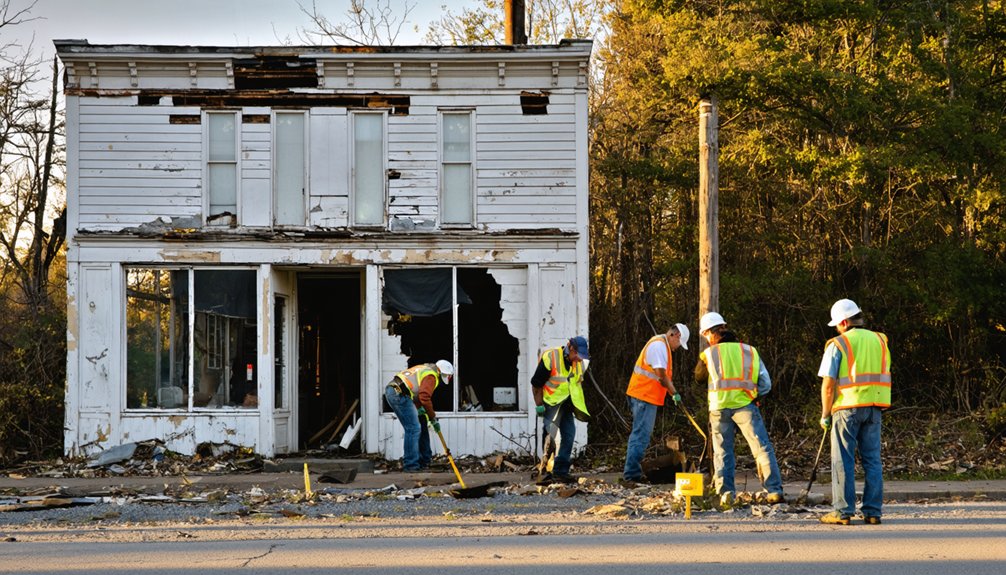
Though Ohio’s ghost towns are largely forgotten by official municipal records, organizations like the Ohio Ghost Town Exploration Co. actively document and promote these sites through coordinates, local histories, and field guides.
Ghost town preservation efforts give you direct access to places that would otherwise vanish entirely from public awareness. Historical hiking communities, travel writers, and regional historians collaborate to keep these corridors open and documented.
Ghost town preservation efforts open direct pathways to forgotten places that would otherwise disappear completely from public awareness.
These groups collectively maintain visibility for sites like:
- Moonville Tunnel, where rail-trail access lets you walk the original rail bed through Zaleski State Forest
- Fallsville’s mill ruins, preserved through documented trail guides near Clear Creek
- Sprucevale’s canal locks, still visible thanks to coordinated local documentation efforts
Without these organizations, you’d lose navigable entry points to Ohio’s forgotten settlements permanently.
Frequently Asked Questions
Are Ohio Ghost Towns Legally Accessible to the Public Without Special Permits?
You’ll find that legal access varies by site. Moonville’s in Zaleski State Forest, so it’s publicly accessible. Always check local regulations to boost public awareness and confirm whether permits are required before visiting.
Have Any Ohio Ghost Towns Been Deliberately Restored or Reconstructed?
You’ll find that few Ohio ghost towns have been deliberately restored due to restoration challenges, though Haydenville’s preserved industrial buildings reflect efforts acknowledging their historical significance, letting you explore documented remnants without full reconstruction.
Do Ohio Ghost Towns Appear on Official State Historical Registry Lists?
Yes, some do. Though you’d think they’re forgotten, sites like Moonville carry historical significance recognized officially. You’ll find preservation efforts have earned several Ohio ghost towns documented status on state and national historic registries.
Can Human Remains Still Be Found at Abandoned Ohio Town Sites?
You may encounter human remains at abandoned Ohio town sites, as many contain unmarked cemeteries. These are protected archaeological sites, so you’re legally required to report any discoveries to authorities rather than disturb them.
Have Any Ohio Ghost Towns Been Reclaimed by Private Landowners Recently?
Yes, you’ll find recent acquisitions of Ohio ghost towns by private developers have occurred. Private developments have transformed sites like Haydenville, where investors’ve purchased company-town remnants, converting historically significant properties into privately controlled land or commercial ventures.
References
- https://ohioghosttowns.org/top-10-ghost-towns/
- https://en.wikipedia.org/wiki/List_of_ghost_towns_in_Ohio
- https://hockingvacations.com/blog/exploring-the-ghost-towns-of-ohio-unearthing-forgotten-histories
- https://www.ohiotraveler.com/moonville-its-a-ghost-town/
- https://wrkr.com/ohio-ghost-towns/
- https://www.youtube.com/watch?v=QWTtG6njIDs
- https://www.facebook.com/hiddengemsmidwest/posts/-dare-to-wander-through-ohios-most-haunted-ghost-towns–from-the-spine-tingling/122208341456258617/
- https://www.reddit.com/r/Columbus/comments/1ka7jk/ghost_towns_in_ohio/
- https://ghosttownfindlay.com
- https://ohioghosttowns.org