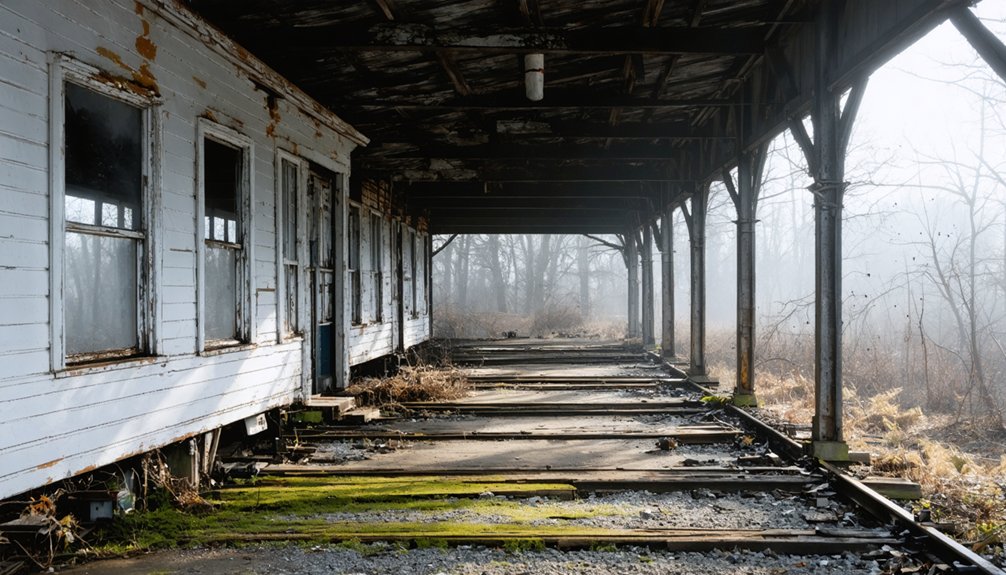
Planning a ghost town road trip to Carolina Station starts with Hanton City in Smithfield, Rhode Island — a Colonial-era settlement swallowed by forest after centuries of hardship. You’ll wander past stone foundations, crumbling cellar holes, and a hidden woodland dam where nature has quietly won. Pair it with Newport’s coastal grandeur and Providence’s living history for a complete journey. Stick around, and you’ll uncover everything you need to explore these forgotten worlds.
Key Takeaways
- Carolina Station is a ghost town in Rhode Island, ideal for road trip enthusiasts seeking forgotten history and eerie abandoned landscapes.
- Pair Carolina Station with nearby Hanton City in Smithfield, another colonial ghost town featuring stone foundations and cellar holes.
- Visit during spring or fall for optimal visibility of ruins, as summer foliage significantly obscures abandoned structures.
- Wear sturdy boots, carry water, bring a compass, and inform someone of your destination before exploring remote ghost towns.
- Extend your road trip by adding Newport’s Colonial architecture and Providence’s Benefit Street for a well-rounded Rhode Island heritage experience.
What Is Hanton City and Why Do People Still Seek It Out?
Tucked deep within the forested heart of Smithfield, Rhode Island, Hanton City — also called Lost City, Haunted City, and Island in the Woods — is a Colonial-era ghost town that’s been swallowed whole by centuries of encroaching woodland.
Three founding English families — the Paines, Hantons, and Shippees — carved out this small farming community after King Philip’s War, yet by 1900, the last resident had vanished forever.
What draws you here isn’t just history. It’s the thrill of discovering something the modern world forgot.
Crumbling stone foundations, collapsed cellar holes, a defunct irrigation dam, and worn burial grounds still hide beneath the overgrowth.
This ghost town rewards the curious, the restless, and the adventurous — those willing to push through dense wilderness to find what time tried to erase.
The Colonial Families Who Built and Abandoned This Place
Three English families — the Paines, the Hantons, and the Shippees — built Hanton City from nothing, likely rewarded with this land for their service in King Philip’s War, that brutal 1675 conflict that reshaped New England’s frontier.
These colonial settler dynamics shaped a tight-knit farming community, complete with stone walls, irrigation dams, and a quiet cemetery holding their dead. They carved freedom from wilderness, season by season.
Yet something unraveled here. The abandonment reasons remain frustratingly unclear — harsh winters, exhausted soil, economic pressure, or simply the pull of somewhere better.
The last Hanton died around 1900, and the forest swallowed everything they’d built. Walking these grounds, you’re tracing the outline of lives that chose this place, then ultimately surrendered it back to the trees.
How to Find Hanton City Trail in Smithfield, Rhode Island
Finding Hanton City Trail demands nothing more than pointing your car toward 70 W. Reservoir Rd in Smithfield, Rhode Island. Park, breathe in the wild air, and let the trailhead pull you forward.
Trail navigation here is notably straightforward — you’ll walk roughly three-quarters of a mile through dense woodland before colonial stone foundations materialize from the undergrowth.
Spring and fall offer the clearest sight lines, when thinning vegetation surrenders its grip on centuries-old ruins.
The ruins reveal themselves slowly — spring and fall pulling back the curtain that summer jealously keeps drawn.
Hiking safety matters in these woods. The site sits completely overgrown during warmer months, making orientation tricky.
Wear sturdy footwear, carry water, and tell someone your destination. The forest doesn’t care about your timeline.
The reward? Stone walls, cellar holes, and a quiet ghost town that’s been waiting over a hundred years for you to find it.
Stone Foundations, Cellar Holes, and the Dam Hidden in the Woods
As you push through the tree line and into the clearing, scattered stone foundations emerge from the leaf litter like ancient puzzle pieces, the skeletal remains of homes where families once cooked meals and weathered New England winters.
You’ll stumble upon hidden cellar holes concealed beneath decades of undergrowth, their dark rectangular mouths dropping away into earth that once cooled root vegetables and stored provisions.
Follow the tree line a little further, and you’ll find the forgotten woodland dam, its stonework still intact against the slow persistence of time and forest.
Scattered Stone Foundation Remains
Scattered across the forest floor of Hanton City, stone foundations, cellar holes, and a crumbling dam emerge from the undergrowth like fragments of a forgotten dream.
You’ll wander between these silent stone structures, each one whispering stories of colonial families who carved their lives from this wilderness. The cellar holes sit open like wounds in the earth, while ancient walls trace boundaries that once defined someone’s entire world.
These hiking experiences reward your curiosity with something rare — tangible proof that people lived, worked, and disappeared here completely. Roots have cracked the masonry, trees have reclaimed the clearings, and nature has slowly swallowed everything whole.
Yet somehow, the bones of Hanton City remain, waiting patiently for explorers willing to search through the green silence.
Hidden Cellar Holes Discovered
Three cellar holes punctuate the forest floor of Hanton City like open mouths mid-sentence, each one dropping suddenly into darkness beneath a canopy that’s had a century to seal itself overhead.
You’ll almost miss them entirely if you’re moving too fast through the undergrowth.
That’s the thing about cellar exploration here — the forest doesn’t advertise its hidden history. Roots grip the stone edges. Leaves fill the depths. These weren’t dramatic structures; they were basements beneath ordinary lives, beneath kitchens and bedrooms and winter provisions.
Step carefully around each rim. Notice how the stonework still holds despite generations of frost and neglect.
Someone stacked those rocks deliberately, purposefully. Now you’re the only one who remembers they exist, standing at the threshold between their world and yours.
The Forgotten Woodland Dam
Beyond the cellar holes, the forest floor shifts beneath your feet — softer, damper, carrying the faint mineral smell of still water.
You’re closing in on something most visitors never find: a defunct irrigation dam, swallowed by centuries of natural decay and tangled vegetation.
Push through the undergrowth and it appears — stones stacked deliberately, purposefully, by hands that understood water and land in ways most modern people never will.
This forgotten history doesn’t announce itself. It waits.
The dam once controlled water flow for Hanton City’s farming operations, a quiet engineering feat now reclaimed by moss and root.
Standing beside it, you feel the weight of abandonment — not as sadness, but as permission.
The wilderness took this place back, and you’re simply a witness.
The Best Seasons to Visit Before the Forest Swallows It Again
When you visit Hanton City matters almost as much as whether you visit at all.
Summer turns this ghost town invisible — dense canopies swallow every foundation, every crumbling wall, every whisper of colonial life beneath an impenetrable green curtain.
Your best hiking windows are spring and fall, when bare branches finally surrender their secrets.
March through early May reveals stone foundations emerging from dormant undergrowth like bones surfacing through shallow earth.
October and November offer that same clarity, wrapped in amber light that makes the ghost stories feel entirely plausible.
Come at the wrong time, and you’ll wander through forest finding nothing.
Come at the right time, and Hanton City will find you.
What to Bring for the Hike Into Hanton City

The hike to Hanton City is short — barely three-quarters of a mile from the trailhead at 70 W. Reservoir Rd — but don’t let that fool you. The forest doesn’t make things easy.
Pack your hiking essentials: sturdy boots, layered clothing, and a reliable compass or downloaded offline map. Cell signals fade fast under dense woodland canopies. Bring water, a small first-aid kit, and a charged flashlight — foundations hide in shadows even midday.
For ghost town explorations like this one, a camera captures what memory misses. Wear long pants to push through overgrowth without scratching your legs raw.
You’re walking into a forgotten world, not a groomed trail. Come prepared, and the ruins will reveal themselves. Come careless, and you’ll just find trees.
Other Rhode Island Stops Worth Pairing With This Trip
While you’re already chasing Rhode Island’s forgotten corners through Hanton City’s moss-covered foundations and crumbling stone walls, you might as well push the adventure further.
Newport’s Historic District rewards you with centuries-old Colonial architecture, cobblestone streets, and Gilded Age mansions that pulse with a different kind of haunted grandeur.
Providence rounds out the journey with its own layered heritage — Benefit Street’s “Mile of History” alone packs more atmospheric, story-soaked stops than most states can offer in an entire region.
Hanton City Ghost Town
If you’re already making the trek out to Smithfield, Rhode Island’s Hanton City — also known as Lost City or Haunted City — deserves a spot on your itinerary.
Start at 70 W. Reservoir Rd and hike roughly three-quarters of a mile through dense woodland to reach the ruins.
Colonial-era stone foundations, crumbling walls, and a defunct irrigation dam emerge from the overgrowth like whispers from another century.
Hanton City legends suggest a friendly ghost still watches over the settlement, and ghost town myths have drawn paranormal explorers for generations.
Visit in spring or fall when the vegetation thins enough to actually see the ruins.
This place was abandoned over a hundred years ago — and the forest has been slowly reclaiming it ever since.
Newport Historic District
Newport’s Historic District turns a day trip into a full Rhode Island adventure worth building your whole weekend around.
Walk streets lined with preserved historic architecture dating back centuries, where colonial heritage breathes through every cobblestone and timber-framed facade. You’ll find the Breakers, Cliff Walk, and waterfront taverns where revolutionaries once plotted independence over warm ale.
Newport rewards the curious traveler who moves without a rigid itinerary — duck into a tucked-away gallery, trace the harbor’s edge at dusk, or simply sit with a coffee while centuries-old buildings rise around you.
Pair this stop with your Hanton City exploration, and suddenly you’re threading together Rhode Island’s layered past — from abandoned forest settlements to gilded coastal grandeur — into one unforgettable road trip.
Providence Heritage Sites
Providence packs centuries of American history into a walkable, endlessly rewarding city that earns its place on any Rhode Island road trip itinerary.
Stroll Benefit Street’s “Mile of History,” where Federal-style mansions and colonial architecture line cobblestone sidewalks in one of America’s finest concentrations of preserved 18th-century buildings.
Visit the First Baptist Church in America, founded by Roger Williams in 1638, or wander the Brown University campus perched above the city.
Heritage preservation efforts here run deep, giving you access to living history rather than sanitized replicas.
Providence landmarks reward curious travelers willing to slow down and look closely.
Pair an afternoon here with your ghost town exploration, and you’ve built a road trip that moves freely between Rhode Island’s haunted edges and its storied, breathing heart.
How to Explore Hanton City Without Getting Lost or Leaving a Mark
Wandering through Hanton City’s overgrown trails feels like stepping into a living time capsule, but you’ll want to come prepared to stay oriented and leave the site exactly as you found it.
These hiking tips keep your exploration honest and memorable:
- Start at 70 W. Reservoir Rd and follow the marked trail — the ruins sit roughly ¾ mile in.
- Visit during spring or fall when thinning vegetation reveals stone foundations and cellar remains.
- Photograph everything, touch nothing — those crumbling walls have survived centuries without your fingerprints.
- Embrace the ghost stories circulating about Hanton City’s friendly spectral overseer, but navigate by compass, not curiosity.
The forest reclaims everything here.
Don’t let it reclaim your sense of direction.
Frequently Asked Questions
Is There an Entrance Fee to Access the Hanton City Hiking Trail?
You’ll find no entrance fee blocking your path to Hanton City’s mysteries! Embrace hiking safety and trail etiquette as you roam freely through haunted, fog-draped forests, where forgotten colonial ruins await your adventurous, untethered spirit.
Are Pets Allowed on the Hanton City Trail in Smithfield?
The knowledge base doesn’t specify pet friendly policies for Hanton City Trail, so you’ll want to verify locally before leashing up your furry companion. Practice proper trail etiquette and let adventure call you both into Smithfield’s enchanting woodland ruins!
How Long Does a Typical Visit to Hanton City Usually Take?
You’ll typically spend 2-3 hours exploring Hanton City’s hauntingly beautiful ruins. Follow hiking tips to navigate stone foundations and walls. These enchanting local attractions beckon you to wander freely through history’s forgotten whispers.
Is the Hanton City Trail Suitable for Young Children or Strollers?
The trail’s uneven, forested terrain makes it unsuitable for strollers. For family friendly activities, you’ll navigate rugged woodland paths where trail accessibility demands sturdy footwear — older, adventurous children can conquer this wild, history-steeped journey with you.
Are Overnight Camping Stays Permitted Anywhere Near Hanton City Ruins?
The knowledge doesn’t confirm camping regulations near Hanton City ruins, so you’ll want to verify locally. Still, nearby attractions await your free spirit — explore, wander, and let Rhode Island’s haunted woodland whispers fuel your adventurous soul!
References
- https://en.wikipedia.org/wiki/Hanton_City
- https://weird-island.simplecast.com/episodes/57-ghost-town-hanton-city-ky53imy0
- https://www.facebook.com/groups/PawtucketNews/posts/3909684365756536/
- https://www.instagram.com/reel/DQVFWbAj-KN/
- https://www.youtube.com/watch?v=PeehoMoCGdo
- https://www.instagram.com/p/Ci8SnWaPcq2/
- https://ecori.org/forested-ghost-town-haunted-by-development-pressures/
- https://www.geotab.com/ghost-towns/
- https://www.onlyinyourstate.com/state-pride/rhode-island/abandoned-railway-station-ri
- https://www.reddit.com/r/RhodeIsland/comments/xnpzke/rhode_islands_ghost_town_hanton_city_i_got_lost/