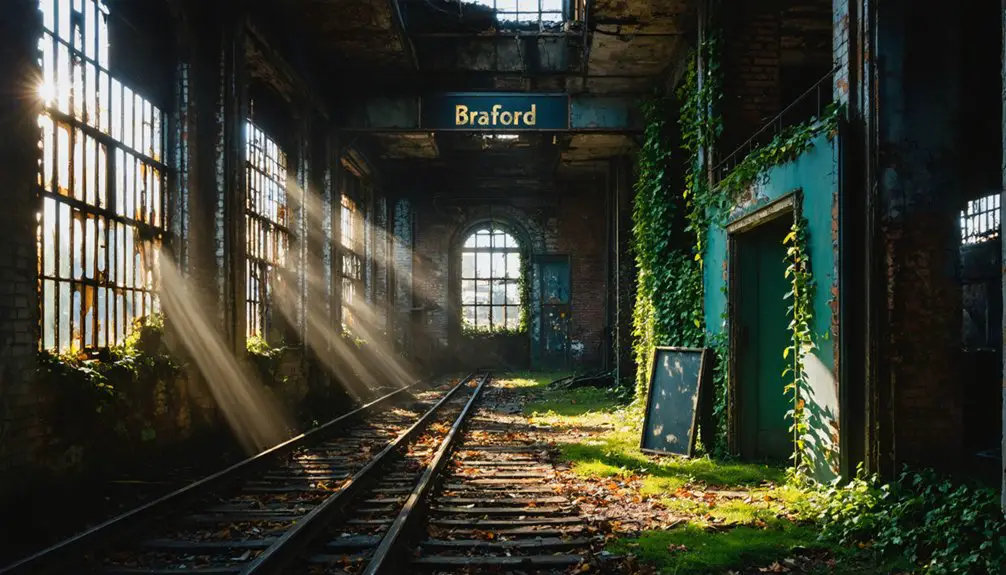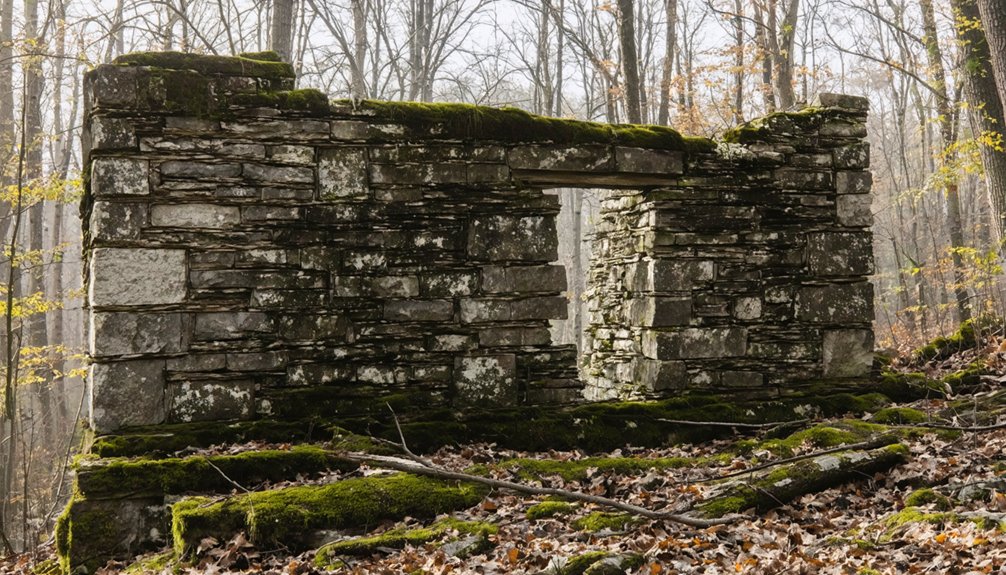
Rhode Island’s ghost towns aren’t always easy to define, but you’ll find haunting remnants scattered across the state. You can walk Hanton City’s stone foundations in Smithfield, explore Ramtail Factory’s ruins — once listed as “haunted” on an 1885 census — or trace where Napatree Point’s cottages stood before the 1938 hurricane erased them entirely. Estimates range from one to seventeen ghost towns depending on who’s counting. Keep going, and you’ll uncover exactly what each site holds.
Key Takeaways
- Hanton City in Smithfield features stone foundations and cellar holes from an early colonial farming community, accessible via the Hanton City Trail.
- Rhode Island’s ghost town count ranges from 1 to 17, depending on how “ghost town” is defined by different sources.
- Ramtail Factory, founded in 1799, was uniquely listed as “haunted” in the 1885 Rhode Island census and remains in ruins today.
- Napatree Point was a beach community of 39 cottages destroyed by the 1938 hurricane, later converted into a wildlife preserve.
- Abandoned mill villages like Slatersville Mills and Valley Falls Mill remain largely unpreserved and risk disappearing entirely over time.
What Counts as a Ghost Town in Rhode Island?
Defining a ghost town in Rhode Island isn’t as straightforward as you might expect. Some sources count only 8 abandoned locations, while others list 17, and at least one account recognizes just a single documented ghost town in the entire state. That gap reflects a genuine debate over classification.
Rhode Island ghost towns defy easy counting — estimates range from one to seventeen, depending on who’s defining “abandoned.”
Are you looking at full abandonments, partial ruins, or haunted sites? Historical preservation advocates apply stricter standards, focusing on documented settlement decline and structural remains.
Tourism development interests, however, cast a wider net, including ghost communities like Napatree Point and military sites like Fort Getty.
You’ll encounter labels ranging from “ghost town” to “abandoned place” to “ghost community,” each carrying different implications. Understanding those distinctions shapes how you explore and interpret Rhode Island’s forgotten landscapes.
Hanton City: Rhode Island’s Most Visited Ghost Town
If you’re looking for Rhode Island’s most accessible slice of Colonial history, you’ll find it hidden in the woods along the Hanton City Trail in Smithfield. Locals once called it the Lost City, and when you walk among its crumbling stone foundations, cellar holes, and ancient walls, it’s easy to understand why that name stuck.
You’re fundamentally stepping into the quiet remains of a small New England farming community that faded away by the early 19th century, leaving behind just enough for the imagination to reconstruct what daily life once looked like here.
Hanton City’s Colonial Origins
Tucked deep within the forested trails of Smithfield, Hanton City stands as one of Rhode Island’s most compelling colonial relics, earning it the reputation as the state’s most visited ghost town. Its colonial history traces back to early New England settlers who carved out a modest farming community from the surrounding wilderness.
You can still read their settlement patterns in the landscape — stone foundations, cellar holes, and weathered walls tell the story of families who built lives here with their own hands. These settlers valued self-sufficiency and independence, virtues you’ll recognize immediately when walking the grounds.
Exploring The Ruins Today
Walking through Hanton City today, you’ll find a quiet woodland landscape scattered with the tangible evidence of colonial life — stone foundations, cellar holes, crumbling walls, and the remnants of a long-defunct dam.
Follow the Hanton City Trail, and you’ll move freely through what locals still call the Lost City, piecing together a vanished community from the ruins beneath your feet.
Unlike heavily managed tourist attractions, this site rewards independent exploration.
Historical preservation efforts here remain intentionally minimal, letting the forest and the stonework speak for themselves.
You won’t encounter crowds or entrance fees — just open woodland and centuries-old craftsmanship slowly reclaimed by nature.
That rare combination of accessibility and authenticity makes Hanton City one of Rhode Island’s most compelling destinations for anyone drawn to forgotten places.
Ramtail Factory: The Ghost Town on the Census
If you trace the Ponagansett River into Foster, you’ll find the ruins of Ramtail Factory, a woolen mill village founded by William Potter in 1799 and powered by a massive water wheel fed by the river’s current.
The mill hummed with production for decades before fading into abandonment and local legend.
What makes Ramtail truly singular, though, is that Rhode Island’s 1885 census officially listed it as haunted — a designation you won’t find attached to virtually any other settlement in American record-keeping.
Potter’s 1799 Mill Founding
When William Potter founded his woolen mill on the Ponagansett River in 1799, he wasn’t just building a factory — he was planting the seed of an entire village. He harnessed the river’s power through a large water wheel, turning raw potential into a working community.
Workers settled nearby, lives took root, and Ramtail Factory grew into something self-sustaining and real.
You can still feel that weight when you walk the ruins today. The site carries deep archaeological significance, offering tangible proof of how early American industry shaped rural life.
Its historical preservation matters because it connects you directly to that vanished world. Potter’s vision didn’t just produce wool — it produced a community that Rhode Island couldn’t forget, even after the last resident walked away.
The Ponagansett River Wheel
The massive water wheel anchored to the Ponagansett River wasn’t just mechanical infrastructure — it was Ramtail Factory‘s heartbeat. When you stand near those ruins today, you’re connecting with river ecology that once powered an entire working village.
The wheel drove Ramtail’s woolen production from 1799 forward, harnessing the river’s current with remarkable efficiency. Historical preservation efforts keep this story alive for those willing to seek it out.
Picture what that wheel meant daily:
- Constant mechanical rhythm defining workers’ schedules
- River current transformed directly into economic output
- An entire community’s survival tied to water flow
When the factory fell silent, that wheel stopped turning — and Ramtail’s fate was sealed. The Ponagansett River kept flowing, indifferent to the abandonment surrounding it.
Rhode Island’s Haunted Census
Few government documents carry the weight of the 1885 Rhode Island census — but one entry stands apart from every routine tally of farms, families, and factories. Ramtail Factory earned the rare, official designation of “haunted,” making it the only site in state history recorded as such in a government document. That designation wasn’t casual gossip — it reflected decades of persistent local legend tied to the mill’s dark past.
Today, historical preservation efforts keep Ramtail’s story alive, ensuring you can still explore its ruins along the Ponagansett River. It’s become one of Rhode Island’s most compelling tourist attractions, drawing visitors who value authentic, unfiltered history.
When a government formally acknowledges a haunting, you don’t dismiss it — you go see it for yourself.
Rhode Island’s Abandoned Mill Villages Nobody Talks About
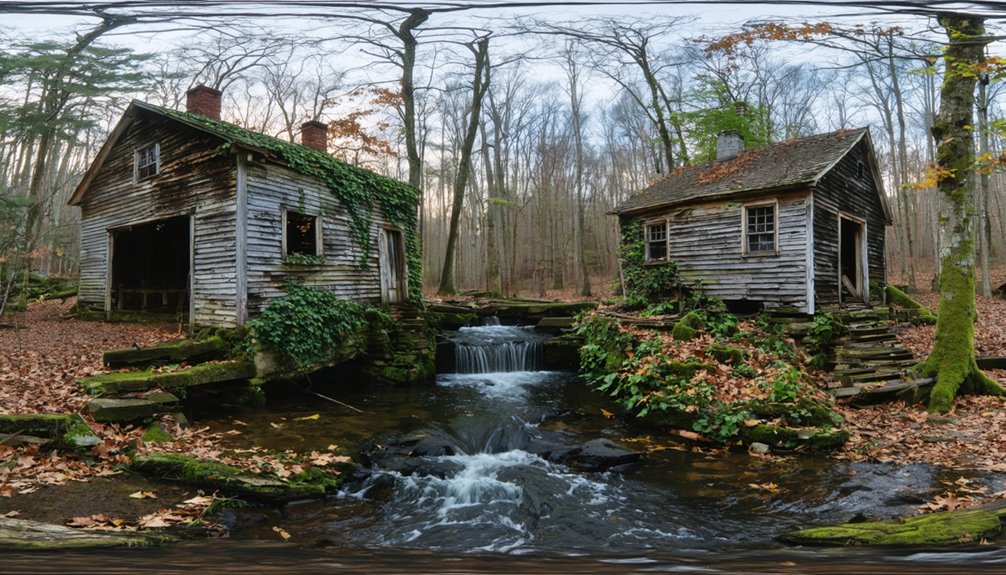
Rhode Island’s industrial past left behind more than just memories — it scattered dozens of abandoned mill villages across the state’s landscape, most of which never make it onto the tourist maps. Industrial decline hollowed out these communities quietly, leaving ruins that reward the curious explorer willing to look beyond the obvious.
Consider what you’ll find if you venture off the beaten path:
- Slatersville Mills, where stone structures still whisper of a once-thriving textile economy
- Social Village, a forgotten manufacturing settlement swallowed by time
- Valley Falls Mill, gutted by fire in 1999 and left standing as a skeletal landmark
Mill preservation efforts remain inconsistent, meaning many sites disappear before anyone documents them. You owe it to yourself to find these places before they’re gone entirely.
Napatree Point: The Beach Community the Hurricane Erased
Before the Great Hurricane of 1938 made landfall, Napatree Point in Westerly was a tight-knit beach community of 39 cottages stretched along a sandy spit at the southwestern tip of Rhode Island. Families spent summers there, close to the water, far from the noise of ordinary life.
Then the hurricane hit, and it erased every single structure in a matter of hours. Fifteen residents died.
Hurricane destruction didn’t just level the buildings — it reshaped the land itself, accelerating coastal erosion that made rebuilding impractical and unwise. Rather than reconstructing what was lost, authorities converted the area into a wildlife preserve.
Today, you can walk that narrow strip of land and find no trace of the community that once stood there. Nature reclaimed it completely.
Do Rhode Island’s Abandoned Forts Count as Ghost Towns?
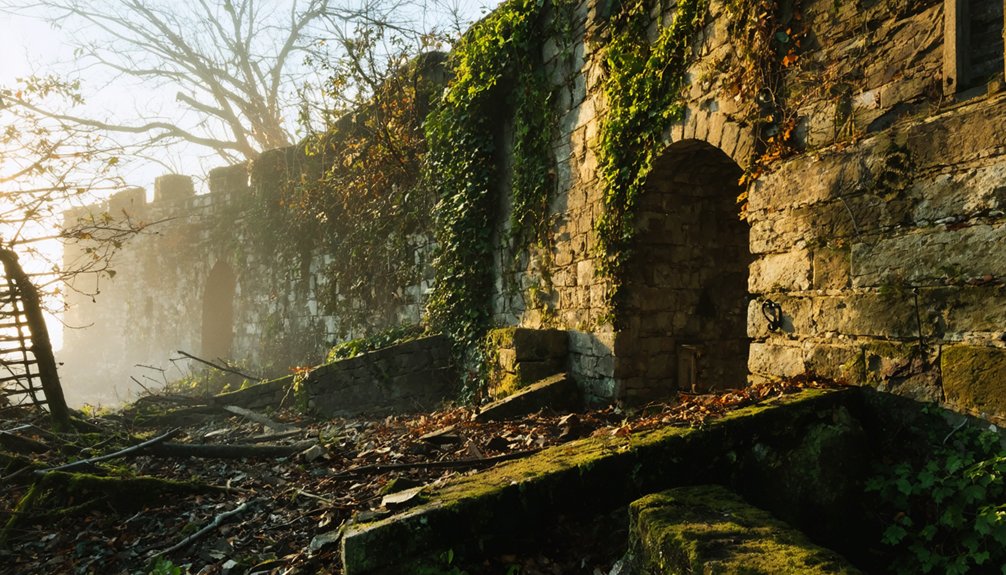
Along Narragansett Bay, Fort Getty and Fort Wetherill stand as weathered remnants of a coastal defense network built in the early 1900s and expanded during World War II. Whether they qualify as ghost towns depends entirely on your definition, but they share the same abandoned stillness you’ll find in Rhode Island’s forgotten villages.
These sites matter for several reasons:
- Historical preservation efforts keep the crumbling batteries and bunkers accessible to visitors
- Both forts function today as tourist attractions, drawing explorers who value uncurated history
- Their silence tells a story no museum exhibit can replicate
You’re free to walk these grounds, read the decay, and decide for yourself. Ghost town or not, they carry the unmistakable weight of lives and purposes the modern world left behind.
How Many Ghost Towns Does Rhode Island Actually Have?
Depending on who’s counting, Rhode Island has anywhere from one to seventeen ghost towns — and that range tells you more about definitions than it does about history. Some sources document eight sites, others push to seventeen, and stricter accounts recognize only one formally documented ghost town.
The disagreement stems from how you classify places — ghost town, abandoned community, haunted site, or ghost community all carry different weight. Historical preservation efforts complicate the count further, since restored or maintained sites blur the line between abandoned and memorialized.
Tourism development adds another layer, as some locations get rebranded to attract visitors rather than acknowledged as true ruins. You’re better off exploring these places on your own terms and deciding what qualifies, because no official authority has settled the question definitively.
Frequently Asked Questions
Can You Visit These Rhode Island Ghost Towns for Free?
You can walk freely through crumbling stone foundations and whispering woods — Hanton City’s historical preservation and Ramtail’s urban decay welcome you at no cost, letting you explore Rhode Island’s forgotten past unrestricted.
Are Any Rhode Island Ghost Towns on Private Property?
Yes, some sites with haunted legends and abandoned structures sit on private property, so you’ll want to research access rules before you explore, respecting boundaries while still chasing Rhode Island’s fascinating, freedom-filled ghost town history.
What Is the Best Time of Year to Explore Ghost Towns?
Over 60% of explorers prefer fall’s mild seasonal weather for ideal exploration times. You’ll find crisp air, thinning foliage revealing hidden foundations, and comfortable temperatures that make wandering forgotten landscapes feel authentically adventurous and deeply nostalgic.
Are Rhode Island Ghost Towns Safe to Explore Alone?
You can explore them, but don’t go alone. Abandoned structures at sites like Ramtail Factory pose real hazards, and haunted legends aside, unstable ruins and remote terrain make a trusted companion essential for your safety.
Have Any Rhode Island Ghost Towns Been Excavated by Archaeologists?
Sure, because who needs *actual* history when you’ve got haunted legends? Yet archaeologists have examined abandoned structures like Hanton City, where you’ll find excavated cellar holes and foundations revealing Rhode Island’s forgotten colonial past.
References
- https://www.rimonthly.com/haunted-places-rhode-island/
- https://ghost-towns.close-to-me.com/states/rhode-island/
- https://en.wikipedia.org/wiki/Hanton_City
- https://en.wikipedia.org/wiki/Category:Ghost_towns_in_Rhode_Island
- http://freepages.rootsweb.com/~gtusa/history/usa/ri.htm
- https://www.bostonglobe.com/2022/10/28/metro/10-spookiest-places-rhode-island-with-peculiar-past/
- https://www.youtube.com/watch?v=CWGW-p1qeAo
- https://newenglandwithlove.com/ghost-towns-in-rhode-island/