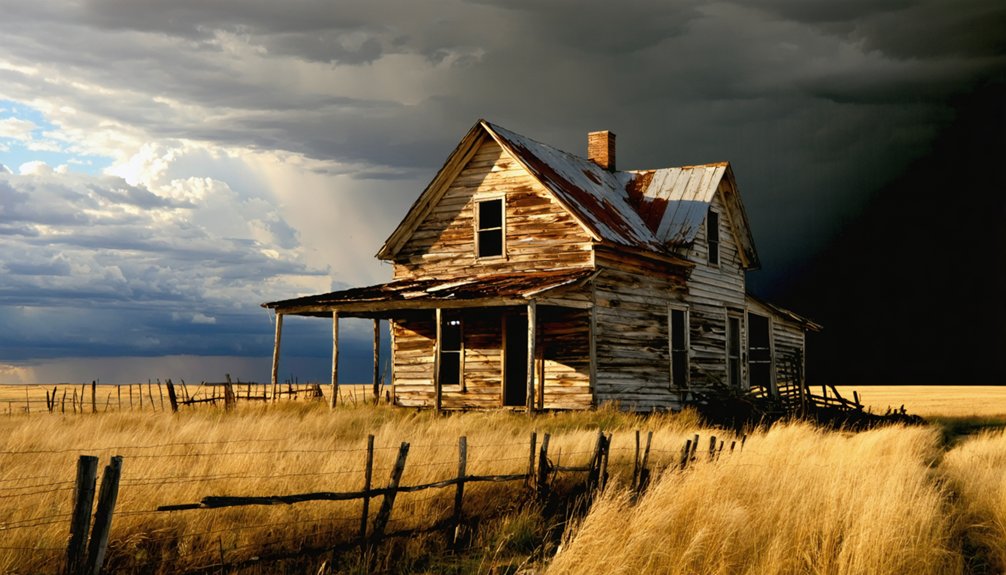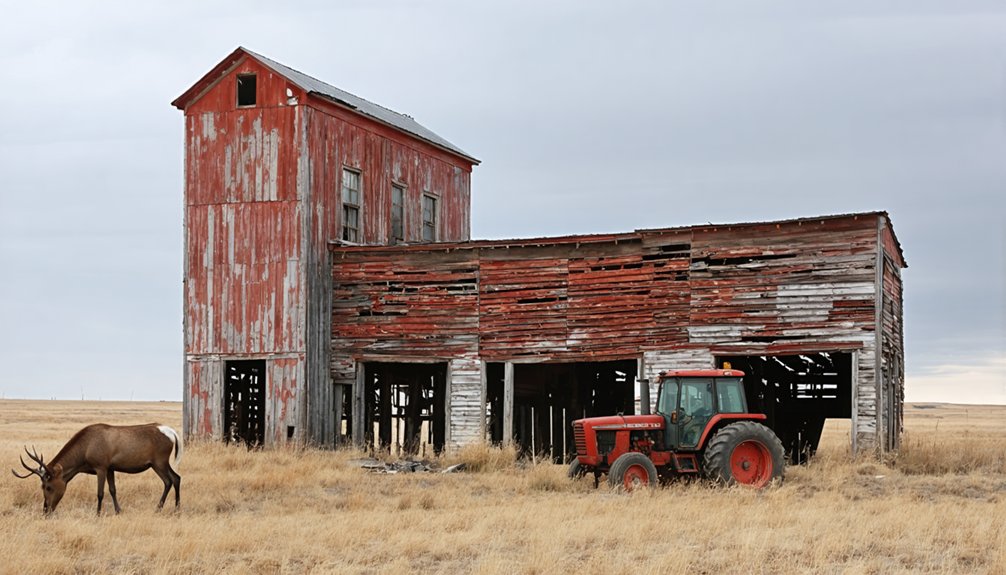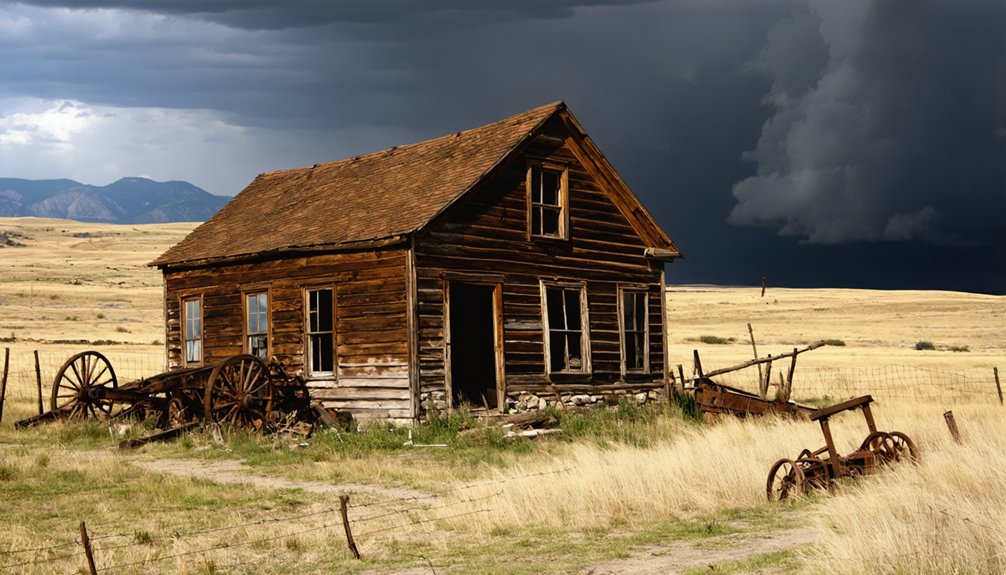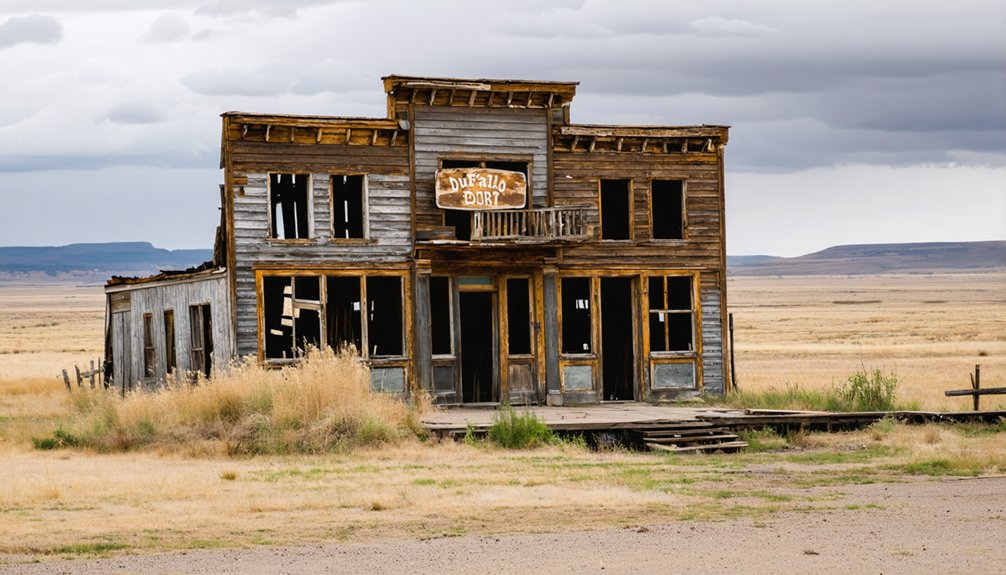
South Dakota’s ghost towns tell a story of boom-and-bust cycles driven by mining exhaustion, railroad rerouting, and agricultural collapse. You’ll find over 800 documented abandoned sites statewide, with more than 600 concentrated in the Black Hills alone. Towns like Ardmore, Mystic, and Tinton rose quickly and collapsed just as fast once their economic lifelines disappeared. Some exist only as crumbling foundations, while others retain eerie structural remains. There’s far more to uncover about these forgotten places than you’d expect.
Key Takeaways
- South Dakota has over 833 documented ghost town sites, with the Black Hills region alone containing more than 600 abandoned settlements.
- Mining exhaustion, railroad rerouting, water shortages, and the Dust Bowl were the primary causes of town abandonment across South Dakota.
- Notable ghost towns include Ardmore, Mystic, Tinton, Okaton, and Addie Camp, each reflecting distinct histories of rapid rise and decline.
- Physical remains vary widely, from weathered storefronts and crumbling foundations to cellar holes and overgrown streets depending on abandonment duration.
- Before visiting, verify land ownership, obtain necessary permissions, and follow preservation laws like ARPA to avoid artifact removal penalties.
What Makes a South Dakota Town a Ghost Town?
When most people picture a ghost town, they imagine a completely empty settlement, but South Dakota’s ghost towns don’t always fit that narrow definition. A town qualifies when it loses its economic function — its businesses close, its population drops to near zero, and its services disappear. Some sites retain a handful of aging residents yet still meet that threshold. Others exist only as foundations, cellar holes, or overgrown streets.
Researchers apply broad criteria, counting mining camps, railroad sidings, and townsites alongside formally platted communities. That approach explains why one documented project recorded 833 vanished or historical sites statewide.
Historical preservation efforts and tourism opportunities have kept certain places visible, while hundreds of others remain uncharted. Understanding these distinctions helps you accurately recognize what South Dakota’s abandoned landscape actually represents.
Why Did So Many South Dakota Towns Simply Disappear?
South Dakota’s ghost towns didn’t vanish by accident — specific, documentable forces drove each wave of abandonment. Mining decline emptied Black Hills camps once ore bodies played out. Railroad rerouting strangled prairie towns that depended on rail access for commerce and mail. Water shortages pushed out residents in places like Ardmore.
The Dust Bowl and agricultural consolidation finished off farming communities that couldn’t sustain schools or stores.
You’ll notice these forces rarely struck alone — they compounded. A town losing its rail stop also lost its economic base, accelerating departure. Some survivors became tourist attractions, their ruins preserved through historical preservation efforts. Most didn’t.
Understanding why towns disappeared helps you distinguish between places that collapsed completely and those that found purpose in documenting their own decline.
How Many Ghost Towns Does South Dakota Actually Have?
If you’re trying to pin down an exact number, you’ll find that South Dakota’s ghost-town count is a moving target. One research project has recorded 833 vanished or historical sites pulled from federal place-name archives, while SDPB reports well over six hundred abandoned sites in the Black Hills region alone.
Documentation stays incomplete because Wikipedia’s ghost-town list is explicitly labeled as such, and only 4 of those 833 recorded sites currently have full records charted.
Statewide Ghost Town Estimates
Pinning down an exact number of South Dakota ghost towns is harder than it sounds. One dedicated ghost-town project pulled federal place-name archives and documented 833 vanished or historical sites**, yet only four of those carry fully verified records**. That gap tells you how much ground remains uncovered.
Wikipedia’s own list carries an “incomplete” label, so you can’t treat any single source as definitive.
The Black Hills region alone accounts for well over six hundred abandoned sites, reflecting the area’s dense mining history. Statewide, these places range from formal townsites with historical preservation significance to forgotten railroad sidings with nothing left standing.
Some have become legitimate tourist attractions, while others exist only as coordinates on an old federal map. The true count keeps growing as researchers dig deeper.
Black Hills Abandoned Sites
The Black Hills region alone holds well over six hundred documented ghost towns, making it the densest concentration of abandoned sites in the state. Sites like Tinton, Mystic, Etta, and Spokane reflect the mineral-extraction history that built and then emptied these communities once ore bodies played out.
You’ll find that historical preservation efforts vary widely across these locations — some retain visible structures while others exist only in federal place-name archives. A few have evolved into tourist attractions, drawing visitors who want to explore the region’s mining-era past on their own terms.
Deadwood stands apart as a preserved heritage destination rather than a true ghost town. The Black Hills concentration demonstrates how quickly resource-driven boomtowns collapse when the economic foundation disappears.
Why Documentation Remains Incomplete
- Scattered records — mining camps, railroad stops, and townsites were often never formally incorporated, leaving gaps in historical preservation archives.
- Verification demands — each site requires field confirmation before researchers can finalize its status, slowing progress considerably.
- Visitor accessibility barriers — remote terrain, private land, and unmarked locations make physical documentation difficult and dangerous.
You’re fundamentally working with a living inventory that grows as researchers uncover forgotten places across the state.
Black Hills South Dakota Ghost Towns Born From the Mining Boom
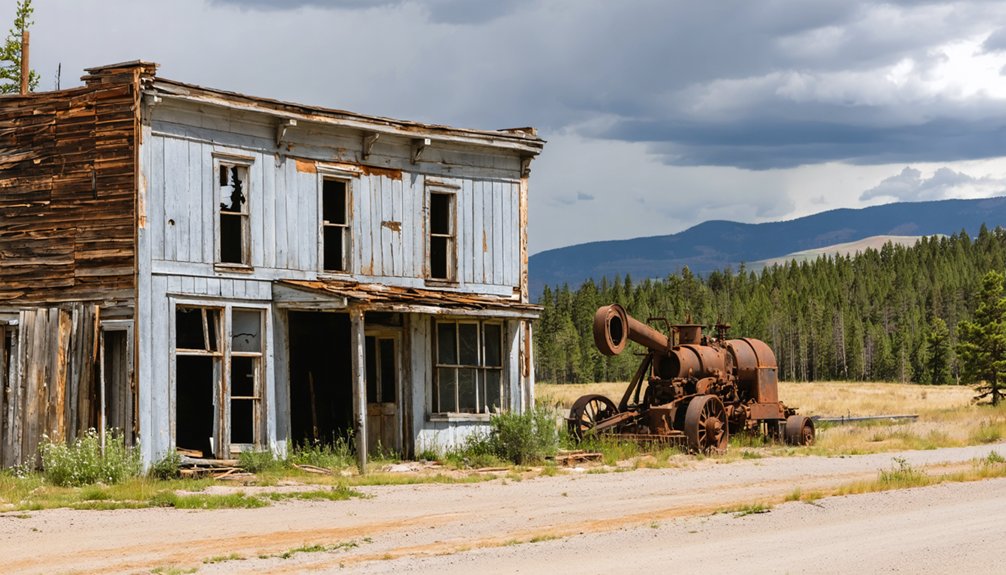
When you explore South Dakota’s Black Hills, you’re looking at a region that produced well over six hundred ghost towns born almost entirely from the mining boom.
Towns like Tinton, Mystic, Etta, and Spokane rose quickly as miners chased ore, then collapsed just as fast once the deposits played out or the mines shut down.
You’ll find that mining decline, water shortages, and shifting economics all worked together to empty these settlements, leaving behind scattered ruins that still mark where boomtowns once stood.
Black Hills Mining Origins
During the gold rush era, miners flooded the Black Hills and built settlements that would eventually empty just as fast as they’d filled. You’ll find mining relics and town legends scattered across hundreds of abandoned sites throughout western South Dakota.
Three facts that define this region’s ghost-town history:
- SDPB documents well over 600 ghost towns in the Black Hills region alone, reflecting the scale of the mining boom.
- Towns like Tinton, Mystic, Etta, and Spokane rose and collapsed as ore bodies played out and miners moved on.
- Addie Camp, active from 1892 to 1917, shows the typical cycle—rapid settlement followed by neglect once the nearby mine closed.
These towns didn’t fade slowly; they emptied with purpose once the ore ran dry.
Notable Mining Ghost Towns
Several of those 600-plus Black Hills ghost towns have names that still show up on maps, trail guides, and historical registries—and they’re worth knowing by name. Spokane, Mystic, Etta, and Tinton each reflect the region’s mining history directly—camps that rose fast when ore was present and collapsed just as fast when it wasn’t.
Addie Camp in Pennington County operated from 1892 to 1917, tied entirely to the Addie Mine. Once the mine closed, town decline followed without pause.
These sites didn’t fade because of poor planning—they faded because extraction economies are temporary by nature. You can still find physical remains at several of these locations, making them documentable stops for anyone tracing how the Black Hills boom built, and then emptied, entire communities.
Reasons Towns Were Abandoned
Mining towns in the Black Hills didn’t collapse randomly—they followed a predictable sequence tied to extraction economics. Once ore bodies played out, economic decline accelerated fast.
You can trace most abandonments to three core causes:
- Mining exhaustion – When mines closed, workers left, and businesses had no customer base to sustain them.
- Water shortages – Towns like Ardmore couldn’t survive without reliable drinking water, forcing residents to relocate permanently.
- Railroad bypass – When rail routes shifted, isolated communities lost their trade lifelines almost overnight.
These weren’t slow, mysterious declines—they were structural collapses driven by identifiable forces.
Understanding why these towns failed gives you a clearer picture of how fragile boomtown economies actually were and why hundreds of Black Hills sites now sit empty.
South Dakota Ghost Towns the Railroad Left Behind
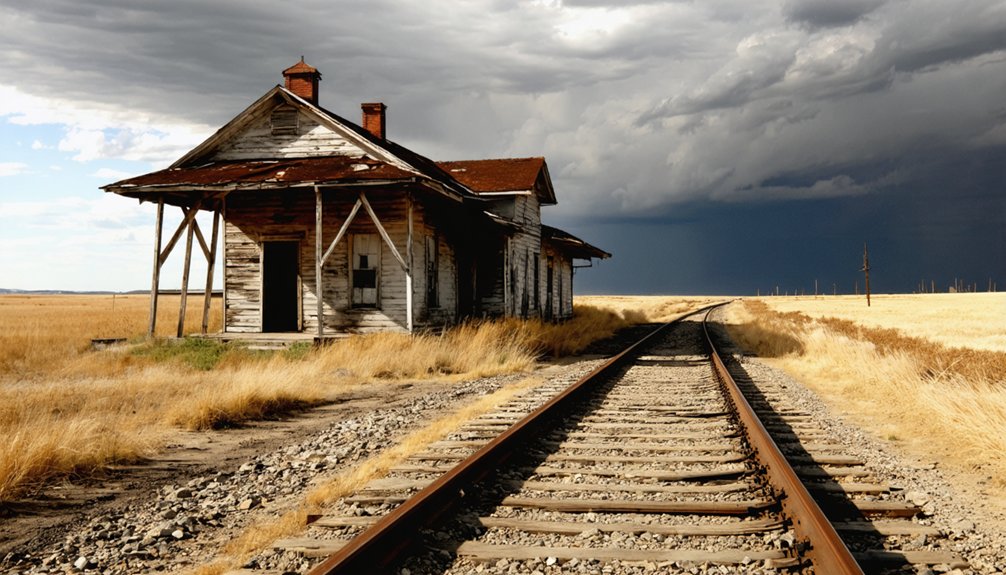
When the railroad bypassed a town or pulled up its tracks, the community’s economic lifeline vanished almost immediately. You can see this pattern clearly in places like Ardmore, founded in 1889, which faced both economic decline and water shortages that sealed its fate.
Railroad relics still mark these forgotten stops across South Dakota’s prairie landscape. Okaton followed a similar arc, briefly surviving as a ghost-town curiosity before emptying out again.
Owonka and Capa tell comparable stories — crumbling structures left behind once rail traffic stopped supporting local trade, mail routes, and storefronts. Without rail access, farms consolidated, schools closed, and residents left seeking opportunity elsewhere.
These towns didn’t die slowly — they collapsed quickly once the railroad removed the foundation everything else depended on.
The Most Haunting South Dakota Ghost Towns to Visit Today
If you’re looking for ghost towns that still carry a tangible sense of history, South Dakota offers dozens of documented sites worth visiting. Historical preservation efforts vary, but several sites remain accessible tourist attractions worth your time:
- Mystic – A Black Hills mining community with visible structural remains and documented historical significance dating to the ore-extraction era.
- Tinton – A former mining settlement in the Black Hills where you’ll find physical remnants that reflect the region’s mineral-extraction past.
- Addie Camp – Active from 1892–1917, this Pennington County site offers a documented timeline tied directly to the Addie Mine’s operational lifespan.
You can cross-reference these locations against federal place-name archives, where researchers have recorded 833 vanished or historical South Dakota sites awaiting full verification.
What Remains Inside These Abandoned Places

Stepping into these abandoned places, you’ll find that physical remnants vary sharply depending on how a town died and how long it’s been left alone. Mining settlements like Tinton and Mystic often yield collapsed timber structures, rusted equipment, and excavated hillsides.
Prairie towns like Cottonwood and Capa leave behind weathered storefronts, crumbling foundations, and overgrown lots. Historical preservation efforts remain inconsistent across sites, meaning some structures receive documentation while others deteriorate without intervention.
Addie Camp, active from 1892 to 1917, now sits neglected, offering raw evidence of mineral-era settlement. Where tourist attractions have emerged around ghost towns, foot traffic sometimes accelerates decay rather than protecting it.
You’ll notice that what survives largely reflects not historical significance, but rather geography, climate, and whether anyone bothered to care.
How to Explore South Dakota Ghost Towns Without Getting Into Trouble
Exploring these sites responsibly starts with determining land ownership before you arrive. Federal, state, tribal, and private land each carry different access rules, and trespassing carries real legal consequences. Historic preservation laws like ARPA make removing artifacts a federal offense, so urban exploration here means observing, not collecting.
Before entering any site, confirm these three essentials:
- Verify ownership through county records or the BLM land-use maps covering western South Dakota’s ghost-town corridors.
- Obtain permission from private landowners or the managing agency before stepping onto restricted ground.
- Leave everything undisturbed — photographing structures protects history without violating preservation statutes.
You’ll find that respecting these boundaries keeps access open for everyone. Sites get locked down permanently when visitors ignore the rules, erasing your freedom to explore them at all.
Frequently Asked Questions
Which South Dakota Ghost Towns Are Considered the Oldest Historically Documented Settlements?
You’ll find Addie Camp (1892) and Ardmore (1889) among the oldest documented settlements, each carrying haunted legends tied to their architectural remnants—abandoned structures that reveal the raw, unfiltered history of South Dakota’s earliest forgotten communities.
Are Any South Dakota Ghost Towns Currently Protected Under Federal Preservation Laws?
Yes, some are. Take Deadwood — it’s a National Historic Landmark, shielding it from unchecked development. You’ll find preservation challenges persist for lesser-known sites, though many leverage tourist attractions status to secure documented federal protections.
Can You Legally Purchase Land or Property Within Abandoned South Dakota Ghost Towns?
You can legally pursue land ownership in abandoned South Dakota ghost towns, but you’ll need to verify property legality carefully, as parcels may belong to private owners, counties, or the federal government.
Have Any South Dakota Ghost Towns Ever Been Successfully Revived or Repopulated?
Like embers refusing to die, yes, you’ll find Deadwood successfully revived through cultural preservation efforts, escaping urban decay to become a heritage destination—proof that freedom-seekers can breathe life back into forgotten places.
Do Any South Dakota Ghost Towns Appear on Official State Historical Registry Listings?
Yes, you’ll find abandoned structures like Deadwood and Addie Camp carry official historical recognition. These sites, wrapped in haunted legends, are documented on state and national registries, giving you verified access to South Dakota’s preserved ghost-town heritage.
References
- https://en.wikipedia.org/wiki/List_of_ghost_towns_in_South_Dakota
- https://www.youtube.com/watch?v=_0WNYsFLSLA
- https://www.atlasobscura.com/things-to-do/south-dakota/ghost-towns
- https://ghosttowntrails.com/south-dakota
- https://en.wikipedia.org/wiki/Category:Ghost_towns_in_South_Dakota
- https://www.youtube.com/watch?v=iLdeP_SBrJc
- https://everafterinthewoods.com/deserted-ghost-towns-in-south-dakota-that-history-buffs-still-visit/
- https://www.sdpb.org/rural-life-and-history/2023-08-21/some-black-hills-ghost-towns-and-their-origins
- https://coratravels.com/blog/ghost-towns-in-south-dakota
- https://kids.kiddle.co/List_of_ghost_towns_in_South_Dakota