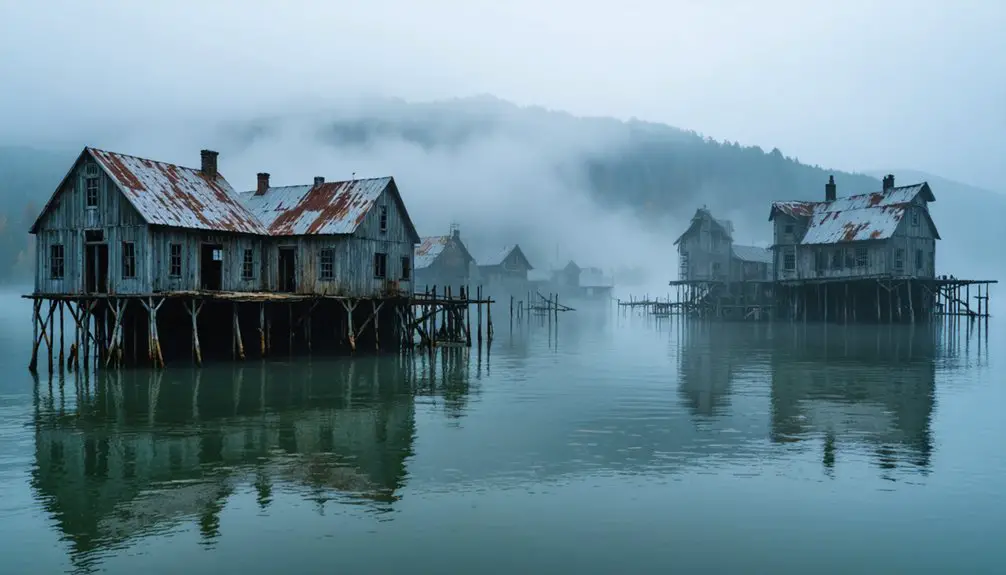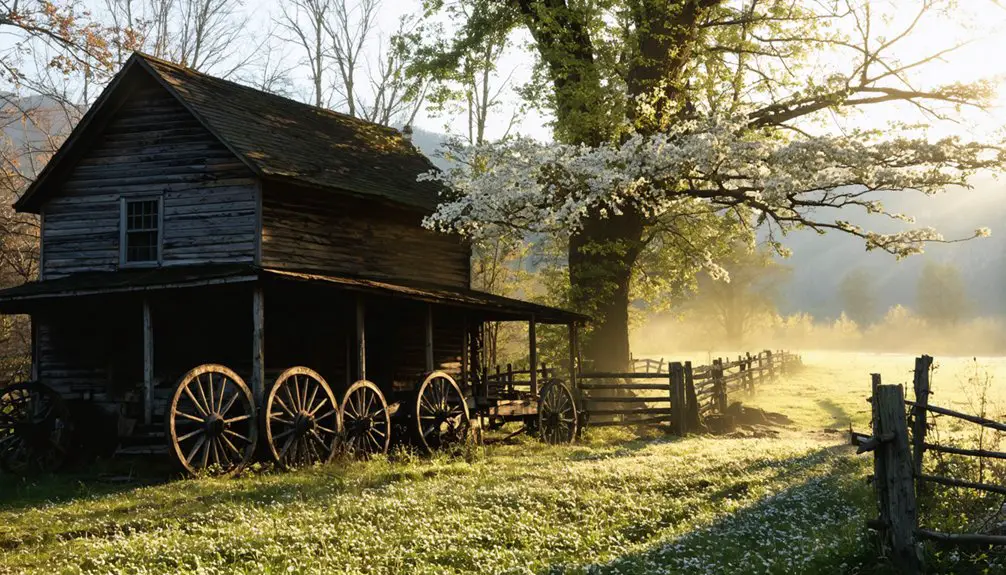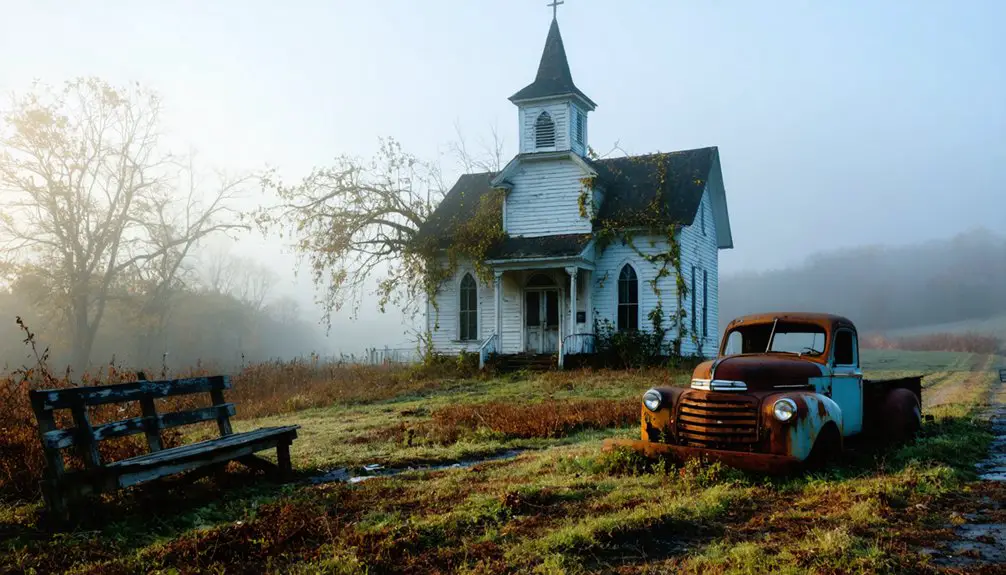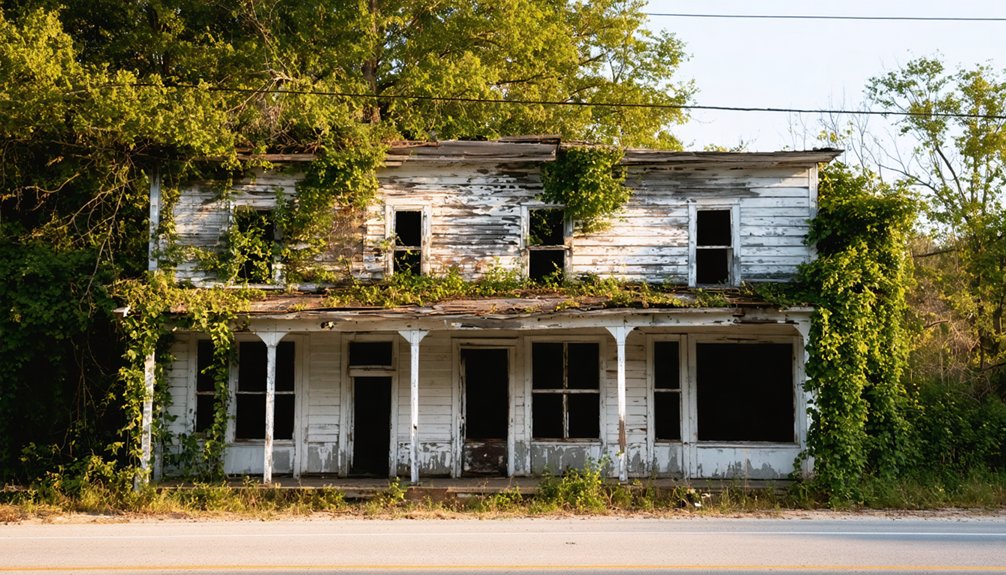
Tennessee’s ghost towns aren’t just forgotten places—they’re communities you can trace through deliberate destruction, flooding, and economic collapse. You’ll find submerged towns like Willow Grove buried beneath reservoirs, preserved settlements like Elkmont and Cades Cove frozen in the Smokies, and cautionary sites like Old Jefferson, demolished prematurely due to engineering miscalculations. Each town carries documented history through post offices, schools, and churches that once defined them. Keep exploring to uncover the full stories behind Tennessee’s lost communities.
Key Takeaways
- Elkmont, originating in the 1840s, is a Smoky Mountains ghost town with 16 restored cabins preserved by the National Park Service.
- Cades Cove features intact 19th-century Appalachian structures, offering visitors an authentic glimpse into Tennessee’s forgotten past.
- Willow Grove was submerged beneath a reservoir in 1942, burying its post office, stores, and school underwater permanently.
- Old Jefferson, once Rutherford County’s seat, was unnecessarily demolished in the 1950s due to incorrect flood predictions from engineers.
- Fork Mountain, a former thriving mining town, was abandoned after mining operations ceased and is now open for exploration.
What Qualifies as a Tennessee Ghost Town?
A ghost town isn’t simply an abandoned building or a forgotten road — it’s a community that once functioned with the full infrastructure of daily life, then ceased to exist as a populated place.
Ghost town origins vary widely: forced relocation, flooding, economic collapse, or resource depletion can each strip a settlement of its population.
In Tennessee, you’ll find all of these causes represented. What qualifies a site as a ghost town is its historical significance as a former functioning community — one that had post offices, schools, churches, businesses, and residents.
Once those elements disappear through displacement or destruction, the location earns that designation. Tennessee’s ghost towns aren’t myths; they’re documented, verifiable places where real communities once thrived before circumstances erased them from the populated landscape.
Elkmont: The Smoky Mountains Ghost Town Time Forgot
If you trace Elkmont’s origins back to the 1840s, you’ll find a modest settlement known as the Little River community, which transformed dramatically after the Little River Lumber Company acquired 86,000 acres in 1901.
By the early 1900s, affluent visitors had discovered the area, establishing the Appalachian Clubhouse around 1910, followed by the Daisy Town vacation cottages and the Wonderland Hotel.
Today, the National Park Service actively restores 16 of Elkmont’s surviving cabins, preserving a layered history that moves from frontier settlement to logging boom to upscale retreat.
Elkmont’s Humble Beginnings
Nestled in the upper Little River Valley, Elkmont began as a modest settlement called the Little River community in the 1840s.
You’re looking at a place where early settlers carved out lives along the Little River’s banks, establishing roots that would define Elkmont history for generations.
Rise Of Tourism
As the lumber industry began winding down, Elkmont’s identity shifted dramatically toward tourism in the early 1900s. The Appalachian Clubhouse emerged around 1910, anchoring a new era of visitor experiences for affluent travelers seeking mountain retreats.
You’d find Daisy Town’s vacation cottages dotting the landscape alongside the Wonderland Hotel, both catering to those craving escape from urban life. The tourism impact transformed what was once a working-class logging settlement into an exclusive recreational destination.
Wealthy families claimed seasonal cabins, establishing a culture of leisure that defined Elkmont for decades. This shift from industrial labor to recreational freedom reshaped the community’s character entirely, attracting those who valued open landscapes and mountain air over economic productivity.
That transformation ultimately set the stage for Elkmont’s later preservation and ghost town status.
National Park Restoration
When the National Park Service took stewardship of Elkmont, preservation became the primary mission. Since the early 1990s, active restoration efforts have protected what flooding and neglect almost erased.
Ghost town preservation here isn’t abstract—it’s a documented commitment to cultural heritage you can walk through.
Here’s what restoration has reclaimed for you:
- 16 historic cabins stabilized and protected from further decay
- Structural integrity restored to buildings that once housed Appalachian Club members
- Ghost stories documented, preserving oral traditions alongside physical structures
- Public access maintained, giving you direct connection to Elkmont’s layered history
You’re not just visiting ruins—you’re standing inside living cultural heritage.
Elkmont proves that preservation isn’t about freezing time; it’s about keeping history accessible on your terms.
Cades Cove: History Frozen in the Smokies
Cades Cove, located in the Great Smoky Mountains, appears on Wikipedia’s list of Tennessee ghost towns, and it’s easy to see why.
You’ll find historic buildings, overgrown paths, and old homes that preservation efforts have kept remarkably intact. Walking through Cades Cove, you can examine original structures that reflect 19th-century Appalachian life without government interference stripping away their authenticity.
The site lets you experience history on your own terms. Preservation efforts here strike a balance between maintaining access and protecting the remnants of a once-thriving community.
Locals and visitors alike carry supernatural tales about eerie silences and whispered echoes of former residents. Whether you’re drawn by history or the unexplained, Cades Cove delivers a raw, unfiltered encounter with Tennessee’s forgotten past.
Willow Grove: The Tennessee Ghost Town Buried Underwater
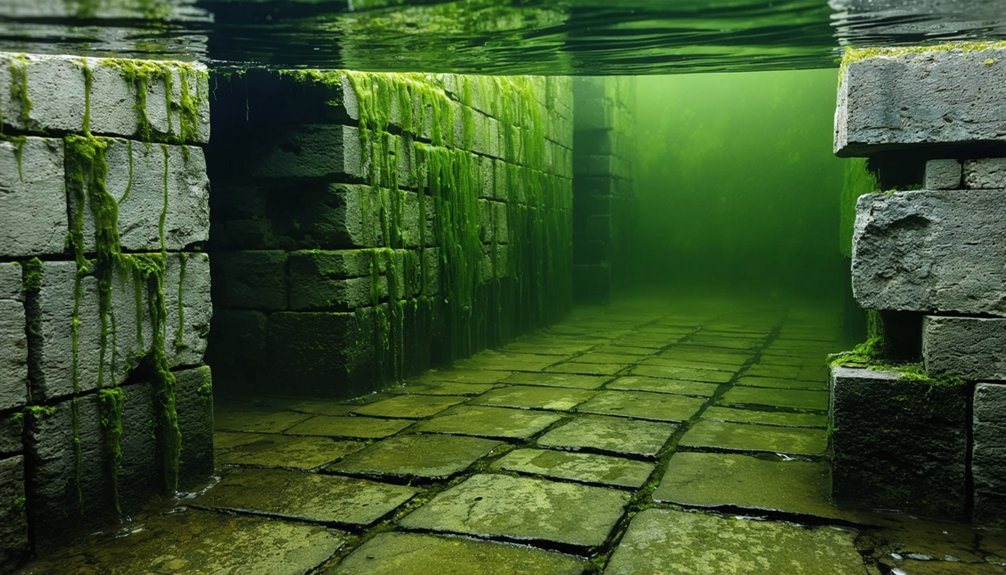
Willow Grove tells a different kind of ghost story — one buried beneath water rather than left standing in open air. Before the 1942 flooding, Willow Grove supported a full community. Residents held a farewell picnic in the schoolyard before relocating, leaving behind underwater memories sealed beneath a reservoir.
What Willow Grove once held:
- A functioning post office connecting residents to the outside world
- General stores, mills, and churches anchoring daily life
- A doctor’s office serving families across generations
- A schoolyard where children learned and neighbors gathered one final time
You won’t walk those streets today. The reservoir erased that freedom permanently.
Yet Willow Grove endures through local stories, reminding you that progress sometimes silences entire communities without their consent.
Tharpe Community: From Iron Mountain to Ghost Town
Not every ghost town disappears beneath water — some vanish through a combination of industrial collapse and forced relocation.
The Tharpe Community, originally called Iron Mountain, built its Iron Mountain Heritage around mid-1800s iron ore deposits. A giant furnace anchored the settlement, supported by a post office, general store, school, mills, churches, and a doctor’s office.
From iron ore deposits to a thriving settlement, Iron Mountain built a community forged in industry and self-reliance.
When the iron industry collapsed, Community Resilience couldn’t prevent the inevitable. Authorities forced residents to relocate before demolishing homes and businesses.
Floodwaters then submerged most remnants, erasing nearly every trace of daily life.
Yet one structure survived — the doctor’s office still stands today in Middle Tennessee’s rolling hills.
That single building represents everything the community once was: industrious, self-sufficient, and ultimately powerless against forces larger than itself.
Old Jefferson: The Town That Never Had to Disappear
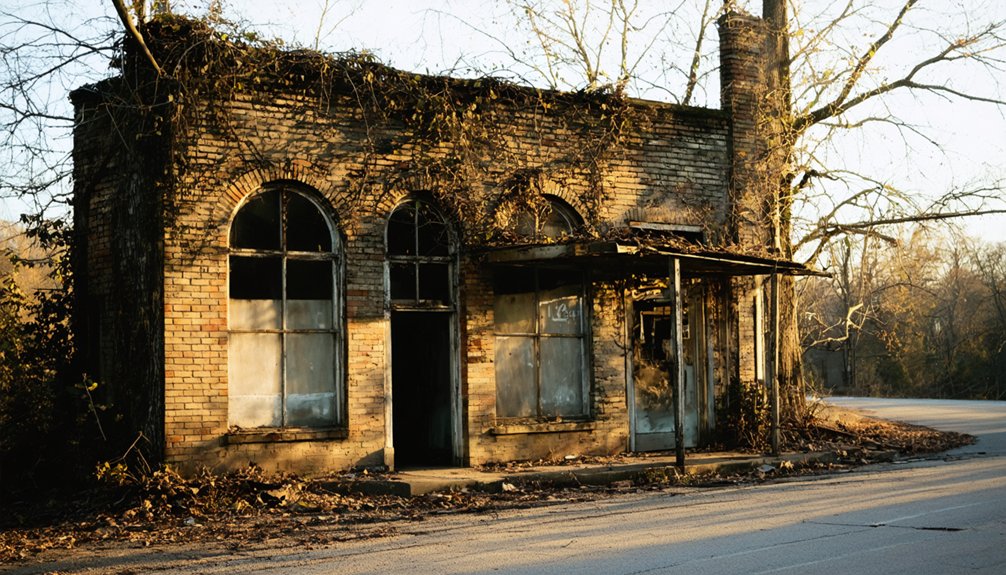
If you trace Rutherford County’s history, you’ll find that Old Jefferson once served as its original county seat, predating nearby Murfreesboro’s rise to prominence.
In the 1950s, engineers anticipated that the Percy Priest Reservoir would permanently flood the area, prompting officials to tear down and burn the town’s structures before the waters arrived.
The flood never materialized, meaning you’re looking at a ghost town that didn’t have to disappear at all—a casualty of miscalculation rather than necessity.
Rutherford County’s Original Seat
Old Jefferson once served as the original seat of Rutherford County, situated near present-day Murfreesboro. This cornerstone of Rutherford history vanished through deliberate human action, not natural decay.
Abandoned structures were hauled away or burned in the 1950s, anticipating a Percy Priest Reservoir flood that never fully materialized.
Consider what was lost:
- A county seat stripped of its governmental identity
- Historic buildings demolished based on miscalculated engineering predictions
- Community roots severed permanently by bureaucratic decisions
- Irreplaceable records of early Tennessee settlement erased from the physical landscape
You’re left confronting an unsettling truth: Old Jefferson didn’t have to disappear. Engineers predicted permanent flooding. They were wrong.
The town was already gone before anyone could reverse course.
Anticipating The Reservoir’s Flood
Engineers made a catastrophic miscalculation when they predicted that Percy Priest Reservoir would permanently flood Old Jefferson’s grounds. Acting on flawed projections, officials abandoned and burned the town in the 1950s, hauling away structures and destroying what remained.
The reservoir impact never reached the predicted levels, leaving Old Jefferson’s site dry — a ghost town created not by water, but by bureaucratic error.
You can feel the town nostalgia when you realize this community didn’t have to disappear. Residents lost their homes, their history, and their freedom to stay — all based on engineering that proved wrong.
No flood claimed Old Jefferson. Instead, misguided authority did. The site stands today as a sobering reminder that government predictions aren’t always worth sacrificing an entire community.
A Town Needlessly Destroyed
What makes Old Jefferson’s fate particularly devastating is that it was entirely avoidable. Engineers predicted flooding that never came, triggering needless destruction of a site with deep historical significance as Rutherford County’s original seat.
Consider what you’ve permanently lost:
- The original county seat, predating Murfreesboro’s establishment
- Structures burned deliberately, reduced to ash based on faulty projections
- Remaining remnants hauled away, erasing physical evidence of community life
- Percy Priest Reservoir never fully flooded the site, confirming the demolition was unnecessary
You’re left confronting a brutal truth: bureaucratic decisions, not natural forces, erased Old Jefferson. No flood claimed it. No disaster struck. Human error and institutional overreach dismantled an irreplaceable piece of Tennessee’s foundational history, leaving nothing but silence where community once thrived.
Fork Mountain: Where the Miners Never Left
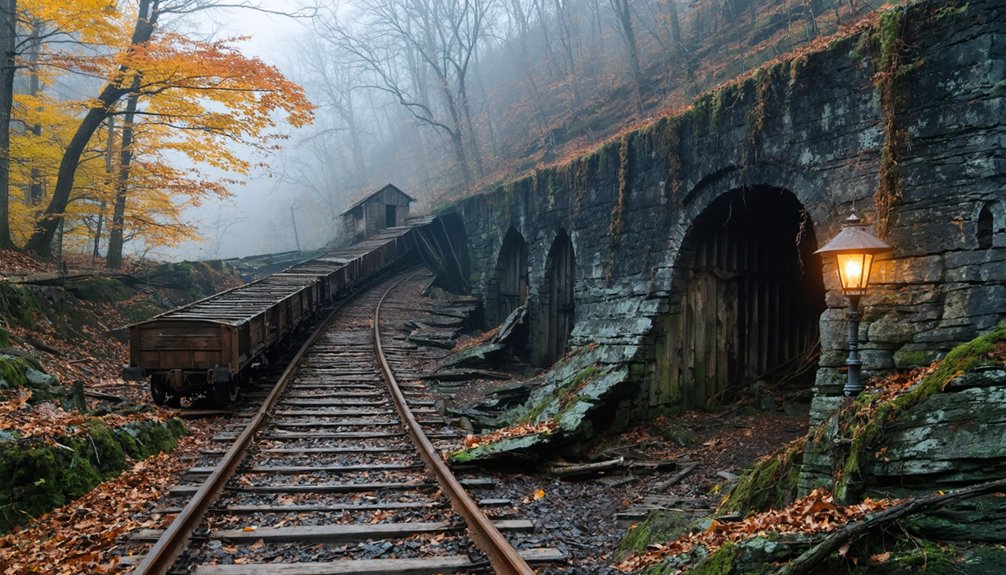
Once a thriving mining town, Fork Mountain now stands frozen in time, its streets empty and silent since operations ceased.
Once a bustling hub of industry, Fork Mountain now sits eerily silent, a town frozen in time.
When you walk through what remains, you’re stepping into a preserved chapter of Tennessee’s mining history that few people recognize.
Wikipedia’s list of Tennessee ghost towns includes Fork Mountain among its documented abandoned settlements, lending credibility to its historical significance.
The end of mining operations didn’t just empty the buildings — it created the foundation for enduring ghostly legends that persist among locals today.
Residents speak of phantom miners still roaming the abandoned landscape, refusing to leave the place they once called home.
For those who value authentic, undisturbed history over manufactured tourism, Fork Mountain offers something rare — an eerie, honest glimpse into a forgotten industrial past.
How These Towns Were Lost: Flood, Fire, and Abandonment
When you examine Tennessee’s ghost towns, you’ll find three main forces erased them from the map: floods, fire, and simple abandonment.
Reservoir projects submerged towns like Willow Grove and Tharpe Community, while Old Jefferson’s structures were hauled away and burned in anticipation of a flood that never came.
In contrast, Elkmont and Fork Mountain faded through economic decline and forced relocation, leaving behind shells of communities that once thrived.
Towns Lost To Floods
Some of Tennessee’s ghost towns didn’t fade quietly—they were drowned beneath reservoirs built for flood control and hydroelectric power. Flood impacts erased entire communities, burying submerged history under water that never receded.
- Willow Grove — Residents held a farewell picnic in 1942 before abandoning their homes forever to rising waters.
- Tharpe Community — Once called Iron Mountain, this town’s furnace, stores, and churches disappeared beneath a reservoir.
- Old Jefferson — Engineers demolished and burned this former Rutherford County seat anticipating floods that never fully came.
- Elkmont — Although primarily lost to park acquisition, rising water threatened its remaining structures for decades.
You can’t reclaim what’s underwater.
These towns remind you that progress often demands sacrifices you never personally agreed to make.
Fire And Abandonment
Not every Tennessee ghost town sank beneath a reservoir—fire and abandonment claimed their share too.
Old Jefferson, once Rutherford County’s original seat, offers one of Tennessee’s most ironic abandonment stories. Engineers predicted Percy Priest Reservoir would permanently flood the town, so residents demolished structures and set fires to whatever remained. The anticipated flood never fully materialized, leaving a scorched, empty landscape frozen in deliberate destruction.
Fork Mountain tells a different story—mining operations simply ceased, and residents walked away, leaving streets silent and frozen in time.
These fire disasters and calculated abandonments stripped communities of their futures just as thoroughly as any flood. You’re left confronting a hard truth: sometimes human decisions, not natural forces, erase entire towns from Tennessee’s map permanently.
Which Tennessee Ghost Towns Can You Actually Visit?
While many of Tennessee’s ghost towns lie submerged beneath reservoirs or have been reduced to ash and rubble, several are still accessible to curious visitors.
Ghost town tourism thrives where history and eerie legends intersect, giving you direct access to Tennessee’s forgotten past.
Here are four ghost towns you can actually visit:
- Elkmont – Explore restored cabins inside Great Smoky Mountains National Park.
- Cades Cove – Walk preserved historic structures surrounded by mountain wilderness.
- Fork Mountain – Wander abandoned mining landscapes frozen in time.
- Tharpe Community – View the doctor’s office still standing amid Middle Tennessee’s rolling hills.
Each site lets you experience Tennessee’s layered history firsthand, connecting you to communities that once thrived before circumstance erased them.
Local Legends Still Haunting These Towns
Tennessee’s abandoned towns carry legends as persistent as the ruins themselves. At Elkmont, you’ll find stories of ghostly apparitions wandering restored cabins, remnants of a wealthy vacation community swallowed by the National Park Service’s boundaries.
Fork Mountain’s empty mining streets fuel local hauntings, with legends of spectral miners still roaming silent roads. Cades Cove draws visitors who report whispers from former residents among overgrown paths and weathered structures.
Even submerged communities like Willow Grove generate spectral sightings, with locals recounting eerie disturbances above the reservoir’s surface. These legends aren’t accidental — they reflect genuine historical displacement, loss, and unresolved community memory.
You can treat these stories as folklore, but they’re fundamentally tied to documented events that erased real, functioning communities from Tennessee’s landscape.
Frequently Asked Questions
Are There Guided Ghost Tours Available at Tennessee’s Abandoned Towns?
Absolutely, you’ll find guided ghost tours at Tennessee’s abandoned towns. Like settlers on horseback, you’re exploring haunted history through Elkmont and Cades Cove, where local legends come alive through documented, thrilling nighttime experiences.
What Is the Best Time of Year to Visit These Ghost Towns?
You’ll find autumn’s the best time to visit, as the autumn colors enhance the historical significance of these sites. Cooler temperatures make exploration comfortable, and the season’s ambiance perfectly complements the eerie, abandoned atmospheres you’ll encounter.
Is It Legal to Take Artifacts From Tennessee Ghost Town Sites?
You shouldn’t remove artifacts from Tennessee ghost town sites. Artifact preservation laws protect these historical remnants, and you’ll face serious legal consequences, including federal charges, if you’re caught taking items from protected or public lands.
How Many Ghost Towns Are Officially Recognized Across Tennessee Today?
You’ll find Tennessee doesn’t officially recognize a specific number of ghost towns, but preservation efforts document dozens carrying historical significance, including Elkmont, Cades Cove, and Old Jefferson, each reflecting unique chapters of the state’s documented past.
Are Tennessee Ghost Towns Safe for Children and Family Visits?
You’ll find Tennessee’s ghost towns offer safe family safety options for all ages. Sites like Cades Cove provide documented ghost town activities, letting you explore preserved history, nature trails, and cultural landmarks while enjoying freedom-filled adventures together.
References
- https://en.wikipedia.org/wiki/List_of_ghost_towns_in_Tennessee
- https://www.tnvacation.com/trip-inspiration/articles/ghost-towns-tennessee
- https://www.youtube.com/watch?v=7mYZYhQaj4U
- https://www.youtube.com/watch?v=yDP8z91cjdc
- https://www.tnmagazine.org/19-ghost-towns-in-tennessee-that-are-not-underwater/
- https://www.loveproperty.com/gallerylist/91679/tour-the-abandoned-tennessee-ghost-town-where-millionaires-vacationed
- https://www.visitmysmokies.com/blog/smoky-mountains/about-elkmont-ghost-town/
- https://www.pigeonforge.com/elkmont-ghost-town/