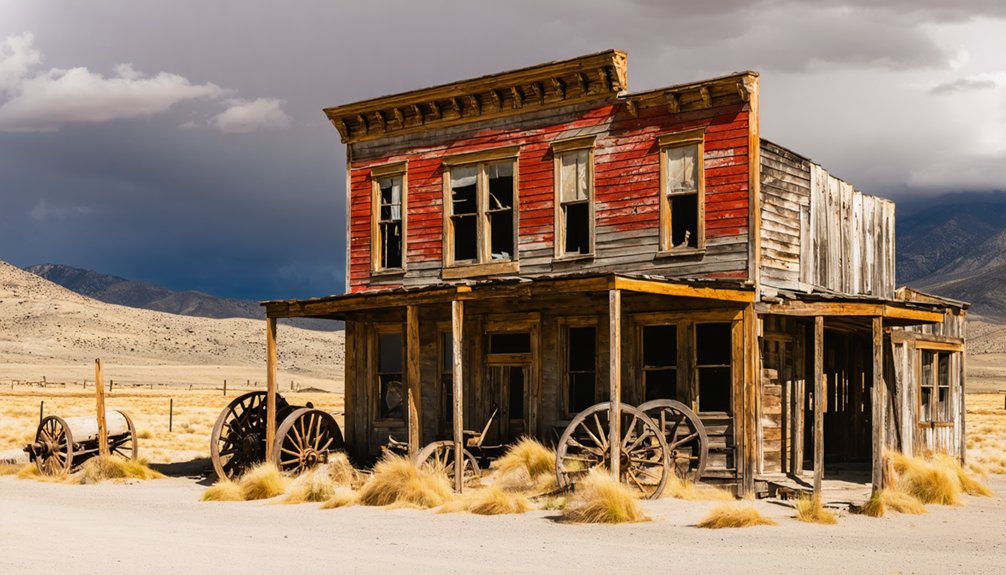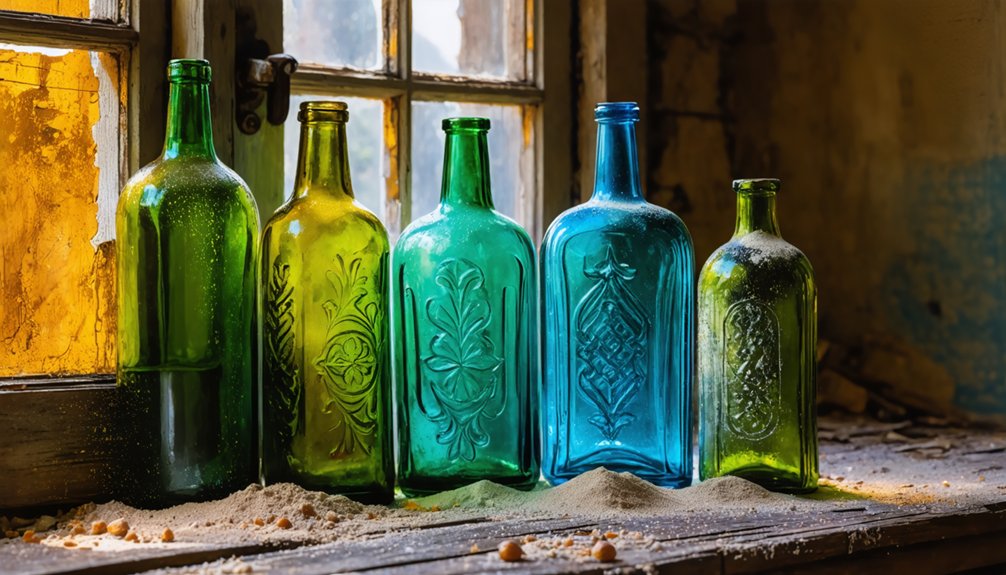
You’ll find ghost town bottles in three primary locations: embedded within architectural structures like Kelly’s 1906 Rhyolite house containing 50,000 Busch beer containers, excavated from privy caches nine feet underground during construction projects, and scattered through unregulated dumps near abandoned mining camps. Embossed markings, mold seams, and pontil scars enable precise dating between 1860-1920, while stratified deposits of whiskeys, patent medicines, and Hutchinson sodas document daily frontier existence. The archaeological context of these discoveries reveals systematic patterns of material culture preservation throughout Nevada’s desert mining settlements.
Key Takeaways
- Ghost town bottle dumps appear near abandoned structures, dried waterways, and wooded embankments, with stratified layers documenting daily existence from 1860-1920.
- Embossed markings, mold seams, and pontil marks enable precise dating, distinguishing hand-blown bottles (1860-1880) from machine-made versions (post-1900).
- Tom Kelly’s Rhyolite house incorporated 50,000 Busch beer bottles collected from 50 saloons, demonstrating bottles’ abundance in mining camp refuse.
- Construction projects expose bottle caches nine feet underground, revealing complete inventories of whiskeys, medicines, and Hutchinson sodas from work camps.
- Preservation protocols are essential when crews uncover 120-year-old privy deposits, as these sites connect artifact locations to historical maps.
The Legendary Rhyolite Bottle House of Nevada
When gold was discovered in Nevada’s Bullfrog Hills in 1905, the boomtown of Rhyolite materialized with remarkable speed, swelling to 10,000 residents by 1906 and establishing infrastructure that included electric lights, running water, and fifty saloons.
You’ll find that scarcity drove innovation here. A stonemason constructed an L-shaped dwelling using approximately 50,000 beer bottles—primarily Busch—embedded in adobe mortar, circumventing lumber shortages and prohibitive shipping costs. The architectural design incorporated bottles into both structure and walkway, requiring eighteen months and $2,500.
This bottle curation transformed saloon refuse into building material through calculated necessity. By 1920, Rhyolite’s population collapsed to fourteen residents, yet this structure endured. It remains Nevada’s finest bottle house example, managed by the Bureau of Land Management, demonstrating practical frontier resourcefulness.
Tom Kelly’s Architectural Marvel Using 50,000 Bottles
Tom Kelly, an Australian stonemason nearing 80 years old, compensated local children 10 cents per wheelbarrow to amass 50,000 glass bottles—predominantly Busch beer containers—for his 1906 construction project. He selected this unconventional building material for its thermal properties, light transmission capabilities, and adaptation to the lumber-scarce Mojave Desert environment.
The resulting three-room, L-shaped structure cost approximately $2,500, with bottles laid in horizontal courses and secured with adobe mortar, their bases facing outward to create translucent walls that filtered natural light while maintaining interior temperature regulation.
Kelly’s Bottle Collection Process
How did an aging prospector transform mining camp refuse into architectural history? You’ll find Kelly’s method exemplified practical bottle repurposing at industrial scale. His prospector scavenging targeted Rhyolite’s estimated 50 saloons, where miners discarded Adolphus Busch beer bottles daily. Kelly exploited this free supply, collecting 50,000 bottles in under six months during 1905-1906.
The collection process capitalized on mining camp abundance that others overlooked. While conventional builders struggled with scarce lumber—limited to Joshua trees—Kelly recognized opportunity in what prospectors threw away. His systematic approach transformed waste into building material, embedding bottles in mortar to create three-room construction.
This wasn’t romantic recycling; it was calculated resourcefulness. Kelly demonstrated early 20th-century ingenuity by converting disposal problems into architectural solutions, establishing precedent for Nevada’s bottle house movement.
Three-Room House Construction
Kelly’s systematic collection efforts culminated in Rhyolite’s most distinctive structure—a three-room house incorporating approximately 50,000 bottles within its L-shaped floor plan. The Australian stonemason drew upon architectural influences from both frontier pragmatism and Victorian ornamentation, creating a single-story dwelling with gable roof and decorative gingerbread trim. You’ll notice he positioned bottle bottoms outward, transforming waste materials into living history documentation of the town’s saloon culture.
Adobe mortar bound the bottles in regular horizontal courses, though smooth glass surfaces challenged adhesion. Kelly invested $2,500 primarily in wood fixtures and trim, completing construction by February 1906 after eighteen months. The structure functioned conventionally inside with plastered walls, while glass walls provided natural illumination and thermal regulation—cool summers, warm winters.
Historical Preservation and Repurposing
Upon completion in February 1906, Kelly’s architectural experiment immediately transcended its role as mere shelter when he raffled the structure for $5 per ticket—a shrewd recoupment strategy that transferred ownership to the Bennet family.
They occupied the dwelling until 1914, weathering Rhyolite’s decline before abandonment catalyzed its transformation. Paramount Pictures recognized the structure’s cultural significance in 1925, installing a new roof for film production that preserved the building’s integrity.
Post-filming conversion to a museum legitimized its architectural merit, with caretaker Lewis Murphy conducting tours from 1936 to 1954.
Today’s BLM protection acknowledges this sustainable bottle recycling prototype as America’s oldest complete bottle house. You’ll find it perfectly preserved within Rhyolite’s ghost town boundaries—a memorial to mining-era resourcefulness that challenged conventional construction paradigms through material repurposing.
Building Materials Born From Necessity in Desert Mining Camps
When timber proved scarce across Nevada’s desert mining camps, prospectors transformed the detritus of boom-town life into functional shelter. You’ll find evidence of these repurposed material innovations in Tonopah’s 1906 barrel cabin and the 1910 bottle house constructed from thousands of discarded saloon containers.
Scarcity bred innovation: Nevada miners constructed barrel cabins and bottle houses from saloon refuse and boom-town waste.
Mining town recycling practices extended to Goldfield’s 1906 bottle structure, where daily waste became building blocks embedded in mud mortar.
Beyond surface dwellings, dugouts carved into hillsides required minimal materials while providing thermal regulation through earth insulation. Randsburg’s example featured refined stonework and functional chimneys.
Where permanence mattered, adobe construction dominated—Harmony Borax Works’ 1882 settlement housed forty workers producing three tons daily. These structures weren’t mere curiosities; they represented pragmatic responses to resource scarcity, utilizing available materials with engineering efficiency.
Mudlarking Adventures in Alabama Coal Mining Towns
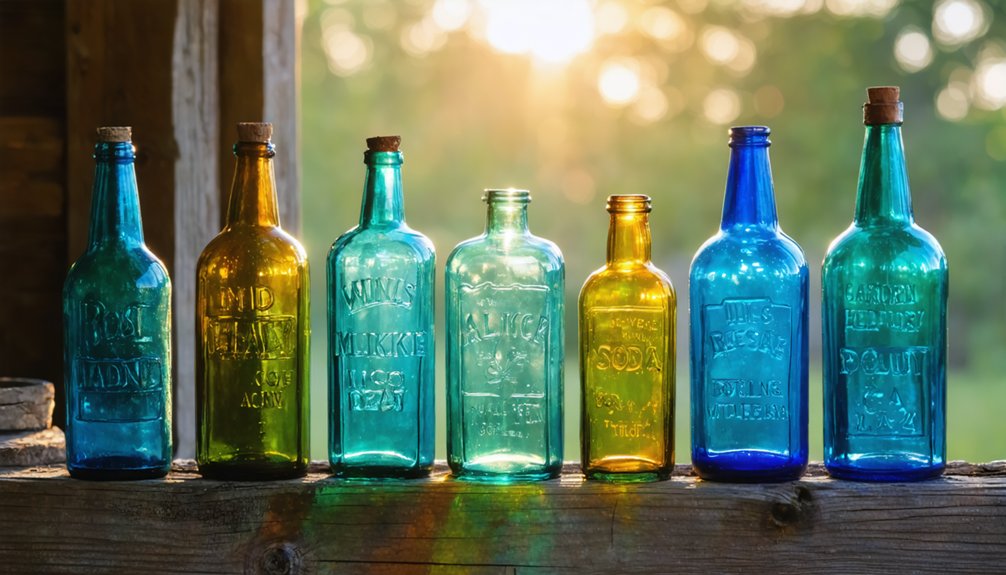
You’ll locate productive mudlarking sites by identifying creek bends where trash accumulated downstream from company housing and commissaries in communities like Aldrich, Blocton, and Ensley. Embossed glass fragments enable precise dating through manufacturer marks, bottle seam characteristics, and closure methods that evolved from hand-blown techniques in the 1890s to machine production by the 1920s.
These diagnostic features establish temporal boundaries for artifacts recovered from coal town dump sites, correlating physical evidence with documented operational periods of specific mining operations.
Creek Trash Dump Indicators
As you approach abandoned coal mining sites in Alabama’s ghost towns, tailings piles serve as primary visual markers for locating historical dump areas where miners discarded refuse alongside industrial waste. These sites reveal mining impacts on indigenous communities, particularly where Creeks once harvested Red Mountain’s powdery hematite for ceremonial purposes before land reclamation efforts altered landscapes permanently.
Recognizable dump indicators include:
- Pratt Coal & Coke Company tailings photographed in 1968, marking slopes where convict laborers disposed of extraction residue
- Coal tipple remnants at Glen Mary signaling centralized operations where workers discarded broken equipment and personal items
- Hematite dust deposits near Eureka 1 mine identifying ore processing zones
You’ll find miners’ brass tags, octagonal clacker money, and glass bottles concentrated where company infrastructure—boarding houses, commissaries, pumping tanks—once stood before abandonment.
Embossed Glass Age Dating
Surface indicators guide you to dump sites, but the bottles themselves reveal precise chronological information through their embossed markings. You’ll find manufacturer symbols and patent dates on bases that establish production floors—”PAT NOV 30TH 1858″ means nothing earlier.
Body-side embossing material types reveal product origins: medicine, whiskey, or utility bottles each display distinct characteristics. Alabama coal camp dumps yield pre-1910 specimens with tooled lips and abbreviated maker codes like “W.T. Co.” for Whitall Tatum.
Comparison of markings against Toulouse’s database authenticates finds and narrows dating windows to 10-15 years when combined with mold seams. Post-1930 “Federal Law” embossing rarely appears in abandoned town sites, confirming ghost town abandonment timelines.
Base numbers function as mold identifiers or date codes—higher sequences indicate later production runs within manufacturers’ operational periods.
Dating Antique Bottles Through Embossing and Labels
When examining bottles recovered from ghost towns and historical sites, embossed markings offer the most immediate pathway to accurate dating. You’ll find manufacturer marks like “W.T. Co.” or prohibition-era text providing definitive production periods. Sharp, distinct embossing indicates 1905–1920 manufacture when air-venting improved clarity.
Embossed markings on historical bottles provide immediate dating clues, with manufacturer codes and sharp lettering revealing specific production periods between 1905–1920.
Cross-reference embossing with these physical characteristics:
- Mold seam features running completely over the lip confirm machine production post-1900, while seams ending below the neck indicate 1860–1880 hand-blown construction
- Pontil mark analysis reveals iron rod attachment scars definitively dating bottles to pre-1860
- Air-venting marks scattered across surfaces pinpoint 1905–1920 manufacturing windows
You’re decoding manufacturing evolution through tangible evidence—each mark represents technological advancement and economic forces shaping frontier commerce.
Road Construction Reveals Hidden 1800s Bottle Caches
While embossing and physical markers provide controlled analysis of individual specimens, modern infrastructure projects create unexpected opportunities for archaeological discovery.
Road construction methods expose bottle caches nine feet underground, revealing patented 1877 specimens alongside 1920s amber chemicals. You’ll find excavations disclosing complete inventories—whiskeys, medicines, Hutchinson sodas from 1880s bottling works operated by Herman Krueger into the 1930s. These sites yield mold-turned bottles, Kentucky bourbon labels, and tara syrups preserved in deep pits.
Artifact preservation protocols become critical when construction crews uncover 120-year-old privy caches at former residences like Mary Rude’s Leeds property. Cart paths breaking through ancient walls connect work camp locations to historical maps, documenting how communities discarded intact bottles with original corks, wicks, and chemical contents still analyzable today.
The Rise and Fall of Rhyolite Boomtown
Gold’s discovery on August 9, 1904, transformed the Bullfrog Hills from geological obscurity into Nevada’s most dramatic boomtown cycle. You’ll find Rhyolite’s bustling economy supported extraordinary infrastructure within three years:
- Three railroad lines delivered materials for concrete sidewalks, electric lighting, and a three-story building costing $90,000
- Fifty saloons and thirty-five gambling tables served populations fluctuating between scholarly estimates of 3,500 and newspaper claims of 10,000
- Mining town architecture included an opera house, stock exchange, and formal churches—unprecedented amenities for Death Valley’s harsh environment
The Montgomery-Shoshone Mine’s closure in 1911 triggered systematic abandonment. Financial constraints from the 1907 panic prevented capital investment in deeper ore extraction. By 1920, population approached zero, leaving behind concrete ruins documenting unfettered enterprise’s ephemeral nature.
Three Bottle Houses That Define Ghost Town History
When you examine bottle houses in ghost towns, you’ll find Tom Kelly’s 1906 Rhyolite structure stands as the oldest and largest in the United States, incorporating over 50,000 beer, whiskey, and medicine bottles collected from local saloons.
This architectural innovation emerged from practical necessity—lumber scarcity in Nevada’s desert forced miners to repurpose abundant glass waste into durable building materials using adobe mortar. The structure’s century-long survival demonstrates how resource constraints generated construction methods that provided thermal regulation and natural lighting while establishing a legacy that influenced later bottle houses in Calico, California, and Cap-Egmont, Canada.
Rhyolite’s 50,000 Bottle Structure
Among Nevada’s architectural curiosities, Tom Kelly’s bottle house stands as the oldest and largest glass bottle structure in the United States, containing approximately 50,000 beer, whiskey, and medicine bottles mortared into its walls. This 1906 construction demonstrates unique bottle construction techniques born from necessity in Rhyolite’s wood-scarce environment.
Kelly’s bottle house blueprints reveal practical innovation:
- Material sourcing: Children collected bottles from 50+ saloons for 10 cents per wheelbarrow
- Construction timeline: Six months (September 1905-February 1906) at $2,500 total cost
- Structural design: Three rooms with plastered interiors, porch, and decorative gingerbread trim
The structure provides superior insulation—cool summers, warm winters—while allowing natural daylight penetration. You’ll find this best-preserved Nevada bottle house serving as Rhyolite’s informal museum, protected by on-site caretakers since Paramount Pictures’ 1925 restoration.
Mining Camp Construction Innovation
Three distinct Nevada mining camps pioneered bottle architecture between 1905-1908, transforming discarded glass containers into permanent structures when conventional building materials remained prohibitively expensive or unavailable. Rhyolite’s Tom Kelly house utilized 50,000 Adulphus Busch bottles, creating a three-room dwelling with interior plaster that contradicted the temporary nature of transient mining populations.
Gold Point’s 1908 shift from canvas tents to wooden structures demonstrated how camps evolved architecturally as silver discoveries justified permanent investment. Goldfield’s rapid transformation from tent city following its 1902 emergence showcased desert resource utilization at scale, with miners repurposing every available material.
These innovations reflected practical adaptation rather than aesthetic choice—you’ll find that frontier builders created enduring structures from saloon waste when lumber costs exceeded miners’ wages, establishing architectural precedents that survived their camps’ eventual abandonment.
Preserved Desert Architectural Relic
Nevada’s most documented bottle architecture stands in Rhyolite, where Tom Kelly’s 1905-1906 dwelling represents the oldest and largest surviving example of this frontier construction method. You’ll find 51,000 beer bottles embedded in cement mortar—testament to adaptive reuse in mining regions when conventional materials remained scarce.
The structure’s preservation journey illustrates evolving desert settlement values:
- Film Industry Intervention (1925): Paramount Pictures financed restoration, dismantled rear wall for interior shots, then rebuilt with stabilization
- Caretaker Era (1936-1954): Lewis Murphy maintained site integrity, offered guided tours
- Museum Conversion: Post-filming transformation secured long-term protection
This bottle house architecture exemplifies boomtown resourcefulness—transforming 50 saloons’ waste into permanent shelter. Today it anchors Rhyolite’s ghost town narrative, documenting how miners conquered material limitations through ingenious substitution.
Garbage Dumps as Time Capsules of the Mining Era

When mining towns flourished across the American West during the late nineteenth and early twentieth centuries, their inhabitants disposed of refuse with little concern for environmental impact or future archaeological value. You’ll find these unregulated dumps in wooded embankments, near abandoned structures, and along dried waterways—wherever convenience dictated.
The dump site significance emerges through stratified layers of ash, broken glass, ceramics, and medicine bottles that document daily existence in these settlements. Though decay claims most organic materials, artifact preservation practices reveal culturally significant items when you excavate carefully.
Each pile connects directly to specific properties, potentially qualifying sites for historical registers. These waste deposits function as accessible archaeological resources, exposing bulk garbage that conventional documentation overlooked during the mining era’s rapid expansion and subsequent abandonment.
Preserving Bottle Artifacts for Future Generations
Once you’ve recovered bottles from ghost town dump sites, proper preservation becomes essential to maintain their historical integrity and material stability. Your bottle restoration methods should respect the artifact’s authenticity while ensuring longevity.
Begin with thorough cleaning—empty contents into designated sinks, rinse with distilled water and mild detergent, then air dry completely to prevent bacterial growth.
For damaged specimens, employ conservation-grade materials:
- Reconstruct missing sections using silicone molds and tinted epoxy cured properly
- Control-dry waterlogged glass through successive ethanol baths and dilute adhesive application
- Store at 45-50% relative humidity to prevent gel layer deterioration
Ethical display protocols require UV-filtered cases, minimal light exposure, and rotation schedules. Store bottles in acid-free archival boxes with silica gel packets, maintaining adequate spacing between pieces to prevent damage while preserving their stories.
Frequently Asked Questions
What Legal Permissions Are Needed to Collect Bottles From Ghost Towns?
You’ll need landowner permission before collecting, as bottle ownership regulations protect private property rights. Legal bottle collection guidelines require verifying site status—federal lands and designated historical areas have additional restrictions that limit your access and collection activities.
How Can You Safely Clean Antique Bottles Without Damaging Their Value?
You’ll preserve value by using gentle cleaning methods like lukewarm water and soft brushes, avoiding harsh chemicals on labels. For rare finds, you’re better off consulting professional restoration services who understand historical preservation techniques and collector standards.
What’s the Current Market Value for Embossed Bottles From the 1800S?
You’ll find 1800s embossed bottles ranging from $50 to $1,500+, depending on condition and rarity. Current bottle valuation trends favor authenticated examples with clear embossing. Master bottle authentication techniques to identify truly valuable pieces worth $2,000–$60,000+.
Are There Active Bottle Collecting Clubs or Organizations to Join?
Yes, you’ll find over 50 active clubs nationwide through FOHBC’s directory. Members share bottle restoration techniques, historical bottle display ideas, and participate in shows, auctions, and educational programs. Annual dues typically range $10-$20.
Which Ghost Towns Are Best for Finding Rare Antique Bottles Today?
Like frontier prospectors staking claims, you’ll find Ruso’s 1906 sites yield cork-top treasures at three-foot depths. Observe bottle hunting etiquette by respecting property boundaries and practicing responsible collecting practices—document finds methodically, preserve historical context, and leave sites undisturbed for future discoverers.