Planning a ghost town road trip to Brewton, Mississippi means following Pascagoula River Road into dense woods to find what’s left of Jackson County’s second county seat. You’ll discover a crumbling courthouse basement, a nearby historical marker, and legends tied to outlaw James Copeland‘s alleged courthouse arson. There are no restored facades or official signs — just raw history swallowed by fire, floods, and shifting politics. Stick around, and you’ll uncover everything this forgotten river bluff still has to tell.
Key Takeaways
- Brewton sits on the west bank of the Pascagoula River in Jackson County, Mississippi, once serving as the county’s second county seat.
- The only significant remnant is a crumbling courthouse basement; expect ruins over restoration with no signage or preserved structures.
- Fall offers the clearest views, though spring and winter provide unique atmospheric perspectives for exploring the dense surrounding woods.
- Bring offline resources like USGS topographic maps and Mississippi Department of Archives and History records, as connectivity is limited.
- Combine your visit with nearby Moss Point and Pascagoula maritime heritage sites for a full day trip covering regional frontier history.
What Is Brewton, Mississippi and Why Does It Matter?
Tucked along the west bank of the Pascagoula River in Jackson County, Brewton, Mississippi checks every box for a classic American ghost town — a forgotten settlement that once held a courthouse, stores, a hotel, a bank, and real political ambition before fires, floods, and shifting fortunes erased it from the map.
You won’t find artistic renderings of its former skyline or polished museum displays here. What you’ll find instead are local legends, a partial courthouse basement, and thick woods swallowing whatever ambition once stood there.
Brewton served as Jackson County’s second county seat, making it historically significant beyond its small footprint. If you crave unfiltered history on your own terms, this remote stretch off Pascagoula River Road delivers exactly that.
How a River Bluff Became Jackson County’s Second Courthouse
Geography shaped Brewton’s early promise more than anything else. When Jackson County needed a second courthouse, local leaders looked to the high bluff rising above the Pascagoula River’s west bank. That elevated position felt strategic — visible, defensible, and central enough to serve a growing frontier county.
You’d have found real historic architecture here once: a courthouse, stores, a hotel, a bank, and a jail. The bluff carried genuine authority in its time. Local legends even tie the site to outlaw James Copeland and courthouse arson, which hints at how volatile frontier justice could get.
That volatility mattered. Fires, river-crossing difficulties, and Indian conflicts weakened the settlement’s hold. What started as a confident civic choice slowly unraveled, leaving the bluff to the woods.
The Fires and County Politics That Erased Brewton
Once you understand why Brewton rose, you can start to see exactly how it fell — and fire did a lot of the heavy lifting.
Repeated blazes tore through the sawmill and courthouse, stripping the town of its two most important functions.
When local leaders lost confidence in the site, they moved the county seat elsewhere, and Brewton never recovered from that political abandonment.
Courthouse Fires And Politics
Fire and politics didn’t just slow Brewton down—they erased it. The sawmill burned. The courthouse burned. Each time, rebuilding grew harder, and county leaders grew less convinced this remote bluff deserved their investment.
When the county seat moved elsewhere, Brewton lost its reason to exist.
Local legends tie outlaw James Copeland to at least one of these fires, adding a lawless edge to what was already a fragile settlement. Whether arson or accident, the result was the same—abandoned structures rotting into the bluff, and a community scattering toward better opportunities.
You’re not visiting a place that faded quietly. You’re standing where deliberate decisions and destructive events collided, stripping a once-promising town down to a courthouse basement and a historical marker.
County Seat Power Shifts
When Brewton held the county seat, it held real power—a courthouse meant government contracts, legal authority, and the kind of economic gravity that pulled settlers and businesses into a settlement. Once that designation moved elsewhere, urban decay followed fast. Without the courthouse anchoring economic activity, stores closed, residents left, and the timber economy couldn’t compensate for the political loss.
You’re looking at a place where historical preservation never took hold because there was nothing left worth preserving after the fires and government reshuffling ran their course. The county seat moved, the sawmill burned, and Brewton simply emptied out.
What remained wasn’t a town—it was a memory embedded in a riverbank. That’s exactly what makes it worth your detour today.
James Copeland and the Courthouse Burning Legend
The legend of outlaw James Copeland clings to Brewton like smoke. One of the South’s most notorious legendary outlaws, Copeland allegedly torched the courthouse that once crowned this river bluff settlement. Whether you believe the story or not, it sharpens the atmosphere when you’re standing at the site.
Copeland ran a violent criminal network across the Gulf Coast region during the mid-1800s, and Brewton fell within his territory. Historians debate his direct role in the fire, but the legend persists because it fits — a remote courthouse, a ruthless outlaw, and a town already teetering.
When you visit, that tension between fact and folklore becomes part of the experience. You’re not just seeing ruins; you’re stepping into a story that history never fully resolved.
What You Can Actually See at the Brewton Ghost Town Site?
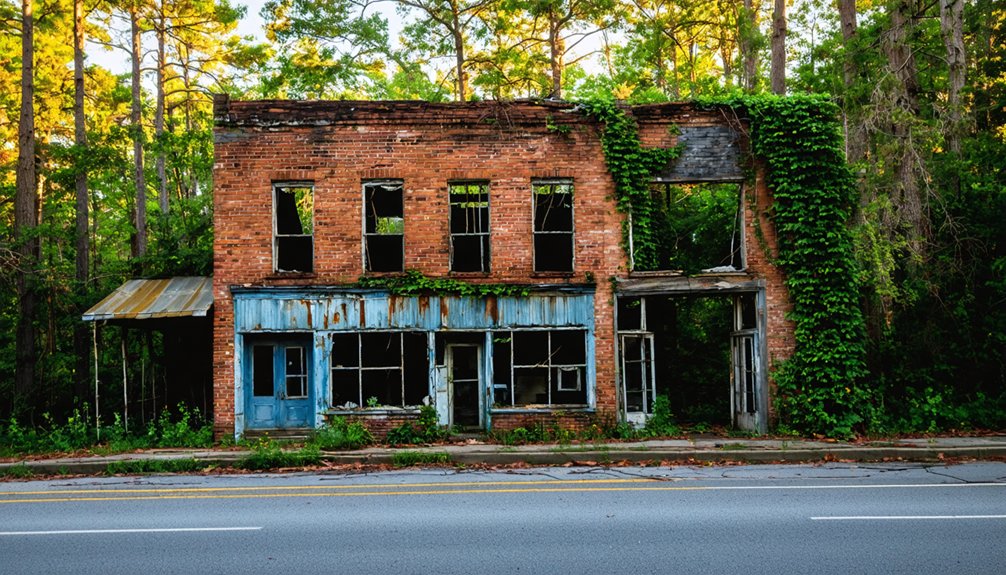
When you arrive at the Brewton site, don’t expect standing buildings or a preserved historic district — what you’ll find is a fragment of the old courthouse basement, quietly reclaimed by thick woods along the Pascagoula River.
That crumbling remnant is fundamentally the only physical evidence that a county seat, hotel, bank, and sawmill once operated here.
You’ll also want to look for the nearby historical marker, which gives you the context that the landscape itself no longer provides.
Courthouse Basement Remains
After making your way through thick woods along Pascagoula River Road, you’ll find that Brewton doesn’t offer much in the way of standing structures — but that’s part of the draw. The most significant remnant of this town’s historical architecture is the courthouse basement, a raw, grounding connection to Jackson County’s frontier past.
Standing near the west bank of the Pascagoula River, this fragment rewards curious travelers who appreciate river geography and untamed history. Here’s what makes the basement worth the detour:
- It marks the site of Jackson County’s second courthouse.
- Fire — possibly tied to outlaw James Copeland — destroyed what stood above it.
- It anchors the entire ghost-town experience, turning an empty clearing into a real story.
Nothing else survives. That absence speaks volumes.
Historical Marker Nearby
Beside the courthouse basement, a historical marker gives you something concrete to read while you take in the remote, wooded silence of the Brewton site. It anchors the experience, connecting river geography, frontier politics, and local legends to the ground beneath your feet.
You’re standing where early Jackson County leaders once envisioned a thriving county seat along the Pascagoula River’s west bank, and the marker helps you visualize what’s no longer there. Without it, the thick tree cover and quiet landscape offer few obvious clues about the town’s past.
The marker won’t take long to read, but it adds real context to the ruins. Pair it with the basement remnants, and you’ve got a complete, if brief, picture of Brewton’s rise and fall.
Is Brewton Worth the Drive for a Day Trip?
Whether Brewton is worth the drive depends largely on what you’re after. If you crave raw history, urban legends, and untamed landscapes over polished museums, this ghost town delivers. Preservation challenges mean you won’t find restored buildings, but that’s exactly the point.
Brewton rewards the curious, not the comfortable — raw history over restored facades, untamed over polished.
Pack your curiosity and plan around these three highlights:
- The courthouse basement remnant — one of Mississippi’s quietly powerful historical fragments
- The James Copeland outlaw legend — a story that transforms ruins into something cinematic
- The Pascagoula River corridor — pair Brewton with nearby river history stops for a full day
You’re trading comfort for authenticity here. The remote setting rewards travelers who want freedom from tourist crowds and appreciate history in its rawest, most honest form.
How to Find Brewton Off Pascagoula River Road
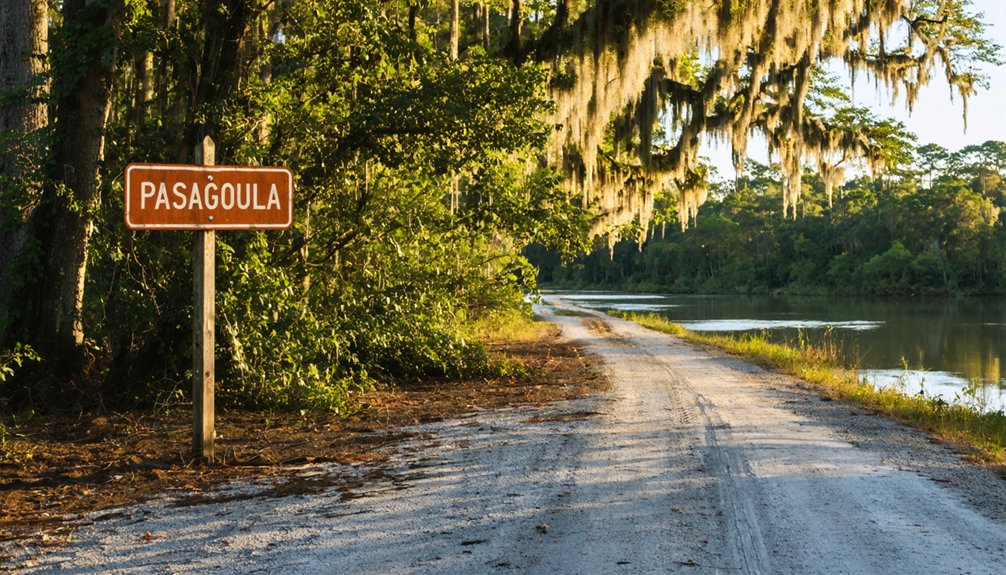
Finding Brewton isn’t complicated, but it does demand attention. You’ll follow Pascagoula River Road until the landscape thickens into dense woods and the pavement feels less certain. There’s no dramatic entrance, no restored facades, and no signs pointing toward something grand.
Preservation challenges have kept this site raw and largely unmarked, so you’re orienting yourself by awareness rather than infrastructure. A nearby historical marker offers your clearest orientation point once you’re close.
Urban legends about outlaw James Copeland burning the courthouse still circulate around this stretch of Jackson County, adding a charged atmosphere to what’s already an isolated stop.
What you’ll find is a partial courthouse basement, heavy tree cover, and quiet. Bring your own research, trust your instincts, and move deliberately through the site.
The Best Time of Year to Visit Brewton, Mississippi
Timing your visit to Brewton makes a real difference in what you’ll experience on the ground. Weather considerations matter here because summer heat and humidity can turn a simple woods walk into an exhausting slog.
Your three best windows are:
- Spring – Mild temps, green landscape, easy trail conditions for exploring the courthouse ruins.
- Fall – Cooler air, thinner foliage, and better visibility through the thick woods surrounding the site.
- Winter – Quiet, comfortable, and surprisingly accessible since the area rarely sees snow.
Each season opens the site differently, but fall gives you the sharpest view of what remains.
Local legends surrounding James Copeland and the burned courthouse hit differently when you’re standing in cold, still air with nothing but trees around you.
Other Jackson County History Stops Near Brewton
Brewton works best when it’s part of a longer day rather than a standalone stop, and Jackson County gives you plenty to build around it.
Follow the Pascagoula River corridor and you’ll find sites tied to the timber industry that once defined this entire region, from old mill communities to river landings that fed lumber downstream to coastal markets.
Moss Point and Pascagoula offer waterfront history, maritime heritage, and architecture worth your time.
If urban legends pull you in, the James Copeland outlaw trail runs through this same stretch of Mississippi, connecting frontier crime, courthouse drama, and backcountry mythology into one compelling narrative thread.
Stack these stops deliberately, and you’ll leave with a full picture of how Jackson County grew, thrived, and in some places, quietly disappeared.
Mississippi Ghost Town Archives and Maps Worth Bookmarking
Before you head out, it’s worth building a solid research foundation so you’re not piecing together Brewton’s history from unreliable sources on the road. These resources help you separate documented history from urban legends and ghost stories before you arrive.
- Mississippi Department of Archives and History (mdah.ms.gov) – Search county records, historical photographs, and Jackson County documents tied directly to Brewton’s courthouse era.
- Historic Mississippi Ghost Towns Database – Cross-reference settlement timelines, ownership changes, and decline patterns across the state’s abandoned communities.
- USGS Historical Topographic Maps (topoview.usgs.gov) – Pull older maps showing Brewton’s position along the Pascagoula River’s west bank, giving you real geographic context.
Download what you need before leaving cell range. Remote sites like Brewton don’t offer reliable connectivity.
Frequently Asked Questions
Is There an Entrance Fee to Visit the Brewton Ghost Town Site?
You won’t pay an entrance fee to explore Brewton’s historically significant ruins. The site’s lack of formal preservation efforts means you’re free to roam this remote ghost town, experiencing true frontier history on your own terms.
Are Pets Allowed When Visiting the Brewton Ghost Town Area?
Pets possibly permitted, but prioritize pet safety in Brewton’s thick, remote woods. No formal pet restrictions are confirmed, yet you’ll want to keep your furry companions leashed amid the wild, untamed terrain surrounding this ghost town.
Can You Camp Overnight Near the Brewton Ghost Town Location?
No official camping regulations exist for the Brewton ghost town site, so you’ll want to explore nearby Pascagoula River area campgrounds for overnight amenities. They’ll give you a perfect, freedom-filled base for your adventure!
Is the Brewton Site on Public or Private Property?
Before you hit the road, know that property ownership details for Brewton’s site remain murky. You’ll want to verify access restrictions locally, as the land likely falls under private hands. Always ask before you explore.
Are There Any Guided Tours Available at the Brewton Ghost Town?
You won’t find any formal guided tours or historical preservation programs at Brewton’s ghost town. You’re free to explore this remote, rugged site independently, soaking in its rich frontier history and atmospheric ruins at your own pace.
References
- https://en.wikipedia.org/wiki/Brewton
- https://en.wikipedia.org/wiki/List_of_ghost_towns_in_Mississippi
- https://www.ghosttowns.com/states/ms/brewton.html
- https://www.treasurenet.com/threads/brewton-ghost-town.96121/
- https://www.onlyinyourstate.com/experiences/mississippi/ms-ghost-towns
- https://raregoldnuggets.com/?p=3890
- https://sites.rootsweb.com/~mstttp/ghosttowns/ghosttowns.htm
- https://www.thetravel.com/mississippi-ghost-towns-worthy-of-a-road-trip/
- https://samplingamerica.com/ghost-towns-in-mississippi/