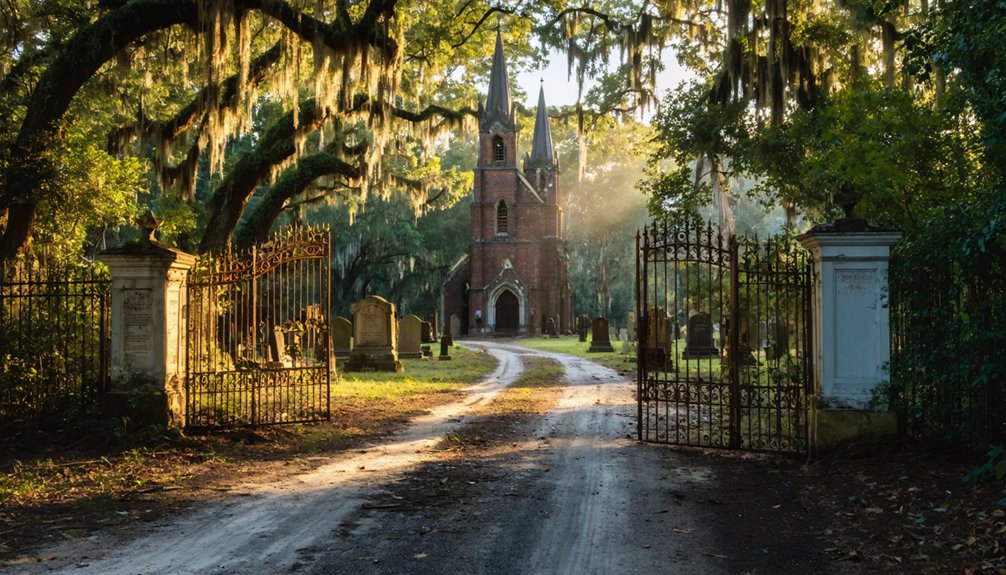
Planning a ghost town road trip to Ebenezer, Georgia means stepping into one of the South’s most haunting colonial landscapes. Located about 25 miles north of Savannah along the Savannah River, this Salzburger settlement was founded in 1734, briefly served as Georgia’s capital, and crumbled into near-total ruin by 1855. You’ll find preserved landmarks, rugged terrain, and an eerie silence that few destinations can match. There’s far more to this forgotten town than first meets the eye.
Key Takeaways
- Ebenezer, founded in 1734 by Salzburger refugees, sits along the Savannah River in Effingham County, approximately 25 miles north of Savannah.
- Jerusalem Lutheran Church, built in 1769, survived British occupation and still holds services, making it Georgia’s oldest continuously active church.
- Key surviving structures include the Salzburger House, Kitchen, and old parsonage, offering authentic glimpses into colonial frontier life.
- Wear comfortable shoes, bring water, confirm visiting hours in advance, and note that no on-site food services are available.
- Nearby historic sites like Sunbury and Fort Barrington complement the trip, broadening your understanding of Georgia’s colonial and Revolutionary War history.
Why Ebenezer, Georgia Is One of the South’s Most Forgotten Ghost Towns
Tucked along the banks of the Savannah River in Effingham County, Ebenezer, Georgia carries the weight of a history most travelers have never heard of. Founded in 1734 by Salzburger refugees fleeing religious persecution, this settlement fought hard for survival. It endured flooding, British occupation, and slow economic collapse.
By 1855, visitors described it as almost entirely in ruins, with only two residences standing. Yet its cultural significance runs deep. Ebenezer briefly served as Georgia’s capital in 1782 and shaped early colonial identity across the region.
The architectural details of surviving structures, particularly Jerusalem Lutheran Church, built in 1769, tell that story better than any textbook. You won’t find crowds here. What you’ll find is one of the South’s most honest, overlooked windows into American history.
The Salzburger Settlers Who Founded Ebenezer in 1734
When you visit Ebenezer, you’re standing on ground first claimed by a group of Protestant refugees who risked everything to worship freely.
In 1734, Salzburger settlers fled religious persecution in Austria and made the grueling journey to Georgia’s colonial frontier, where they carved a community out of wilderness.
Their courage and conviction gave Ebenezer its foundation — and its enduring story.
Fleeing Religious Persecution
Before Ebenezer became a ghost town, it was a refuge. The Salzburgers who settled here in 1734 weren’t explorers chasing adventure — they were Protestants driven from their Austrian homeland by Catholic authorities who gave them no choice but to leave or abandon their faith.
You can feel that weight when you walk the site today. The historic artifacts preserved here tell a story of people who sacrificed everything for the right to worship freely. They crossed an ocean and carved a settlement from Georgia’s wilderness because freedom demanded that cost.
Local legends surrounding the Salzburgers paint them as resilient, deeply spiritual, and fiercely committed to community. Understanding why they came makes the town’s eventual silence feel even more profound. They built something worth grieving.
Settling Georgia’s Frontier
The Salzburgers who arrived in Georgia in 1734 didn’t choose this land on a whim — they chose it because James Oglethorpe offered them something their homeland had stripped away: the freedom to practice their Protestant faith without persecution.
They settled near Ebenezer Creek, carved a community from dense frontier wilderness, and immediately prioritized cultural preservation — rebuilding their religious traditions on unfamiliar soil. When flooding and poor farmland made that first site unworkable, they relocated to New Ebenezer on the Savannah River.
There, they constructed Jerusalem Lutheran Church in 1769, a landmark of historic architecture that still stands today. These weren’t passive refugees — they were determined builders who transformed hardship into legacy, leaving behind a colonial settlement worthy of your road trip detour.
How War and Isolation Turned Ebenezer Into a Ghost Town
Once a thriving colonial settlement, Ebenezer didn’t fall apart overnight—it unraveled slowly under the weight of war, neglect, and geographic isolation.
British occupation during the Revolutionary War left buildings in ruins, and postwar efforts to restore trade never gained traction.
The town’s remote location along the Savannah River, once an asset, became a liability as commerce shifted elsewhere.
What Survived: The Landmarks Still Standing at the Ebenezer Site
Although Ebenezer crumbled into near-total ruin by 1855, a handful of landmarks survived and still anchor the site today. The crown jewel is Jerusalem Lutheran Church, built in 1769 and recognized as one of Georgia’s oldest churches still holding services. Its continued operation stands as a quiet act of cultural preservation, honoring the Salzburger settlers who built it in defiance of persecution.
When you visit, you’ll also find a museum, the Salzburger House and Kitchen, and the old parsonage. Each structure carries real historical significance, offering direct connections to colonial life, religious freedom, and Revolutionary War-era Georgia.
The contrast between the ruined townsite surrounding these buildings and the structures themselves makes Ebenezer unlike any ghost town you’ve likely visited before.
Jerusalem Lutheran Church: Built in 1769 and Still in Use
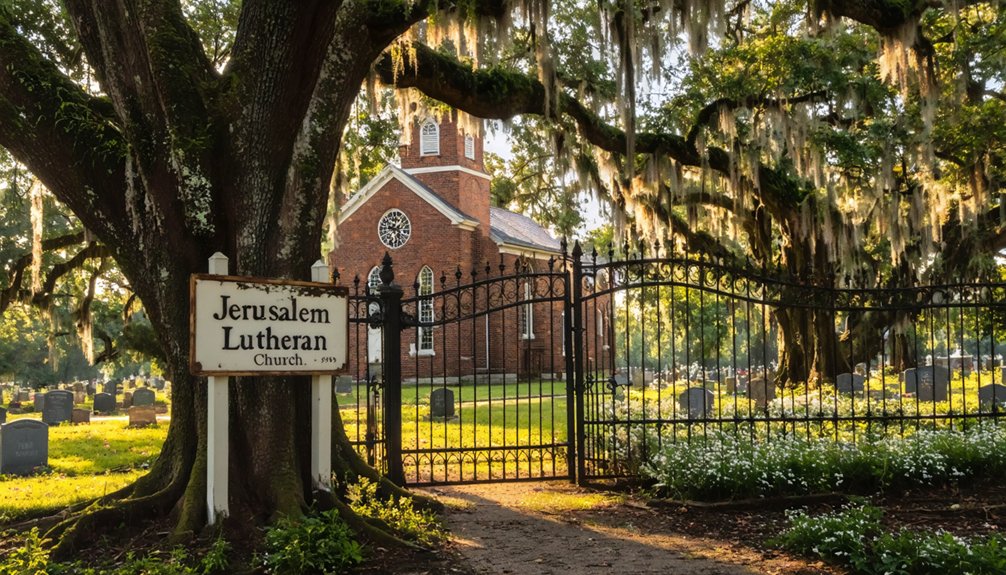
When you visit the Ebenezer site, the Jerusalem Lutheran Church stands as the most striking proof that not everything was lost. Built in 1769, this colonial-era structure survived British occupation and the destruction of the Revolutionary War that left most of the town in ruins.
Today, an active congregation still worships here, making it one of Georgia’s oldest churches in continuous use.
Church’s Colonial Origins
Built in 1769, the Jerusalem Lutheran Church stands as one of Georgia’s oldest churches still holding active services—and it’s the crown jewel of your stop at Ebenezer. Its historical architecture tells a story of defiance, faith, and cultural preservation that resonates deeply with anyone who values hard-won freedom.
When you walk the grounds, you’re stepping into colonial Georgia through four defining layers:
- Salzburger refugees built it after fleeing religious persecution in Europe
- Construction began just 35 years after the town’s 1734 founding
- It survived British occupation during the Revolutionary War
- It remains an active congregation centuries later
That continuity is remarkable. The church isn’t a relic—it’s living proof that a community’s identity can outlast destruction, abandonment, and time itself.
Surviving Revolutionary War Damage
The Jerusalem Lutheran Church didn’t just survive the Revolutionary War—it absorbed it. British forces occupied the building, stripped resources, and left the surrounding town fractured beyond recovery. Yet the church endured.
Local folklore holds that the congregation’s stubborn faith kept the structure from total ruin when everything else crumbled around it.
You’ll notice the weight of that history the moment you step inside. The walls standing before you date to 1769, making this one of Georgia’s oldest continuously operating churches.
That continuity didn’t happen by accident. Preservation efforts over the decades have kept the structure functional and historically intact.
While Ebenezer itself fell silent, this church kept speaking. It’s a rare thing—a building that outlasted a war, a town, and two centuries of neglect.
Active Congregation Today
What makes Jerusalem Lutheran Church remarkable isn’t just its age—it’s that people still worship here. Built in 1769, this living landmark anchors Ebenezer’s ghost town landscape with quiet, enduring purpose.
When you visit, you’re stepping into active cultural preservation—not just preserved walls, but a sustained community of faith. Here’s what keeps this congregation meaningful today:
- Regular worship services continue inside the original 18th-century structure
- Community outreach programs connect the congregation to surrounding Effingham County
- The on-site museum educates visitors about Salzburger heritage and religious freedom
- Annual commemorative events honor the founding settlers’ sacrifices
You’ll feel the contrast sharply—a ruined town surrounding a thriving church. That tension tells the real story: while Ebenezer collapsed, its spiritual core never did.
Visiting the Ebenezer Site: Hours, Admission, and Site Conditions
Since Ebenezer operates more as a preserved historic site than a traditional tourist destination, you’ll want to plan your visit around the Jerusalem Lutheran Church, which anchors the entire grounds. The church connects you directly to the cultural traditions the Salzburger settlers carried across the Atlantic in pursuit of religious freedom.
On-site, you’ll find a museum housing historical artifacts, the Salzburger House and Kitchen, and the old parsonage. These structures give you a tangible sense of what daily colonial life looked like before war and neglect swallowed the town.
Before you go, confirm current hours directly with the site, as availability can shift seasonally. Admission details vary, and the grounds reflect a rugged, preserved character rather than polished tourism infrastructure.
Dress for uneven terrain and bring water.
How to Get to Ebenezer, Georgia and What to Expect
Reaching Ebenezer requires a short but scenic drive into Effingham County, placing the site near Rincon, Georgia, roughly 25 miles north of Savannah. The rural roads reveal Georgia’s quiet, untamed landscape before you arrive.
Expect these realities before you go:
- Navigation — Use “New Ebenezer Road, Rincon, GA” for accurate GPS routing.
- Road conditions — Rural, narrow roads lead to the site; drive cautiously.
- Historic architecture — Jerusalem Lutheran Church dominates the preserved landscape, standing since 1769.
- Local cuisine — Rincon and nearby Savannah offer dining options; the site itself has no food services.
You’re stepping onto ground where religious freedom was literally carved from wilderness. Pack water, wear comfortable shoes, and bring curiosity.
Ebenezer rewards travelers who arrive prepared and leave nothing behind.
Ghost Towns Near Ebenezer Worth Adding to Your Route
Ebenezer doesn’t have to be your only stop — Georgia’s coastal plains and river corridors hold several other abandoned settlements worth folding into your route.
Sunbury, a once-thriving colonial port in Liberty County, offers haunting cemetery grounds and traces of architectural styles that reflect its mercantile past.
Fort Barrington, along the Altamaha River, carries deep Revolutionary War significance and rewards explorers who don’t mind rough roads.
Each site layers a distinct cultural influence onto Georgia’s broader colonial story, letting you trace how settlers, soldiers, and tradespeople shaped — then abandoned — entire communities.
Together, these stops transform a single ghost town visit into a fuller picture of how freedom was fought for, built around, and ultimately lost across Georgia’s early landscape.
Before You Go: Safety at Abandoned Sites
Ghost town structures have stood without maintenance for decades. Floors, stairs and roof timbers fail without warning, and a building that looks solid from outside may not hold your weight. Stay out of standing structures unless the site is actively maintained and open to visitors.
Mine workings are the more serious hazard. Vertical shafts can be hundreds of feet deep, are often unfenced, and may be hidden by brush or capped with rotted boards. Never enter an adit, tunnel or shaft: abandoned workings can hold oxygen-poor or toxic air that gives no warning before you lose consciousness.
Enclosed spaces with rodent droppings carry a risk of hantavirus, which is contracted by breathing contaminated dust. Do not sweep or stir up dust inside old cabins and outbuildings.
Cell coverage at these sites is usually poor or absent. Tell someone your route and expected return time, and carry more water than you think you need.
Frequently Asked Questions
Is Ebenezer, Georgia the Same as New Ebenezer?
Like two names on one weathered tombstone, yes, they’re the same place! You’ll find historical landmarks and local legends woven together at New Ebenezer, the Salzburgers’ relocated settlement that became Georgia’s enduring ghost town.
Was Ebenezer Ever Officially Recognized as Georgia’s State Capital?
You’ll find that Ebenezer briefly served as Georgia’s capital in 1782, a moment of immense historical significance. This fleeting honor reflects the town’s deep cultural heritage, reminding you how powerfully this small settlement shaped early American freedom.
Are Weddings or Events Permitted at Jerusalem Lutheran Church Today?
Like a living ember from Georgia’s past, Jerusalem Lutheran Church’s wedding regulations aren’t confirmed in available records — you’d want to contact them directly to explore Church history and modern event possibilities firsthand.
Is the Ebenezer Historic Site Accessible for Visitors With Mobility Limitations?
Accessibility details aren’t fully confirmed, but you’ll want to call ahead before visiting. Some areas may offer accessible pathways and wheelchair ramps, though the historic grounds can present uneven terrain that challenges true freedom of movement.
Can Visitors Swim or Kayak Near Ebenezer Creek or the Savannah River?
You’ll find Creek kayaking near Ebenezer Creek and River swimming along the Savannah River are both possible, but always check local regulations and conditions first before diving into these wild, historic Georgia waterways.
References
- https://en.wikipedia.org/wiki/Ebenezer
- https://www.youtube.com/watch?v=nAtgLQfY77o
- https://www.youtube.com/watch?v=Qjwhs7lvBWI
- https://www.youtube.com/watch?v=S-3POYlfYu8
- https://www.youtube.com/watch?v=oqG9GgvcKd0
- https://www.facebook.com/gpbmedia/videos/long-before-it-became-a-ghost-town-ebenezer-was-one-of-georgias-earliest-and-mos/1015978217431146/
- https://saltywavesandspanishmoss.wordpress.com/2020/07/22/exploring-a-georgia-ghost-town/
- https://commons.wikimedia.org/wiki/Category:Ebenezer
- https://www.georgiaencyclopedia.org/articles/counties-cities-neighborhoods/effingham-county/
- https://www.gutenberg.org/files/70735/70735-h/70735-h.htm