Gold Butte National Monument sits 90 miles northeast of Las Vegas, protecting nearly 300,000 acres of raw Mojave Desert where a copper and gold mining town once supported 2,000 residents. You’ll access the 62-mile backcountry byway from Exit 112 on Interstate 15, crossing the Virgin River into open, fee-free wilderness. Bring water, a high-clearance vehicle, and a spirit for solitude. Everything you need to plan this unforgettable desert ghost town road trip is waiting ahead.
Key Takeaways
- Gold Butte National Monument sits 90 miles northeast of Las Vegas, accessed via Exit 112 on Interstate 15, near Mesquite, Nevada.
- The 62-mile backcountry byway passes Gold Butte Ghost Town at mile 14.5, once home to nearly 2,000 mining residents.
- A high-clearance vehicle is essential; four-wheel drive is recommended for unpaved sections and sandy washes beyond Whitey Pocket.
- No fuel, food, or services exist past Riverside Bridge, so pack ample water, food, a first-aid kit, and emergency communication gear.
- Free primitive camping is permitted for up to 14 days, with Whitney Pocket offering the most popular spot among dramatic rock formations.
What Makes Gold Butte Worth a Ghost Town Road Trip?
Although Las Vegas sits just 90 miles southwest, Gold Butte National Monument feels like another world entirely — a vast, 300,000-acre stretch of Mojave Desert where a once-thriving mining town of 1,500 to 2,000 people has crumbled back into the earth. Copper, gold, lead, and zinc once drew prospectors here.
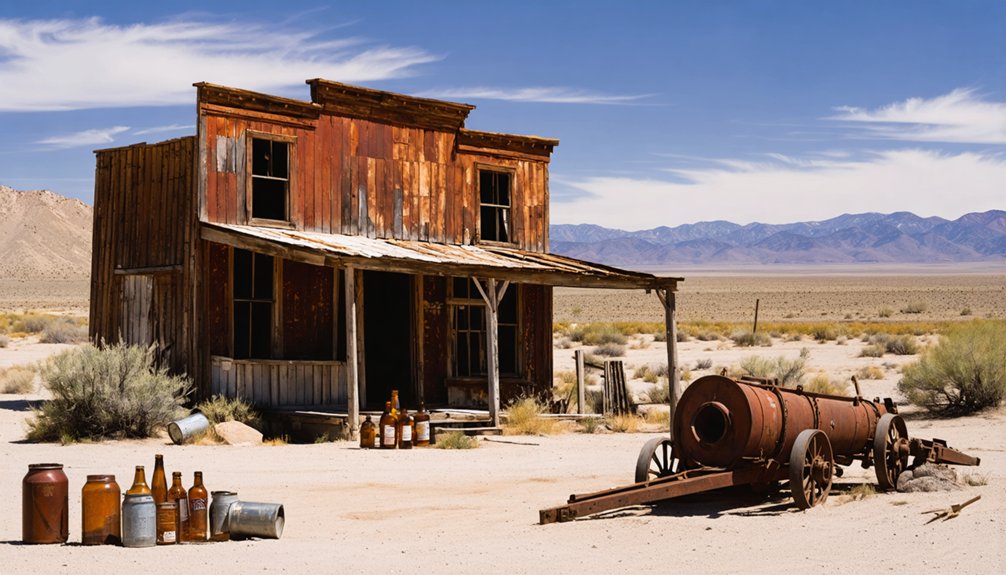
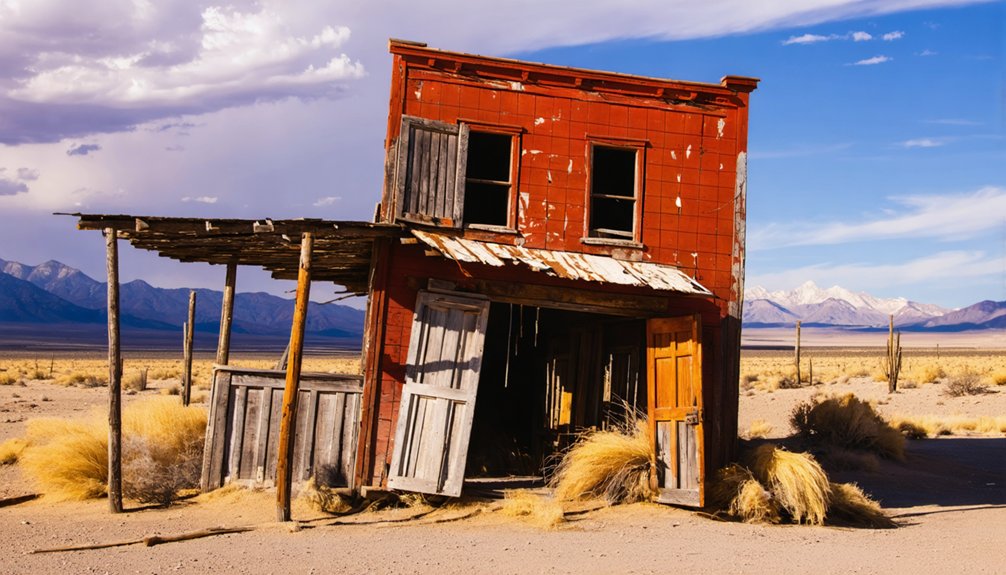
Once a booming mining town of 2,000, Gold Butte has slowly surrendered itself back to the Mojave Desert.
Now, collapsed mines and abandoned structures stand as quiet monuments to ambition.
But Gold Butte isn’t just a ghost town. It’s a living landscape where wildlife conservation protects critical Mojave habitat, and cultural preservation safeguards over 2,000 sacred archaeological sites, including 400-plus petroglyph panels etched by Native Americans centuries ago.
You’ll explore it all on your own terms — no admission fees, no crowds, no guardrails. Just open desert and the freedom to discover it yourself.
How to Get to Gold Butte National Monument
Getting to Gold Butte starts at Exit 112 on Interstate 15 — the Riverside/Bunkerville exit — where you’ll leave the highway behind and head south three miles to cross the Virgin River via the Riverside Bridge.
From there, you’re entering nearly 300,000 acres of raw Mojave Desert, sitting 90 miles northeast of Las Vegas and just five miles south of Mesquite.
No admission fees, no permits, no gatekeepers — just open land demanding your respect.
You’ll drive paved Gold Butte Road, though don’t expect smooth sailing; potholes remind you this place prioritizes historical preservation and wildlife observation over tourist convenience.
Pack your supplies before arriving, because no fuel, food, or services exist once you cross that bridge.
Freedom out here is earned, not handed to you.
What Vehicle Do You Actually Need for This Drive?
Surviving Gold Butte’s unpaved sections demands a high-clearance vehicle — sharp rocks litter the backcountry roads and will shred an underprepared tire without hesitation. You’re orchestrating terrain that once supplied copper, gold, and zinc to a booming frontier town, so respect it accordingly. Bring a spare tire that’s fully inflated and road-ready before you leave civilization.
Four-wheel drive isn’t always mandatory, but it’s your safety net when washes turn unpredictable. You’ll want that clearance when you’re stopping at scenic viewpoints overlooking the Mojave’s raw expanse or pausing for unexpected wildlife encounters along the backcountry byway.
This desert doesn’t forgive shortcuts. Prepare your vehicle like your freedom depends on it — because out here, beyond every service station and emergency line, it genuinely does.
Pack This Before You Leave for Gold Butte
Your vehicle is ready — now your pack needs to match its resolve. Gold Butte offers no stores, no water stations, and no rescue services across its 300,000 wild acres. You’re on your own out there.
Bring more water than you think you’ll need, high-calorie food, a first-aid kit, and emergency communication gear. Pack binoculars for wildlife observation — desert bighorn and tortoise move through these lands freely. Carry a camera and treat every petroglyph panel with the reverence cultural preservation demands; you’re walking through 2,000 sacred archaeological sites.
Don’t forget a fully inflated spare tire — the sharp unpaved rocks will test you. Sun protection, layered clothing, and detailed maps complete your kit. Prepare thoroughly, and Gold Butte rewards you completely.
How the 62-Mile Backcountry Byway Actually Works
Once you exit Interstate 15 at Exit 112 — the Riverside/Bunkerville offramp — the 62-mile Gold Butte National Backcountry Byway begins pulling you into a landscape that hasn’t changed much since copper miners staked their claims here in the early 1900s.
Cross the Virgin River via Riverside Bridge, then follow paved Gold Butte Road for 21 potholed miles before the pavement surrenders to dirt near Whitey Pocket.
From there, you’ll head toward Mud Wash Road, turning west past Devil’s Throat and Red Bluff Spring. Scenic viewpoints open across ancient desert terrain, and wildlife encounters — desert tortoise, bighorn sheep — remind you this land belongs to something older than any ghost town.
Budget 4–5 hours and expect the route to demand your full attention.
The Gold Butte Ghost Town: What You’ll Find at Mile 14.5
At mile 14.5, you’ll arrive at what remains of a once-thriving mining town that briefly supported 1,500 to 2,000 residents in the early 20th century, complete with its own post office.
Miners pulled copper, gold, lead, and zinc from the ground here, fueling a boom that burned fast and collapsed even faster.
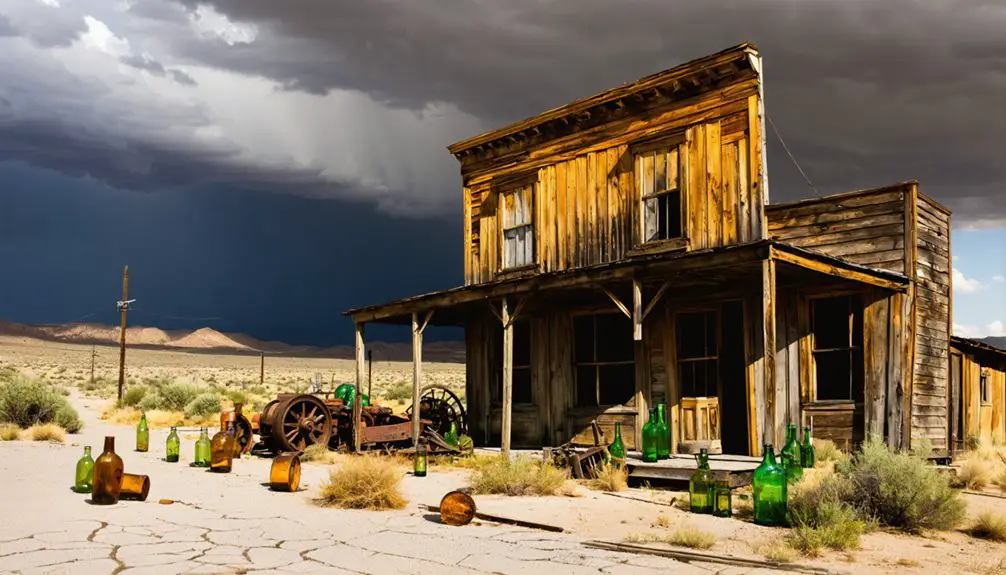
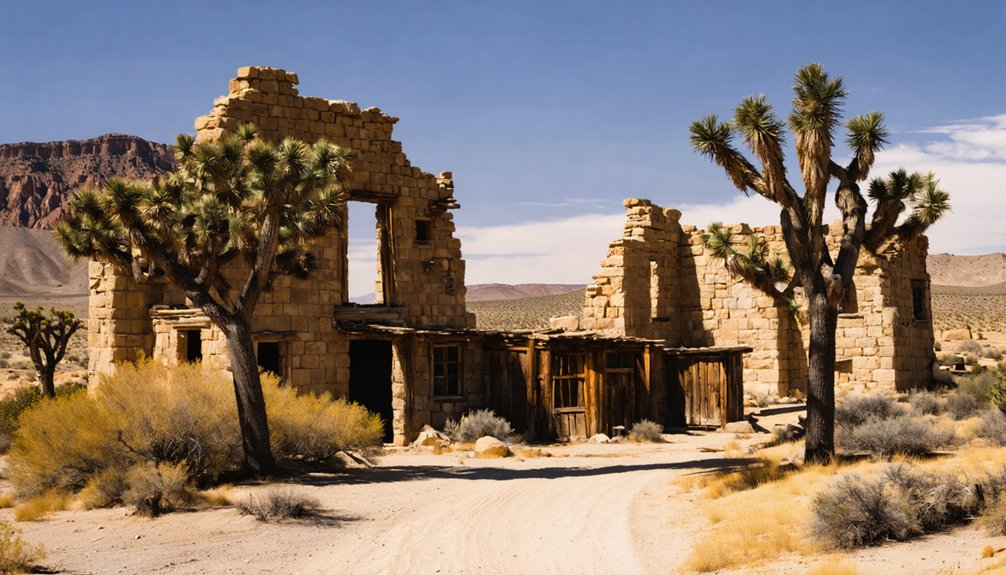
Today, you’ll find crumbling structures and sealed mine shafts scattered across the desert floor, silent evidence of a community that vanished almost as quickly as it appeared.
Mining Town’s Turbulent Past
Fourteen and a half miles into the byway, the Gold Butte ghost town emerges from the desert like a fever dream of ambition and collapse.
Between 1,500 and 2,000 people once carved a life out of this unforgiving Mojave landscape, chasing copper, gold, lead, and zinc beneath the hardpan earth. They built enough of a community to warrant a post office — proof that real lives, real stakes, and real dreams existed here.
That historical significance shouldn’t be lost on you as you walk among collapsed mine shafts and crumbling structures.
Cultural preservation matters in places like this, where the desert slowly reclaims what ambition built. Touch nothing, disturb nothing. Let the ruins speak. Their silence carries more truth than any gold ever could.
Ruins and Remnants Today
What remains at mile 14.5 tells the whole story without a single word. Collapsed mines gape open like wounds in the earth. Abandoned structures lean against desert wind, stubbornly refusing to disappear. You’re standing inside living cultural heritage — a place where 1,500 to 2,000 people once chased copper, gold, lead, and zinc from this unforgiving ground.
Look carefully and you’ll see more than ruins. The Mojave’s wildlife habitats reclaim everything slowly — creosote pushing through foundations, desert creatures threading through broken timber. Nature doesn’t wait.
Bring water, wear sturdy boots, and give yourself time to wander without a designated trail forcing your direction. Nobody’s telling you where to look. That freedom is exactly what makes Gold Butte unforgettable.
Metals Extracted From Ground
Those ruins didn’t appear by accident — they’re the physical aftermath of serious industrial ambition. Miners came here chasing copper, gold, lead, and zinc, pulling real wealth from the Mojave’s unforgiving ground. That pursuit built homes, a post office, and a community of nearly 2,000 people practically overnight.
Now, standing among collapsed shafts and crumbling structures at mile 14.5, you’re reading the earth’s receipts. The same desert flora that reclaims abandoned foundations tells you nature always outlasts extraction.
Pause long enough for wildlife observation, and you’ll notice the land has quietly moved on.
The metals are gone. The ambition evaporated. But you’re free to wander these remnants and feel exactly what happens when human hunger meets a landscape that refuses to stay conquered.
Petroglyphs, Little Finland, and What Else to Stop For
Beyond the ghost town, Gold Butte’s backcountry reveals layers of human and geological history that’ll stop you in your tracks. Over 400 petroglyph panels scatter across the landscape, their cultural significance stretching back thousands of years. Don’t miss the Falling Man petroglyph — it’s one of the most striking Native American rock art sites in the entire Mojave.
Little Finland rewards curious explorers with surreal, rust-colored rock formations twisted into shapes that seem almost impossible. You’ll feel like you’ve landed on another planet.
The monument’s wildlife diversity runs deep, sheltering species uniquely adapted to desert extremes. Keep your eyes open — this land rewards the observant traveler. Every stop pulls back another layer of a place that’s simultaneously ancient, wild, and completely untamed.
Where to Camp Inside Gold Butte National Monument
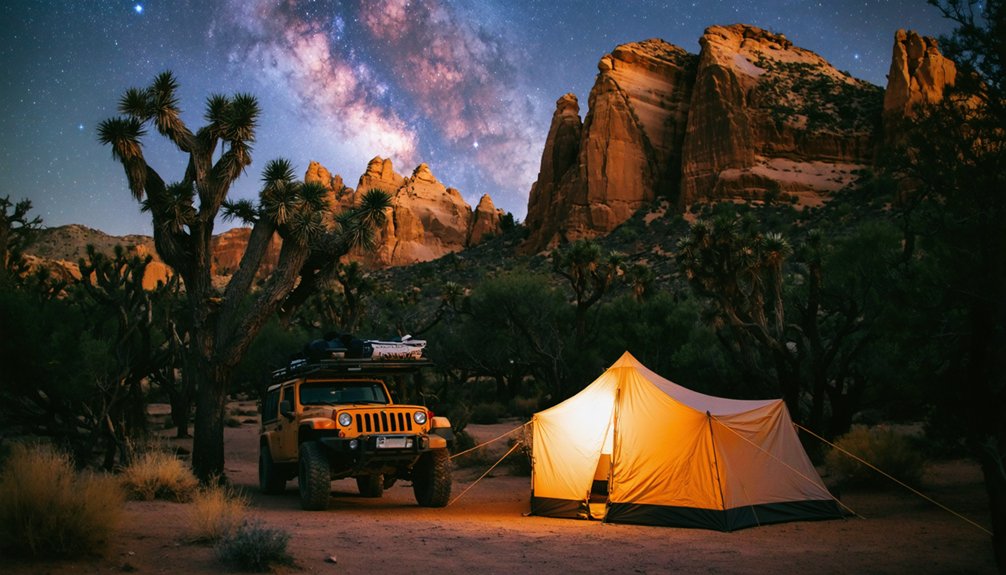
Staying the night inside Gold Butte transforms a day trip into something far more immersive. You’ll camp where miners once chased fortune, surrounded by desert flora and local wildlife stirring at dusk. No developed campgrounds exist here — just open land and 14 days of freedom.
No developed campgrounds, no crowds — just open desert, ancient silence, and 14 nights of freedom.
Before you unroll your sleeping bag, remember:
- Whitney Pocket is the most popular primitive camping spot, offering dramatic rock formations and relatively level ground.
- Self-sufficiency is non-negotiable — pack all water, food, and emergency supplies before entering the monument’s 300,000 acres.
- The 14-day limit applies to most areas, so plan your route and move deliberately.
Nights here belong entirely to you, the stars, and whatever ancient silence this desert has always kept.
Frequently Asked Questions
Is There Cell Phone Service or Wi-Fi Available Inside Gold Butte?
Just as Gold Butte’s miners vanished into silence, so does your signal—you’ll find zero cell coverage or Wi-Fi availability inside the monument. Embrace the disconnect; it’s your ultimate freedom out here.
Are Pets Allowed on the Trails and Campsites at Gold Butte?
You can bring your pets to Gold Butte’s trails and campsites! Prioritize pet safety in this rugged desert wilderness, follow leash regulations, and make sure they’re prepared for the untamed, sun-scorched terrain where adventure awaits around every ancient rock.
What Is the Best Time of Year to Visit Gold Butte?
You’ll find the best weather in spring and fall, when cooler temperatures make exploring Gold Butte’s ancient petroglyphs and ghost town ruins truly unforgettable. Visit on weekdays to dodge seasonal crowds and claim your freedom in this wild, untamed desert.
Are Campfires Permitted During Primitive Camping at Gold Butte National Monument?
The knowledge doesn’t specify campfire regulations for Gold Butte. Before you embrace primitive camping restrictions under Nevada’s wild stars, check with the BLM directly—they’ll confirm current campfire rules for your adventurous ghost town journey.
Can You Visit Gold Butte National Monument in a Single Day Trip?
You can absolutely squeeze a universe of adventure into one day! Drive the 62-mile byway, explore historical preservation sites, spot wildlife viewing opportunities, and uncover ghost town ruins — all before sunset claims the Mojave sky.
References
- https://www.youtube.com/watch?v=6vCvESpcIGY
- https://dixie4wheeldrive.com/off-road-trail-spotlight-gold-butte-ghost-town-and-radio-crystal-mine-mesquite-nevada-trails/
- https://www.thearmchairexplorer.com/nevada/gold-butte-back-country-byway.php
- https://www.youtube.com/watch?v=qsk120Dc1P0
- https://kensphotogallery.blogspot.com/2015/01/daytrip-gold-butte-town-site-gold-butte.html
- https://mesquitelocalnews.com/2016/11/30/gold-butte-adventure/
- https://www.youtube.com/watch?v=2GnE710F3D0
- https://nvtami.com/2024/02/25/gold-butte-national-monument/
- https://www.destinationwest.org/home-page/gold-butte-ghost-town
- https://redrockadventure.com/other-adventures/backroads/1215-gold-butte-national-monument-–-offroad