Planning a ghost town road trip to Collins, Indiana means stepping into a forgotten world of peppermint farms, mint mill ruins, and Vandalia Railroad history tucked inside Whitley County’s Smith Township. You’ll find fewer than two standing structures, no tourist centers, and raw, unfiltered history at every turn. Visit between late spring and early fall when the roads are most passable. There’s far more to this quiet relic than its crumbling walls reveal.
Key Takeaways
- Collins, Indiana, is an unincorporated community in Whitley County’s Smith Township with fewer than two standing structures and no visitor centers.
- The best time to visit is late spring through early fall when roads are most passable and lighting is ideal for photography.
- Key historical highlights include mint mill ruins, a weathered schoolhouse, and the former Vandalia Railroad connection that once drove local commerce.
- Nearby ghost towns like Lagro, Chili, Lincolnville, and Somerset can be added to extend and enrich your road trip experience.
- Local folklore and oral histories provide cultural context, making slight misdirection and rural exploration part of the authentic adventure.
Is Collins, Indiana Really a Ghost Town?
While Collins, Indiana carries the eerie label of a ghost town, it technically doesn’t qualify as one. Official records confirm it remains an inhabited, unincorporated community in Whitley County’s Smith Township. Fewer than fifteen permanent residents call it home, which fuels urban legends about the place being completely abandoned.
Collins, Indiana isn’t truly a ghost town — fewer than fifteen residents still quietly call this Whitley County settlement home.
You’ll find that local legends surrounding Collins stretch the truth a bit. The settlement still breathes, even if barely. Some sources misclassify it because of its skeletal infrastructure, sparse population, and near-total absence of commercial activity.
No municipal government exists, and fewer than two developed structures remain standing.
But that ambiguity is exactly what makes Collins worth visiting. You’re free to explore a living relic that exists somewhere between active community and forgotten past.
The Peppermint Farms and Mint Mills That Built Collins
Before Collins earned its ghost town reputation, peppermint cultivation drove its entire economy. Farmers here worked open fields, harvesting peppermint and feeding it into mint mills that extracted essential oils shipped across the nation. That agricultural heritage built something real — a functioning community with purpose and pride.
Walking these grounds today, you’ll feel the weight of what once thrived here:
- Rows of peppermint stretched endlessly, filling the air with sharp, clean fragrance
- Mint mills hummed with mechanical energy, turning raw crops into profitable oils
- Farmers controlled their own livelihoods, free from urban dependency
- The Vandalia Railroad connected isolated Collins to national markets overnight
That self-sufficient spirit still echoes across these quiet fields, reminding you that Collins was never just a footnote — it was a living, breathing community.
Why the Vandalia Railroad Put Collins on the Map
When you trace Collins’ growth, you’ll find the Vandalia Railroad sitting right at the center of it. The railroad gave local farmers a direct line to national markets.
Massive onion shipments rolled out of Collins to large distribution hubs across the country. That agricultural access transformed Collins from a quiet rural settlement into a genuinely productive community worth putting on the map.
Railroad Routes Transformed Collins
The Vandalia Railroad didn’t just pass through Collins — it put the community on the map entirely. Farmers loaded tons of onions onto those railcars, shipping harvests straight to national distribution centers. You can almost picture the vintage signage marking the depot, locals exchanging local legends about record-breaking harvests and bustling trade days.
When you visit, let these facts sink in:
- A single railroad line once gave isolated farmers direct access to national markets
- Onion crops from quiet Indiana fields fed cities hundreds of miles away
- The railroad created economic independence for small rural communities
When the trains stopped running, Collins fundamentally stopped growing.
That railroad silence tells you everything about how fragile rural prosperity truly was.
Onion Shipments Fueled Growth
Onions built Collins. Before the mint mills grabbed attention, farmers here were hauling massive onion harvests straight to the Vandalia Railroad, shipping tons of product to national distribution centers across the country.
You’ll hear it woven through local folklore when you visit — community legends about wagons stretching down rural roads, loaded heavy with onions bound for distant city markets.
The railroad didn’t just move crops; it gave Collins an economic pulse. Farmers had real buyers, real income, and real motivation to keep planting.
That agricultural energy attracted the general store, supported families, and briefly made Collins a functioning rural hub.
Without those onion shipments rolling onto Vandalia cars, Collins might never have developed enough identity to earn its place on your ghost town road trip map.
Vandalia’s Agricultural Market Impact
Before the Vandalia Railroad carved its route through rural Indiana, small farming settlements like Collins had nowhere meaningful to send their crops. The railroad changed everything, connecting hardworking farmers directly to national markets and giving their labor real economic purpose.
You’re looking at a community that once punched above its weight:
- Tons of fresh onions rolled out of Collins toward distant cities, feeding families across the country
- Peppermint oil extracted locally reached national shelves through Vandalia’s efficient network
- Local traditions built around harvest seasons suddenly carried genuine commercial value
- Agricultural heritage transformed from survival farming into meaningful market participation
That railroad didn’t just move crops — it moved futures. Collins briefly thrived because ordinary people seized an extraordinary opportunity to trade freely and independently.
What the Schoolhouse and Mill Ruins Look Like Today
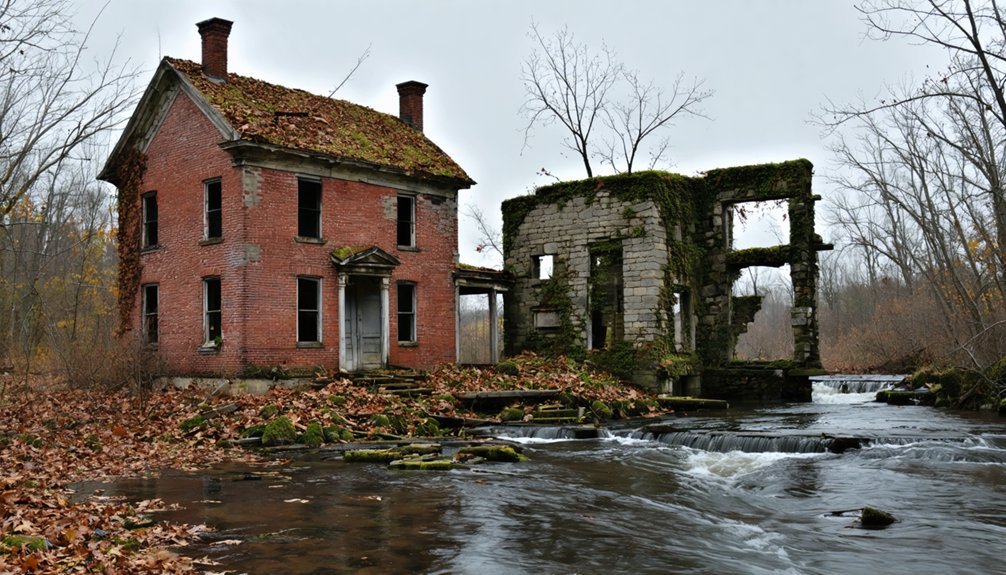
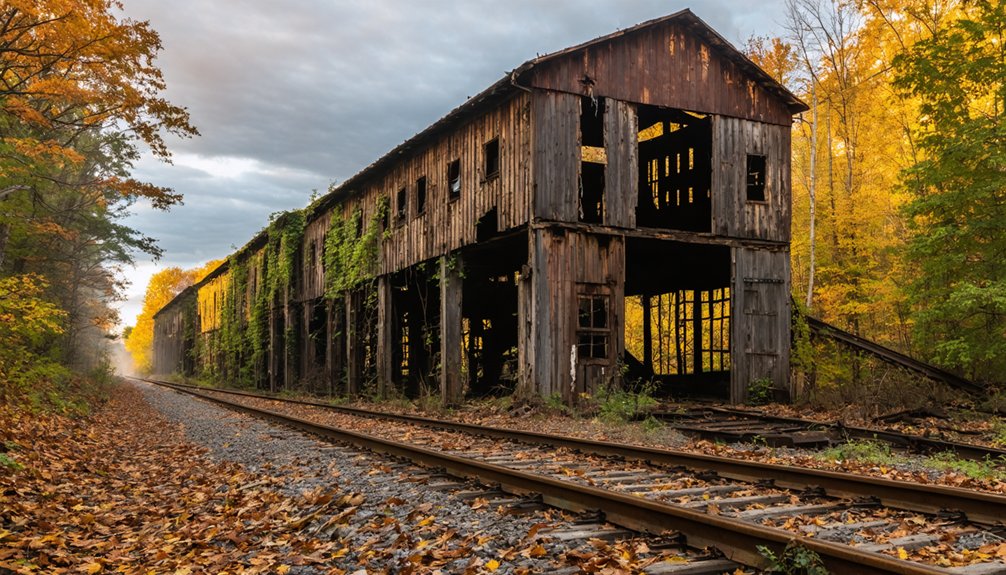
Standing quietly amid open farmland, Collins’ abandoned schoolhouse and mint mill ruins offer a glimpse into the community’s agricultural past. You’ll notice the schoolhouse preservation remains incomplete, leaving weathered walls and a crumbling foundation that speak volumes about decades of neglect.
Nature has reclaimed much of the structure, with vegetation pushing through aged timber and cracked plaster.
The mint mill reconstruction was never pursued, so what you’ll find are scattered stone remnants and rusted mechanical fragments half-buried in the soil. These ruins aren’t polished tourist attractions — they’re raw, unfiltered history sitting openly on rural land.
Walk the perimeter freely, photograph the decay, and let the silence tell the story. Collins doesn’t package its past; it simply leaves it there for you to discover.
Where Collins Sits in Whitley County and How to Find It
You’ll find Collins tucked into Smith Township in Whitley County, Indiana, where open farmland and quiet back roads define the landscape.
To reach it, you’ll navigate rural routes with minimal signage, so loading offline maps before you leave is a smart move.
The sparse infrastructure means you won’t find gas stations or convenience stores nearby, so plan accordingly before you head out.
Collins Geographic Location Overview
Tucked within Smith Township in Whitley County, Indiana, Collins sits amid open farmland and quiet rural roads that stretch endlessly across the flat Midwestern landscape. No formal city boundaries or zoning regulations constrain this place. You’re free to wander where community legends still echo across forgotten fields and local flora reclaims abandoned ground.
- Stand where peppermint once perfumed the air across vast, open fields
- Feel the silence of roads connecting nowhere to nowhere
- Touch the weathered remnants of a settlement that refused to disappear completely
- Breathe in the raw, unhurried freedom only truly rural places offer
Fewer than two developed structures remain visible today. Collins offers no visitor centers or guided tours — just honest, unfiltered history waiting for those curious enough to seek it.
Finding Collins means first making peace with the fact that GPS won’t always cooperate out here. You’re heading into Smith Township, deep within Whitley County, Indiana, where open farmland stretches wide and road signs grow sparse. Trust your map more than your phone signal.
Collins sits quietly off the beaten path, connected to nearby towns only by basic rural roads. You’ll notice the landscape shifting — fewer structures, longer silences, more sky. That openness is exactly what draws free-spirited explorers to places carrying this kind of community legacy.
Ask locals you encounter along the way. Their directions often come wrapped in local folklore, small stories that make the destination richer before you even arrive. Embrace the uncertainty — getting slightly lost here is honestly part of the experience.
When Collins Roads Are Most Accessible for Visitors
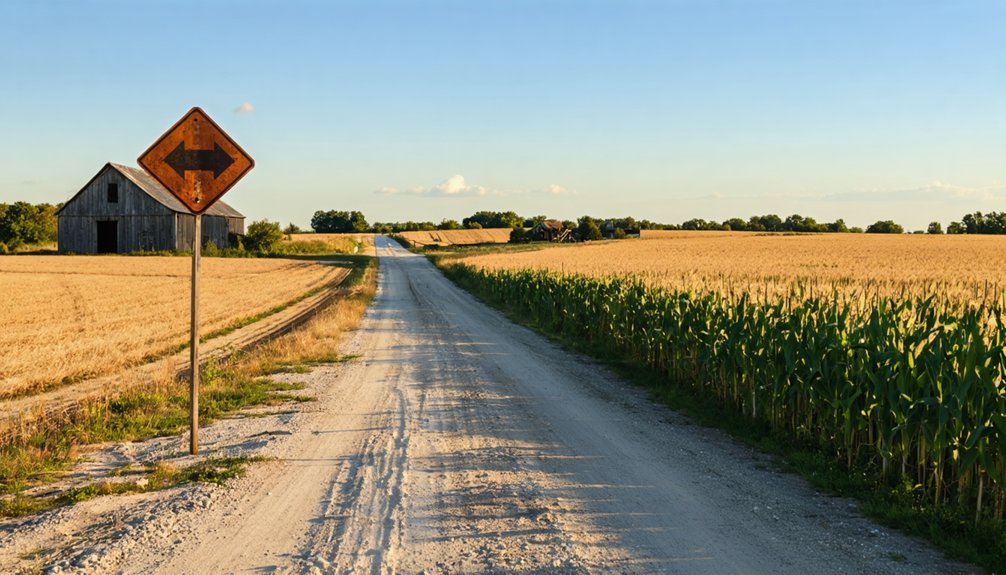
Since Collins sits in a rural stretch of Whitley County with minimal road infrastructure, timing your visit smartly makes a real difference. Late spring through early fall offers the clearest, most passable roads, letting you explore freely without weather-related setbacks.
Timing your visit to Collins matters — late spring through early fall means passable roads and zero weather headaches.
Local folklore suggests longtime residents once navigated these same paths daily, connecting their world through farmland and community preservation efforts that still echo today.
Plan your trip around these conditions for the best experience:
- Late spring mornings bring dry roads and soft golden light perfect for photography
- Summer weekdays keep traffic nonexistent, giving you true solitude
- Early fall afternoons showcase harvest-season farmland at its most atmospheric
- Avoid winter months entirely, as unpaved sections become dangerously muddy and impassable
You’re chasing history here, so travel on your own terms.
What Researchers and Historians Say About Collins
Historians and rural researchers alike regard Collins as a compelling snapshot of early Indiana farming culture, even if it rarely makes headlines. You’ll find that scholars studying Smith Township frequently highlight Collins as a prime example of how small agricultural communities shaped the region’s economic identity.
The mint mill and Vandalia Railroad connection tell a story of self-sufficient enterprise that defined rural Indiana life. Experts emphasize cultural preservation as essential to understanding settlements like Collins, warning that forgotten communities lose their stories permanently without documentation.
Community memory also drives much of the academic interest here, as researchers piece together firsthand accounts from older residents and historical records. If you value authentic history untouched by commercialization, Collins offers exactly the kind of raw, unfiltered perspective that serious history enthusiasts genuinely appreciate.
Other Ghost Towns Near Collins Worth the Drive
While Collins makes for a fascinating stop, you’ll want to extend your road trip to explore other ghost towns scattered across northern Indiana that are equally worth your time. Long before urban development swallowed surrounding regions and modern amenities replaced quiet dirt roads, these settlements thrived independently:
Collins is just the beginning — northern Indiana’s ghost towns stretch far beyond, each one quietly daring you to look closer.
- Lagro — a canal-era town where crumbling limestone buildings whisper forgotten commerce
- Chili — a rural crossroads that once buzzed with life before residents slowly vanished
- Lincolnville — a haunting stretch of foundations reclaimed by wildgrass and silence
- Somerset — where abandoned storefronts stand as stubborn reminders of a community’s collapse
Each stop adds depth to your journey, connecting you to Indiana’s raw, unfiltered past that no tourist brochure fully captures.
Frequently Asked Questions
Are There Any Local Guides Available to Escort Visitors Around Collins?
You won’t find any local guide services or guided tour options in Collins. You’re free to explore this quiet, historic settlement independently, discovering the old schoolhouse and mint mill remnants entirely on your own terms.
What Is the Best Nearby Town to Book Overnight Accommodations?
You won’t find five-star hotels near Collins! Head to Columbia City for overnight accommodations — it’s your gateway to historic landmarks, local dining, and the perfect launchpad for your freewheeling ghost town adventure.
Can Visitors Legally Walk Through the Abandoned Schoolhouse Property?
You’ll want to verify legal access before exploring the abandoned schoolhouse, as historic preservation laws protect private property. Always seek permission from the landowner to make certain you’re respecting boundaries while satisfying your adventurous spirit.
Are There Any Annual Events or Festivals Celebrating Collins History?
You won’t find any annual events or festivals celebrating Collins’ history, but you’re free to explore its historical landmarks and uncover local legends on your own adventurous, self-guided journey through this quiet, forgotten Indiana community.
What Photography Equipment Works Best for Capturing Rural Ghost Town Sites?
You don’t need expensive gear — vintage lenses capture Collins’ weathered textures beautifully, giving shots authentic character. Drone photography reveals the isolated farmland’s sweeping scale, letting you document this hauntingly quiet Indiana settlement from breathtaking perspectives you’d otherwise miss.
References
- https://www.youtube.com/watch?v=45D4dbASJyE
- https://indianacountyparks.org/wp-content/uploads/2023/11/03-Ghost-Town-Trail-Combined-Maps.pdf
- https://www.houseofhighways.com/usa/midwest/indiana/collins
- https://www.wrtv.com/news/local-news/want-the-scariest-experience-indiana-has-to-offer-go-on-the-haunted-indiana-road-trip
- https://en.wikipedia.org/wiki/List_of_ghost_towns_in_Indiana
- https://ghost-towns.close-to-me.com/states/indiana/
- https://www.onlyinyourstate.com/experiences/indiana/indiana-abandoned-places-road-trip
- https://www.onlyinyourstate.com/experiences/indiana/ghost-towns-in
- https://www.traillink.com/trail/ghost-town-trail/
- https://transalleghenytrails.com/our-trails/ghost-town-trail/