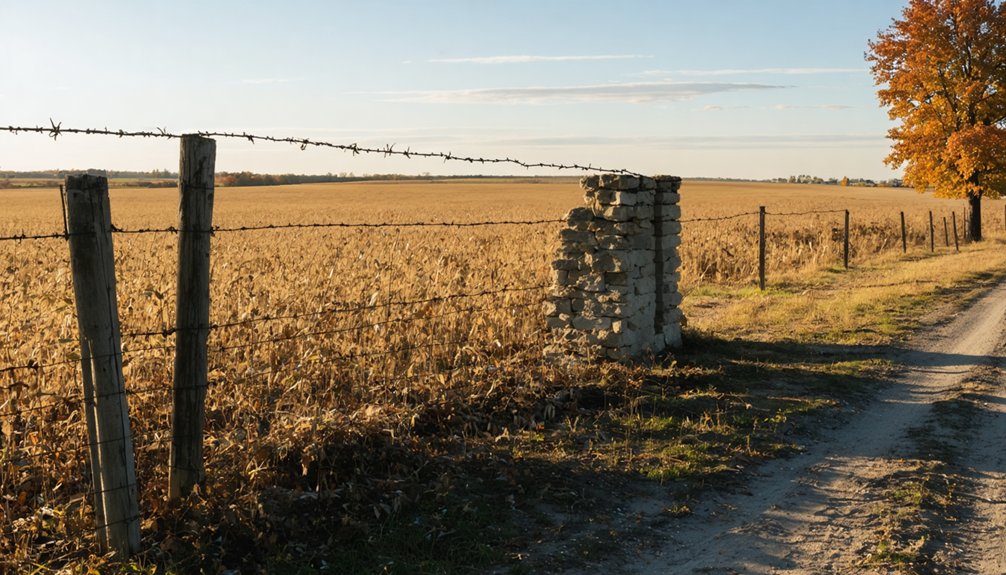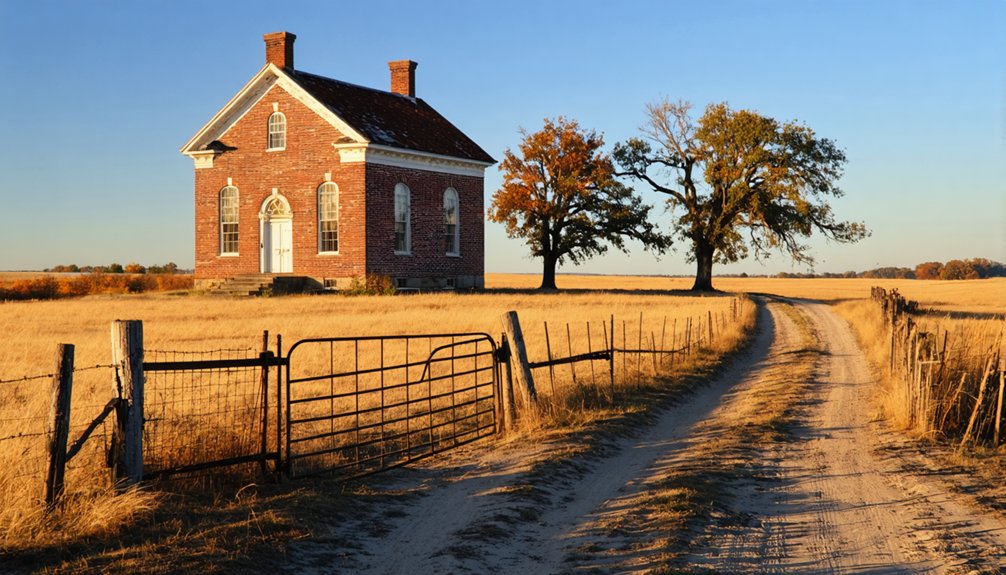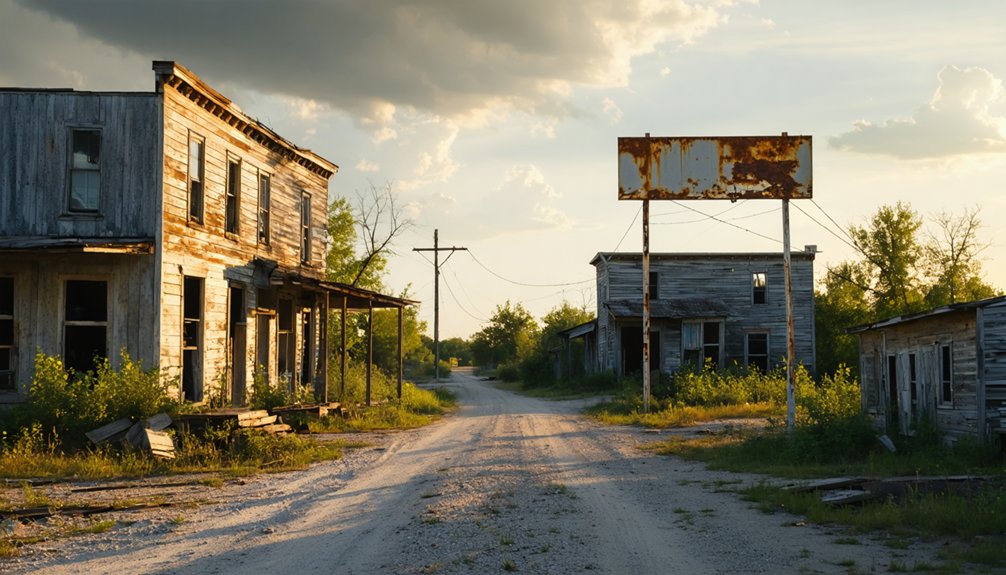
To plan your ghost town road trip to Little Rock, Illinois, head to the far northwestern corner of Kendall County, about 4.3 miles northwest of Plano along Galena Road (CR 9). There’s no main street waiting for you—just open land, Little Rock Creek, and county roads tracing a forgotten stagecoach corridor. This quiet landscape holds more history than it first reveals, and understanding what shaped it makes the drive far more rewarding.
Key Takeaways
- Little Rock, Illinois, sits in northwestern Kendall County, roughly 4.3 miles northwest of Plano, making Plano the ideal starting point for your trip.
- Use Galena Road (CR 9) as your primary route, with Little Rock Road (CR 12) marking the eastern boundary of the former community.
- The site has no visitor infrastructure, signage, or structural remnants, so arrive prepared to interpret an open, natural landscape independently.
- Little Rock declined after railroads bypassed the area, redirecting commerce to nearby Plano and Aurora, leaving no streets or storefronts behind.
- Stock up on supplies in Plano before visiting, as Little Rock offers no amenities, only natural features like Little Rock Creek and county roads.
What Is Little Rock, Illinois: and Why Does It Matter?
Tucked into the far northwestern corner of Kendall County, Little Rock, Illinois is an unincorporated community that most drivers pass without a second glance — if they notice it at all. Its historical significance runs deeper than its quiet roadside presence suggests.
Little Rock started as a stagecoach stop along Galena Road, a frontier corridor that once carried settlers, commerce, and ambition across early Illinois. That transportation legacy shaped the community’s identity and, eventually, its decline.
When roads shifted and growth moved elsewhere, Little Rock faded into the ghost-town lists that historians quietly maintain. Today, it survives as a place name, a county road marker, and a half-mile stretch of land between Little Rock Creek and Little Rock Road — waiting for the curious traveler who actually bothers to look.
Where Exactly Is Little Rock Located?
You’ll find Little Rock tucked into the far northwestern corner of Kendall County, Illinois, roughly 4.3 miles northwest of Plano and about 12 air miles west-southwest of Aurora — two anchors that’ll help you orient your route.
The community sits east of Little Rock Creek along Galena Road (CR 9), just west of Little Rock Road (CR 12), giving you two county roads to triangulate the site.
Before you head out, note one quirk in the historical record: at least one compiled ghost-town source lists Little Rock under LaSalle County rather than Kendall, a discrepancy worth keeping in mind as you cross-check your maps.
Kendall County’s Northwestern Corner
Nestled in Kendall County’s far northwestern corner, Little Rock sits east of Little Rock Creek along Galena Road (CR 9), placing it roughly 4.3 miles northwest of Plano and about 12 air miles west-southwest of Aurora.
Little Rock Road (CR 12) marks its eastern boundary, meaning the former settlement once stretched nearly half a mile between road and creek.
That geography isn’t accidental. Its historical significance stems directly from transportation evolution — specifically, stagecoaches rolling along Galena Road, carrying settlers deeper into Illinois frontier territory.
The creek named the community; the road built it. When you drive CR 9 today, you’re tracing the same corridor those early travelers relied on.
The land remembers the route even when the town itself has all but disappeared.
Nearby Towns For Reference
Finding Little Rock on a modern map takes a little detective work, but two nearby towns make reliable anchors: Plano sits about 4.3 miles to the southeast, and Aurora lies roughly 12 air miles to the east-northeast. Both towns give you practical stopping points for fuel, food, and lodging before you head out to explore the ghost town’s former footprint.
Their historical significance runs deeper than convenience, though. Aurora grew alongside railroad expansion, while Plano developed as a regional agricultural center.
Little Rock developed as a community rooted in transportation history as a stagecoach stop along Galena Road.
Framing your visit around these reference points reminds you that Little Rock wasn’t isolated — it once connected travelers moving through a landscape still finding its shape.
County Attribution Discrepancy
Before you plot Little Rock on your GPS, there’s a small but telling wrinkle worth knowing: depending on which historical source you consult, the community lands in either Kendall County or LaSalle County. Most evidence places it firmly in Kendall County’s far northwestern corner, along Galena Road near Little Rock Creek.
Yet compiled ghost-town directories list it under LaSalle County, a discrepancy that speaks to the historical significance of borderland settlements, where record-keeping was inconsistent and county lines shifted meaning over time. For the independent road tripper, this ambiguity isn’t an obstacle — it’s a clue.
Community remnants like Little Rock often slip between jurisdictions precisely because they faded before official records solidified. Cross-reference your sources, trust the creek and the county roads, and you’ll find it.
Is Little Rock in Kendall or LaSalle County?
Before you head out, you’ll want to know that sources don’t fully agree on which county claims Little Rock.
Most road-trip references and ghost-town directories place it firmly within Kendall County, specifically Little Rock Township, and that’s the attribution you should trust for navigation.
The discrepancy likely traces back to compiled historical directories that conflated county boundaries or copied earlier errors, a common problem in Illinois ghost-town research where records were assembled from inconsistent local sources.
Sources Disagree On County
When you start cross-referencing sources to pin down Little Rock’s exact location, you’ll hit a curious snag: some compiled ghost-town directories place Little Rock in Kendall County, while at least one other lists it under LaSalle County. That discrepancy matters for anyone chasing historical significance through primary records.
Keep these research realities in mind:
- Compiled ghost-town lists vary — editors pulled from different county histories, creating conflicting attributions that preservation challenges have never fully resolved.
- Kendall County placement aligns best with geographic evidence, specifically Galena Road (CR 9) and Little Rock Creek’s location in the county’s far northwest.
- Cross-check multiple sources before committing to a route — a single directory can mislead you into the wrong county entirely.
Trust the landscape over the lists.
Kendall County Placement Confirmed
Although compiled directories muddy the waters, geographic evidence firmly settles Little Rock in Kendall County — specifically in the county’s far northwestern corner, where Galena Road (CR 9) runs east of Little Rock Creek and west of Little Rock Road (CR 12).
When you trace the transportation history of this corridor, the placement makes sense. Galena Road functioned as a stagecoach artery pushing northwest through Illinois frontier territory, and Little Rock grew directly along that route.
Historical context reinforces the Kendall County designation: township records identify the site within Little Rock Township, anchoring it clearly within county boundaries.
The LaSalle County label appearing in some directories likely reflects clerical drift across compiled ghost-town lists. Trust the road coordinates. You’ll find the former settlement exactly where Kendall County’s geography says it should be.
Why The Discrepancy Exists
Pinning Little Rock to Kendall County resolves the geography, but it doesn’t explain why LaSalle County keeps appearing in the record.
Map discrepancies like this one are common across Illinois ghost-town directories, where compilers pulled from inconsistent local histories and secondhand sources. Historical accuracy suffers when nobody revisits the original records.
Three reasons the confusion likely persists:
- Compiler error — Early ghost-town lists were aggregated quickly, and county lines got mislabeled without field verification.
- Boundary proximity — Little Rock sits in Kendall County’s far northwestern corner, close enough to neighboring counties to invite confusion.
- Duplicate place names — Illinois has multiple “Little Rock” references, making it easy to conflate separate entries across different counties.
Trust the geography. Kendall County is correct.
The Stagecoach Route That Built Little Rock
Before railroads stitched Illinois together, stagecoaches ruled the frontier, and Galena Road was one of the arteries that kept early settlers moving. Drivers called it Chicago Road further west, and it carried merchants, migrants, and mail across raw Illinois terrain.
Little Rock grew directly from that traffic, establishing itself as a stagecoach stop where travelers could rest before pushing deeper into the frontier.
That historical significance shapes everything you’ll experience when you visit today. The community’s half-mile stretch between Little Rock Road and Little Rock Creek wasn’t accidental — it followed the logic of transportation evolution, positioning itself exactly where road travelers needed it most.
When stagecoaches disappeared and railroads bypassed the area, Little Rock’s reason for existing quietly vanished alongside them, leaving only road names and creek banks behind.
Why Little Rock Became an Illinois Ghost Town
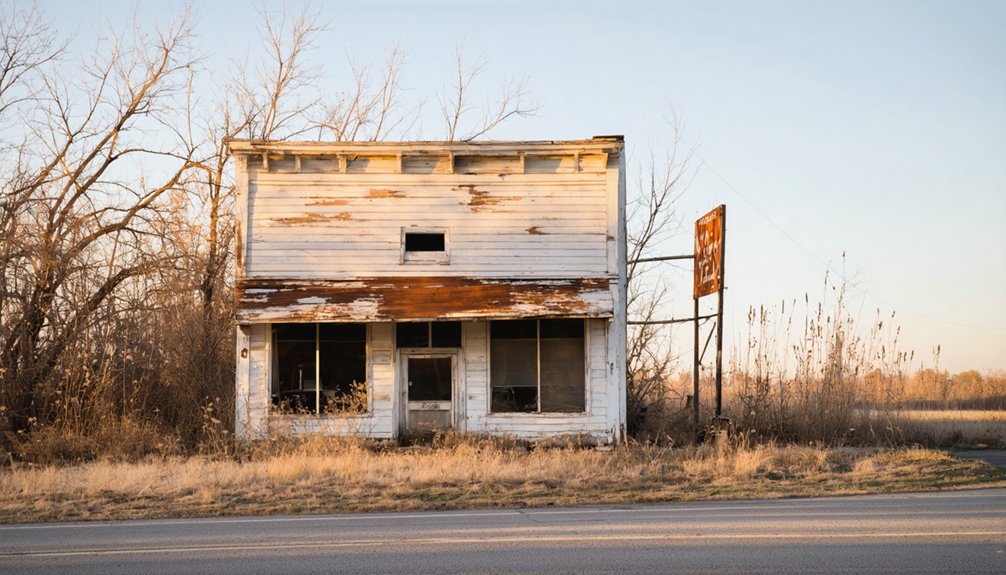
When you trace Little Rock’s decline, you’ll find the same culprit that erased dozens of Illinois frontier towns: the stagecoach route lost its grip.
As railroads rewired regional travel in the mid-19th century, Galena Road surrendered its commercial pull, and communities built around it lost their reason to exist.
Little Rock didn’t survive the shift—it simply stopped mattering to the travelers who once kept it alive.
Transportation Shifts Triggered Decline
Like so many frontier communities, Little Rock didn’t fade because of a single disaster—it lost its reason to exist. The historical context here matters: when transportation decline reshaped Illinois, stagecoach stops became obsolete almost overnight.
Three shifts likely sealed Little Rock’s fate:
- Railroads bypassed the route, pulling commerce toward new rail towns and leaving Galena Road traffic to wither.
- County roads replaced early stagecoach corridors, redirecting travelers away from established stops like Little Rock.
- Nearby Plano absorbed regional economic activity, drawing residents and businesses southeast toward better-connected ground.
You’re looking at a place that simply got bypassed. No fire, no flood—just the relentless logic of progress rerouting itself. That invisibility is exactly what makes Little Rock worth finding.
Stagecoach Route Lost Relevance
Once Galena Road lost its role as a vital artery connecting frontier Illinois, Little Rock lost its identity. The stagecoach stop that once gave this community its historical significance simply had no replacement purpose when faster, more reliable transportation options bypassed it entirely.
You can almost feel that shift standing along County Road 9 today. Freight moved to railroads. Travelers followed new corridors. The half-mile stretch of settlement that once hummed with stagecoach traffic went quiet, and transportation decline did what it always does — it erased the economic reason to stay.
Little Rock didn’t collapse dramatically. It faded. When the road stopped mattering, so did the community built around serving it. That’s the quiet, unavoidable truth ghost towns teach you every time.
What the Little Rock Site Looks Like Today
Arriving at the Little Rock site today, you won’t find a main street, a crumbling storefront, or even a historical marker to confirm you’re standing in the right place. What you’ll find instead is open landscape, county roads, and a creek quietly marking where a community once stretched half a mile.
No historical landmarks survive. Local legends have faded with the residents who carried them.
Navigate using these three reference points:
- Galena Road (CR 9) — the historic corridor running through the former settlement
- Little Rock Road (CR 12) — the eastern boundary of the old community
- Little Rock Creek — the western natural border that named the place itself
The site rewards curious, self-directed travelers who find meaning in absence rather than preservation.
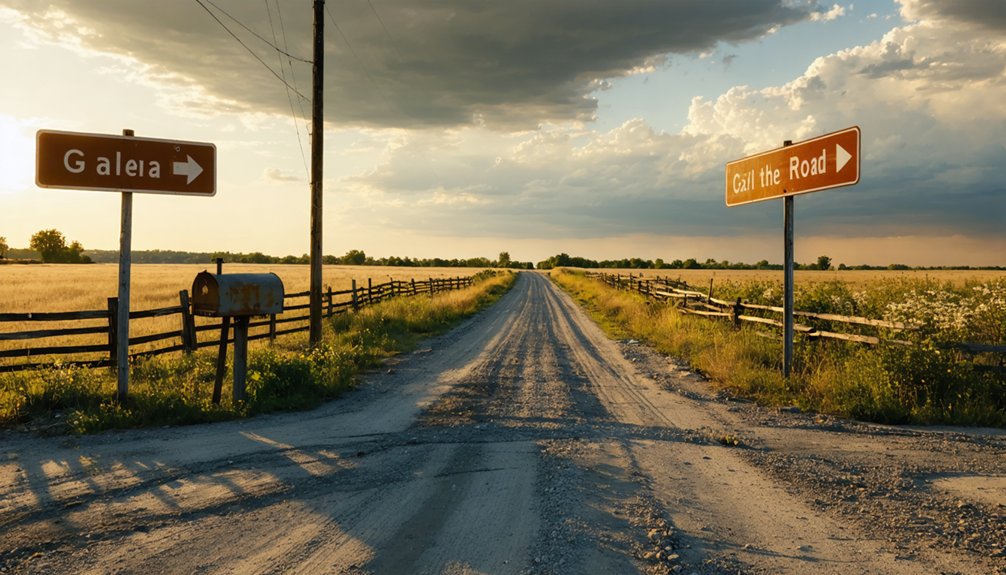
Finding your way to the Little Rock site comes down to two county roads that still carry the ghost of the old stagecoach corridor.
For road navigation, fix your heading northwest from Plano, roughly 4.3 miles out.
Galena Road (CR 9) is your primary spine — the same route that once moved stagecoaches through frontier Illinois.
Little Rock Road (CR 12) marks your eastern boundary, while Little Rock Creek defines the western edge.
Historical accuracy matters here: some sources list the township under LaSalle County rather than Kendall, so don’t let a conflicting map throw you off course.
You’re looking for the stretch between those two roads, roughly half a mile of ground where a real community once stood.
Trust the creek. It hasn’t moved.
Pair Your Visit With Plano or Aurora
Since Little Rock offers no gas stations, no diners, and no visitor infrastructure of any kind, you’ll want to anchor your road trip around one of two real towns within easy reach.
Plano sits roughly 4.3 miles southeast, while Aurora anchors the region about 12 air miles east-northeast. Both towns deepen your appreciation of the area’s transportation history and historical significance.
Consider these practical pairings:
- Plano – Fuel up, eat, and research Kendall County’s early settlement patterns before heading northwest toward the ghost town.
- Aurora – Use it as your base for a longer itinerary connecting multiple vanished Illinois communities.
- Both towns together – Frame the entire drive as a corridor through frontier Illinois, where stagecoach roads once connected everything.
How Little Rock Reflects the Larger Illinois Ghost Town Pattern

Little Rock isn’t an anomaly — it’s a pattern. Across Illinois, dozens of communities rose alongside early roads, river landings, and frontier corridors, then quietly disappeared when transportation evolution redirected traffic elsewhere.
Railroads bypassed stagecoach stops. Canal proposals collapsed. New county roads replaced old ones. Each shift rewrote the map and erased another town’s reason for existing.
Understanding that historical context makes Little Rock feel less like a footnote and more like a mirror. You’re not just visiting a forgotten crossroads — you’re reading evidence of how freely people once moved, built, and abandoned places when opportunity called them somewhere new.
Illinois ghost towns don’t haunt you with tragedy. They remind you that movement itself shaped this land, and Little Rock is proof.
What to Know Before You Make the Drive
Before you load up the car, understand that Little Rock isn’t a preserved site with a parking lot and an interpretive sign — it’s a coordinate on a county road. Its historical significance lives in the landscape itself, not in any preservation efforts or maintained structures. Come prepared to read the land.
- Navigate using Galena Road (CR 9) and Little Rock Road (CR 12) — these two corridors bracket where the community once stretched half a mile.
- Check county attribution before researching — sources split between Kendall and LaSalle Counties, so expect inconsistencies.
- Use Plano as your staging point — it sits roughly 4.3 miles southeast and offers fuel, food, and a practical return route.
You’re chasing a ghost. Drive accordingly.
Frequently Asked Questions
What Is the Best Time of Year to Visit Little Rock?
You’ll find the best visiting months are late spring and early fall, when seasonal weather stays mild and the creek-side landscape comes alive, giving you the freest, most atmospheric sense of this vanished frontier community.
Are There Any Guided Ghost Town Tours Available Near Little Rock?
Guided tours aren’t a well-worn path here—you’ll carve your own route through ghost town history. Little Rock’s quiet roads invite independent exploration, where freedom-seekers like you uncover forgotten stories firsthand.
Is the Little Rock Site on Public or Private Land?
The sources don’t confirm land ownership for Little Rock’s site. You’ll want to research local records before visiting. No preservation efforts are documented, so treat it as historically sensitive ground and respect any boundaries you encounter.
Can I Find Little Rock Listed on Google Maps or GPS?
Like Brigadoon flickering in the mist, Little Rock may elude Google Maps entirely. You’ll want to search GPS Coordinates near Galena Road (CR 9) instead, cross-referencing historical directories to pinpoint this vanished community yourself.
Are There Any Local Historians or Contacts Who Document Little Rock?
You’ll find no dedicated contacts, but local historians in Kendall County actively pursue historical preservation efforts. Dig into regional archives, and you’ll uncover local legends that breathe life into Little Rock’s atmospheric, freedom-calling frontier past.
References
- https://freepages.rootsweb.com/~gtusa/history/usa/il.htm
- https://www.facebook.com/hikingwithshawn/posts/the-shawnee-national-forest-is-full-of-ghost-towns-this-one-was-called-progress/809600367640516/
- https://www.heraldtimesonline.com/story/lifestyle/home-garden/2021/01/15/some-illinois-ghost-towns/43846097/
- https://en.wikipedia.org/wiki/Little_Rock
- https://drloihjournal.blogspot.com/2022/09/lost-towns-of-illinois-little-rock.html
- https://en.wikipedia.org/wiki/List_of_ghost_towns_in_Illinois
- https://www.facebook.com/lchsmuseum/posts/this-months-ghost-town-of-lasalle-countyalthough-the-lost-town-of-science-left-l/10154005091567946/
- https://en.wikipedia.org/wiki/Category:Former_populated_places_in_Illinois
- https://sites.rootsweb.com/~iltttp/ghosttowns.htm
- https://www.youtube.com/watch?v=z9kIKzVlz6I