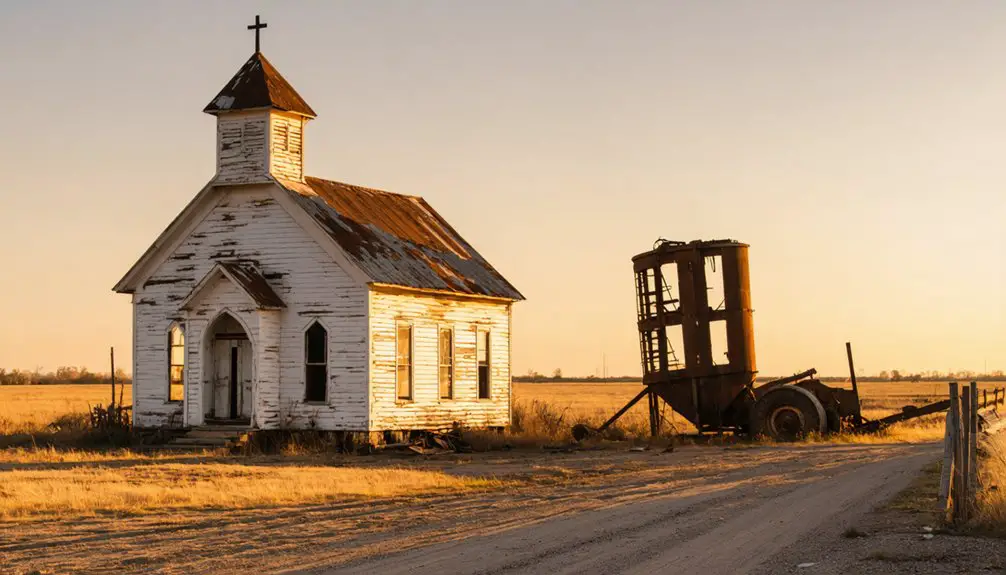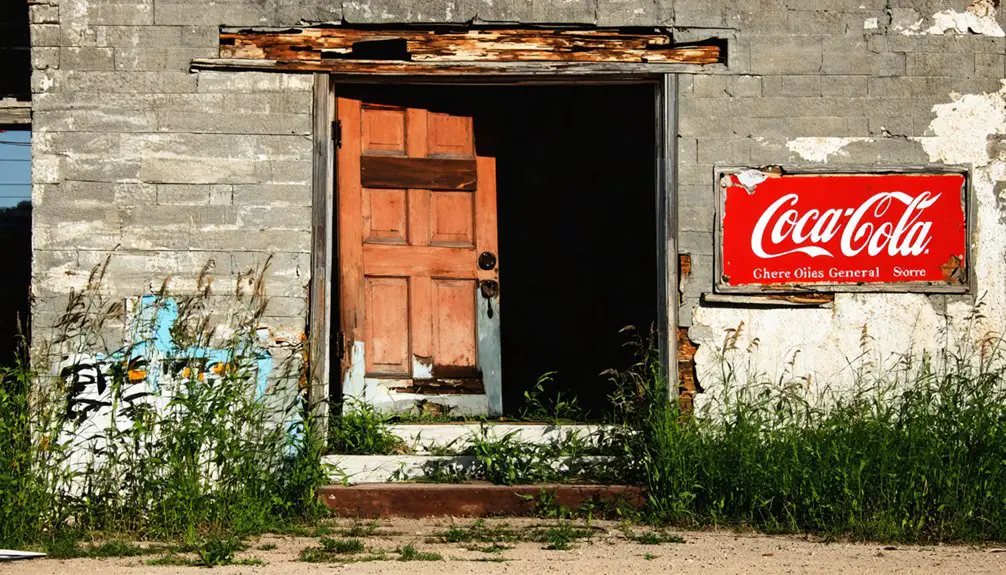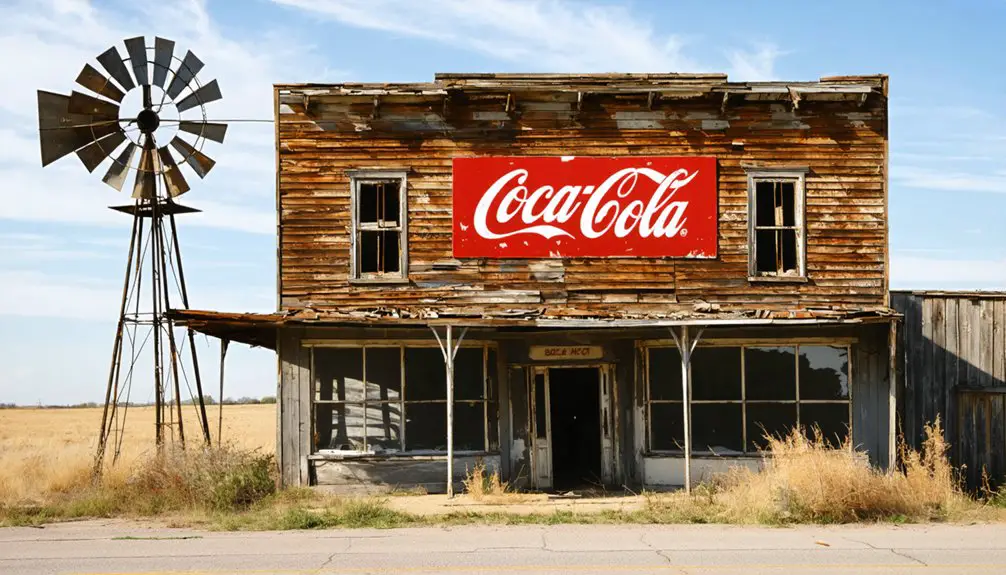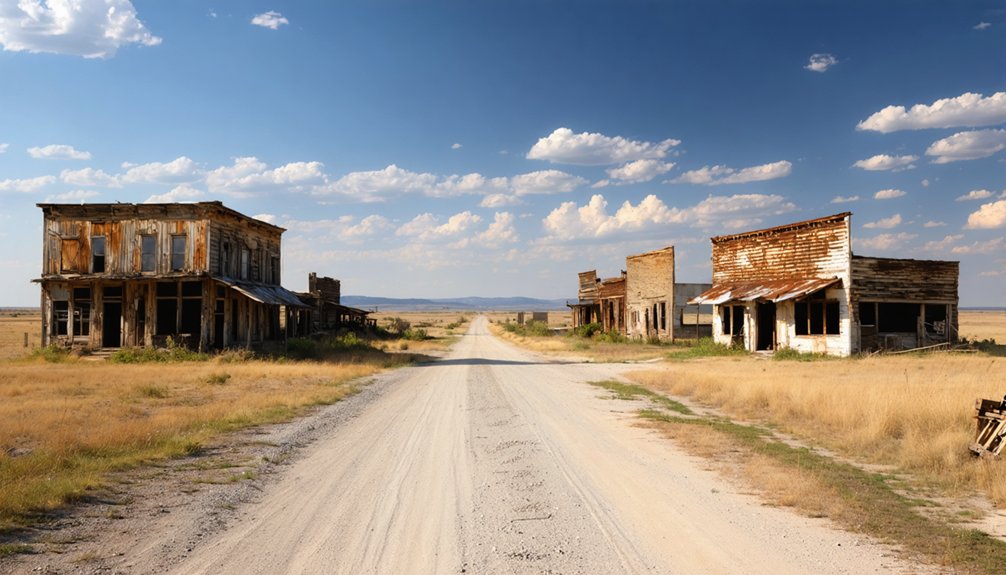
Start your ghost town road trip to Mouser, Oklahoma from Guymon, heading north on Highway 136, then east on County Road 7. You’ll find weathered wooden buildings and abandoned machinery frozen in time since the railroad shut down in 1972. Mouser’s open prairie landscapes make it perfect for photography and exploration. Spring and fall offer the best weather for the drive. There’s much more to uncover about this fascinating Panhandle ghost town ahead.
Key Takeaways
- Mouser is located 12.5 miles north and 2 miles east of Guymon, Oklahoma, accessible via Highway 136 and County Road 7.
- Use Guymon as your base, offering hotels and restaurants while serving as a central hub for exploring multiple ghost towns.
- Visit in spring or fall for mild weather; summer requires early starts and extra water due to extreme heat.
- Pack essentials including extra water, a first aid kit, offline maps, and a spare tire for this remote, unpaved location.
- Mouser’s weathered buildings, abandoned machinery, and open prairie landscapes offer excellent photography and historical exploration opportunities.
Where Exactly Is Mouser, Oklahoma?
Tucked into Texas County, Oklahoma, Mouser sits 12.5 miles north and 2 miles east of Guymon, placing it roughly 12 miles west of Hooker along an abandoned railroad corridor. You’ll find it just off County Road 7, east of Oklahoma State Highway 136, with US Route 64 providing convenient highway access nearby.
The Beaver, Meade and Englewood Railroad once ran directly through here, shaping local history and sustaining the community until the line’s abandonment in 1972. That single event sealed Mouser’s fate, leaving community remnants standing silent against the Oklahoma panhandle sky.
When you’re planning your route, use Guymon as your base — it’s the panhandle’s largest incorporated town — then head north to explore what time and railroad economics left behind.
What Makes Mouser Worth the Drive?
Few ghost towns offer the layered history that Mouser does — a place where railroad economics, prairie isolation, and human ambition collided and quietly unraveled. When the Beaver, Meade and Englewood Railroad abandoned its line in 1972, it didn’t just cut service; it severed Mouser’s lifeline entirely.
You’ll find standing structures that tell that story without a single tour guide.
Community legends still circulate among longtime Texas County residents, connecting you to a human past that maps can’t capture. Pair your visit with stops in Guymon or Hooker for local cuisine that grounds your road trip in genuine regional culture.
Mouser rewards curious travelers who crave authentic, unfiltered history — not a packaged experience, but raw evidence of how quickly a community can disappear from the map.
How to Get to Mouser on Highway 136
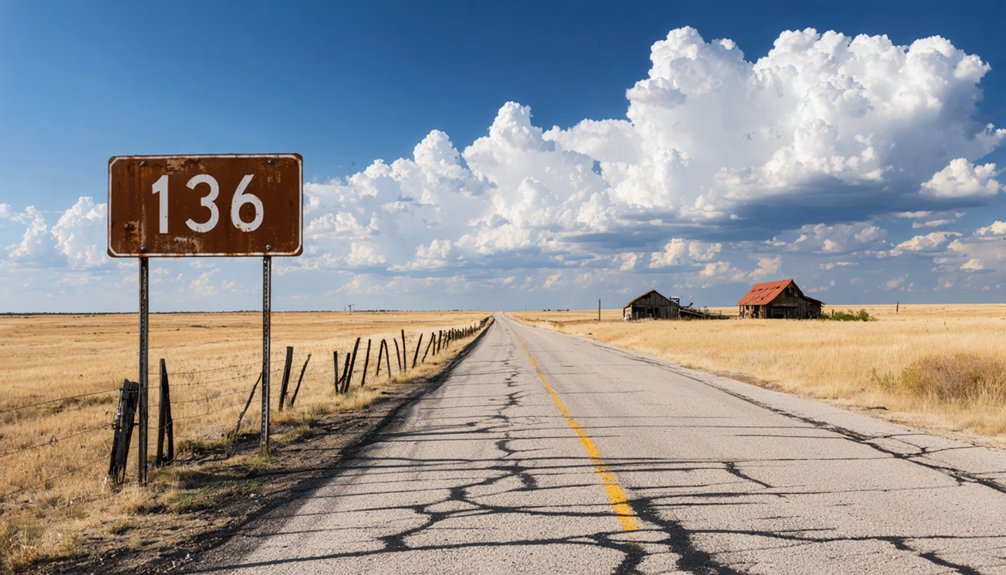
Getting to Mouser is straightforward once you orient yourself along Oklahoma State Highway 136. Head east off the highway onto County Road 7, and you’ll find yourself approaching this forgotten panhandle community in no time.
The drive itself rewards you with open skies and flat terrain that defines this region, offering genuine wildlife sightings of pronghorn and prairie birds along the roadside.
You’re positioned 12.5 miles north and 2 miles east of Guymon, making that city your ideal staging point. Stock up on local cuisine in Guymon before heading out, since Mouser offers nothing in the way of amenities.
US Route 64 also provides western highway access, giving you flexible routing options as you plan your approach to this abandoned Texas County community.
The Abandoned Structures Still Standing at Mouser
Although Mouser’s population long since vanished, physical structures still stand across this abandoned Texas County community, giving you something tangible to photograph and explore. You’ll find historical architecture frozen in time, alongside abandoned machinery that tells the story of a once-active railroad town.
- Weathered wooden buildings reflecting early Oklahoma Panhandle construction styles
- Abandoned machinery left behind when rail service ceased in 1972
- Structural remnants connected to the Beaver, Meade and Englewood Railroad era
- Deteriorating foundations marking where community life once centered
- Open landscapes surrounding structures, giving you unobstructed photography angles
Walk freely through this untouched environment and let the silence do the storytelling. Nothing’s been cleaned up or staged here — what you’re seeing is authentic, raw abandonment that rewards curious explorers willing to venture off the beaten path.
The Railroad That Built Mouser: and Killed It
Those weathered structures you’re photographing didn’t appear by accident — they owe their existence entirely to the Beaver, Meade and Englewood Railroad, the Katy line that once cut directly through Mouser and gave the community its reason for being.
Rail lines like this one created instant economies across the Oklahoma panhandle, pulling settlements from bare prairie almost overnight. Mouser thrived because the railroad demanded it — goods moved, people followed, and a community took root.
Then 1972 arrived. The line was abandoned, and Mouser’s economic lifeline simply vanished. No railroad meant no commerce, no reason to stay.
That railroad history now defines the ghost town‘s entire narrative. Walking these grounds, you’re witnessing historical preservation in its rawest form — a community frozen at the exact moment its purpose disappeared.
Ghost Towns Along the Katy Line Worth Adding to Your Route
When the Beaver, Meade and Englewood Railroad abandoned its Katy line in 1972, it didn’t just silence Mouser — it hollowed out an entire string of communities across Texas County.
You can trace that same route today, connecting ghost town after ghost town along the old rail corridor, each one frozen at the moment the trains stopped coming.
Adding these stops to your Mouser road trip turns a single destination into a haunting journey through the economic wreckage that railroad abandonment left behind.
Katy Line Ghost Towns
Since Mouser sits along the abandoned Beaver, Meade and Englewood Railroad—commonly known as the Katy line—you’ll find several other ghost towns scattered along this same corridor, making it easy to string together a compelling multi-stop route through Texas County.
Each stop reveals layers of local history and offers unexpected wildlife observation opportunities across the open panhandle landscape.
- Explore remnants of communities that thrived solely because of rail commerce
- Photograph weathered structures frozen in time along the corridor
- Trace the original rail bed connecting forgotten settlements
- Discover how 1972’s abandonment reshaped the entire region overnight
- Camp near Wild Horse Lake Hay Meadow for an immersive overnight experience
This corridor rewards curious travelers who prefer self-directed exploration over scripted tourism.
Railroad Abandonment Impact
The 1972 abandonment of the Beaver, Meade and Englewood Railroad didn’t just silence train whistles across the Oklahoma panhandle—it effectively pulled the economic plug on an entire network of communities that had built their identities around rail commerce. When the trains stopped running, businesses lost their lifelines, families relocated, and local legends faded into dusty memories.
Mouser felt this collapse directly. Without rail access, the town couldn’t sustain itself, joining dozens of similar casualties scattered across Texas County.
Today, these abandoned corridors have become unexpected canvases for art preservation efforts and historical documentation by explorers who refuse to let these stories disappear. You’ll find that traveling this forgotten route connects you to an unfiltered version of Oklahoma history that no highway billboard ever advertises.
Planning Your Route
Stretching across the Oklahoma panhandle, the abandoned Katy line connects a string of ghost towns that deserve a spot on your itinerary alongside Mouser. Each stop reveals layers of local history waiting to be uncovered, and preservation efforts vary from site to site, making every visit uniquely rewarding.
- Start in Goodwell and head north along Highway 136 toward County Road 7.
- Use US Route 64 as your eastern boundary for navigation.
- Follow the abandoned railroad corridor to locate forgotten communities.
- Photograph standing structures before weather and time claim them.
- Cross-reference Texas County ghost town inventories to maximize your stops.
You’ll cover significant ground efficiently by treating the old rail route as your invisible guide through the panhandle’s forgotten past.
Make Guymon Your Base Camp for This Road Trip
Guymon, the largest incorporated town in the Oklahoma Panhandle, sits just 12.5 miles south of Mouser, making it the perfect base camp for your ghost town adventure.
You’ll find lodging options there that keep you close to the action without sacrificing comfort.
When you’re ready to head out, take Oklahoma State Highway 136 north, then cut east onto County Road 7 to reach Mouser directly.
Guymon’s Central Location
When planning your ghost town road trip to Mouser, you’ll want to make Guymon your base camp. As the largest incorporated town in the Oklahoma panhandle, it puts you within striking distance of historical preservation sites and forgotten community stories scattered across Texas County.
From Guymon, you’re perfectly positioned to:
- Drive 12.5 miles north and 2 miles east directly to Mouser
- Access County Road 7 and Oklahoma State Highway 136 effortlessly
- Explore multiple ghost towns along the abandoned Katy railroad line
- Investigate the Wild Horse Lake Hay Meadow Massacre historical site nearby
- Use US Route 64 as your primary highway corridor
Guymon’s central location means less time orienting yourself and more time discovering the raw, untamed history that defines this corner of Oklahoma.
Nearby Lodging Options
Making Guymon your base camp isn’t just a smart logistical move—it’s where you’ll find the lodging options that keep your ghost town adventure running smoothly.
As the largest incorporated town in the Oklahoma Panhandle, Guymon offers reliable local lodging that smaller stops simply can’t provide. You’ll find chain hotels, motels, and budget-friendly rooms that let you recharge before hitting County Road 7 again.
Ghost town accommodations don’t exist in Mouser—there’s nothing out there but abandoned structures and open prairie.
Staying in Guymon puts you just 12.5 miles south of Mouser, meaning you’re never far from your next exploration.
Book your room, load up your map, and use Guymon as the launching pad your road trip deserves.
Planning Your Departure Route
Starting your ghost town road trip in Guymon gives you the perfect launchpad—you’re just 12.5 miles south of Mouser, with a straightforward route waiting.
Head north, then shift east of Oklahoma State Highway 136 onto County Road 7. You’ll arrive at community remnants that quietly echo local history from another era.
Pack these essentials before departing:
- Full tank of gas—services thin out quickly past Guymon
- Camera—abandoned structures deserve documentation
- Paper map—cell coverage gets unreliable in rural Texas County
- Water and snacks—no stops exist near Mouser
- Flexible timeline—exploration rewards those who linger
US Route 64 also connects you westward if you’re extending your route. Guymon’s central position makes backtracking effortless, keeping your road trip efficient and completely on your terms.
Gear and Safety Essentials for Panhandle Ghost Town Visits
Exploring abandoned panhandle communities like Mouser requires smart preparation, since remote Texas County locations sit far from medical facilities, fuel stations, and cell service. Pack a physical map, extra water, and a first aid kit before leaving Guymon or Hooker.
Your vehicle needs a full tank and a spare tire, because County Road 7 won’t forgive breakdowns.
Bring a charged camera for exceptional photography opportunities around Mouser’s remaining structures and historical landmarks along the abandoned Katy railroad corridor.
Sturdy boots protect you from debris inside deteriorating buildings. Tell someone your route and expected return time.
Download offline maps covering Texas County before you lose signal. Afternoon panhandle winds pick up fast, so layer your clothing accordingly.
Prepared explorers experience freedom; unprepared ones experience emergencies.
Best Time of Year to Visit Mouser and the Katy Line Ghost Towns
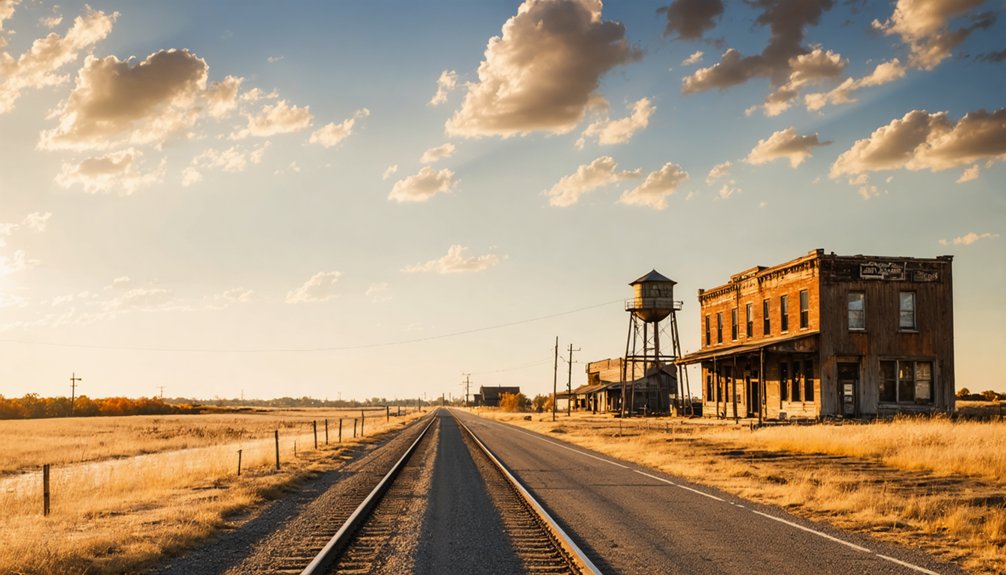
Once your gear’s packed and your safety plan’s set, timing your visit becomes the next decision that shapes your entire experience along the Katy line. Spring and fall deliver the most rewarding conditions for exploring Mouser and surrounding ghost towns.
Timing your visit shapes everything — spring and fall deliver the most rewarding conditions along the Katy line.
- Spring (April–May): Mild temperatures, wildflowers blooming, ideal for wildlife photography
- Fall (September–October): Crisp air, golden light, stunning landscape contrast against abandoned structures
- Summer: Extreme panhandle heat demands early morning departures; bring extra water
- Winter: Harsh winds and ice make County Road 7 potentially impassable
- Local cuisine stops: Guymon restaurants stay open year-round, fueling your route between ghost towns
You’re free to roam any season, but spring and fall genuinely maximize both your comfort and your photography opportunities along the abandoned Katy line corridor.
Frequently Asked Questions
Is Mouser, Oklahoma Listed in Official Ghost Town Inventories?
Yes, you’ll find Mouser listed in official Oklahoma ghost town inventories! It’s recognized for its historical significance, making it one of the state’s unique tourist attractions where you can explore abandoned structures and vanished railroad heritage freely.
What County and Township Section Contains Mouser, Oklahoma?
You’ll find Mouser in Texas County, within Section 26, Township 5N, Range 15E. Its historical settlement patterns echo rural community decline, where once-thriving homesteads surrendered to time, leaving you to explore freedom’s forgotten frontier.
Did Railroad Abandonment Directly Cause Mouser to Become a Ghost Town?
Yes, railroad decline directly turned Mouser into a ghost town! When the Beaver, Meade and Englewood line abandoned operations in 1972, you’d have witnessed the devastating economic impact that stripped the community of its lifeblood, leaving it forever abandoned.
Does Mouser Currently Have an Active Municipal Government?
Mouser has no active municipal government, no bustling streets, no local legends enforced by officials. You’ll find historical preservation in its silent structures, echoing a free, untamed past that’s yours to explore and discover.
How Far Is Mouser From Hooker, Oklahoma?
You’re just 12 miles west of Hooker when you reach Mouser, where historical landmarks and local legends of abandoned railroad days await your adventurous spirit along this hauntingly free, open road journey.
References
- https://okielegacy.net/journal/tabloid/?ID=1117&vol=7&iss=50
- https://en.wikipedia.org/wiki/List_of_ghost_towns_in_Oklahoma
- https://en.wikipedia.org/wiki/Mouser
- https://www.youtube.com/watch?v=ipdzN0yrpfE