When you drive toward Port Chicago, California, you’re chasing a town that simply isn’t there anymore. A catastrophic explosion on July 17, 1944, killed 320 men, erased nearly 1,750 residents’ homes, and handed the land permanently to the military. What remains is a dead-end highway, blackened pier pilings, and a powerful memorial tied to one of America’s most important civil rights stories. Keep going, and the full picture gets even more compelling.
Key Takeaways
- Port Chicago, once home to nearly 1,750 residents, was erased after a 1944 explosion and absorbed into a restricted military zone.
- Access requires advance coordination with the National Park Service, as the memorial site is within a controlled military area.
- Physical remnants include blackened pier pilings, mock-up 500-pound bombs, and explanatory plaques marking the explosion’s historic significance.
- The nearest services, food, and amenities are approximately 6.5 miles west in Martinez, so plan accordingly.
- Dress in layers to prepare for summer heat and unpredictable Delta winds during your visit.
Why Port Chicago No Longer Exists as a Town
Although Port Chicago once thrived as a working waterfront community of nearly 1,750 residents, it no longer exists in any recognizable form — and the story of its disappearance begins, but doesn’t end, with one catastrophic night in 1944.
Port Chicago once housed nearly 1,750 residents — until one catastrophic night in 1944 set its disappearance in motion.
On July 17, a massive munitions explosion killed 320 men and damaged over 300 buildings throughout town. Yet urban abandonment didn’t happen overnight.
The community lingered for years before military expansion ultimately consumed what remained.
By the time historical preservation efforts took hold, the original town was already gone — leveled and absorbed into a restricted military zone.
What you’ll find today isn’t a frozen-in-time streetscape but a carefully maintained memorial where a neighborhood once stood, reminding you that some towns don’t fade slowly — they vanish completely.
The 1944 Explosion That Erased a California Town
Few moments in American home-front history hit as hard as 10:18 PM on July 17, 1944, when munitions loaded onto ships at the Port Chicago Naval Munitions Depot detonated in a blast so powerful it killed 320 men instantly, injured nearly 400 others, and tore through more than 300 buildings across a town that had spent decades quietly growing around lumber, shipping, and petrochemical work along Suisun Bay.
Remarkably, no town residents died, but Port Chicago never recovered. Community redevelopment never followed because the military absorbed the land entirely, erasing streets, homes, and history in one institutional sweep.
What historical preservation survived exists today through the National Park Service memorial, where you can stand near blackened pier pilings and feel exactly how completely one night dismantled an entire California community.
The Port Chicago 50 and Their Civil Rights Legacy
When you stand at the Port Chicago memorial, you’re standing where hundreds of Black sailors refused to return to loading munitions after the explosion, calling out the dangerous, segregated conditions that had already killed more than 200 of their fellow servicemen.
The Navy charged over 200 men on related offenses, then convicted 50 of them on mutiny charges, sentencing each to 15 years of prison and hard labor.
Their stand ultimately pushed the Navy toward policy changes that accelerated the desegregation of U.S. armed forces beginning in February 1946.
Refusing Dangerous Munitions Work
What happened after the explosion cut just as deep as the blast itself. When the Navy ordered surviving sailors back to load munitions under the same dangerous conditions, hundreds refused. You can’t walk this scorched ground — past the blackened pier pilings jutting from the bay like charred remnants of town architecture — without feeling the weight of that refusal.
No local flora softens the industrial edge here; the landscape itself feels like a protest. Over 200 men faced charges. Fifty were convicted of mutiny, sentenced to 15 years of hard labor.
Their defiance wasn’t chaos — it was courage. That stand pressured the Navy toward desegregation beginning in February 1946, proving that moral resistance, even at tremendous personal cost, can reshape the laws governing an entire nation.
The Mutiny Conviction Fallout
Fifty men carried the full weight of institutional vengeance when the Navy pressed mutiny charges — not misdemeanor insubordination, not dereliction, but mutiny, a charge historically reserved for armed insurrection at sea. Each received 15 years of prison and hard labor.
Thurgood Marshall, then an NAACP attorney, attended the trials and publicly condemned them as a miscarriage of justice. His scrutiny helped expose systemic racial inequity baked into military command structures.
The fallout mattered beyond those 50 lives. Their conviction became a catalyst, accelerating Navy desegregation by February 1946.
You’ll find that historical preservation efforts at the memorial honor this legacy directly. Like community redevelopment that rebuilds from destruction, these men’s resistance rebuilt something essential — the legal and moral framework that forced America’s military to finally confront its own contradictions.
Driving Military Desegregation Forward
The Port Chicago 50 didn’t just challenge a single court’s verdict — they cracked open the entire institutional architecture of a segregated military. Their resistance echoed far beyond the courtroom, accelerating change that reshaped American service life and community redevelopment of civil rights norms nationwide.
By February 1946, the Navy began desegregating its ranks. You’re witnessing the environmental impact of fifty men’s courage whenever you stand at that memorial today.
Their legacy produced lasting shifts:
- Thurgood Marshall publicly condemned the trial
- NAACP pressure amplified national scrutiny
- Navy desegregation preceded Truman’s 1948 Executive Order 9981
- Racial assignment policies within munitions units ended
- African American sailors gained broader occupational access
Their defiance didn’t just change uniforms — it changed history.
The Physical Remains at the Port Chicago Memorial
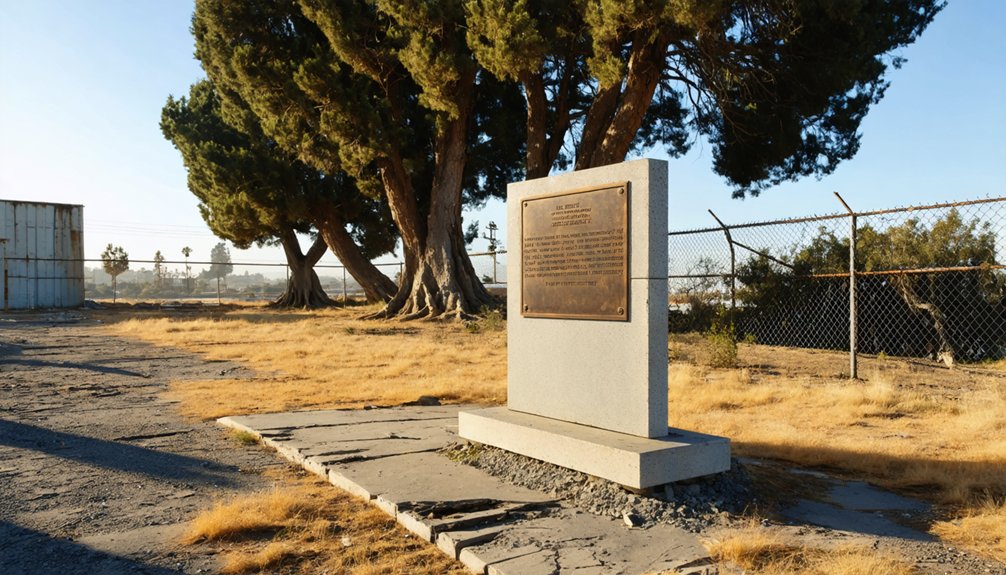
When you arrive at the half-acre National Park Service memorial, you’ll find explanatory plaques and mock-up 500-pound bombs anchoring the story of what happened here on that July night in 1944.
Look offshore and you’ll spot the blackened pier pilings still jutting from the water, silent remnants of the explosion that killed 320 men.
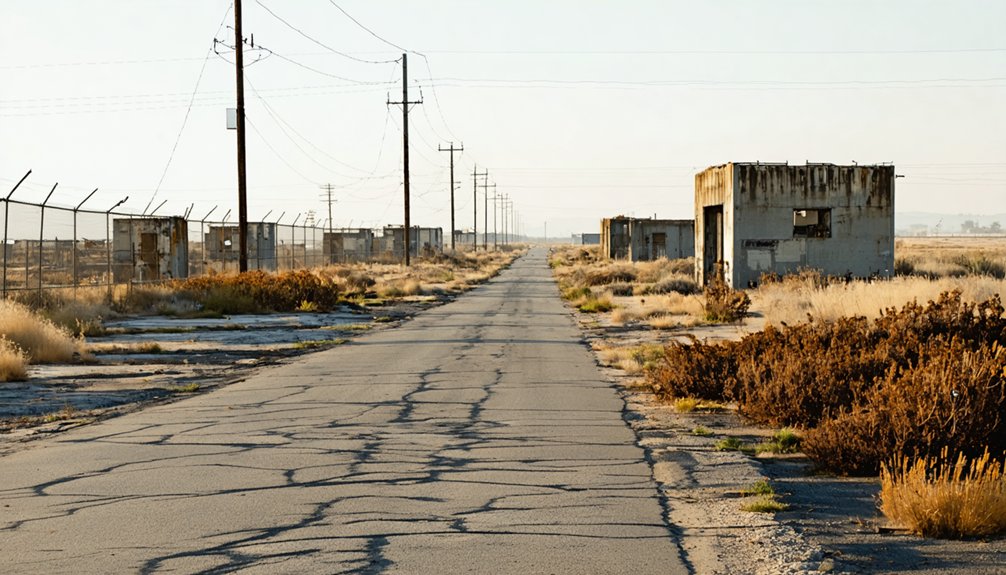
Follow the old 1940s Port Chicago highway along the waterline and you’ll hit a jarring, abrupt dead end at the terminal’s perimeter fence — a fitting, physical reminder that this place never fully came back.
Blackened Pier Pilings Offshore
Standing at the water’s edge near the Port Chicago memorial, you’ll notice something unsettling jutting from the bay: blackened pier pilings, still scorched from the catastrophic 1944 explosion that killed 320 men in an instant. These industrial remnants and shipwreck relics aren’t reconstructions — they’re original, unrestored evidence of America’s deadliest WWII home-front disaster.
What the pilings silently communicate:
- Munitions detonated here with enough force to damage 300+ buildings onshore
- At least 202 African American sailors died loading those munitions
- The pier’s destruction triggered a historic mutiny and military desegregation
- No cleanup erased these physical witnesses from the waterline
- Their charred presence connects you directly to 1944
You’re looking at history that refused to sink completely beneath the surface.
Plaques And Mock Bombs
Beyond the blackened pilings, a half-acre National Park Service memorial holds the site’s most direct storytelling tools: explanatory plaques and mock-up 500-pound bombs that anchor the abstract horror of 1944 into something you can read, circle, and stand beside.
Memorial interpretation here doesn’t sanitize the past. The plaques name the 320 men killed, document the racial segregation that put African American sailors at the most dangerous loading posts, and trace the Port Chicago 50’s resistance straight through to military desegregation.
Historical preservation at this scale works because it demands your physical presence. You’re not scrolling through a screen — you’re standing where the pier exploded.
The mock bombs make tonnage real. Walk the perimeter slowly, read every word, and let the weight of it settle.
The Abrupt Road’s End
The 1940s Port Chicago highway still runs along the water, but follow it long enough and it stops dead at the terminal perimeter fences — no gradual taper, no traffic circle, just pavement cut off by chain-link and restricted military land. That abrupt ending embodies the town’s erasure better than any plaque.
Community nostalgia collides hard with concrete reality here — local architecture is simply gone, swallowed by military expansion.
What the road’s end signals:
- A civilian town fully absorbed into federal control
- No surviving storefronts, homes, or civic structures
- Restricted land blocking further exploration
- The highway itself as the last navigable artifact
- Freedom of movement literally terminated at the fence line
Stand at that dead end and you’ll feel exactly what disappeared.
Nearby Stops That Deepen the Port Chicago Story

Visiting Port Chicago without exploring its surrounding region means missing the broader wartime story that shaped this entire stretch of California’s industrial shoreline.
Head toward Martinez to connect with local cuisine rooted in working-class maritime history, where waterfront diners still carry echoes of wartime longshoremen.
Suisun Bay’s brackish marshes reward wildlife observation, particularly migratory shorebirds threading through the Sacramento–San Joaquin Delta.
The mothballed ghost fleet anchored nearby once held reserve vessels from multiple American conflicts, adding another haunted layer to your drive.
Civil rights history deepens further if you research the broader desegregation timeline that Port Chicago’s mutiny trial accelerated.
Each stop transforms an isolated industrial detour into a coherent American story about race, labor, and the hidden machinery behind Pacific Theater victory.
Getting There: What to Know Before You Drive Out
Planning your route to Port Chicago means accepting that this isn’t a destination built for casual visitors. The industrial setting, restricted access, and sparse local cuisine options demand preparation. Seasonal weather along Suisun Bay shifts fast, so dress in layers.
Before you drive out, keep these essentials in mind:
- Access requires advance coordination with the National Park Service for memorial tours
- Nearest services sit back toward Martinez, roughly 6.5 miles west
- Summer heat and Delta winds define the seasonal weather experience on-site
- The 1940s Port Chicago highway dead-ends at terminal perimeter fencing
- No roadside stops or restaurants exist near the memorial itself
Come prepared, stay curious, and let the abrupt road’s end speak for itself.
Frequently Asked Questions
You’ll need a reservation to visit this site of profound historical significance. The National Park Service controls access to the memorial design, so plan ahead and book your tour to explore this hallowed, freedom-defining ground.
Are Pets Allowed at the Port Chicago Memorial Site?
Coincidentally, while planning your free-spirited journey, pet policies and visitor amenities aren’t detailed in available records for the Port Chicago Memorial. You’d want to contact the National Park Service directly before bringing your furry companion along.
What Is the Best Time of Year to Visit Port Chicago?
Spring and fall offer the best seasonal weather for your visit. Peak visiting months like April and October let you walk those haunted, history-soaked grounds comfortably, connecting freely with the echoes of 1944’s tragic, defining moment.
Is the Port Chicago Memorial Accessible for Visitors With Disabilities?
Ironically, a site of explosive historical significance now welcomes you peacefully. The National Park Service guarantees accessibility features accommodate all visitors, so you can freely explore Port Chicago’s haunting memorial, honoring those 320 souls lost.
How Long Does a Typical Visit to the Memorial Take?
You’ll spend about an hour absorbing the memorial’s historical significance—reading plaques, studying mock-up bombs, and reflecting on the Port Chicago 50’s courage. These memorial activities aren’t rushed; they’re deeply felt moments that’ll resonate long after you’ve left.
References
- https://en.wikipedia.org/wiki/Port_Chicago
- https://www.reddit.com/r/chicago/comments/1jsmgqm/til_there_was_a_town_and_highway_called_port/
- https://www.cocohistory.org/event/port-chicago-the-rest-of-the-story
- https://www.youtube.com/watch?v=m2QtOUnvM8k
- https://www.historynet.com/hallowed-ground-port-chicago-california/
- https://www.nps.gov/poch/learn/historyculture/the-port-chicago-story.htm
- https://www.nps.gov/poch/index.htm
- https://en.wikipedia.org/wiki/Port_Chicago_disaster