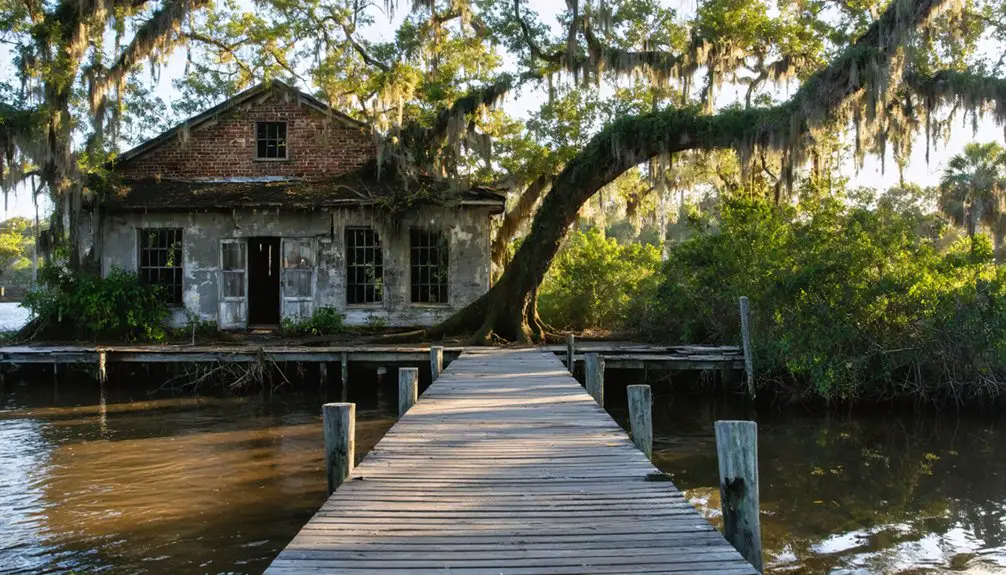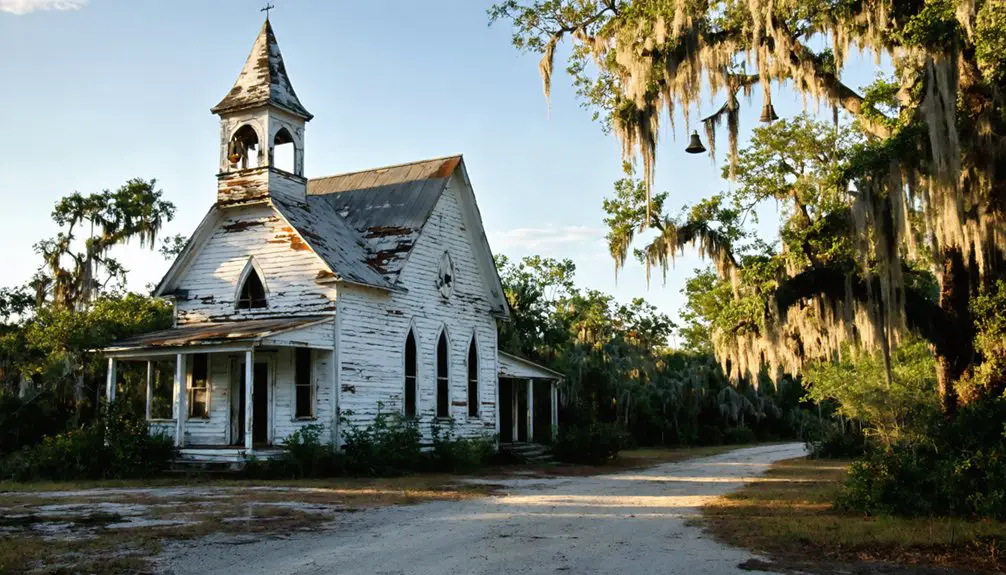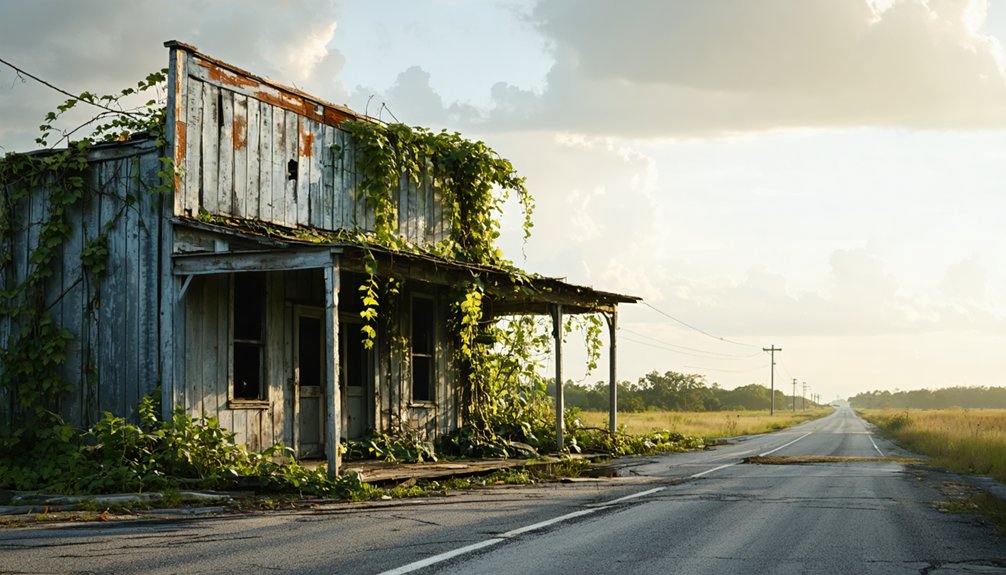
Planning a ghost town road trip to Sardis, Florida means heading to Manatee County, where this 1850s settlement has all but vanished—except for its cemetery. You’ll find it north of Clay Gully Road and west of M&J Road, tucked inside a working sod farm. There’s no signage, so bring GPS. Your standard 2WD vehicle handles the route just fine. Visit between November and March for the best experience, and keep scrolling to uncover everything you need for the trip.
Key Takeaways
- Sardis Cemetery, located north of Clay Gully Road and west of M&J Road, is the only remaining landmark of this 1850s Manatee County settlement.
- No signage exists at the site, so bring GPS coordinates and maps to navigate through the working sod farm entrance.
- Standard 2WD vehicles are sufficient; take the first left after the sod farm entrance to reach the cemetery.
- Visit between November and March, preferably early morning, to avoid Florida’s intense heat and humidity.
- Pair your visit with Gamble Plantation Historic State Park, Lake Manatee State Park, and Manatee Village Historical Park for a fuller regional experience.
What Was Sardis, Florida?
Before Florida filled in with highways and suburbs, small communities like Sardis quietly took root across the state. Sardis established itself in Manatee County during the 1850s, built around faith and community. Residents gathered under a palmetto-roofed shelter before constructing a proper church and school west of what became the town cemetery.
You won’t find much standing today. Ghost town abandonment claimed Sardis gradually, leaving behind only its cemetery as proof that people once lived, worshipped, and buried their dead here. No commercial buildings survived, no town square remains.
What you’re visiting is fundamentally a piece of historical preservation in its simplest form — a burial ground that outlasted everything else. Sardis is a quiet reminder that Florida’s past runs far deeper than its modern surface suggests.
Where Exactly Is Sardis Located?
You’ll find Sardis tucked away in Manatee County, Florida, with no signs guiding you there. To locate it, you’ll use two road landmarks: Clay Gully Road to the south and M&J Road to the east, placing the site to the northwest of their intersection.
Your actual entry point runs through a sod farm’s main entrance, where you’ll take the first left turn to reach the Sardis cemetery.
Manatee County Ghost Town
Where exactly do you go when a ghost town leaves almost no trace? Head to Manatee County, Florida, where Sardis quietly fades into sod farm territory. You won’t find dramatic urban decay or carefully managed ghost town preservation efforts here.
What you’ll find is a cemetery, a dirt road, and a slice of Florida history dating back to the 1850s.
Sardis sits north of Clay Gully Road and west of M&J Road. You’ll access the site through a sod farm’s main entrance, then take the first left toward the cemetery. It’s a straightforward drive requiring no off-road vehicle.
The land won’t announce itself, so bring a map or GPS and trust the road landmarks over any signage.
Key Road Landmarks
Pinpointing Sardis means paying close attention to two intersecting road names: Clay Gully Road and M&J Road. The site sits north of Clay Gully Road and west of M&J Road in Manatee County — no grand signage marks these historic landmarks, so your navigation skills matter.
Use these key waypoints to stay on track:
- Locate the intersection of Clay Gully Road and M&J Road first.
- Look for the sod farm’s main entrance as your primary marker.
- Take the first left turn after entering to reach the cemetery.
- Expect no visible abandoned ruins or formal trailheads nearby.
- Save GPS coordinates before leaving home since roadside signage is absent.
Treat these landmarks as your personal treasure map — miss one detail, and you’ll drive right past history.
Sod Farm Access
Getting to Sardis means steering through a working sod farm rather than following a clearly marked historic site. You’ll enter through the sod farm’s main entrance, then take the first left turn to reach the cemetery. No grand signage marks the way, so trust your landmarks and stay alert.
That understated access actually reflects the site’s character. Sardis survives today primarily through cemetery preservation rather than standing structures, making this quiet corner of Manatee County easy to overlook.
Yet its historical significance stretches back to the 1850s, when early settlers gathered beneath palmetto-roofed shelters to worship and bury their dead.
Treat the working farm with respect, stick to the established route, and you’ll reach one of Florida’s most unassuming but genuinely compelling ghost town remnants.
What Survives at Sardis: The Cemetery and Little Else
Though Sardis once gathered a community under palmetto-roofed shelters and eventually built a church-school west of its burial ground, what’s left today is fundamentally just the cemetery. No abandoned structures remain to explore, and local legends have largely faded alongside the town itself. Still, the site rewards a curious traveler.
Here’s what you’ll find on-site:
- A quiet cemetery serving as the sole surviving landmark
- No standing buildings or commercial remnants
- A sod farm setting that now frames the historic ground
- Minimal physical footprint requiring little exploration time
- A compelling sense of a community erased by time
You’re essentially visiting a burial ground, not a townsite. Keep that expectation clear, and the stop becomes a meaningful, unhurried moment of historical reflection.
How to Get to the Sardis Cemetery
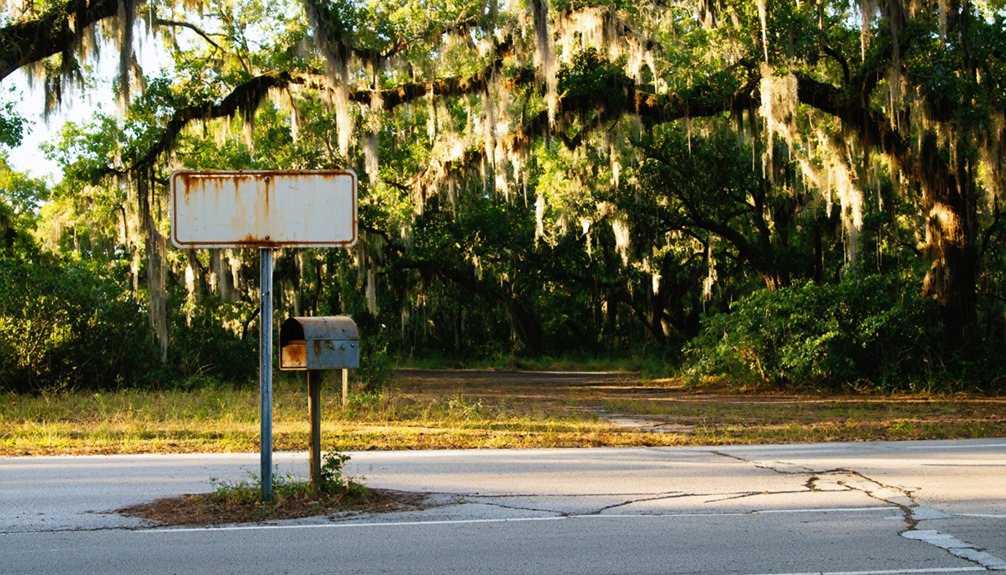
Finding the Sardis cemetery takes a bit of local knowledge since there’s no roadside signage pointing the way. You’ll head to Manatee County and locate Clay Gully Road, positioning yourself north of it, then west of M&J Road. Your entry point runs through the main entrance of a working sod farm, so you’re orienteering active private land rather than a maintained historic site.
Once inside, take the first left turn and you’ll reach the cemetery. A standard 2WD vehicle handles the route fine, so you don’t need a specialized rig.
Keep in mind that preservation challenges mean historical artifacts here are fragile and unprotected, so tread carefully. A GPS helps since road landmarks replace any formal directional markers at this largely forgotten site.
Vehicle Access, Heat, and Cemetery Etiquette at Sardis
You don’t need a truck or SUV to reach Sardis — a standard 2WD vehicle handles the route just fine.
If you’re visiting in summer, pack water and plan for intense Florida heat, since the site offers little shade.
Once you’re at the cemetery, move quietly, stay on clear paths, and treat the grounds with the respect owed to any active burial site.
Standard Vehicle Access Works
Unlike many Florida ghost towns tucked behind rutted dirt paths, Sardis doesn’t demand a specialized vehicle—a standard 2WD car handles the route just fine. That accessibility makes historical preservation easier for everyday explorers who want to connect with local legends without needing specialized equipment.
Follow these practical access tips before you go:
- Enter through the main sod farm entrance off Clay Gully Road
- Take the first left turn toward the Sardis cemetery
- Navigate using road landmarks, not signage—bring GPS
- Confirm the route sits north of Clay Gully Road, west of M&J Road
- Keep your car on established paths to respect the surrounding land
You’re free to visit on your own schedule without coordinating an off-road rig.
Summer Heat Demands Preparation
Florida summers are brutal, and if you’re planning a trip to Sardis, the heat isn’t something you can afford to ignore. The site sits on open land where shade is minimal and the sun hits hard. Bring water, wear light clothing, and plan your visit for early morning when temperatures are manageable.
The surrounding local flora adds a layer of beauty to the experience, but it also traps humidity close to the ground. Stay alert for wildlife sightings — snakes and insects are active in warm months and share this territory freely.
Watch where you step, especially near the cemetery’s older sections. The freedom to explore a forgotten place like Sardis comes with the responsibility to respect both the land and its history.
Respectful Cemetery Visitor Conduct
Sardis cemetery deserves the same quiet respect you’d offer any active burial ground, so keep your behavior measured from the moment you pull through the sod farm entrance. Its cultural significance runs deep, rooted in 1850s community life, and preservation challenges mean every visitor either helps protect or quietly damages what little remains.
- Stay on established paths and avoid stepping directly on grave markers
- Don’t remove, reposition, or photograph artifacts for social media spectacle
- Leave no trash behind — pack everything out
- Keep voices low and machinery, including drones, grounded
- Document what you see through notes or respectful photos, then share responsibly
Your conduct shapes whether this fragile site survives future visits. Treat it as sacred ground, not a backdrop.
Best Time to Visit Sardis, Florida
Although ghosttowns.com lists Sardis as visitable anytime, you’ll want to think carefully about Florida’s brutal summer heat before planning your trip. Temperatures regularly climb past 90°F with suffocating humidity, making even a short cemetery walk genuinely uncomfortable. That heat also accelerates preservation challenges for any remaining ghost town architecture, weathering old markers and structural remnants faster each season.
Instead, aim for late fall through early spring, roughly November through March, when cooler temperatures and lower humidity make outdoor exploration far more enjoyable. You’ll move freely, observe details carefully, and spend meaningful time without rushing back to your vehicle.
Early morning visits during shoulder months offer softer light and cooler air. Plan accordingly, pack water regardless of season, and you’ll get the most from this quiet, historically rich stop.
Pairing Sardis With a Manatee County Drive
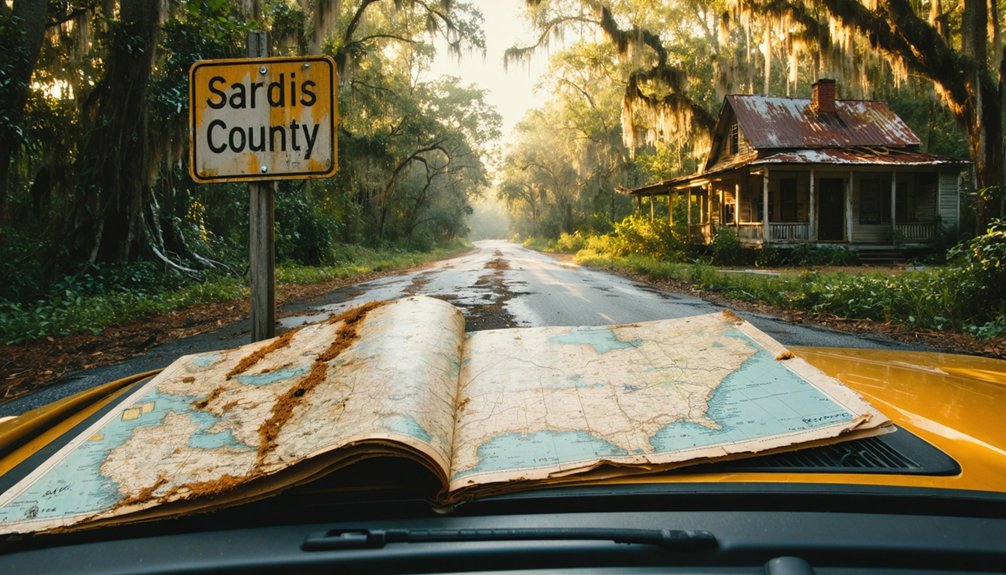
Because Sardis leaves little to explore beyond its cemetery, you’ll want to build it into a broader Manatee County drive rather than treat it as a standalone destination. The region rewards curious travelers chasing historical artifacts and ghost town legends across open roads and rural landscapes.
Pair your Sardis stop with these nearby options:
- Bradenton’s South Florida Museum for regional history and cultural context
- Gamble Plantation Historic State Park for antebellum architecture and preserved grounds
- Lake Manatee State Park for a natural break between stops
- Palmetto’s waterfront district for food and a change of scenery
- Local rural backroads along Clay Gully Road to soak in the same landscape that once surrounded Sardis
String these stops together and you’ve got a full, rewarding day.
Other Manatee County Historical Sites Worth the Detour
Manatee County holds more history than a single ghost town stop can satisfy, so use Sardis as the starting point for a deeper regional exploration.
The Manatee Village Historical Park in Bradenton preserves original frontier-era structures, giving you a tangible connection to the region’s past.
Gamble Plantation Historic State Park tells a layered story tied to preservation efforts that saved one of Florida’s few surviving antebellum mansions.
Both sites reward curious travelers who want more than roadside markers.
You’ll also find that local communities carry urban legends tied to forgotten settlements, vanished homesteads, and burial grounds similar to Sardis itself.
Talk to residents, check county historical society archives, and map your own route.
Manatee County rewards those willing to look beyond the obvious tourist trail.
Where to Find Reliable Florida Ghost Town Records

Tracking down solid records on Florida ghost towns takes some digging, but a few reliable sources cut the research time considerably.
For Sardis specifically, historical documentation remains thin, so cross-referencing multiple platforms strengthens your research.
Preservation efforts vary by site, but these sources consistently deliver useful data:
- Ghosttowns.com – provides road access notes, climate details, and brief histories
- Wikipedia’s ghost town lists – confirms county-level location data
- Florida State Archives – holds deed records, early settlement maps, and census data
- Local county historical societies – often maintain unpublished materials on smaller communities
- Florida Memory Project – digitizes photographs, newspapers, and documents tied to vanished towns
Use these together and you’ll build a clearer picture before you ever leave the driveway.
Frequently Asked Questions
Is the Sardis Cemetery Open to the Public or Privately Owned?
The site sits on private sod farm land, so you’ll want to respect access boundaries. Its historical significance and local legends make it worth exploring, but always seek permission before venturing onto privately managed property.
Are There Any Fees or Permits Required to Visit Sardis?
Like stumbling onto a forgotten trail, no known fees or permits stand between you and Sardis’s historical landmarks. You’ll want permission from the sod farm, though — respect opens doors that local legends say time sealed shut.
Does the Sod Farm Require Advance Permission Before Visitors Enter?
The available sources don’t confirm whether farm access requires visitor permission. You’d be wise to contact the sod farm directly before heading out, ensuring you’re free to explore Sardis cemetery without unexpected setbacks.
Are Any Sardis Cemetery Burial Records Available Online for Research?
You won’t find confirmed digital archives for Sardis cemetery, but you can explore burial documentation through FamilySearch, FindAGrave, and Florida state genealogical databases—they’re your best free tools for uncovering pioneer-era records independently.
Has Sardis Ever Been Considered for Any Historic Preservation Designation?
No documented evidence shows Sardis has received a historic preservation designation. You’ll find its historic significance lies in its cemetery remnant, but formal preservation efforts haven’t visibly emerged in available records, leaving this ghost town notably unregulated.
References
- https://www.instagram.com/reel/DQIG3WnjyQu/
- https://floridatrailblazer.com/tag/ghost-towns/
- https://www.ghosttowns.com/states/fl/sardis.html
- https://en.wikipedia.org/wiki/List_of_ghost_towns_in_Florida
- https://www.ghosttowns.com/states/fl/fl.html
- https://patchproflorida.com/blog/the-fascinating-history-of-floridas-ghost-towns/