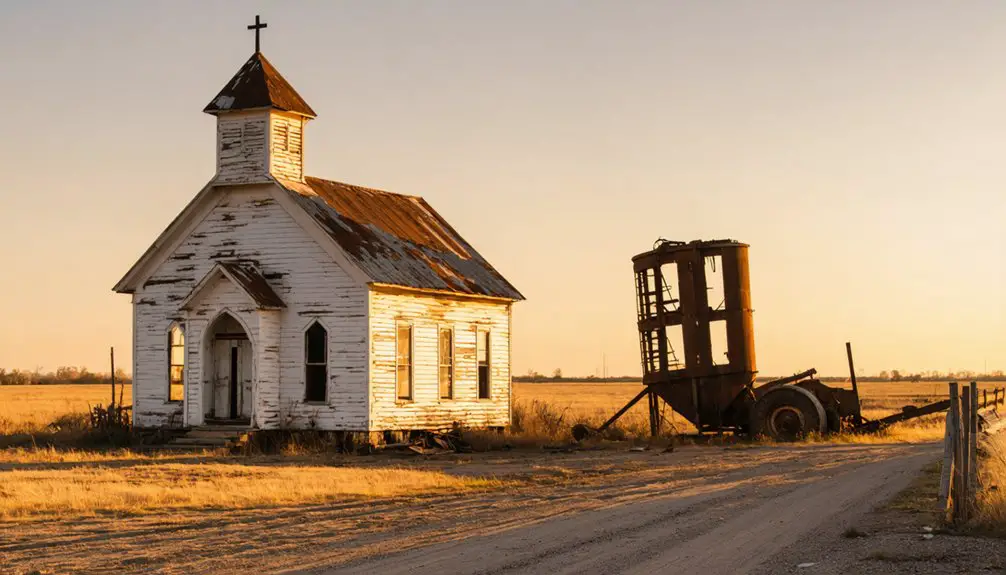
Starting your Sumpter, Oklahoma ghost town road trip from McAlester, you’ll head southeast toward Wilburton, winding past Lake Eufaula’s western shoreline until weathered markers near Adamson’s monument come into view. What’s left here tells a raw, honest story of gold fever and frontier survival, from crumbling facades to original settlers’ graves. Visit in spring or early fall for the clearest roads and best light. There’s far more to uncover about this forgotten Oklahoma wilderness town.
Key Takeaways
- Sumpter features key landmarks like old dredge machinery, weathered timber buildings, a railroad depot, and cemetery grounds with original settlers’ markers.
- The best times to visit are spring and early fall for mild weather, or late September to October for an eerie atmosphere.
- Pack sturdy boots, water, a flashlight, offline navigation tools, and a camera; never explore unstable structures alone.
- From McAlester, head southeast toward Wilburton, watching for markers near Lake Eufaula’s western shoreline to locate Sumpter’s remaining landmarks.
- Extend your trip by visiting nearby ghost towns like Picher, Oklahoma, or Whitney, Oregon, for contrasting ghost town experiences.
What Kind of Ghost Town Is Sumpter, Oklahoma?
While ghost towns vary from completely vanished settlements to small, still-breathing communities, Sumpter, Oklahoma falls somewhere in the middle of that spectrum — a place where history lingers in crumbling structures and quiet streets rather than disappearing entirely beneath the earth or water.
You’ll find that historical preservation here isn’t just bureaucratic — it’s personal, driven by locals who refuse to let the past dissolve. Local legends weave through abandoned doorways and weathered facades, giving you more than ruins to explore.
Unlike Oklahoma ghost towns swallowed by lake expansions or evacuated by environmental disaster, Sumpter offers you something tangible to walk through, photograph, and absorb. It’s the kind of place that rewards the curious traveler who craves authentic history over polished tourism.
What Structures and Landmarks Survive in Sumpter Today
Though time has stripped Sumpter down to its bones, what remains still tells a vivid story. You’ll find surviving fragments of historical architecture that reward curious explorers willing to make the drive.
Preservation efforts have kept these landmarks accessible:
- The old dredge machinery stands frozen mid-operation, a rusting monument to gold fever
- Several weathered timber structures line the main corridor, still upright against the Oregon elements
- The Sumpter Valley Railroad depot anchors the town’s identity with restored railcars nearby
- Cemetery grounds hold original settlers’ markers dating back generations
Walk these remnants and you’ll feel the weight of lives built and abandoned here. Nothing’s staged for tourists — it’s raw, honest history sitting quietly in the Elkhorn Mountains, waiting for you to discover it on your own terms.
The Best Time of Year to Visit Sumpter
Knowing what you’ll find when you arrive is only half the equation — knowing *when* to show up makes all the difference. Sumpter rewards those who plan smart.
Timing isn’t just strategy — it’s the difference between experiencing Sumpter and simply surviving it.
Spring and early fall deliver the sharpest seasonal weather — mild temperatures, clear skies, and roads that cooperate after winter’s punishment.
Summer pulls tourist crowds toward Oregon’s ghost town corridor, meaning you’ll share the silence with strangers. That defeats the purpose.
Late September through October strips the landscape bare in the best way, amplifying the eerie stillness that defines abandoned places.
Winter closes roads near Larch Summit, cutting off access entirely.
If you crave unfiltered freedom and raw historical atmosphere without the noise of crowds, target late spring or early October — the ghost town earns its name then.
How to Get to Sumpter From Mcalester
Leaving McAlester behind, you’ll head southeast toward Wilburton on a stretch of Oklahoma highway that cuts through the same rugged hill country that swallowed dozens of towns whole. Adamson sits midway between both towns, and its historical significance deserves a deliberate stop. Follow these steps:
- Drive southeast from McAlester toward Wilburton.
- Watch for markers near Lake Eufaula’s western shoreline.
- Locate the monument and small cemetery—Adamson’s only architectural remnants.
- Photograph the handful of surviving houses before water reclaims more.
Lake Eufaula has consumed most of Adamson, so what you’re seeing represents a race against time. The road demands your attention here—hills rise sharply, curves tighten unexpectedly. This isn’t passive tourism. You’re chasing what’s left before it disappears completely beneath still, dark water.
What to Pack for an Oklahoma Ghost Town Trip
When you’re heading out to explore Oklahoma’s ghost towns, you’ll want to pack sturdy boots, a first-aid kit, and enough water for a full day on unpaved gravel roads.
Bring a detailed paper map alongside your GPS, since cell service drops out fast in remote stretches of southeast Oklahoma.
A flashlight, compass, and portable battery pack round out the essentials that’ll keep you safe when you’re steering through abandoned structures and isolated terrain.
Essential Gear and Supplies
Packing smart before heading out to Oklahoma’s ghost towns can make the difference between a memorable adventure and a miserable one. These sites carry enormous historical significance, and your preparation directly supports responsible preservation efforts.
Bring these four essentials:
- Sturdy boots — crumbling foundations and uneven terrain demand ankle support
- Water and snacks — remote locations like Adamson offer zero services
- Camera and extra batteries — document abandoned structures before they’re gone forever
- Detailed paper maps — cell service disappears fast in southeast Oklahoma’s hills
You’re stepping into living history, where monuments, cemeteries, and forgotten houses whisper stories of entire communities. Don’t let poor preparation cut your exploration short. Respect the land, travel light, and move freely through Oklahoma’s remarkable abandoned past.
Gear fills your bag, but knowing where you’re keeps you alive out there. Oklahoma’s ghost towns scatter across unpredictable terrain, from Ellis County’s empty cemetery grounds to lake-swallowed Adamson. You’ll want a downloaded offline map — cell service vanishes fast in southeast Oklahoma.
Carry a compass as backup. Paper maps of Pittsburg and Latimer Counties reinforce your digital tools when batteries die. A fully charged GPS device handles the back roads between McAlester and Wilburton without hesitation.
For historical preservation efforts and scenic photography, pack a portable battery bank. You’ll shoot abandoned structures, weathered monuments, and forgotten cemeteries — draining your phone quickly.
A headlamp handles dimly lit interiors safely. Freedom means self-sufficiency, so pack smart, navigate confidently, and let Oklahoma’s forgotten history unfold before you.
Safety Hazards to Know Before Exploring Sumpter
Before you set foot in Sumpter, you’ll want to understand the real risks hiding in its forgotten structures. Its cultural significance makes exploration tempting, but preservation challenges mean decay runs deep.
Watch for these four critical hazards:
- Unstable flooring — Rotted wood collapses without warning beneath your weight.
- Compromised ceilings — Decades of moisture weaken overhead beams dramatically.
- Hidden debris fields — Rusted metal and broken glass hide under overgrowth.
- Wildlife occupation — Abandoned structures shelter snakes, wasps, and rodents.
Wear sturdy boots, carry a flashlight, and never explore alone. These structures aren’t maintained — nobody’s responsible for your safety but you.
Respecting the hazards actually honors Sumpter’s history rather than accelerating its destruction. Freedom here demands personal accountability.
Other Ghost Towns Worth Pairing With a Sumpter Visit
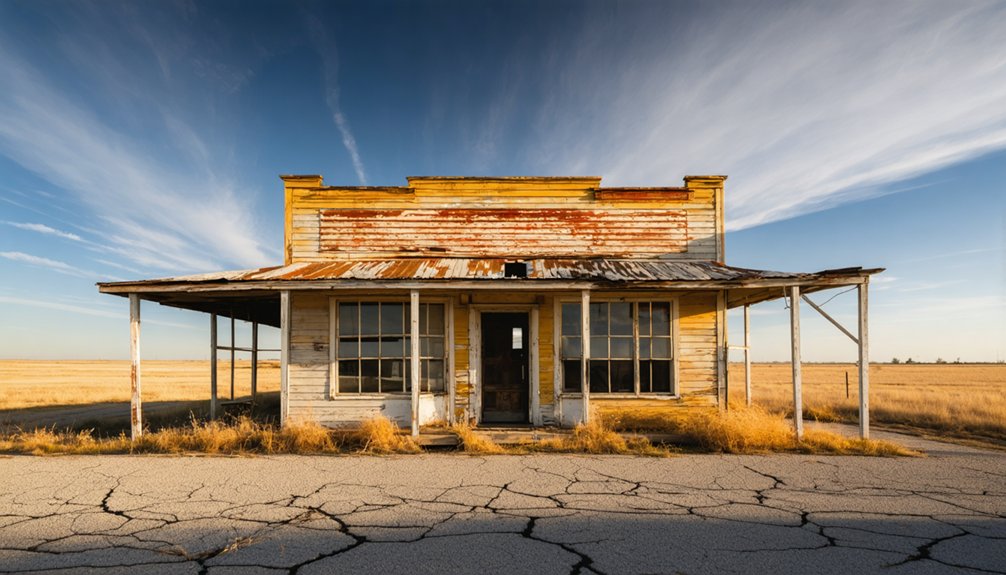
While you’re exploring Oklahoma’s ghost towns, you’ll find several haunting destinations worth adding to your road trip itinerary. Picher, the state’s most recently evacuated ghost town, offers a chilling glimpse into a community abandoned in 2010 due to toxic contamination from the Tar Creek Superfund site.
Pair Sumpter with Picher, and you’ve got a route that spans Oklahoma’s ghost town history from its earliest abandoned settlements to its most modern casualty.
Nearby Ghost Towns Worth Visiting
Sumpter pairs well with Whitney, another ghost town sitting quietly in Eastern Oregon that you can reach by heading south on Highway 410 for 3 miles, then turning right at the T-intersection with Highway 7 and following it for 9.7 miles before making a final left onto North Fork Burnt River Road. Whitney’s cultural significance and historical preservation make it a worthy detour after Sumpter.
Pack your route with these stops:
- Larch Summit – Crest 5,082 feet before descending into Whitney’s valley
- Whitney townsite – Walk abandoned foundations carrying frontier memory
- North Fork Burnt River corridor – Follow gravel roads through raw Oregon wilderness
- Sumpter historic core – Anchor your journey where gold dredges once churned
Both towns reward curious, freedom-seeking travelers willing to explore roads less traveled.
Pairing Sumpter With Picher
Oklahoma’s ghost town circuit adds a completely different dimension to your road trip when you bring Picher into the picture. Once a booming lead and zinc mining hub, Picher carries enormous historical significance as Oklahoma’s most recently evacuated ghost town, abandoned in 2010 after the Tar Creek Superfund contamination made the land uninhabitable.
You’ll find abandoned duplex units standing as hollow reminders of a community forced out by environmental catastrophe rather than economic decline.
Preservation challenges hit Picher harder than almost anywhere else in the state. Toxic chat piles still dominate the landscape, and structural decay accelerates yearly.
Pairing this devastated industrial ruin with Sumpter’s quieter story creates a powerful contrast on your itinerary, showing you two entirely different ways a thriving town can simply cease to exist.
Ghost Towns Near Sumpter You Can Reach the Same Day
If you’re already exploring Sumpter, you can extend your road trip to Whitney, another ghost town sitting in the valley just 12.7 miles south. Its cultural significance lies in its raw, untouched isolation. Preservation efforts remain minimal, making every visit feel like genuine discovery.
Follow these directions from Sumpter:
- Head south on Highway 410 for exactly 3 miles
- Turn right at the T-intersection onto Highway 7
- Follow Highway 7 for 9.7 miles toward Whitney
- Turn left onto North Fork Burnt River Road and descend into the valley
You’ll crest Larch Summit at 5,082 feet before dropping into Whitney’s forgotten hollow. These two towns together create a powerful single-day journey through Oregon’s abandoned past.
Frequently Asked Questions
What Is the History of Sumpter Before It Became a Ghost Town?
You’ll find Sumpter’s historical significance rooted in early settlement activity around 1839, when brave pioneers carved out freedom in Oklahoma’s wilderness, building a thriving community before time, neglect, and shifting fortunes ultimately transformed it into today’s hauntingly abandoned ghost town.
Are There Any Guided Tours Available Specifically for Sumpter Ghost Town?
Like a treasure waiting to be unearthed, guided tour options for Sumpter aren’t formally documented, but you’ll find preservation efforts bring history alive as you independently explore its weathered remnants and storied past.
Is It Legal to Take Artifacts or Souvenirs From Sumpter?
Don’t pocket history’s treasures! Artifact theft violates souvenir regulations, stripping future adventurers of Sumpter’s raw, untamed story. You’re free to explore, photograph, and absorb every weathered detail — just leave the remnants exactly where you’ve found them.
Has Sumpter Ever Been Featured in Film or Television Productions?
You won’t find confirmed Hollywood filming or celebrity visits tied to Sumpter’s haunted legacy, but its raw, untamed spirit practically begs for discovery — you’re writing your own adventurous story every time you explore its forgotten, freedom-soaked grounds.
Are There Any Local Legends or Ghost Stories Associated With Sumpter?
No documented local ghost stories or haunted locations exist for Sumpter. Yet, with ghost towns dating back to 1839, you’ll feel Oklahoma’s restless history whispering through every abandoned structure you boldly explore.
References
- https://www.historicsumpter.com/whitney-oregon-ghost-town/
- https://www.travelok.com/articles/oklahomaghosttowns
- https://en.wikipedia.org/wiki/List_of_ghost_towns_in_Oklahoma