Planning a ghost town road trip to Aubry, Kansas means heading to southeastern Johnson County along Highway 169, where open land now swallows what was once a thriving settlement. You won’t find highway markers or preserved buildings here. What you’ll find is Aubry Cemetery on 191st Street, shaded by cedar trees that mark the graves of men killed in Civil War raids. Stick around, and Aubry’s violent, forgotten story gets even more haunting.
Key Takeaways
- Aubry is located along Highway 169 in southeastern Johnson County, Kansas, with no highway markers indicating its former streets.
- The Aubry Cemetery on 191st Street serves as the primary and most tangible evidence of the town’s existence.
- Cedar trees at the cemetery mark the burial site of three men killed during Quantrill’s 1862 raid.
- Open land now occupies where the town once stood, with no preserved buildings or commercial activity remaining.
- Aubry’s violent Civil War history, including Quantrill’s raids, makes it a historically significant ghost town worth visiting.
The Civil War Raids That Erased Aubry, Kansas
Aubry’s story didn’t just fade quietly into history — it was violently ripped apart by Civil War raiders who turned this small Kansas border town into one of the bloodiest flashpoints of the era.
Quantrill’s forces struck on March 7, 1862, killing three men, looting homes, and burning property.
Three years later, Dan Vaughn’s guerrillas returned, murdering a traveler and torching more houses. Missouri’s proximity made Aubry a repeated target, earning it a reputation as the border’s most dangerous ground.
Even the devastating Lawrence Massacre of 1863 connected to Aubry’s legacy — a local warning went ignored, costing 200 lives.
These Civil War impacts didn’t just traumatize residents; they systematically destroyed the town’s foundation, driving people away and making recovery nearly impossible.
What Quantrill’s Route Through Aubry Left Behind
When Quantrill’s raiders thundered down the Military Road into Aubry, they didn’t just kill and loot — they carved a scar into the landscape that you can still trace today.
Quantrill’s Legacy lives in the cedar trees marking where three 1862 victims were buried, now the heart of Aubry Cemetery on 191st Street.
Three cedar trees still stand sentinel over Aubry Cemetery, silent witnesses to 1862’s violence on 191st Street.
Aubry’s Impact extended beyond body counts.
Repeated raids drove off horses, destroyed homes, and strangled any economic future the town might’ve claimed. Residents couldn’t build what raiders kept burning.
That vulnerability ultimately made Aubry invisible — no railroad came, no commerce survived, no town remained.
When you stand at that cemetery today, you’re standing where freedom failed under threat of violence, and where a community’s story effectively ended before it ever fully began.
Where Aubry Stood: and How to Find It on Highway 169
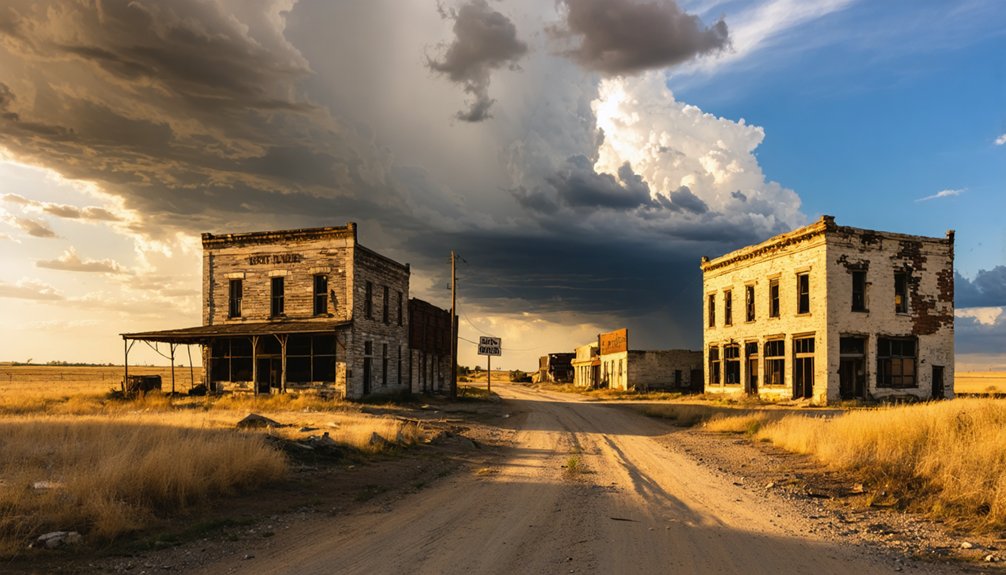
Finding Aubry today means driving Highway 169 through southeastern Johnson County and accepting that almost nothing marks where the town once stood.
No highway markers point to its former streets, and no preserved buildings signal the Aubry location where 50 residents once lived under constant threat of raid.
What you’ll find instead is open land, a stretch of road, and the quiet weight of a place history swallowed whole.
The old filling station that once occupied the site is gone too, leaving only the pavement beneath your tires as evidence that people once chose this spot to build something.
Your best confirmation that you’re in the right place comes from Aubry Cemetery, just off 191st Street, where those cedar trees still stand.
The 1862 Cedar Tree Graves at Aubry Cemetery
Three men killed during Quantrill’s 1862 raid on Aubry were buried beneath cedar trees at the southwest corner of 191st Street, and those same trees still stand today, marking the spot where the cemetery quietly took root.
That cedar tree history carries real weight — those roots anchored a burial ground from one of the border war’s darkest moments.
When you visit, you’re standing where terrified residents laid their dead after raiders swept through, looted homes, and vanished back across the Missouri line.
The cemetery significance extends beyond those three graves; it’s the most tangible proof that Aubry ever existed.
Nothing else survived — no buildings, no markers downtown, no streets.
But this ground held, and it still gives you something solid to stand on.
Other Johnson County Ghost Towns Shaped by Border War Violence
Aubry wasn’t the only Johnson County settlement that border war violence quietly erased from the map. The Border Wars left a trail of abandoned dreams across this region, reshaping town history in ways you can still trace today.
Free-Soiler communities clashed repeatedly with Border Ruffians, and settlements that refused to surrender their ideals often paid the ultimate price — desertion, destruction, and erasure.
As you explore Johnson County’s ghost towns, you’ll notice a pattern: proximity to the Missouri border meant constant vulnerability.
Raids destroyed property, scattered populations, and stripped away any economic momentum a young town had built. What raiders didn’t burn, fear eventually emptied.
These forgotten settlements remind you that the freedom settlers sought came at an extraordinary, often devastating cost.
Frequently Asked Questions
Who Was the Traveler Aubry That the Town Was Named After?
The knowledge doesn’t reveal the traveler’s full identity, but Aubry history tells you he’s a notable figure wrapped in town legends. You’ll want to dig deeper into local historical records to uncover his fascinating story!
What Was William H. Brady’s Background Before Settling in Aubry?
The knowledge doesn’t detail Brady’s heritage or Brady’s influences before 1857. You’d find pioneers like him driven by frontier freedom—claiming land, building futures. His February 22, 1857 arrival marks Aubry’s founding, but his backstory remains historically undocumented here.
Can Visitors Access Aubry Cemetery Year-Round Without Restrictions?
You’ll find Aubry Cemetery accessible year-round with no strict visitor guidelines restricting your exploration. Cemetery hours aren’t formally posted, so you’re free to visit anytime, paying respects to those cedar-shaded graves from the 1862 Civil War raids.
Are There Guided Tours Available for Ghost Town Exploration Near Stilwell?
“The best adventures find you unprepared!” No formal guided tours exist near Stilwell, but you’ll uncover ghost town legends and historical significance by exploring Johnson County’s self-guided historical markers, Aubry Cemetery, and Highway 169’s freedom-rich heritage independently.
What Happened to Aubry’s Residents After the Town Finally Declined?
After Aubry’s decline, you’ll find that resident migration carried most settlers eastward to Stilwell, which absorbed the town’s remnants. Aubry history shows survivors sought stability beyond repeated raids, railroad bypass, and fading prosperity.
References
- https://legendsofkansas.com/aubry-kansas/
- https://johnsoncoks.cottonhills.net/historic-records/old-towns.html
- https://www.jocohistory.org/digital/custom/aubrystilwell
- https://lostkansas.ccrsdigitalprojects.com/sites/lostkansas/files/private_static/2022-12/LT_JO_Aubry_Edwards.pdf
- https://legendsofkansas.com/stilwell-kansas/
- https://metrovoicenews.com/ghost-towns-of-kansas-city/