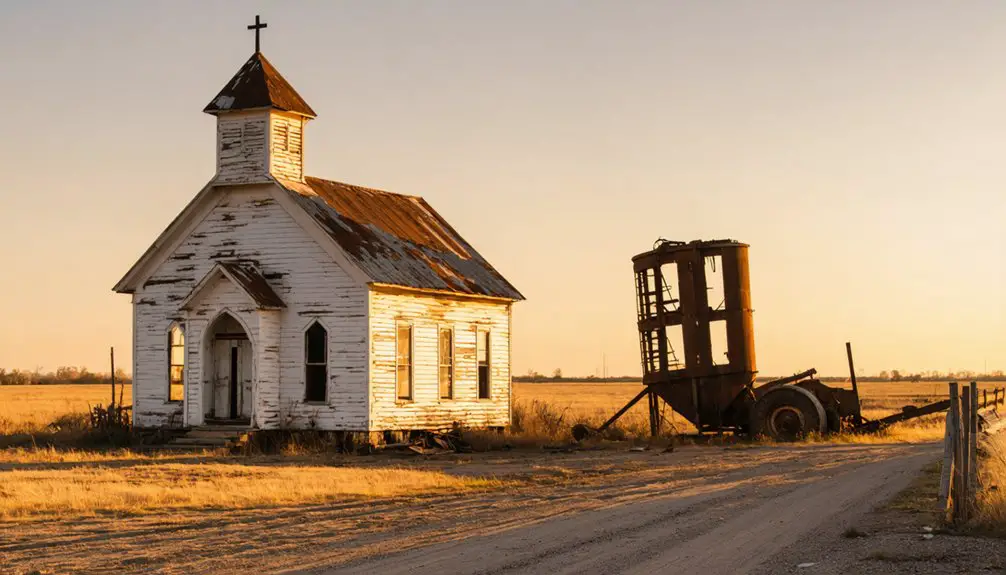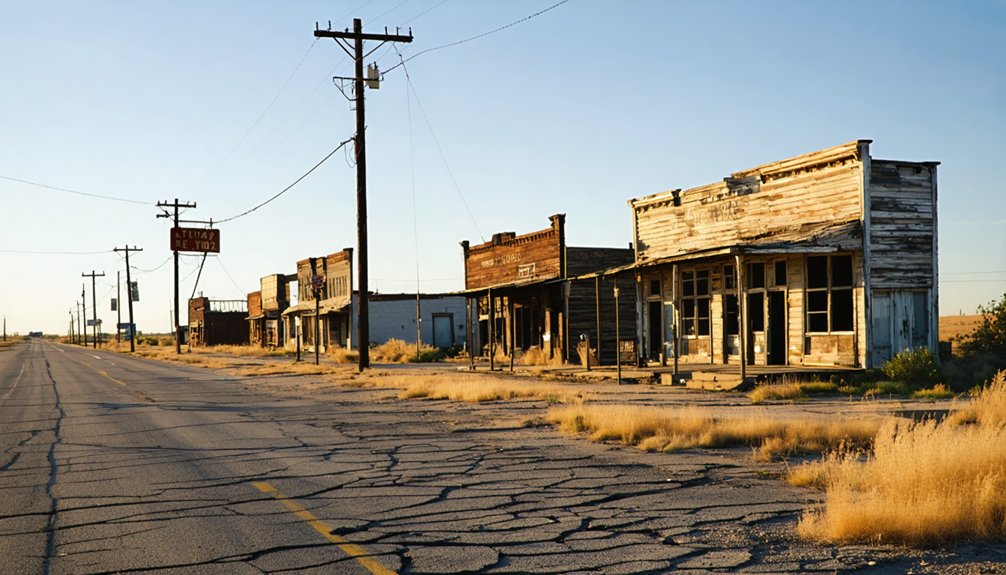
Planning a ghost town road trip to McGee, Oklahoma means trading tourist traps for the real thing. This vanished Garvin County community once buzzed with life during the Chickasaw Nation era, witnessed Oklahoma’s first known Caesarean section, and survived outlaw violence. Today, only the McGee Cemetery remains, quietly holding the town’s entire history. Bring water, sturdy shoes, offline maps, and a sense of curiosity — there’s far more to this forgotten place than meets the eye.
Key Takeaways
- McGee, Oklahoma, located north of Stratford in Garvin County, was once a thriving Chickasaw Nation-era community now considered an authentic ghost town.
- The McGee Cemetery, situated at the southeast edge of the former town site, is the only remaining landmark of this vanished community.
- Bring water, sturdy shoes, offline maps, and GPS coordinates, as signage is minimal and cell service may be unreliable.
- Visit during morning hours for optimal photography conditions and navigate using Garvin County maps to locate the unmarked site.
- Combine your McGee visit with nearby Garvin County ghost towns for a full day of exploring Oklahoma’s forgotten history.
What Makes McGee, Oklahoma Worth the Drive?
McGee, Oklahoma checks every box for history enthusiasts craving an authentic ghost town experience — not the romanticized, tourist-friendly kind, but the raw, quietly haunting kind.
McGee history runs deep, stretching back to the Chickasaw Nation era in Indian Territory, where a thriving community once stood north of present-day Stratford in Garvin County.
McGee’s roots reach back to the Chickasaw Nation era, when a real community thrived in Indian Territory.
You won’t find staged attractions or gift shops here. What you’ll find is the McGee Cemetery, a silent guardian marking ground where real lives unfolded.
Ghost town exploration here means standing where a frontier doctor performed Oklahoma’s first known Caesarean section and where outlaws once terrorized storekeepers.
McGee’s been a ghost town for over sixty years, and that authenticity — unpolished and unfiltered — is exactly what makes the drive worthwhile.
Geronimo, a Kitchen Table Surgery, and the Outlaws Who Killed Joe Moad
Few ghost towns carry stories as gripping as those buried in McGee’s past. When you stand near this forgotten site, you’re standing where Dr. Jesse Mooney once practiced frontier medicine under extraordinary circumstances.
In August 1896, he performed what’s believed to be Oklahoma’s first Caesarean section on a kitchen table inside a dugout.
Then, in February 1897, military escorts brought him to Fort Sill for Geronimo’s treatment, where he successfully battled double pneumonia threatening the famous warrior and his three children.
McGee’s darker history includes outlaw encounters that turned fatal. In 1897, unknown outlaws killed Joe Moad while attempting to burglarize his store, reminding you that frontier life balanced remarkable human achievement against very real danger.
These layered stories make McGee unforgettable.
What’s Actually Left at the McGee Ghost Town Site?
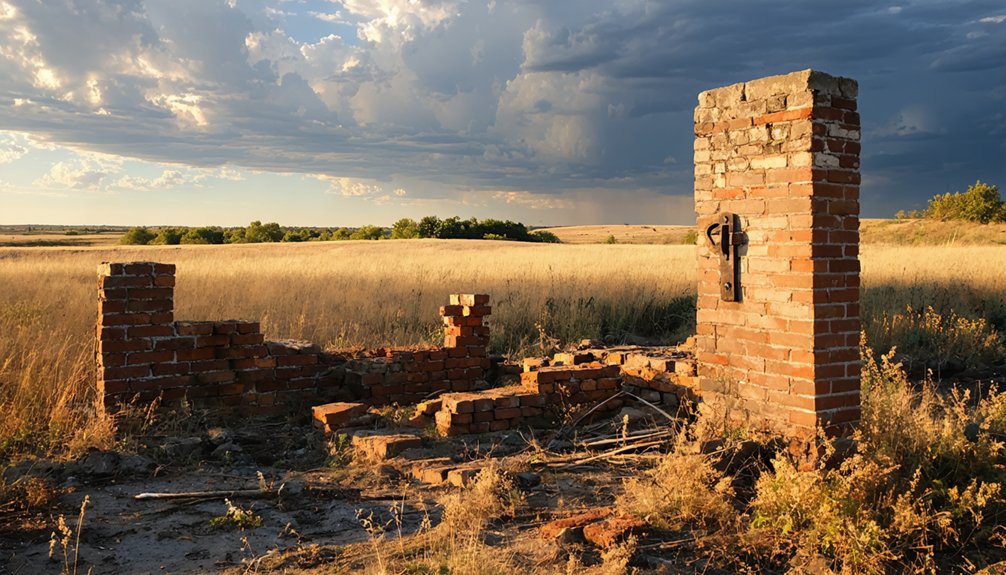
When you make the trip to the McGee town site north of Stratford, don’t expect much — the McGee Cemetery at the southeast edge of the former town is fundamentally all that’s left standing as a tangible witness to the community’s past.
You won’t find a single original structure from the town itself, as the buildings, dugouts, and storefronts have long since vanished from the landscape.
Even the historical records, photographs, and firsthand memories that once preserved McGee’s story are fading fast as the last survivors who knew the town pass on.
McGee Cemetery Remains
Of McGee’s once-bustling storefronts, sawmill, and dugout homesteads, only the cemetery at the southeast edge of the former town site still stands as a tangible witness to the community’s existence.
This quiet patch of ground holds the cemetery history of everyone who built, traded, and survived here during the Chickasaw Nation era.
When you walk among the headstones, you’re standing where McGee’s story actually ended. Ghost stories may swirl around abandoned places, but McGee’s haunting is quieter — it’s the absence itself that unsettles you.
No crumbling foundations, no weathered storefronts, just graves marking lives that shaped Indian Territory.
Bring water, wear sturdy shoes, and expect solitude. The cemetery doesn’t announce itself dramatically, but it rewards visitors who appreciate history’s unfiltered, unvarnished truth.
No Standing Structures
Beyond the cemetery fence, McGee gives you nothing — no crumbling walls, no rusted hinges, no trace of the sawmill that once supplied lumber for Dr. Jesse Mooney’s first drugstore. The land has reclaimed everything.
That erasure is itself part of McGee’s ghost town history. You’re standing where a functioning community once refused railroad agents’ demands, where outlaws murdered Joe Moad, where a frontier surgeon performed Oklahoma’s first known Caesarean section nearby. None of that leaves a physical mark today.
McGee’s significance lives entirely in recorded history, cemetery headstones, and the imagination you bring to open ground. Walk the perimeter, study the landscape, and let the absence speak.
Sometimes a ghost town’s most honest feature is exactly what it can no longer show you.
Fading Historical Records
What remains of McGee exists almost entirely on paper. You won’t find interpretive signs or museum displays here — just fading memories slowly disappearing as McGee’s last living connections pass on.
Historical preservation efforts keep this town’s story alive through scattered documents and photographs.
Here’s what survives in the historical record:
- Early photographs of McGee’s prominent citizens
- Records documenting Dr. Jesse Mooney’s groundbreaking medical achievements
- Documentation connecting McGee to early Stratford history
- Genealogy archives referencing families who lived within the town’s boundaries
- Written accounts of Joe Moad’s 1897 murder and other notable events
Dig into Oklahoma territorial archives before your visit. You’ll arrive with a richer understanding of the lives once lived where empty land now stretches before you.
How to Find McGee When There’s Almost Nothing Left
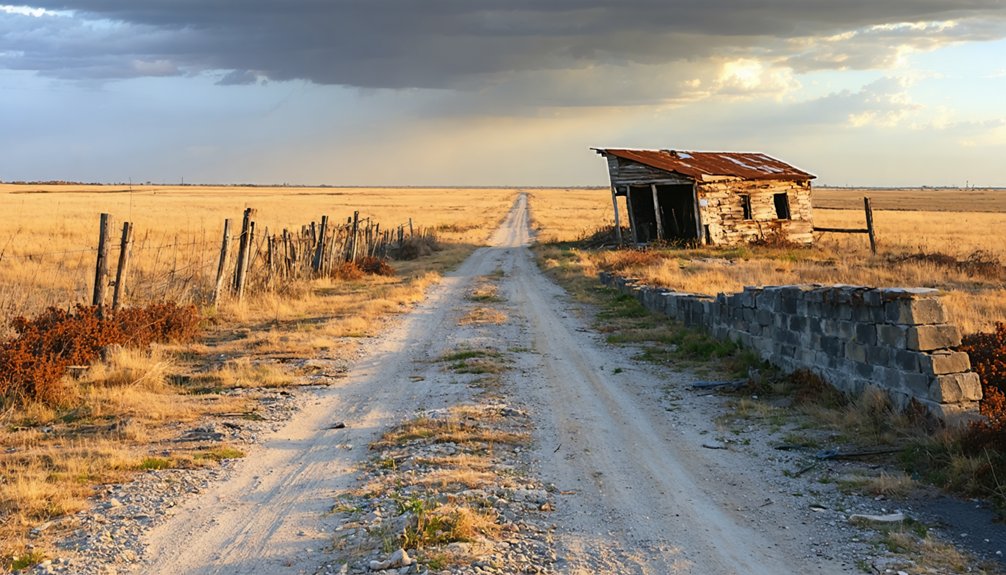
When you’re hunting for a town that’s fundamentally vanished, you’ll need to set your sights on McGee Cemetery at the southeast edge of the former town site as your primary landmark.
Head north of Stratford in Garvin County, Oklahoma, and don’t expect highway signs to guide your way — minimal signage means you’re steering largely by coordinates and local knowledge.
Pull up Garvin County maps before you leave, confirm your GPS coordinates, and accept that the cemetery’s quiet headstones will do most of the storytelling once you arrive.
Cemetery As Your Landmark
Since McGee left behind almost no physical trace of its former self, the cemetery at the southeast edge of the town site becomes your single most reliable landmark. Its cemetery significance runs deep — headstones mark real lives lived during Chickasaw Nation territory days.
Historical preservation here isn’t institutional; it’s personal and quiet.
Use the cemetery as your anchor point and explore freely from there:
- Park respectfully near the cemetery entrance before walking the surrounding area
- Photograph headstones to cross-reference genealogy archives later
- Note the southeast positioning to orient yourself toward the original town footprint
- Bring a paper map since digital signals can be unreliable in rural Garvin County
- Visit during morning hours when light favors photography and temperatures stay manageable
Navigating With Minimal Signage
Finding McGee without signage means you’re steering almost entirely by county road logic and your own preparation.
Pull up Garvin County road maps before you leave, and cross-reference them with the McGee Cemetery location southeast of the original town site. That cemetery becomes your anchor point when pavement fades and landmarks disappear.
Locals occasionally share ghost stories and local legends about McGee, so stopping at Stratford businesses beforehand can yield surprisingly useful directions.
Ask specifically about the cemetery road, not the town itself, since nobody navigates to something that no longer exists.
Trust your odometer, note your turns, and keep your phone charged. Cell service thins out here.
The reward isn’t a dramatic destination, it’s the quiet satisfaction of finding something history almost completely erased.
Garvin County Coordinates
McGee sits north of Stratford in Garvin County, and those two facts are fundamentally your entire roadmap. You won’t find highway markers celebrating local legends or signs announcing historic sites.
What you’ll find is open Oklahoma landscape and the McGee Cemetery at the former town‘s southeast edge — your most reliable landmark.
Use Stratford as your anchor point, then head north. Bring:
- A downloaded offline map before losing cell service
- GPS coordinates for Garvin County’s rural grid roads
- Patience for unmarked intersections
- Research notes connecting ghost towns and local legends
- Cemetery records identifying the McGee site specifically
The cemetery doesn’t just mark a grave — it marks a ghost town‘s entire surviving footprint. That’s your destination.
Garvin County Ghost Towns That Pair Well With a McGee Visit
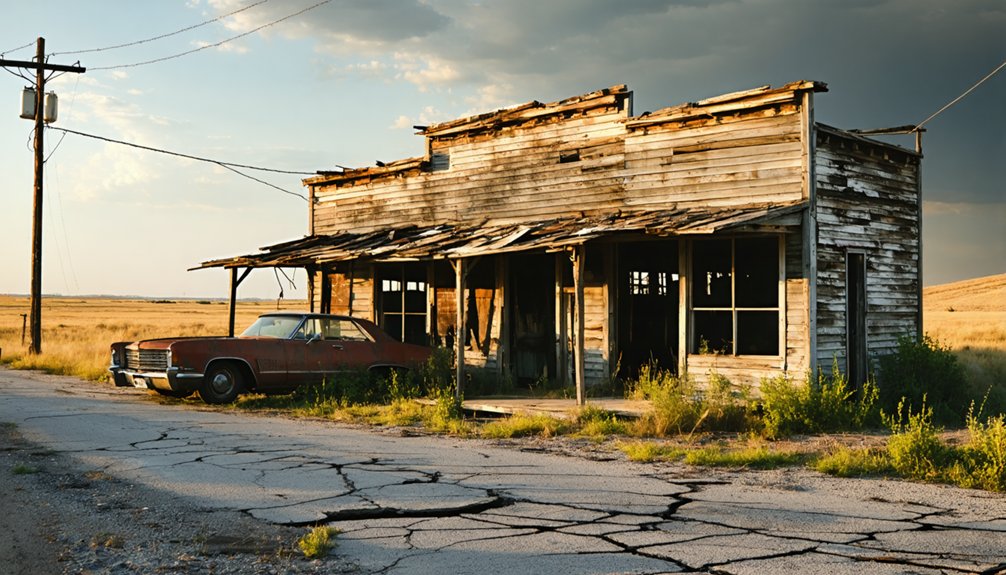
While McGee’s cemetery stands as the sole remaining landmark of that vanished community, Garvin County holds other forgotten towns that’ll round out your ghost town road trip.
This region’s historical significance runs deep, with settlements that rose and fell alongside McGee during Indian Territory’s turbulent era.
Explore nearby communities that share McGee’s story of railroad disputes, economic collapse, and abandonment. Each site carries its own ghost stories and local legends passed down through generations of Garvin County families.
You’ll find overgrown foundations, forgotten cemeteries, and landscapes that whisper of lives once lived there.
Pair your McGee visit with these surrounding ghost towns to build a full day’s adventure. Together, they paint a vivid picture of Oklahoma’s restless, unforgiving settlement history.
What to Pack for a Garvin County Ghost Town Road Trip
Exploring Garvin County’s ghost towns means trading comfort for discovery, so you’ll want to pack smart before you hit the road.
These packing essentials keep you prepared for remote terrain and unpredictable conditions while visiting ghost towns like McGee.
- Navigation tools – Download offline maps since cell service gets spotty in rural Garvin County.
- Water and snacks – No stores exist near abandoned town sites, so bring enough for the full day.
- Sturdy footwear – Uneven ground and overgrown terrain demand solid ankle support.
- Sun protection – Wide-open Oklahoma landscapes offer little shade during warmer months.
- Camera or journal – Capture impressions of the McGee Cemetery and surrounding landscape before memories fade.
Pack light, pack purposefully, and you’ll move freely through Oklahoma’s forgotten history.
Frequently Asked Questions
Was Mcgee Ever Officially Recognized as an Incorporated Town in Indian Territory?
Like a flame that burned bright but left no ash, McGee’s historical significance fades without confirmed town incorporation records. You won’t find official documentation verifying McGee’s formal incorporation status in Indian Territory’s archives.
Are There Any Descendants of Dr. Jesse Mooney Still Living in Oklahoma?
The available records don’t confirm any Mooney legacy descendants still living in Oklahoma. To uncover this family history, you’ll want to explore Garvin County genealogy archives, where you might discover living relatives connected to Dr. Jesse Mooney.
Can Visitors Access Mcgee Cemetery Year-Round, or Are There Seasonal Restrictions?
You’ll find McGee Cemetery accessible year-round without known seasonal restrictions. Visit anytime you’re ready to explore this historic site, where cemetery access connects you directly to McGee’s fascinating frontier past in Garvin County, Oklahoma.
Was Joe Moad’s Killer Ever Identified or Brought to Justice?
Unfortunately, you’ll find no resolution in Joe Moad’s murder investigation — his killers were never identified or brought to justice. This unsolved crime history adds a haunting layer of mystery to McGee’s already enchanting ghost town story.
Did Any Mcgee Residents Relocate to Nearby Stratford After the Town Declined?
The historical records don’t confirm specific Stratford migration details, but you’d find it likely that McGee history shows residents naturally gravitating toward nearby Stratford as economic decline emptied their once-thriving community of opportunity and hope.
References
- http://genealogytrails.com/oka/garvin/towns.html
- https://www.okhistory.org/publications/enc/entry?entry=GH002
- http://mcgeeindianterritory.weebly.com/history-of-mcgee.html
- https://okcfox.com/news/local/oklahomas-secret-past-ghost-towns-of-oklahoma
- https://en.wikipedia.org/wiki/List_of_ghost_towns_in_Oklahoma
- https://www.youtube.com/watch?v=OS2BqmzPplM
- https://www.usbr.gov/history/ProjectHistories/McGee Creek D2.pdf
- https://pocketsights.com/tours/tour/Shamrock-Oklahoma-Ghost-Towns-Creek-Lincoln-Payne-and-Pawnee-Counties-2749