
Planning a Kiamichi ghost town road trip means anchoring your itinerary in Pushmataha County, southeastern Oklahoma, where the Kiamichi Mountains set a hauntingly remote tone. Visit in spring or fall, pack offline maps, sturdy footwear, and extra water since cell service fades fast on county roads. Extend your route to nearby ghost towns like Adamson, Fort Towson, and Red Oak for a fuller picture. Keep scrolling, and you’ll uncover everything you need to make this forgotten corner of Oklahoma unforgettable.
Key Takeaways
- Kiamichi, located in Pushmataha County, southeastern Oklahoma, offers ghost town remnants like overgrown foundations and old roadbeds within a remote mountain setting.
- Anchor your road trip itinerary around Kiamichi, connecting nearby ghost towns like Adamson, Fort Towson, and Red Oak via scenic county roads.
- Spring and fall offer the best visiting conditions, with mild temperatures and colorful landscapes; avoid summer heat and icy winter gravel roads.
- Pack sturdy footwear, offline maps, a camera, and water, as cell service is limited and stops are often roadside markers or field traces.
- Many sites lack standing structures, so approach the trip with patience and curiosity, engaging with the landscape for authentic historical understanding.
Why Kiamichi Belongs on Every Oklahoma Ghost Town List
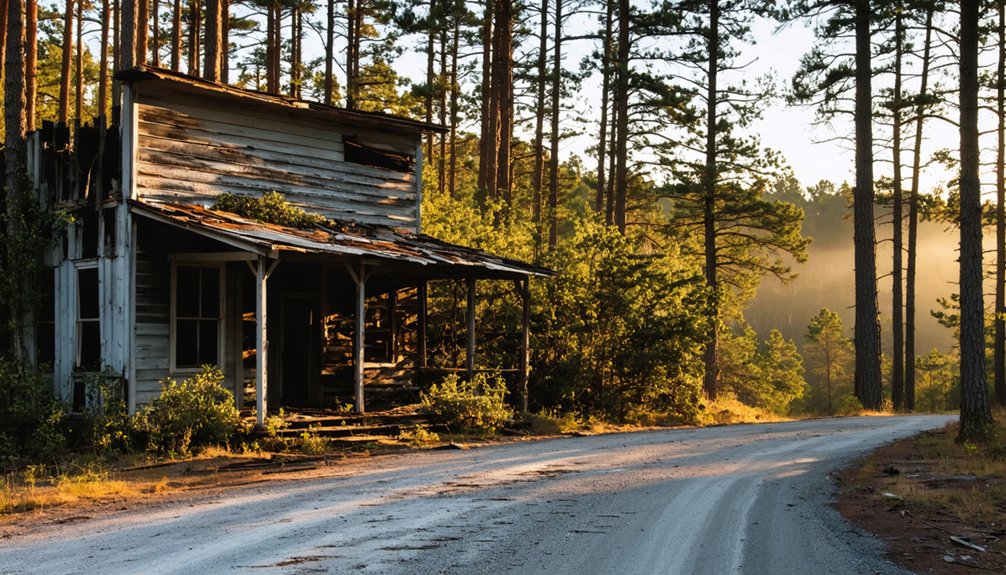
When most people picture an Oklahoma ghost town, they imagine crumbling storefronts or rusted railroad depots frozen in time — but Kiamichi tells a quieter, more layered story.
Most ghost towns offer crumbling storefronts and rusted depots — Kiamichi offers something quieter, stranger, and harder to define.
Tucked into Pushmataha County in southeastern Oklahoma, this forgotten settlement carries Kiamichi history rooted in Indigenous occupation, railroad-era growth, and eventual decline.
You won’t find a Hollywood-style ghost town here. Instead, you’ll discover a place where local folklore and landscape do the heavy lifting.
The surrounding Kiamichi Mountains amplify that atmosphere, wrapping the site in dense timber and river valley terrain that feels genuinely remote.
For travelers who crave authentic history over curated tourist stops, Kiamichi earns its place on every serious Oklahoma ghost town list precisely because it demands something from you — curiosity, patience, and a willingness to look closer.
Where Is Kiamichi, Oklahoma?
You’ll find Kiamichi tucked into Pushmataha County in southeastern Oklahoma, a region defined by dense forests, winding river valleys, and the rugged terrain of the Kiamichi Mountains.
The town sits within a travel corridor that connects landmark communities like Talihina, Stigler, and Fort Towson, making it a natural anchor point for a ghost-town road trip.
Once you orient yourself on a map, you’ll see how the surrounding landscape shaped the settlement patterns that eventually left Kiamichi behind.
Pushmataha County Location
Tucked into the forested hills of southeastern Oklahoma, Kiamichi sits in Pushmataha County — a rugged stretch of terrain shaped by the Kiamichi River and the rise and fall of small resource-dependent communities.
Pushmataha history runs deep here, reflecting cycles of Indigenous occupation, railroad expansion, and economic decline that define Kiamichi significance on Oklahoma’s ghost-town map.
Before you hit the road, know what you’re rolling into:
- County seat is Antlers, your best resupply stop
- Secondary and gravel roads connect most historic sites
- Terrain shifts between dense timber and open river valleys
- Limited cell service on rural county roads
You’re not chasing a theme park version of history here.
You’re driving into a landscape that still carries its past quietly, waiting for you to find it.
Kiamichi Mountains Connection
The Kiamichi Mountains don’t just frame this ghost town — they explain it. Settlers followed these forested routes into southeastern Oklahoma chasing timber, agriculture, and railroad opportunity. When those resources dried up, the towns did too.
You’ll find historical markers scattered along the mountain corridors, each one connecting the landscape to the communities it once sustained. The same terrain that isolated these settlements now rewards you with scenic overlooks and quiet backcountry drives.
Follow the Kiamichi Trails through the ridgelines and river valleys, and you’ll understand why people came here — and why leaving was hard. The mountains didn’t change. The economics did.
That contrast between raw natural beauty and human abandonment is exactly what makes this road trip worth taking.
Nearby Landmark Towns
Kiamichi sits in Pushmataha County in southeastern Oklahoma, anchored by a cluster of historic towns that give you solid reference points for planning your route.
These surrounding communities connect you to historic routes, local legends, and the region’s layered past.
Use these landmark towns as your navigational anchors:
- Talihina – gateway to the Talimena Scenic Drive and mountain corridor
- Stigler – county seat of Haskell County with courthouse-square history
- Red Oak – small crossroads town along older travel corridors
- Fort Towson – former military post preserving frontier-era ruins and stories
Each stop adds context to your trip beyond just chasing ruins.
You’ll move through terrain where railroads, timber operations, and Indigenous history shaped every community you pass through.
How Kiamichi Rose, Faded, and Became a Ghost Town
Kiamichi followed a path common to dozens of southeastern Oklahoma settlements — a brief rise fueled by rail access, agriculture, or timber, followed by a slow unraveling once those economic anchors disappeared.
You’ll find that the town once held enough activity to earn a place on regional maps, but shifting transportation routes and resource depletion gradually pulled residents and commerce away.
What’s left today is a ghost town entry in Oklahoma’s historical record and a stretch of Pushmataha County landscape that tells its story more through absence than through surviving structures.
Settlement and Early Growth
Like many of southeastern Oklahoma’s forgotten places, Kiamichi grew from the same forces that shaped the entire region — railroads, timber, and the steady push of settlement into the Choctaw Nation’s ancestral lands.
Settlement patterns here followed resources, and early industries gave the community its brief, purposeful life.
Settlers arrived chasing opportunity tied to:
- Timber harvests from the dense Kiamichi Mountain forests
- Railroad access that connected isolated communities to outside markets
- Agricultural expansion onto river valley land newly opened to non-Native settlement
- Small-scale commerce that naturally clustered wherever workers gathered
You’re looking at a place that had real momentum once.
People built homes, opened businesses, and planted roots — fully expecting Kiamichi to last.
What they couldn’t control was what came next.
Economic Decline Sets In
The same forces that built Kiamichi eventually dismantled it. When railroads rerouted and nearby resources thinned, the economic factors sustaining the community collapsed quickly.
Timber operations scaled back, agricultural markets shifted, and the steady flow of settlers slowed to nothing. Without rail access driving commerce, businesses closed and families moved toward more connected towns.
Understanding this historical context helps you see Kiamichi not as a failure but as a casualty of larger regional patterns.
Southeastern Oklahoma watched dozens of communities follow the same arc — rapid growth tied to one industry, then swift decline when that industry vanished.
You’re visiting a place where ambition met hard limits. What remains isn’t much to see, but the story behind the silence makes the drive entirely worth it.
Abandonment and Ghost Town
What had once been a functioning community didn’t collapse overnight — it simply hollowed out, one departure at a time. Kiamichi’s abandonment patterns followed a familiar ghost town phenomena — resources dried up, rail lines shifted, and residents quietly moved on.
You’ll recognize the signs when you arrive:
- Overgrown lots where structures once stood
- Roadbeds tracing paths nobody drives anymore
- Foundations half-swallowed by southeastern Oklahoma timber
- Silence where commerce and conversation once existed
What remains isn’t ruin — it’s erasure. Kiamichi didn’t burn or flood into legend. It simply became unnecessary to the economy that once sustained it.
That quiet, gradual disappearance is exactly what makes visiting so striking. You’re not reading history here — you’re standing inside it, free to interpret what got left behind.
What’s Left to See at the Kiamichi Site Today?
When you pull off the highway and make your way toward the Kiamichi site, you won’t find a preserved town frozen in time — you’ll find the quieter evidence of a place that slowly faded rather than dramatically collapsed.
The ghostly remnants here are subtle: overgrown foundations, traces of old roadbeds, and scattered field impressions that reward patient, observant visitors.
Don’t expect signage guiding you to every detail. Instead, bring curiosity and a willingness to read the land itself.
The scenic landscapes surrounding the site offer real payoff — wooded hills, open valleys, and the kind of stillness that makes history feel immediate.
Gravel roads and seasonal conditions can affect access, so check road conditions before you go and wear sturdy footwear for short exploratory walks.
Ghost Towns Near Kiamichi Worth Adding to Your Route

Since you’re already making the drive to Kiamichi, it makes sense to string together a few more ghost-town stops and turn the trip into a genuine historical loop through southeastern Oklahoma.
Each nearby site carries its own ghost stories and historical significance worth exploring on your own terms.
- Adamson – Once supported 15 coal mines; remnants reflect a hard-working industrial past.
- Kiomatia – Prehistoric Caddoan occupation site later abandoned, layering centuries of history.
- Fort Towson – Military post turned historic site with deep frontier-era significance.
- Red Oak – Small community anchoring the scenic corridor between Talihina and Stigler.
Connecting these stops transforms a single-site visit into a rewarding multi-hour loop through forested hills, river valleys, and forgotten chapters of Oklahoma history.
How to Plan Your Kiamichi Ghost Town Road Trip
Knowing which stops to make is only half the battle — pulling them into a workable route is what turns a loose list of ghost towns into an actual road trip.
Start by anchoring your itinerary around Kiamichi, then build outward using scenic routes through the Kiamichi Mountains toward Talihina, Red Oak, and Fort Towson.
Layer in ghost town history at each stop, but keep expectations flexible — many sites are roadside markers or field traces rather than standing structures.
Use county roads to connect smaller locations, and build buffer time into your schedule.
Check road conditions before heading out, especially on gravel stretches. Carry a paper map as backup, and plan fuel stops in larger towns since rural southeastern Oklahoma offers limited services between sites.
When to Go and What to Pack for the Drive

Timing your Kiamichi ghost town road trip well can mean the difference between a comfortable, photogenic drive and a muddy, miserable crawl down washed-out county roads. The best seasons are spring and fall, when temperatures stay mild and the forested hills glow with color.
Avoid peak summer heat and winter ice on gravel roads.
Pack essential gear before you leave civilization behind:
- Sturdy footwear for walking overgrown lots and uneven foundations
- Offline maps or a GPS device since cell service drops fast in rural southeastern Oklahoma
- Water and snacks because services thin out quickly between stops
- A camera with extra storage to capture landscapes, markers, and remnants
You’re chasing history on your own terms, so come prepared and move freely.
Frequently Asked Questions
Is Camping Available Near the Kiamichi Ghost Town Site?
Like explorers of old, you’ll find camping options nearby in the Kiamichi Mountains. Beavers Bend State Park offers local amenities — your basecamp for chasing ghost town history through southeastern Oklahoma’s wild, forested terrain.
Are There Guided Ghost Town Tours Offered in Southeastern Oklahoma?
You won’t find many formal guided tours, but local historical societies occasionally lead excursions that’ll immerse you in ghost town history and local legends, giving you the freedom to explore southeastern Oklahoma’s forgotten past on your own terms.
Can You Legally Collect Artifacts or Souvenirs From Kiamichi?
You’ll want to leave those “historical treasures” where they rest. Artifact preservation laws and local regulations protect Kiamichi’s remnants, so admiring them freely through your lens beats risking serious legal consequences for pocketing even small souvenirs.
Is the Kiamichi Site Accessible for Visitors With Mobility Limitations?
Kiamichi’s rugged terrain and rural roads limit wheelchair accessibility, and you won’t find dedicated visitor facilities on-site. You’ll want to plan ahead, bringing sturdy mobility aids and checking seasonal road conditions before exploring this beautifully wild, untamed ghost town.
Are There Entrance Fees Required to Visit the Kiamichi Area?
Like a wide-open road, Kiamichi’s ghost town history and local legends are yours to explore freely — you won’t pay any entrance fees to visit, making it an accessible, budget-friendly stop on your adventure.
References
- https://www.youtube.com/watch?v=7qLnz359Bow
- https://www.facebook.com/TracesofTexas/posts/formerly-a-country-store-this-unimposing-structure-is-all-that-remains-of-the-gh/1418424210311967/
- https://www.rideok.com/sod-town-ghost-town-in-the-oklahoma-panhandle/
- https://www.facebook.com/groups/1321800061169511/posts/5407515495931260/
- https://www.travelok.com/articles/oklahomaghosttowns
- https://woodvineandoaks.com/jumbo-oklahoma/
- https://oktttp.genealogyvillage.com/ghost_towns/ghost_towns.htm
- https://myfamilytravels.com/a-historic-oklahoma-town-where-frontier-stories-still-linger-beyond-the-main-road/
- https://www.reddit.com/r/route66/comments/1rznw5o/best_ghost_towns_in_oklahoma/
- https://www.rideok.com/category/destinations/ghost-towns/