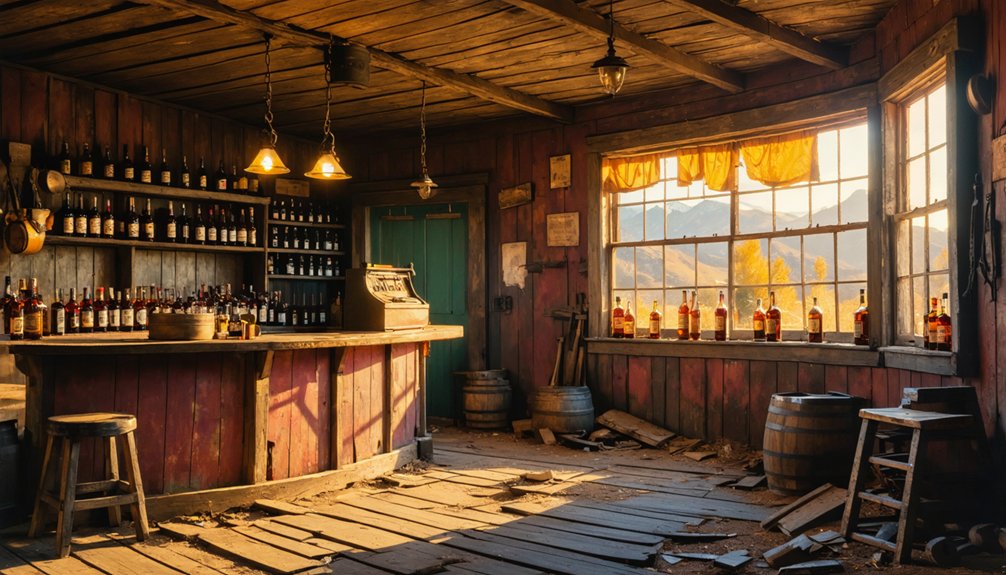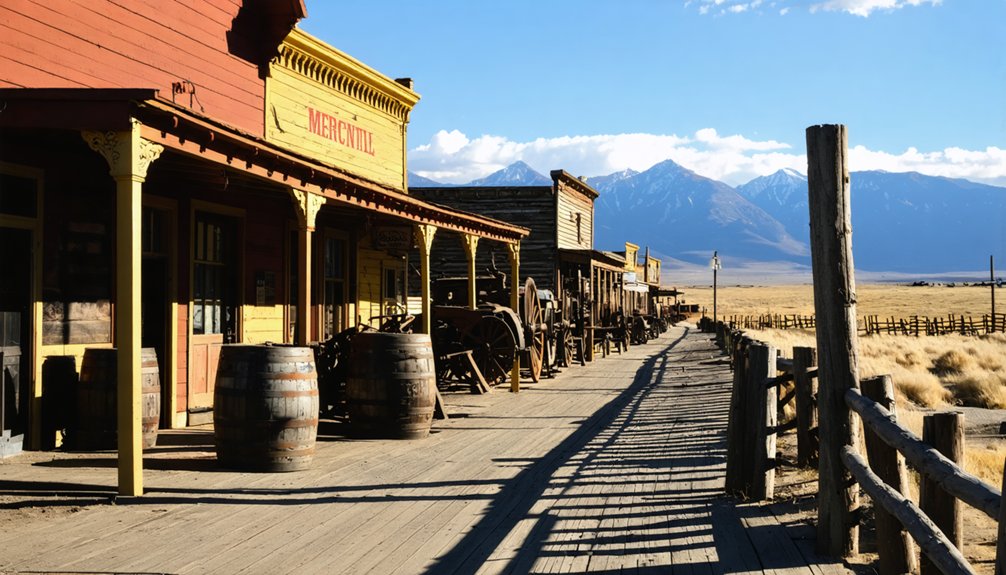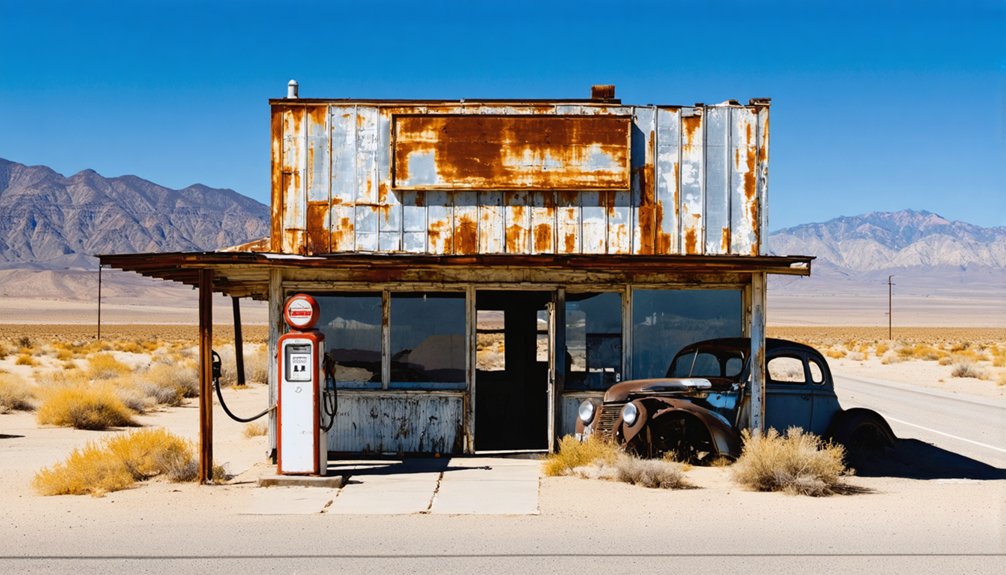
Planning a ghost town road trip to Midland, California means stepping into the sunbaked ruins of a 1920s gypsum boomtown that once sheltered nearly 1,000 workers in the Riverside County desert. Located roughly 20 miles northwest of Blythe, it’s where U.S. Gypsum Co. built an entire community from scratch, then quietly dismantled it by 1966. Concrete slabs, sealed mine portals, and industrial remnants are all that’s left — and there’s much more to this story worth uncovering.
Key Takeaways
- Midland, California, is a ghost town located 20 miles northwest of Blythe, built by U.S. Gypsum Co. and abandoned after 1966.
- Access Midland via Lovekin Boulevard from Blythe or Rice-Midland Road from Rice, with minimal traffic and straightforward desert driving.
- Visitors can explore concrete slabs, partial gypsum plant structures, and sealed mine portals offering glimpses into California’s industrial history.
- The best visiting months are October through April, avoiding summer temperatures exceeding 110°F for a safer, more comfortable experience.
- Pack at least one gallon of water per person daily, an emergency kit, offline maps, and check weather forecasts before departing.
What Was Midland, California?
Tucked into the remote desert of Riverside County, Midland, California was a thriving company town that U.S. Gypsum Co. built and owned from 1925 until the 1960s.
At its peak, nearly 1,000 residents called this desert settlement home, working the vast gypsum deposits buried within the Little Maria Mountains. Miners extracted material used for plasterboard, Pyrobar blocks, and even artificial snow for Hollywood films.
At its height, Midland housed nearly 1,000 residents mining gypsum destined for plasterboard, Hollywood snow, and beyond.
Underground operations ran through the Brown Mine and Victor Mine until 1948. Midland history ends abruptly in 1966, when operations ceased and the town was systematically dismantled.
Today, only concrete slabs and partial plant structures remain. For ghost town tourism enthusiasts craving authentic, off-the-beaten-path exploration, Midland delivers a raw, unpolished glimpse into California’s forgotten industrial past.
Where Exactly Is Midland and How Do You Get There?
Pinpointing Midland on a map takes some deliberate searching — it sits roughly 20 miles northwest of Blythe, California, in the sun-scorched expanse of Riverside County’s southeastern desert.
Understanding Midland Geography means accepting you’re heading somewhere deliberately forgotten, tucked against the Little Maria Mountains where silence now rules.
Two Access Routes serve modern explorers well. From Blythe, head north along Lovekin Boulevard, then turn onto Midland Road — straightforward desert driving with minimal drama.
Alternatively, if you’re rolling south from Rice, the Rice-Midland Road delivers you directly to the site with equal efficiency.
You’ll want a reliable vehicle, fresh water, and honest expectations.
What awaits isn’t a restored attraction — it’s raw, stripped desert terrain where concrete slabs mark where 1,000 lives once unfolded.
The Gypsum Mining History That Built a Town
Few desert towns were built on something as unglamorous as gypsum, yet U.S. Gypsum Co. transformed raw desert into a thriving community of 1,000 people. Operations launched in the 1920s, pulling vast deposits from the Little Maria Mountains through increasingly ambitious mining techniques.
Underground work at the Brown Mine and Victor Mine ran from 1930 to 1948, pushing gypsum production to remarkable levels.
What came out of those mines wasn’t wasted. Workers processed raw gypsum into Pyrobar blocks, plaster wallboard, and even artificial snow for Hollywood film sets.
You’re looking at a place where industrial grit met creative application. By 1966, though, the deposits no longer justified the effort, and the machinery fell silent, leaving only concrete slabs behind.
Why Midland Became a Ghost Town by 1966
As you stand among Midland’s concrete slabs, you’re witnessing the aftermath of a straightforward corporate equation: once U.S. Gypsum exhausted the region’s vast deposits, they simply walked away.
Company operations ceased in 1966, ending four decades of industrial activity that had sustained nearly 1,000 residents in this remote desert outpost.
What’s most striking is how completely the town disappeared afterward — stripped down to nothing but foundation slabs and partial plant structures, as if a thousand lives had never unfolded here.
Gypsum Deposits Exhausted
Though Midland once bustled with nearly 1,000 residents, the town’s fate was sealed the moment U.S. Gypsum exhausted the Little Maria Mountains’ deposits.
Decades of intensive gypsum mining stripped the earth bare, leaving nothing economically viable behind.
When the reserves ran dry, the company simply walked away, transforming a thriving community into a ghost town virtually overnight.
You’ll notice this pattern across abandoned industrial settlements — when resources disappear, so does everything else.
Key factors that ended Midland’s run:
- Underground mining operations at Brown and Victor Mines ceased completely by 1948
- Surface quarrying continued until 1966, masking the town’s inevitable decline
- No alternative industry existed to sustain the population once gypsum production stopped
The land gave everything it had, and then the silence moved in.
Company Operations Ceased
When U.S. Gypsum’s extraction costs outweighed the value of remaining deposits, the company quietly pulled out, ending gypsum production in 1966. You can almost feel the weight of that decision walking through what’s left — concrete slabs baking in the desert sun, partial plant structures standing like forgotten monuments.
Town dynamics shifted fast once company operations ceased. Nearly 1,000 residents depended entirely on U.S. Gypsum’s payroll, and when the work vanished, so did the people. There were no alternatives, no secondary economy to absorb the blow.
The town wasn’t just abandoned — it was dismantled, stripped down deliberately after closure. What drew families here for decades disappeared practically overnight, leaving behind only silence, cracked concrete, and the haunting outline of what once thrived.
Town Demolished After Closure
Once U.S. Gypsum pulled out, Midland’s town history ended swiftly and without ceremony. The company didn’t just leave — they erased. Workers stripped structures down to bare concrete slabs, dismantling every trace of the community that once housed 1,000 people.
The mining legacy left behind tells the full story:
- Underground mines like the Brown and Victor operated from 1930 to 1948 before abandonment.
- The Victor Mine was later converted into the county’s largest fallout shelter.
- By 1966, quarrying operations ceased entirely, triggering demolition.
You’ll walk terrain where families once lived, worked, and built something real. That freedom to explore raw, unfiltered history is exactly what makes Midland worth the desert drive. Nothing’s prettied up here — just honest ruins and open sky.
What’s Still Standing at Midland Today
When you walk through what’s left of Midland today, you’ll find concrete slabs stretching across the desert floor like a silent floor plan of a town that once housed 1,000 people.
Partial structures from the gypsum plant still stand, stripped of everything useful but stubbornly refusing to disappear entirely.
In 2003, U.S. Gypsum sealed the old mine portals and stopes for safety, closing the last chapter on a place that once supplied Hollywood with artificial snow and American homes with plasterboard walls.
Remaining Concrete Slabs
After the last worker left Midland in 1966, crews stripped the town down to almost nothing — yet a few concrete slabs and partial gypsum plant structures stubbornly remain.
These ghost town remnants carry real historical significance if you know what you’re looking for.
Walk the site and you’ll find quiet evidence of a community that once housed 1,000 people:
- Concrete foundation slabs marking where homes and facilities once stood
- Partial gypsum plant structures still rising against the desert sky
- Sealed mine portals, closed by U.S. Gypsum in 2003 for safety
Historic aerial photos reveal just how extensive this operation truly was.
What’s left may feel sparse, but standing on those slabs, you’re touching the bones of something that mattered.
Partial Plant Structures
Though most of Midland was hauled away or bulldozed after 1966, the gypsum plant’s partial structures held their ground — and they’re still the most visually striking things you’ll find on site today.
These weathered remnants carry real historical significance. At their peak, they supported a full manufacturing operation producing plasterboard, Pyrobar blocks, and even artificial snow for Hollywood films.
You’re walking through what once fed a company town of 1,000 people.
The partial structures rise against the Little Maria Mountains like industrial fossils — stripped down, sun-bleached, but unmistakably purposeful. U.S. Gypsum sealed the mine portals in 2003, but these above-ground remnants remain open to the desert air.
Bring a camera. The contrast between the ruined machinery and the raw Mojave landscape makes every frame worth capturing.
Midland’s Victor Mine: The Fallout Shelter Still Out There
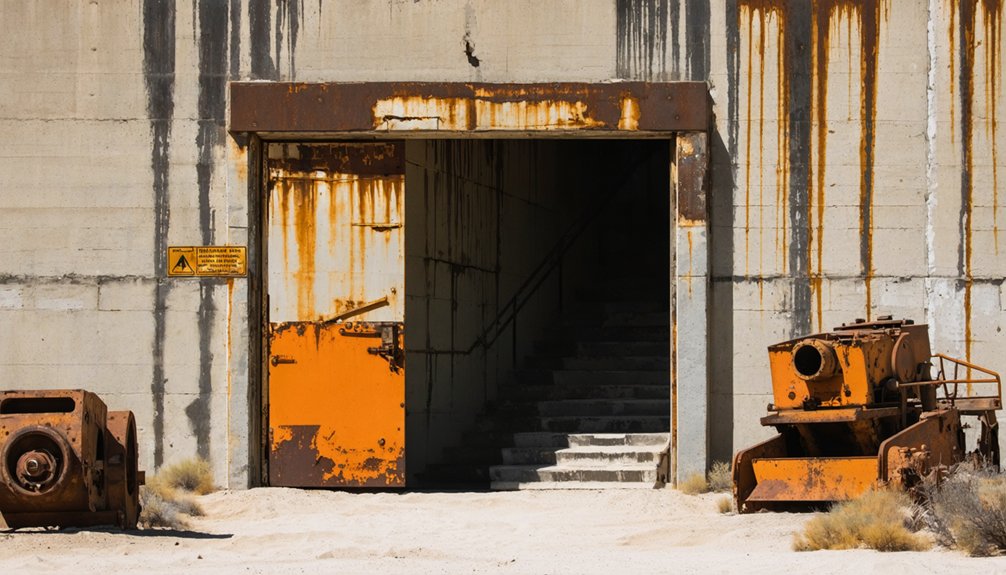
One of Midland’s most haunting remnants isn’t a crumbled building or a weathered foundation slab — it’s an underground mine that outlived its original purpose entirely.
The Victor Mine operated from 1930 to 1948, then transformed into the county’s largest fallout shelter, sitting 3 miles west of the old plant.
Its historical significance runs deep — a raw shift from industrial extraction to Cold War survival thinking.
Here’s what you should know before exploring:
- The Victor Mine was abandoned in 1948 after nearly two decades of gypsum extraction.
- It was later converted into a fallout shelter, the largest in Riverside County.
- In 2003, U.S. Gypsum implemented safety measures, sealing portals and stopes permanently.
That sealed darkness still waits out there, carrying stories most travelers never find.
Best Time of Year to Visit Midland
You’ll want to plan your visit to Midland between October and April, when the Mojave Desert’s brutal summer heat retreats and temperatures settle into a bearable range for exploring the concrete slabs and gypsum plant remnants.
Spring mornings carry a particular stillness over the Little Maria Mountains that makes it easy to imagine the town’s 1,000 residents moving through their routines.
Avoid the summer months entirely—desert temperatures regularly exceed 110°F, turning this already unforgiving landscape into something genuinely dangerous.
Ideal Visiting Seasons
Because Midland sits in the scorching heart of southeastern California’s Riverside County desert, timing your visit is everything. Summer temperatures regularly exceed 110°F, making ghost town exploration genuinely dangerous.
You’ll want to plan around cooler months to fully absorb the site’s historical significance.
The ideal visiting windows are:
- October through November – Mild temperatures, clear skies, and golden desert light perfect for photography
- February through April – Wildflowers occasionally bloom near the Little Maria Mountains, softening the industrial ruins beautifully
- December through January – The coolest months offer crisp air and uncrowded solitude that lets the ghost town’s haunting silence sink in
Arrive early morning regardless of season. The desert rewards those who move freely on their own schedule.
Weather Considerations
Midland’s desert climate swings between brutal extremes, so understanding seasonal patterns before you hit the road could make the difference between a memorable excursion and a dangerous one.
Summer temperatures regularly exceed 110°F, turning the Riverside County desert into a genuinely hostile environment. Weather patterns here follow predictable seasonal trends — winters offer mild, navigable days between November and February, making them your best window for exploration.
Spring and fall provide secondary opportunities, though spring winds can reduce visibility dramatically across the open terrain surrounding the Little Maria Mountains.
Pack serious water reserves regardless of season, since Midland’s remoteness means zero services exist on-site.
Check forecasts obsessively before departing Blythe, because desert conditions shift faster than most travelers anticipate, and the town’s concrete slabs won’t offer you any shelter.
What to Pack for the Drive Out to Midland
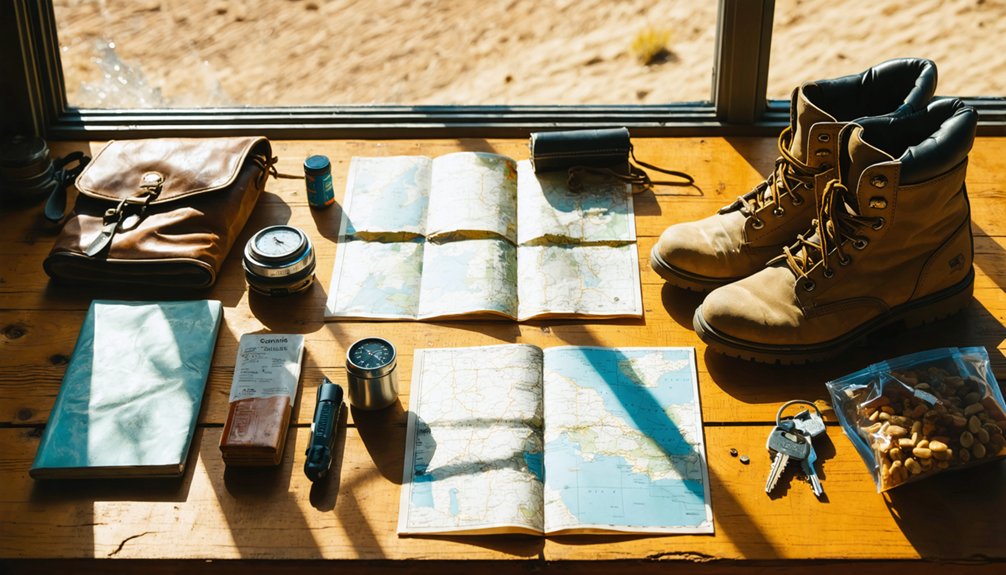
Packing smart for the drive out to Midland means treating this like the serious desert expedition it’s — temperatures in Riverside County‘s southeastern reaches can swing brutally between scorching midday highs and cool desert nights.
Treat the drive to Midland like a desert expedition — because in Riverside County’s brutal heat, it absolutely is.
The remote stretch along Midland Road offers no services, no shade, and no second chances if you’ve forgotten something critical.
These packing essentials and travel tips keep you self-sufficient:
- Water: Carry at least one gallon per person daily
- Navigation: Download offline maps; cell signals disappear fast
- Emergency kit: Include jumper cables, a tire patch kit, and emergency blankets
You’re chasing the ghost of a thousand-person gypsum town — arrive prepared, or don’t arrive at all.
Nearby Ghost Towns Worth Adding to Your Route
Once you’ve walked Midland’s concrete slabs and felt the silence of a town that housed a thousand souls, the Mojave Desert’s ghost town circuit pulls you deeper — and it’s worth following.
Calico, sitting three miles north of I-15 between Barstow and Yermo, delivers ghost town experiences rooted in silver rush history dating back to April 1881. San Bernardino County now preserves it as a regional park.
Head south toward Ridgecrest and you’ll find Randsburg, a living ghost town that peaked at 3,500 residents in 1899 — its historical significance still breathes through working storefronts.
Death Valley’s Ballarat offers adobe ruins stripped raw by time. Each stop compounds the previous one, building a layered understanding of desert ambition, boom, and inevitable abandonment.
Pairing Midland With Calico, Randsburg, and Ballarat on One Route
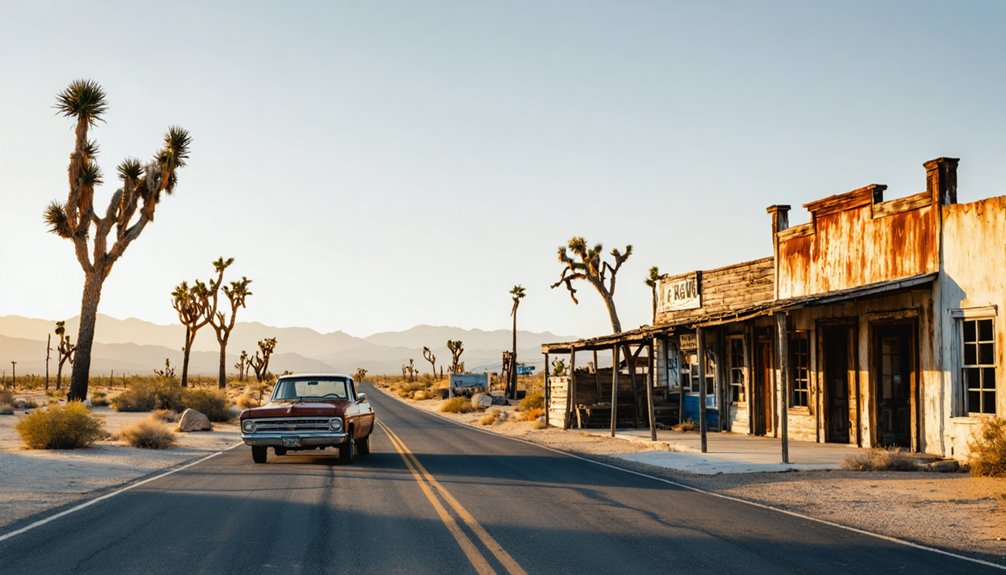
Stringing these four ghost towns into a single desert loop takes planning, but the route rewards the effort with a compressed history of California’s mineral ambitions.
Anchor your drive around these ghost town attractions and historical landmarks:
- Midland: Start near Blythe among concrete slabs and gypsum plant remnants, where 1,000 people once carved their lives from desert rock.
- Calico: Head northwest toward Barstow, where silver discoveries in 1881 built a boomtown now preserved as a San Bernardino County park.
- Randsburg and Ballarat: Push into Death Valley’s shadow, tracing gold fever through Randsburg’s still-breathing streets and Ballarat’s crumbling adobe ruins.
You’re not just driving miles—you’re threading through layered eras of ambition, exhaustion, and abandonment that define California’s restless interior.
Frequently Asked Questions
Is Camping Allowed Near the Midland Ghost Town Site Overnight?
The knowledge doesn’t confirm camping’s allowed at Midland’s ghost town amenities. You’ll want to verify local desert regulations before pitching camp. Research nearby BLM land for camping tips — you’re free to roam California’s hauntingly nostalgic desert wilderness.
Are There Guided Tours Available at the Midland Ghost Town?
You won’t find official guided exploration here — Midland’s ghost town history remains wonderfully untamed. You’re free to wander independently, uncovering concrete slabs and gypsum plant remnants on your own terms, answering only to your curiosity.
Do Any Local Historians Lead Organized Visits to Midland?
No records confirm local historians lead organized visits to Midland. You’ll uncover its historical significance and local legends independently, wandering concrete slabs where 1,000 souls once thrived — a raw, liberating ghost town experience awaiting your exploration.
Is the Road to Midland Passable for Standard Passenger Vehicles?
Once home to 1,000 souls, Midland’s road conditions are manageable for most drivers. You’ll navigate Lovekin Boulevard and Midland Road comfortably, though vehicle recommendations lean toward higher clearance for the rougher desert stretches near the Little Maria Mountains.
Are There Any Visitor Regulations for Exploring the Midland Site?
No official regulations exist, but you’ll want to respect visitor etiquette and take safety precautions seriously. The sealed mine portals are dangerous — don’t attempt entry. Roam freely across the concrete slabs, honoring this hauntingly abandoned desert relic.
References
- https://main.sbcounty.gov/2025/05/29/san-bernardino-county-history-calico-ghost-town/
- http://www.ghosttownaz.info/midland-ghost-town.php
- https://www.visitcalifornia.com/road-trips/ghost-towns/
- https://en.wikipedia.org/wiki/Midland
- https://sgphotos.com/photostories/inyos/
- https://sdghosts.com/uss-midway-museum/
- https://en.wikipedia.org/wiki/List_of_ghost_towns_in_California