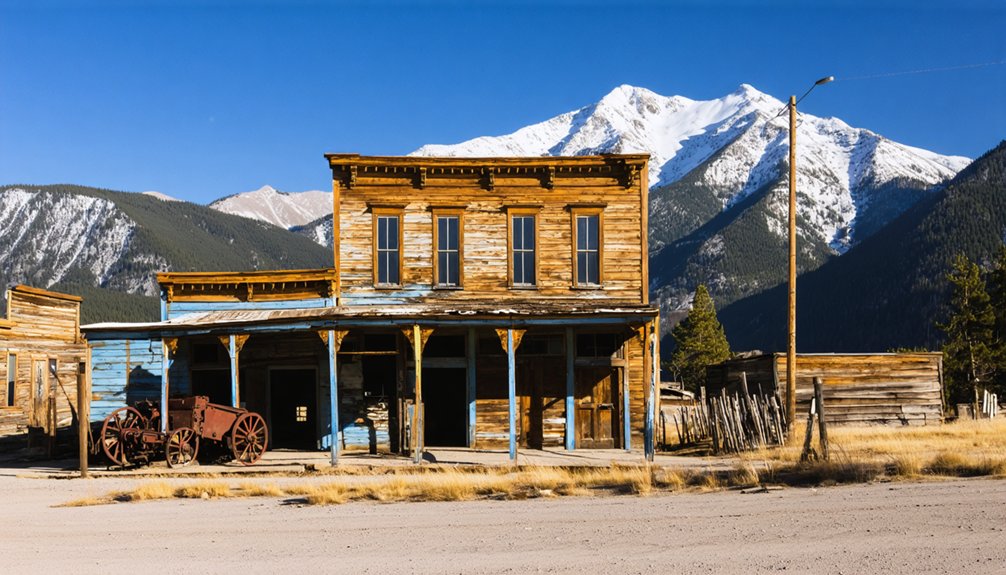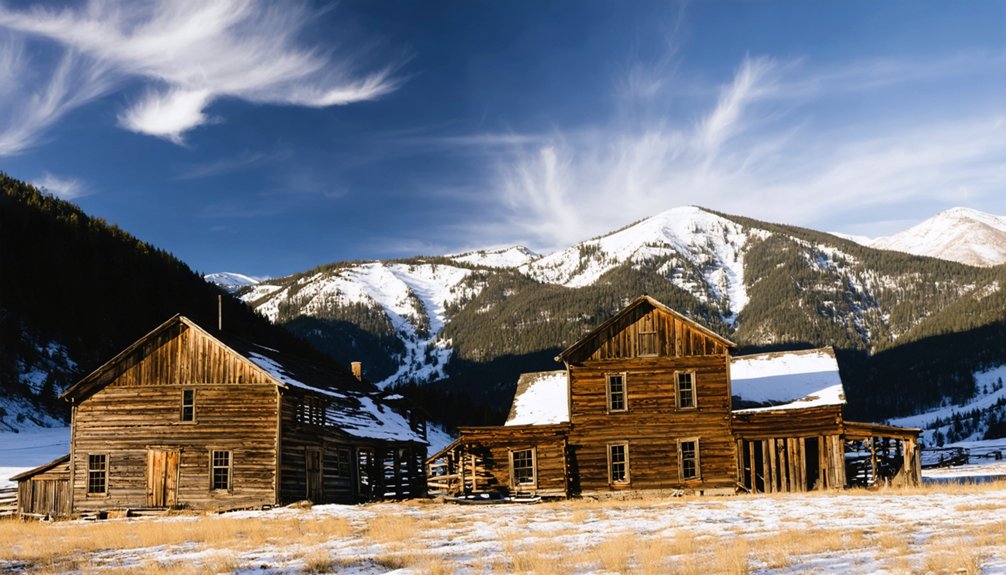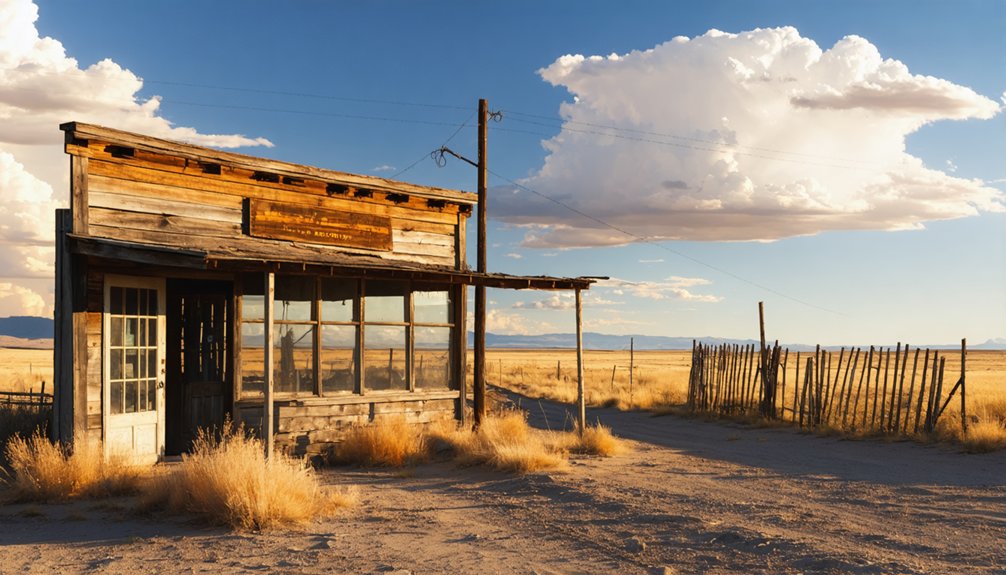
To plan your ghost town road trip to Agate, Colorado, take Exit 340 off I-70, about 15 miles from Limon, where the flat eastern plains stretch endlessly in every direction. You don’t need a 4WD vehicle — just sturdy boots, plenty of water, and a curiosity for forgotten places. Spring and fall offer the most comfortable conditions for exploring the crumbling storefronts. There’s far more history buried in these wind-scoured streets than you’d ever expect.
Key Takeaways
- Agate, Colorado, founded in 1876, is a semi-abandoned ghost town accessible year-round via Exit 340 off I-70, just 15 miles from Limon.
- Spring and fall offer the best visiting conditions, while summer explorers should arrive early morning to avoid extreme heat.
- A standard 2WD vehicle suffices for access, with unpaved stretches manageable without four-wheel drive for comfortable exploration.
- Pack water, sturdy boots, sunscreen, a first aid kit, and sealed bags for camera gear to ensure safe exploration.
- Abandoned buildings pose structural hazards, rattlesnakes may inhabit the area, and cell service is unreliable, so exercise caution throughout.
What Kind of Ghost Town Is Agate, Colorado?
Agate isn’t your typical ghost town—no crumbling mine shafts, no high-altitude drama. Instead, you’ll find a semi-abandoned plains settlement where urban exploration meets quiet, understated historical significance. Founded in 1876 as Gebhard, then renamed Agate in 1882 during its mining heritage boom, this eastern Colorado community never fully surrendered.
Demographic shifts gradually hollowed it out, yet community revival is visibly stirring—new homes rising near architectural remnants that still whisper local legends to anyone paying attention.
Environmental conditions here mean scorching summers and biting winters, but the town remains accessible year-round. Ghost town tourism draws curious travelers off Interstate 70, each seeking something raw and real.
Agate’s cultural impact lies in what it preserves: the honest bones of frontier ambition, neither glamorized nor forgotten.
How to Get to Agate, Colorado From I-70
Getting to Agate couldn’t be simpler — you’ll take Exit 340 off I-70, roughly 15 miles from Limon, and you won’t need anything more than a standard 2WD vehicle to make the trip.
The same highway that carries travelers across Colorado’s vast eastern plains delivers you almost directly to this forgotten frontier settlement.
It’s a rare ghost town that doesn’t demand a rugged four-wheel drive or a white-knuckle climb up a mountain pass to reach it.
Exit 340 Off I-70
Reaching Agate takes just one exit off Interstate 70 — Exit 340 — making it one of Colorado’s most effortlessly accessible ghost towns.
As you pull off the highway, the flat eastern Colorado plains stretch endlessly around you, a landscape unchanged since settlers first arrived here in 1876. The exit history of this quiet interchange carries the weight of frontier ambition — wagons once rolled where your tires now hum.
Watch for highway landmarks that signal your arrival: the open sky deepens, the noise of the interstate fades, and something older fills the silence. You don’t need four-wheel drive or special gear — just curiosity and an open road ahead.
Exit 340 is your gateway to a place that time quietly forgot.
Accessible By 2WD
Once you’ve rolled off Exit 340, the good news keeps coming — you don’t need a rugged off-road vehicle or a lifted truck to explore Agate. Your standard car handles the terrain just fine, leaving you free to focus on what matters.
Keep your eyes open for:
- Crumbling storefronts hiding historical artifacts worn smooth by decades of prairie wind
- Local wildlife darting through abandoned lots where families once built their lives
- Unpaved stretches that remain manageable without four-wheel drive
- Unmarked turnoffs worth slowing down for, revealing the town’s quiet, forgotten corners
That accessibility is rare among Colorado’s ghost towns. Agate doesn’t demand sacrifice just to reach it — it simply waits, patient and unhurried, for anyone curious enough to show up.
From Gebhard to Ghost Town: Agate’s Rise and Fall
The town now known as Agate didn’t begin with that name — it started as Gebhard in 1876, a frontier settlement carved out of Colorado’s eastern plains during an era when silver dreams drew settlers westward.
Gebhard history reflects that restless ambition perfectly: prospectors, homesteaders, and merchants all betting their futures on boom-time promises.
What’s Left to See in Agate Today
What remains of Agate today feels less like a town and more like a conversation interrupted mid-sentence.
You’ll wander past abandoned structures that still hold their shape, weathered but defiant, each one carrying historical significance worth pausing over. The silence here isn’t empty — it’s layered.
Watch for:
- Crumbling storefronts along the original town grid, their facades still readable
- Abandoned homes with intact architectural details from the late 1800s
- Scattered foundations marking where community life once anchored itself
- New residential construction on the outskirts, creating a strange, living contrast
You won’t need anything special to reach it — just exit 340 off I-70 and your own curiosity.
Agate rewards the attentive traveler willing to read between its broken lines.
How Silver Mining Built and Buried This Colorado Ghost Town
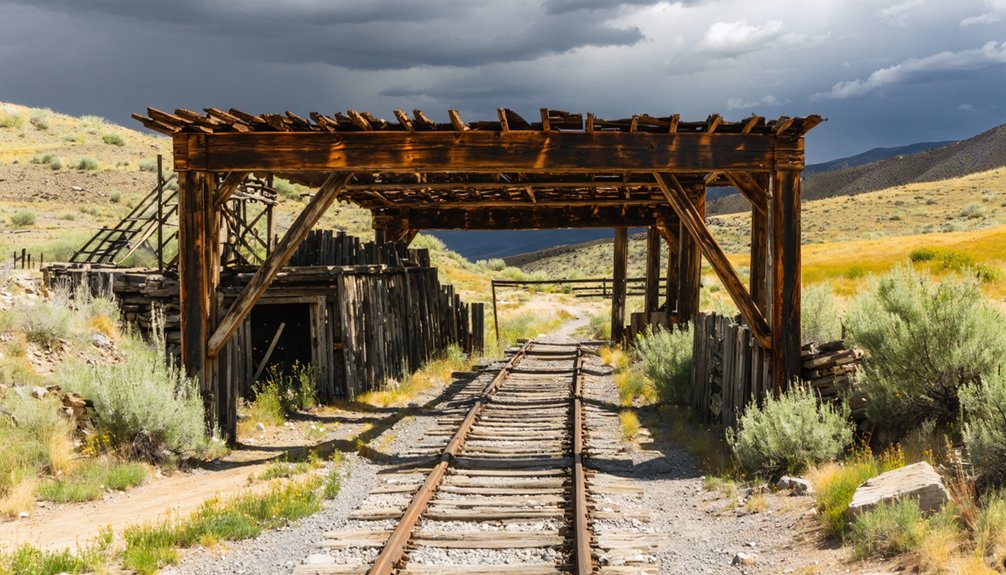
When you walk Agate’s empty streets, you’re standing in the shadow of silver’s broken promise.
Colorado’s mining boom pulled settlers into towns like Agate throughout the 1870s and 1880s, building communities almost overnight from raw frontier land.
Then came 1893, when silver’s collapse gutted the economy and left hundreds of Colorado’s mining-dependent towns — Agate among them — to slowly fade into memory.
Silver’s Rise And Fall
Silver built Agate almost overnight, and just as quickly, it took everything back. Silver mining reshaped this quiet eastern Colorado settlement, drawing settlers hungry for opportunity and freedom into its orbit during the 1880s.
The economic impact was swift and brutal when silver prices collapsed in 1893:
- Miners abandoned claims, leaving behind tools, dreams, and half-built lives
- Businesses shuttered as currency dried up across Colorado’s plains
- Families scattered toward newer promises elsewhere
- Ghost-quiet streets replaced once-bustling frontier commerce
You can still feel that boom-and-bust tension walking through Agate today. The land remembers what ambition looked like before it crumbled.
Colorado lost countless communities to silver’s collapse, but Agate’s story hits differently — it’s close enough to touch, just off Interstate 70.
Mining Shaped Agate’s Fate
Few Colorado ghost towns wear their mining history as plainly as Agate does. Silver’s promise drew settlers here, transforming a humble frontier outpost called Gebhard into a thriving community by 1882. That town evolution wasn’t accidental — mining impact shaped every building raised, every business opened, every family that staked its future on Colorado’s eastern plains.
Then silver collapsed in 1893, and Agate’s story shifted dramatically. You can feel that rupture walking through the abandoned structures still standing today. The boom-driven energy that once filled these streets simply vanished, leaving behind weathered wood and quiet foundations.
Yet something remains — a raw, honest reflection of the ambitions of people who believed a mining economy would sustain them forever. It didn’t, but their imprint endures.
The Best Time of Year to Visit Agate
Timing your visit to Agate can make all the difference between a memorable exploration and a miserable one. Weather considerations shape your experience considerably across all best visiting seasons:
- Spring and fall offer mild temperatures perfect for wandering abandoned structures without battling extreme conditions.
- Summer heat turns eastern Colorado’s semi-arid plains brutal, so early morning arrivals become essential.
- Winter visits occasionally reward you with crisp, clear days that cast dramatic shadows across deteriorating facades.
- Year-round accessibility via Interstate 70’s exit 340 means you’re never truly locked out.
You’ll find autumn particularly evocative, when golden light softens the weathered wood and crumbling foundations.
Whatever season calls you, pack water, wear sturdy boots, and embrace the freedom of exploring Colorado’s forgotten frontier on your own terms.
What to Pack for Agate’s Heat, Dust, and Dirt Roads

Once you’ve chosen your season, what you pack determines how long you’ll actually last out there. Agate’s eastern Colorado plains don’t forgive the unprepared. For heat protection, bring wide-brimmed hats, lightweight long sleeves, and more water than you think you’ll need. The sun hammers down without mercy on those open stretches.
Dust management matters just as much. Pack bandanas or buffs to cover your nose and mouth when the wind kicks up, because it will. Sealed bags protect your camera gear and documents. Wear closed-toe shoes — broken glass and weathered nails hide everywhere among those abandoned foundations.
Toss in sunscreen, polarized sunglasses, and a first aid kit. You’re not just visiting history here; you’re moving through it, and the land demands respect.
Ghost Towns Near Agate Worth Adding to Your I-70 Route
Agate’s hardly the only ghost town worth stopping for along I-70, and if you’re already driving through eastern Colorado’s windswept plains, you’d be missing out to stop at just one.
Colorado’s got over 1,500 ghost towns scattered across the state, with nearly 640 still showing visible remains worth exploring.
String a few of these forgotten communities together, and your road trip transforms from a single stop into a haunting, rolling tour through the ruins of the state’s mining-era past.
Nearby Ghost Towns Overview
While Agate makes for a compelling stop on its own, you’d be shortchanging yourself if you didn’t factor in the other ghost towns scattered along and near the I-70 corridor.
Colorado’s eastern plains hide communities whose ghost town characteristics and historical significance rival anything you’d find deeper in the Rockies. Each settlement tells a raw, unfiltered story of ambition and collapse.
Consider adding these stops to your route:
- Punkin Center – a quiet remnant of plains homesteading
- Matheson – stripped down but historically significant
- Simla – retains fragments of its early frontier identity
- Calhan – offers weathered structures worth photographing
You’re building more than a road trip here — you’re threading together an honest portrait of Colorado’s forgotten frontier.
I-70 Corridor Stops
The I-70 corridor running through eastern Colorado functions as an unlikely ghost town highway, threading past forgotten settlements that most drivers blow past at 75 miles per hour without a second glance.
You’re missing some of the finest I-70 attractions hiding in plain sight. Agate sits conveniently at exit 340, making it one of the easiest corridor stops you’ll ever add to your itinerary.
For solid road trip tips, plan your eastbound or westbound journey with deliberate buffer time between Limon and Denver. That stretch rewards patient explorers willing to exit the interstate, breathe the high-plains air, and walk streets where 19th-century settlers once built genuine lives.
The highway connects these forgotten places — you just have to slow down enough to notice them.
Regional Exploration Routes
Once you’ve walked Agate’s dusty lots and photographed its sagging storefronts, eastern Colorado reveals itself as a ghost town atlas hiding beneath the prairie grass.
Colorado shelters over 1,500 ghost towns, with roughly 640 still showing visible remains along scenic routes worth chasing.
Expand your road trip by targeting these historical landmarks near the I-70 corridor:
- Limon area remnants — abandoned homesteads dot the surrounding plains within 15 miles
- Elbert County back roads — unpaved routes connecting forgotten settlements reward patient explorers
- Eastern plains mining camps — silver-era communities shaped by the 1893 price collapse
- Highway 40 corridor — parallel scenic routes revealing additional frontier-era structures
You’re not just driving roads here — you’re tracing the collapse of entire economies, one abandoned storefront at a time.
Why Agate Survived When Colorado’s Other Ghost Towns Didn’t
Unlike hundreds of Colorado’s mining settlements that vanished when silver prices collapsed in 1893, Agate held on—quietly, stubbornly, the way a fence post weathers decades of plains wind.
Agate’s resilience wasn’t dramatic. There were no heroic reinventions, no second gold strikes. Instead, the town simply refused to disappear entirely.
Its mining legacy planted roots deep enough to survive the bust cycle that swallowed so many neighboring communities.
The Interstate 70 corridor gave Agate something most ghost towns never had—continued access. People still drive through, still build homes nearby, still acknowledge this little stretch of Elbert County deserves to exist.
You’ll feel that stubborn persistence when you arrive. The abandoned structures and new construction standing side by side tell the whole story without saying a word.
Structural Hazards and Rural Risks to Know Before You Explore
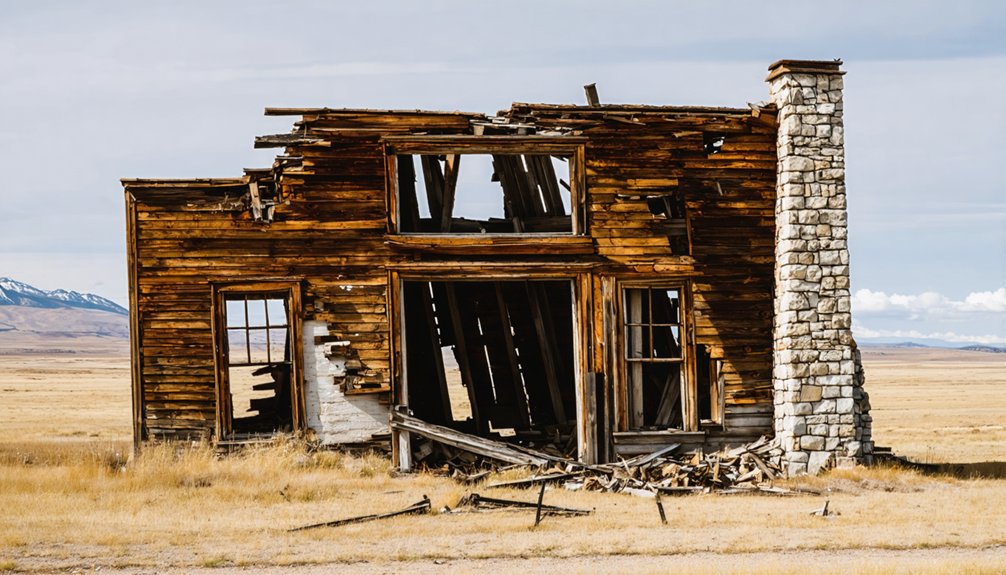
Wandering through Agate’s abandoned structures carries real risk, and you’d be foolish to ignore it. Structural safety isn’t guaranteed in these weathered buildings, and rural exploration demands respect for the environment’s unpredictability.
Watch for these hazards before stepping inside anything:
- Rotting floorboards that collapse without warning beneath your weight
- Unstable walls and ceilings weakened by decades of eastern Colorado’s freeze-thaw cycles
- Wildlife occupants, including rattlesnakes sheltering inside dark, undisturbed rooms
- No cell service in many areas, making emergency communication unreliable
You’re free to roam here, but that freedom demands personal responsibility. Tell someone your plans, carry water for the brutal summer heat, and trust your instincts.
Freedom without responsibility is just recklessness. Tell someone where you’re going, bring water, and trust your gut.
If a structure feels wrong, it probably is.
Frequently Asked Questions
Are There Any Guided Tours Available in Agate, Colorado?
The knowledge doesn’t mention any guided tours in Agate. You’ll explore local history on your own terms, wandering freely through abandoned structures, letting the ghost town’s raw, unfiltered past speak directly to your adventurous spirit.
Can You Camp Overnight Near the Agate Ghost Town Site?
Imagine waking up under vast Colorado stars near Agate’s weathered remnants. You’ll need to research local camping regulations and secure overnight permits beforehand, as no designated campgrounds exist directly at this evocative, freedom-calling semi-ghost town site.
Is Photography of Abandoned Buildings in Agate Legally Permitted?
You’ll find no specific legal restrictions blocking your lens in Agate. Photograph freely from public areas, capturing weathered facades and forgotten doorways. Follow basic photography tips: respect private property boundaries and let history’s haunting beauty speak for itself.
Are There Any Restaurants or Gas Stations Near Agate?
You’ll find a million miles of open road before spotting services, but Limon’s just 15 miles away, offering gas and restaurants. Keep these travel tips handy when exploring local attractions near Agate’s hauntingly beautiful, forgotten streets.
Does Agate Host Any Annual Events or Historical Festivals?
No documented annual events or historical festivals exist for Agate, but you’ll find its local folklore and historical significance alive in the weathered, abandoned structures that evoke a nostalgic freedom only Colorado’s forgotten frontier towns can offer.
References
- https://www.ghosttowns.com/states/co/agate.html
- https://www.youtube.com/watch?v=aPD3smZgRXo
- https://janmackellcollins.wordpress.com/category/colorado-ghost-towns-2/
- https://www.colorado.com/articles/colorado-ghost-towns
- https://en.wikipedia.org/wiki/List_of_ghost_towns_in_Colorado
- https://kids.kiddle.co/List_of_ghost_towns_in_Colorado