You’ll find Aldridge’s haunting concrete ruins deep in East Texas’s Angelina National Forest, where a timber empire once employed 500 workers and produced 125,000 board feet daily. Four massive mill structures—boiler room, engine room, fuel room, and drying kiln—still stand amid the pines, their crumbling walls revealing rusted rebar and spaces where machinery thundered. Beyond the sawmill site, you can swim in the turquoise Blue Hole, a flooded quarry framed by white cliffs, then trace the ghostly 11-mile tram line that connected this vanished boomtown’s industrial heart.
Key Takeaways
- Aldridge is a ghost town in East Texas that thrived from 1905 to 1923 around a sawmill employing 500 workers.
- Four massive concrete structures remain from the original sawmill, with deteriorating walls revealing rusted rebar and industrial machinery spaces.
- The Blue Hole is a 12-acre flooded quarry with turquoise waters and white cliffs, located near the sawmill ruins.
- An 11-mile abandoned railroad tram trail winds through Angelina National Forest, tracing the historic timber transportation route.
- The U.S. Forest Service has preserved the site since 1935, maintaining access to concrete foundations and wilderness areas.
The Rise and Fall of a Timber Boomtown
Deep in the pine forests of East Texas, Hal Aldridge saw opportunity where others saw only trees. By 1905, he’d constructed a wooden sawmill that churned out 75,000 board feet daily, transforming wilderness into wealth.
The town exploded to 76 buildings by 1911, with residents’ community life revolving around the hotel, warehouse, and company store. At its peak in 1918, the mill employed 500 workers and produced 125,000 board feet per day.
But fortune proved fleeting. Devastating fires struck in 1911 and 1915, forcing costly rebuilds. By 1923, the surrounding forests stood bare—depleted by relentless harvesting. The population scattered, chasing timber opportunities elsewhere.
Today, where wildlife habitat restoration slowly reclaims the land, only whispers remain of this once-thriving boomtown. The U.S. Forest Service acquired the site in 1935, preserving the remnants of this timber industry legacy. Visitors now flock to Blue Hole, a swimming spot created when a stone quarry collapsed during Aldridge’s heyday.
What Remains: Concrete Ruins and Historic Structures
When you arrive at Aldridge today, you’ll find four massive concrete structures rising from the forest floor—the boiler room, engine room, fuel room, and drying kiln—their hand-poured walls designed to survive the fires that twice destroyed the town’s wooden buildings.
Beyond these skeletal remains, you can trace portions of the old railroad tram that once hauled timber through the settlement, and if you venture to the nearby Blue Hole Stone Quarry, you’ll discover where workers extracted the sandstone that built the town’s foundations.
These crumbling monuments to industrial ambition now wear coats of graffiti and rust, their porous concrete invaded by the same forest that once fueled Aldridge’s prosperity. Owner Hal Aldridge made the decision to rebuild with concrete after the sawmill’s repeated destruction by fire, while other wooden structures eventually collapsed into ruins. Despite years of vandalism and artifact hunting, ongoing preservation efforts have brought volunteers from across the country to help stabilize and protect these rare remaining sawmill ruins.
The Four Standing Structures
Four concrete sentinels rise from the East Texas forest floor, their hollow skeletons marking where the Aldridge sawmill once thundered with industrial ambition. You’ll find the engine room, boiler room, fuel room, and drying kiln still standing—monuments to Hal Aldridge’s vision of an indestructible mill. Hand-poured after the devastating 1911 fire, these reinforced structures once powered production of 125,000 board feet daily.
Today, concrete wall deterioration reveals rusted rebar and empty spaces where iron wheels turned. Trees thrust through porous walls while graffiti stains mar surfaces that were built to last forever. Industrial debris preservation efforts continue despite limited funding, with tar-splotched sandstones and metal barrel loops scattered near foundations. The mill pond remains visible among the ruins, a remnant of the water systems that once supported the massive sawmill operations. These ruins stand as your gateway to experiencing raw industrial archaeology.
Blue Hole Stone Quarry
A brilliant turquoise pool spans twelve acres where 19th-century quarrymen once extracted sandstone block by block, their hammers and chisels carving away the earth to build coastal fortifications 200 miles distant. Kyle’s Quarry powered Galveston’s seawall and Sabine Pass jetties through decades of sandstone extraction operations before dynamite blasting triggered an unexpected transformation in 1920.
The natural spring breakthrough sent pressurized water shooting skyward for days, ultimately flooding the hollowed quarry and creating today’s Blue Hole. Craggy white cliffs now frame waters colored by mineral-rich sandstone—quartz, chert, and angular clay fragments that once traveled by ox-drawn wagons to the Gulf Coast. A standard gauge railroad connected Rockland to the quarry starting in 1895, replacing the ox-drawn wagons with more efficient transport for the extracted stone. You’ll need advance permission to visit this privately-owned site, where $1.5 million in improvements has transformed abandoned industry into preserved wilderness.
Railroad Tram Remnants
Through dense East Texas pine forest, crumbling concrete monuments mark where industrial ambition once thundered through the wilderness. You’ll discover portions of the 11-mile BFB&C Railroad tram line still visible along trails threading through Angelina National Forest. By 1907, this narrow-gauge lifeline connected northwest quarries to Aldridge’s sawmill, solving timber transportation challenges that once seemed insurmountable.
The tracks carried millions of board feet before crews tore them up in 1925, leaving only ghostly remnants for you to trace. This engineering feat fueled the community’s explosive growth around the original 1905 mill, though deforestation impacts ultimately doomed the town.
Today, you can follow these abandoned corridors from Boykin Springs Recreation Area, where iron rails once sang with prosperity’s promise.
Reaching the ghost town of Aldridge requires traversing deep into Angelina National Forest, where the abandoned sawmill site sits just north of Jasper near a bend in the Neches River. You’ll find two routes: a 2.5-mile hike from Boykin Springs Recreation Area following yellow arrows past creek crossings, or a quick 100-yard walk from the gated trailhead on County Road 34.
For parking tips, shoulder space exists at the County Road 34 gate, while Boykin Springs offers designated spots near the campground’s main bathroom. Weather considerations matter—high clearance vehicles prove essential on County Roads during wet conditions.
GPS cues like “800 ft, destination on left” guide your final approach through the Piney Woods, where bridge crossings mark your entry into this forgotten lumber empire. Many bus services have been renumbered and reorganized over the years to simplify navigation for visitors traveling between different areas of the region.
Exploring the Aldridge Sawmill Site
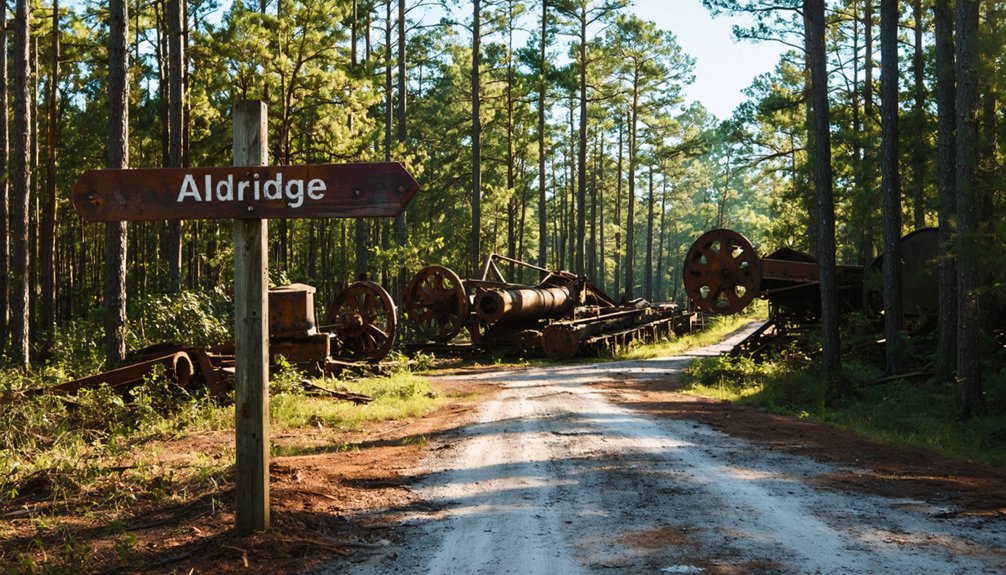
When you arrive at the sawmill site, you’ll find haunting concrete foundations and machinery bases rising from the forest floor—silent monuments to the industrial giant that once processed 125,000 board feet of lumber daily.
Just beyond the ruins, the Blue Hole beckons with its crystal-clear waters, a popular swimming spot where locals have cooled off for generations.
Follow the old railroad tram trail as it winds through the pines, tracing the path where oxcarts once hauled massive boilers and timber rolled toward distant markets.
The site operated from 1905 to 1923 before fires and depleted timber resources forced its closure, leaving behind these evocative remnants of East Texas’s logging bonanza era.
Historic Concrete Structures Remain
Deep in the Angelina National Forest, hand-poured concrete structures rise from the undergrowth like industrial monuments to a vanished era. You’ll discover the skeletal remains of Aldridge’s mill, power plant, fuels building, and dry kiln—pioneering examples of reinforced concrete construction in early Texas industry.
The significance of concrete design becomes clear when you understand Aldridge’s history: after fire destroyed the original wooden mill in 1911, owner Hal Aldridge rebuilt using innovative hand poured construction techniques. This made it one of Texas’s first fire-resistant sawmills, dramatically reducing insurance costs while protecting investments.
These ruins, mapped by forest archeologists in 1989 and evaluated for the National Register in 1979, now stand as evidence/proof/record of industrial ambition. You’re free to explore them via trail from nearby Boykin Springs Recreation Area.
Blue Hole Swimming Spot
Just beyond Aldridge’s concrete skeletons, a collapsed stone quarry offers an unexpected reward for your exploration. This deep, water-filled depression—known as Blue Hole—formed when the quarry supplying materials for mill construction gave way during the town’s industrial heyday.
What awaits at Blue Hole:
- Crystal-clear water quality in a picturesque swimming hole surrounded by second-growth pines
- Zero crowds or commercial development—just raw nature and invigorating deep water
- A 2.5-mile hike from parking areas through Angelina National Forest’s pine-scented trails
- No recreational amenities—pack everything you need for true backcountry swimming
The site’s clarity and isolation make it perfect for cooling off after exploring mill remnants. You’ll find this hidden gem tucked within East Texas pineywoods, accessible only to those willing to venture off-grid.
Railroad Tram Trail Remnants
Threading through Angelina National Forest‘s towering pines, the remnants of John H. Kirby’s Burrs Ferry, Browndell and Chester Railroad reveal how railroad construction innovations transformed the wilderness. Beginning in 1903, small-gauge steam trains revolutionized timber transport, hauling massive log loads that oxen couldn’t manage.
You’ll discover tram line extensions that once spiderwebbed across eleven miles, connecting logging camps to Aldridge’s sawmill by 1907. These narrow paths weren’t just industrial arteries—they carried front camp workers home to their families and linked turpentine camps deep in virgin pine forests. The track generally on the ground required very few cuts and fills, resulting in remarkably few wrecks during operations. Mill owners constructed railroads to move lumber products from the forest to processing facilities and distant markets.
Today’s 2.5-mile interpretive trail from Boykin Springs follows these historic routes. As you walk, you’re tracing the same paths where boxcar communities once thrived, now transformed into the Farm-to-Market roads crisscrossing East Texas.
Nearby Attractions in Angelina National Forest
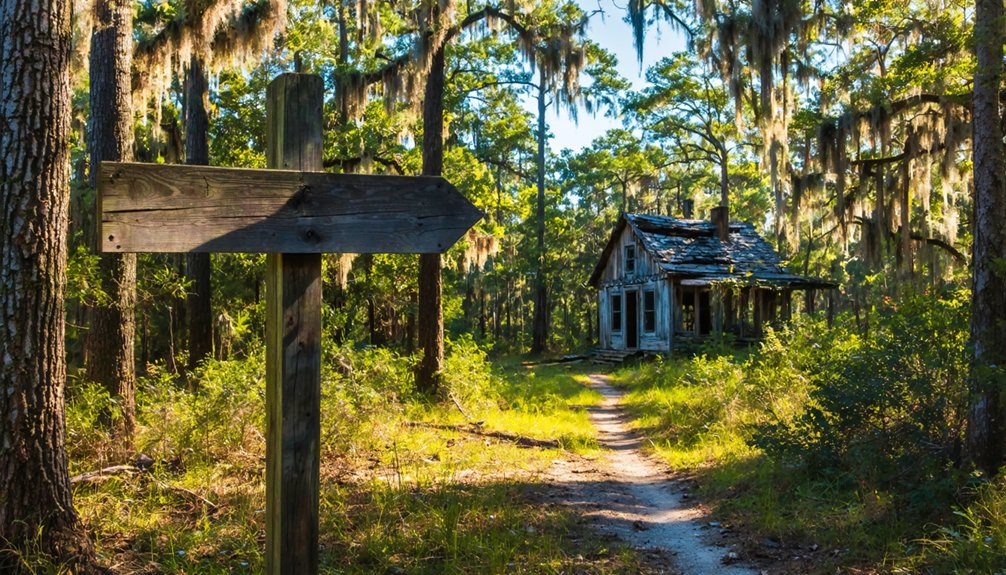
The Angelina National Forest surrounds Aldridge with over 150,000 acres of outdoor recreation spanning three counties in East Texas. You’ll discover wilderness that extends far beyond the ghost town‘s weathered ruins. As you explore the area, consider venturing to the nearby ghost towns near Cuthbert, Texas, each offering a glimpse into the past. The stories of those who once inhabited these towns can be felt in the air, inviting you to imagine their daily lives. It’s an unforgettable experience that complements the natural beauty of the forest surrounding Aldridge.
Essential Forest Experiences:
- Stephen F. Austin Interpretive Trail – Navigate an easy 1.5-mile boardwalk loop where diverse bird species (150 recorded) and butterfly observation opportunities (80 species) await your camera lens.
- Water Adventures – Launch your boat at Sam Rayburn Reservoir or paddle the 9-mile Bevilport Trail from Angelina River to Neches River.
- Campground Options – Choose from five Forest Service parks including Boykin Springs and Sandy Creek on Steinhagen Reservoir.
- Martin Dies Jr. State Park – Fish and paddle where the Angelina and Neches rivers converge south of the forest.
Chart your own path through these piney woods.
Best Time to Visit and What to Bring
Planning your expedition to Aldridge requires strategic timing and proper gear to navigate the dense East Texas wilderness. Spring and fall deliver ideal weather patterns—temperatures ranging from mid-60s to low-80s make the 2.5-mile forest trek comfortable.
Winter offers the lowest crowd levels if you’re seeking solitary exploration among graffitied sawmill ruins. Pack sturdy hiking boots for uneven terrain, bug spray to combat humidity-driven insects, and long sleeves to push through vine-smothered structures. Bring ample water since no facilities exist at this remote historic site.
Year-round access means you’re free to explore whenever wanderlust strikes, though avoiding peak summer heat preserves your energy. Check recent weather before departure—heavy rain transforms trails into muddy obstacles. Your flashlight will illuminate shaded areas beneath the thick forest canopy.
Frequently Asked Questions
Is Overnight Camping Allowed Near the Aldridge Ruins?
You’ll find rustic overnight stays are welcome near Aldridge’s forgotten streets. Dispersed camping offers freedom without traditional amenities available at developed sites, though accessibility for visitors means you’ll stay close to parking areas. Remember: hunting season restricts your wandering.
Are Dogs Permitted on the Trail to Aldridge?
Dogs are likely permitted on Aldridge trail, as no restrictions are noted. Follow dog friendly policies by keeping pets leashed, ensuring proper pet waste disposal, and respecting wildlife. Always verify current Forest Service regulations before visiting.
Do I Need a Permit to Visit the Site?
You don’t need a permit for basic visitation—hikers can freely explore Aldridge’s haunting ruins. However, permit requirements apply for specific activities like camping reservations, large trail groups, or hunting, respecting necessary visitation restrictions while preserving your adventure’s spirit.
Is the Trail to Aldridge Suitable for Children?
Yes, the trail’s relatively flat terrain and 5-mile round trip make it family-friendly. Your children will enjoy scenic views along Boykin Creek and exploring local history through abandoned sawmill structures, though you’ll need caution around muddy sections.
Are There Restroom Facilities at the Trailhead or Ruins?
You’ll find restrooms at Boykin Springs trailhead with showers and multiple stalls, but no portable toilets available at the ruins themselves. Trail accessibility conditions remain excellent along the 2.75-mile path following the old tramway route.
References
- https://www.youtube.com/watch?v=mQJonzJBYK8
- https://www.youtube.com/watch?v=LJGqpgFt8D4
- https://texastimetravel.com/directory/aldridge-sawmill-historic-site-angelina-national/
- https://www.texasalmanac.com/places/aldridge-0
- https://www.tshaonline.org/handbook/entries/aldridge-tx-jasper-county
- https://www.texasbeyondhistory.net/aldridge/legacy.html
- https://www.exploros.com/summary/aldridge-sawmill
- https://www.texasbeyondhistory.net/aldridge/logging.html
- https://www.desertedtexas.org/2015/05/aldridge-texas/
- https://www.thehistorycenteronline.com/uploads/exhibits/Aldridge_article_2009.pdf