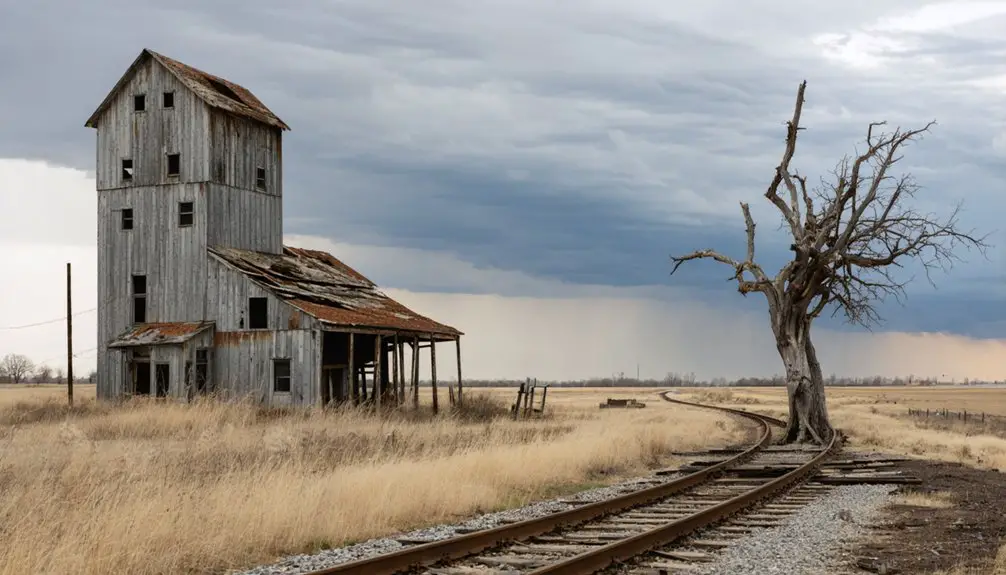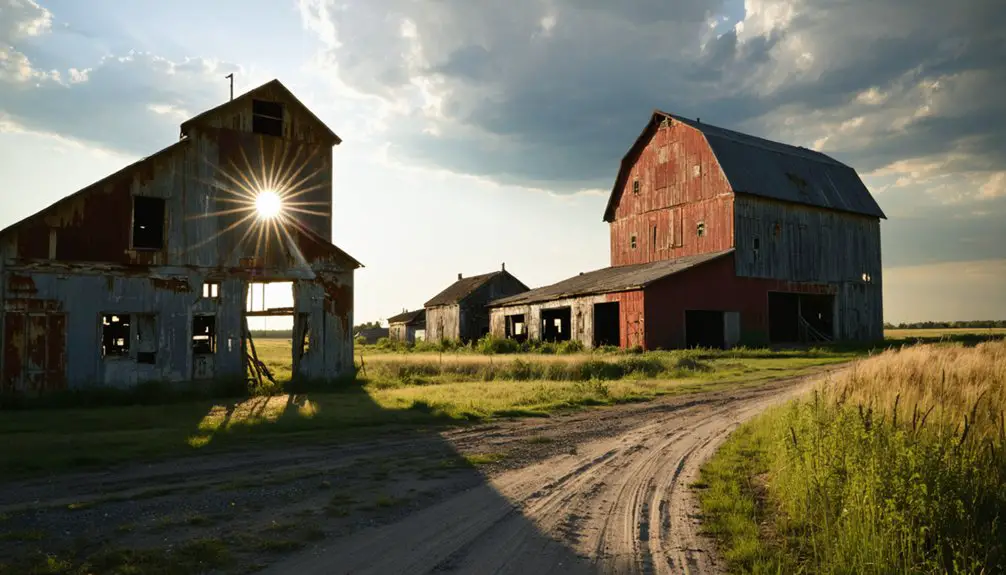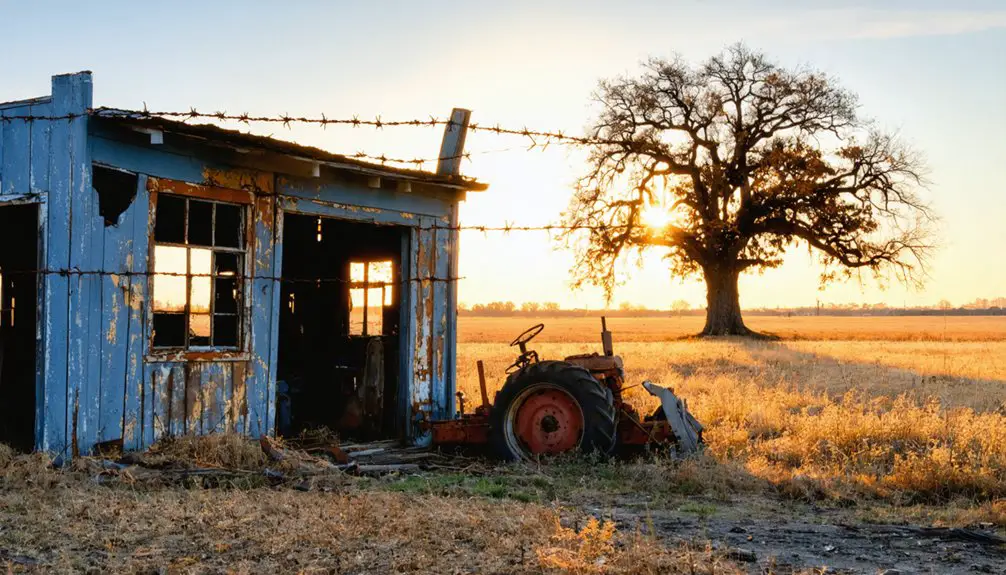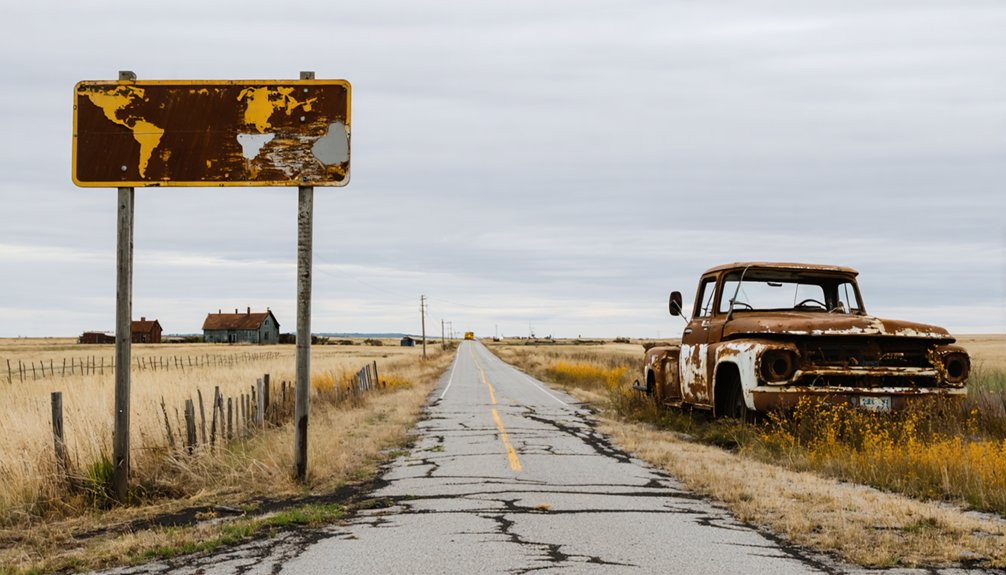
Almon, Minnesota presents a unique challenge for ghost town enthusiasts—you won’t find it on modern maps, and historians still debate whether this settlement truly existed beyond scattered cemetery records and folklore. Instead, you’ll want to redirect your road trip toward verified alternatives like Mower County’s six accessible ghost towns, including Hamilton’s railroad-bypassed ruins and flood-erased Cedar City. Minnesota’s Mesabi Iron Range offers another compelling route, where relocated mining communities and abandoned pit edges tell stories of America’s steel heartland that’ll reward your exploration with tangible history.
Key Takeaways
- Almon’s exact location remains unverified on modern Minnesota maps, making trip planning challenging without confirmed coordinates or landmarks.
- Focus on Almon’s documented stagecoach history and specific markers to distinguish it from similar abandoned settlements like Elcor or St. Albans.
- Consider exploring Mower County’s six accessible ghost towns, including Hamilton and Madison, as verified alternatives if Almon proves elusive.
- Combine ghost town exploration with outdoor activities like trails and cave systems for a more comprehensive Minnesota adventure.
- Research scattered cemetery records and local folklore sources beforehand, as concrete information about Almon remains scarce and contradictory.
The Mystery of Almon: Separating Fact From Fiction

You won’t find Almon on most modern maps of Minnesota, and that’s precisely what makes tracking down this ghost town feel like detective work. The truth is, concrete information about Almon remains frustratingly elusive.
Unlike well-documented Minnesota ghost towns such as Forestville or Nininger, Almon exists in a fog of murky historical facts and conflicting accounts. Some sources spell it “Almond,” while others question whether it ever existed as a genuine town. References appear only in scattered cemetery records and local folklore mentioning unexplained occurrences tied to the area. Without verified founding dates, population records, or archaeological evidence, you’re essentially chasing shadows.
This lack of documentation doesn’t diminish the adventure—it amplifies it, turning your road trip into genuine exploration.
Why Minnesota’s Ghost Towns Captivate Road Trippers
Minnesota’s ghost towns weave together everything road trippers crave: historical mystery, supernatural whispers, and landscapes that demand exploration. You’ll discover the cultural significance of ghost towns through crumbled seminary walls at Wasioja and restored 1890s storefronts in Forestville—tangible connections to pioneers who built communities from nothing.
The psychological draw of abandoned places pulls you deeper as you wander taconite mining settlements where entire neighborhoods vanished overnight, or stand beside Grey Cloud Island’s flood-damaged kiln imagining ghostly figures locals still report. These aren’t sterile museums—you’re walking through genuine time capsules where railroads shifted, industries collapsed, and young men never returned from war.
Pair ruins with Root River trails and underground cave systems for road trips that satisfy your hunger for both haunting history and jaw-dropping scenery.
Common Confusions: Towns Often Mistaken for Almon
The dusty roads leading to Minnesota’s forgotten settlements blur together after your third or fourth ghost town expedition, and suddenly you’re standing in Elcor’s overgrown streets convinced you’ve found Almon. False reports investigation reveals common mix-ups: Elcor’s iron mining remnants near Gilbert lack Almon’s stagecoach history, while Reyataotonwe’s Native American farming village predates settler routes entirely.
St. Albans’ failed 1860 village status doesn’t match Almon’s established inn and cemetery landmarks. Hassan’s water-power mill dreams along Crow River bend served different purposes than Almon’s traveler stopover role. Leaf River’s gradual fade offers no defining features, making ruins preservation nearly impossible to document.
You’ll avoid these detours by focusing on Almon’s specific stagecoach-era markers rather than chasing every abandoned Minnesota settlement that promises adventure.
Hennepin County’s Vanished Settlements Worth Exploring
Beyond scattered prairie settlements and forgotten mining camps, Hennepin County harbors its own collection of erased communities—though you won’t find them on most ghost town bucket lists. These vanished settlements reveal lost towns’ contrasting fates: some drowned beneath lake expansions, others consumed by Minneapolis’s relentless sprawl.
You’ll discover unexpected residents’ personal stories in county archives—families who watched their neighborhoods disappear not through catastrophe, but through bureaucratic erasure. Unlike Elcor’s company-ordered evacuation or Forestville’s gradual fade, Hennepin’s ghost towns often vanished overnight when urban planners redrew boundaries.
Track down their locations using historical plat maps at the county recorder’s office. The freedom to explore means piecing together fragments: a surviving street grid, repurposed foundations, cemetery plots marking where vibrant communities once thrived.
Mower County Ghost Towns as Alternative Destinations
Why settle for Almon’s elusive traces when Mower County spreads six accessible ghost towns across its southern townships? You’ll find Hamilton straddling the Fillmore County border, where 30 businesses once served 400 former county residents before the railroad carved a different path.
Hamilton’s thirty businesses and four hundred residents couldn’t survive once the railroad bypassed this Fillmore County border town.
Head to Madison’s saw mill ruins ten miles north along Cedar River’s west bank, or explore Two Rivers at the Turtle and Cedar confluence, where Robert Autis’s hotel foundation still marks the spot.
Cedar City and Troy City vanished beneath 1858’s devastating floods—their abandoned agricultural sites now hide beneath riverside vegetation six and eight miles south.
Frankford’s fading remnants dot the eastern county edge, offering the solitude you’re craving without crowds.
The Mesabi Iron Range: Mining Towns Frozen in Time
Stretching 110 miles from Grand Rapids to Babbitt, the Mesabi Iron Range transformed northeastern Minnesota into America’s steel heartland before leaving behind skeletal towns that cling to rust-red hillsides.
You’ll find communities like Hibbing, forcibly relocated in 1919 when mining operations expansion demanded the earth beneath 200 homes. The Oliver Iron Mining Company literally moved entire neighborhoods—houses, churches, stores—on log rollers to make way for cavernous open pits.
This community life adaptation created a unique landscape where elevated boardwalks once connected company-built locations, and residents watched their backyards become mile-deep craters.
Today, you can stand at these abandoned pit edges where over 100 mines once roared, supplying 188 million tons during WWII. The iron-stained ground still whispers of steam shovels and the tens of thousands who built America’s arsenal.
What Caused Minnesota’s Towns to Disappear
Five forces conspired to erase Minnesota’s frontier dreams from the map, each leaving distinct scars across the landscape.
Economic diversification efforts failed spectacularly when single-industry villages collapsed overnight—lumber mills closed, clay pits emptied, and 32-million-bushel grain elevators stood silent. You’ll find Hennepin County towns that once boasted post offices and hotels now reduced to names on faded maps.
Ghost towns emerge when a single industry dies—mills close, mines empty, and entire communities disappear from maps overnight.
Railroad bypasses delivered death sentences. Pomme de Terre and Helvetia vanished when tracks curved elsewhere, stranding farmers miles from markets.
Agricultural crisis impacts hit hardest during the 1980s—Tenney lost 79% of its population as remoteness overwhelmed fertile soil’s promise.
Nature struck brutally: the 1863 Minnesota River flood drowned San Francisco, diphtheria ravaged Helvetia in 1884, and government soldiers evicted Falls City’s squatters before communities could root.
Essential Stops for Your Minnesota Ghost Town Route
Your ghost town journey begins at Forestville, where silence hangs heavier than the century-old dust in the Meints family’s general store. After exploring this preserved 1800s settlement, your route reveals Minnesota’s diverse ghost town discoveries across distinct regional variations:
- Elcor on the Mesabi Iron Range—walk streets where 1,000 miners once lived before 1956’s final evacuation order
- Renova in Mower County—find the Lahti Stern general store that stubbornly outlasted the railroad’s betrayal
- Nininger along the Mississippi—search for historical markers in flood-scarred bottomlands
- Hamilton—trace the creek that once centered a 400-person community before Racine stole its railroad
Each stop offers unrestricted exploration through landscapes where commerce, ambition, and human resilience left tangible marks before infrastructure changes rewrote their destinies.
What Remains: Structures and Markers You Can Still Find
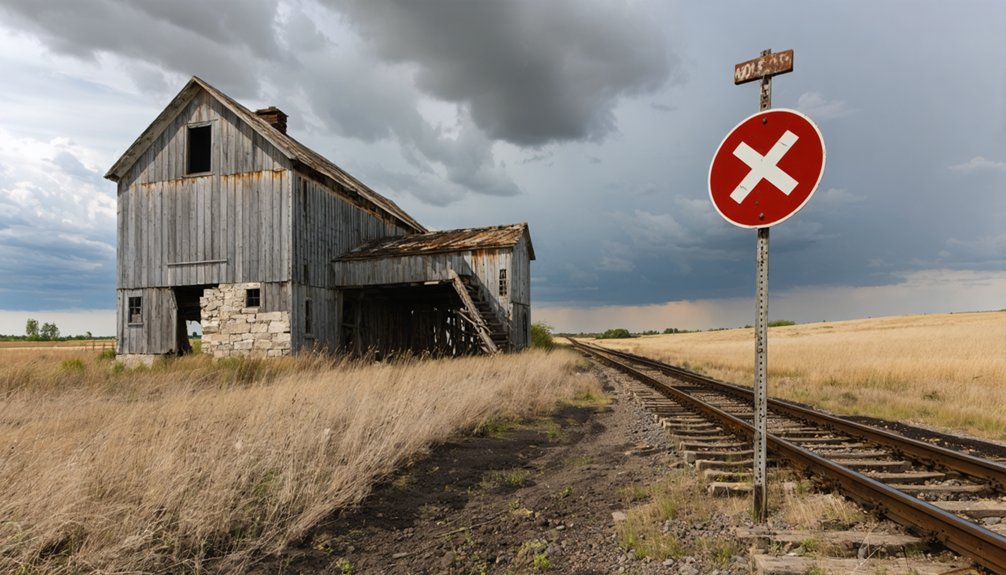
Across Minnesota’s abandoned settlements, the physical evidence tells stories that official records often miss. You’ll discover relics preserved over time—charred mill walls rising beside rivers, their stone frames open to sky like skeletal monuments.
Stone frames stand skeletal against Minnesota skies, their charred walls testifying to histories that paperwork never captured.
Fading industrial remnants dot open fields: bunker foundations, machinery sites forming eerie patterns, and the ACO silo near Morton standing sentinel over the Minnesota River.
At former mining sites in Elcor, scattered equipment marks the early 20th-century boom. You can trace roundhouse outlines through thick brick walls and empty locomotive pits. Historical plaques anchor these wandering grounds, while a single white house often stands as the sole survivor among barn foundations visible from old aerial surveys.
Cemetery graves predating 1900 reveal even older origins, where natural reclamation merges architecture with wild overgrowth.
Planning Your Minnesota Ghost Town Adventure
You’ll want to map your route through Minnesota’s rural backroads before heading out, as many ghost towns like Almon sit miles from major highways with spotty cell service. Pack a physical map or downloaded offline GPS coordinates, along with water, snacks, and a full tank of gas—these remote sites rarely have services nearby.
Bring a camera, sturdy walking shoes, and layers for unpredictable weather, since you’ll be exploring open fields and crumbling foundations where towns once thrived.
Route and Logistics Planning
Planning a ghost town adventure requires honest acknowledgment: Almon, Minnesota has faded so completely from the landscape that even finding reliable directions proves challenging. You’ll need to embrace uncertainty and old-school navigation skills for this journey into the truly forgotten.
Exploring the history of Boston, Alabama ghost town can unveil the remnants of bygone days, beckoning those intrigued by tales of lost communities. As you wander through the area, be prepared to discover remnants of old structures and hints of a vibrant past that once thrived in this now-quiet landscape. Each shadow and whisper in the wind adds to the allure, enticing adventurers to step deeper into the narrative of what once was.
Before departing, prepare for minimal infrastructure:
- Download offline maps since cell service becomes unreliable in remote areas
- Pack sufficient fuel, water, and emergency supplies—no visitor amenities exist
- Research nearby towns for parking accommodations and overnight stays
- Contact local historical societies for updated access information
This isn’t a curated tourist experience with marked trails and interpretive signs. You’re venturing into authentic abandonment, where nature reclaims what civilization left behind. The reward isn’t convenience—it’s the raw freedom of discovering places most people have completely forgotten exist.
Essential Items to Bring
When venturing into Minnesota’s vanished settlements, your survival depends less on technology and more on wilderness fundamentals. Pack waterproof boots for Almon’s muddy trails and thermal layers—weather shifts without warning across the Mesabi Range. Your emergency preparedness kit should include bear spray, a first-aid supply, and N95 masks for dust-choked mining structures.
Backcountry navigation requires detailed topographic maps and a GPS with offline capabilities, since cell towers don’t reach these forgotten coordinates. I’ve learned this the hard way, circling abandoned foundations while my phone displayed zero bars. Bring DEET-heavy bug spray, two liters of water daily, and a headlamp for exploring dim interiors. Document everything with your camera, but remember—trash bags matter. Leave these ghost towns as wild as you found them.
Frequently Asked Questions
Does Almon, Minnesota Actually Exist as a Real Ghost Town?
Almon’s existence remains unverified—you’ll find no documented ghost town’s history, coordinates, or local urban legends. It’s likely a phantom reference itself. Before planning your freedom-seeking road trip, you’d better confirm this town actually existed beyond forum mentions.
What’s the Best Season to Visit Minnesota’s Abandoned Ghost Town Sites?
Summer’s your sweet spot for exploring Minnesota’s ghost towns. You’ll enjoy favorable weather patterns perfect for wandering preserved buildings steeped in historical significance. June through August offers warm days, accessible trails, and that untethered feeling of discovering forgotten places independently.
Do I Need Special Permits to Explore Ghost Town Properties?
You won’t face red tape at public ghost towns like Forestville, but private property concerns mean you’ll need landowner permission for most sites. Permission requirements vary—some owners welcome explorers, while trespassing fines reach $1,000 in mining country.
Are Minnesota Ghost Towns Safe to Visit With Children?
Safety varies by location. You’ll want to take basic safety precautions like sturdy footwear and watching for unstable structures. Check nearby amenities beforehand—some ghost towns are remote. Older kids typically handle these adventures better than toddlers.
Can I Camp Overnight Near Any Ghost Town Locations?
Like pioneers claiming untamed territory, you’ll find freedom camping near ghost towns at Split Rock’s Shipwreck Creek Campground or dispersed forest sites. Check local regulations first, then enjoy camping amenities ranging from full hookups to primitive backcountry spots.