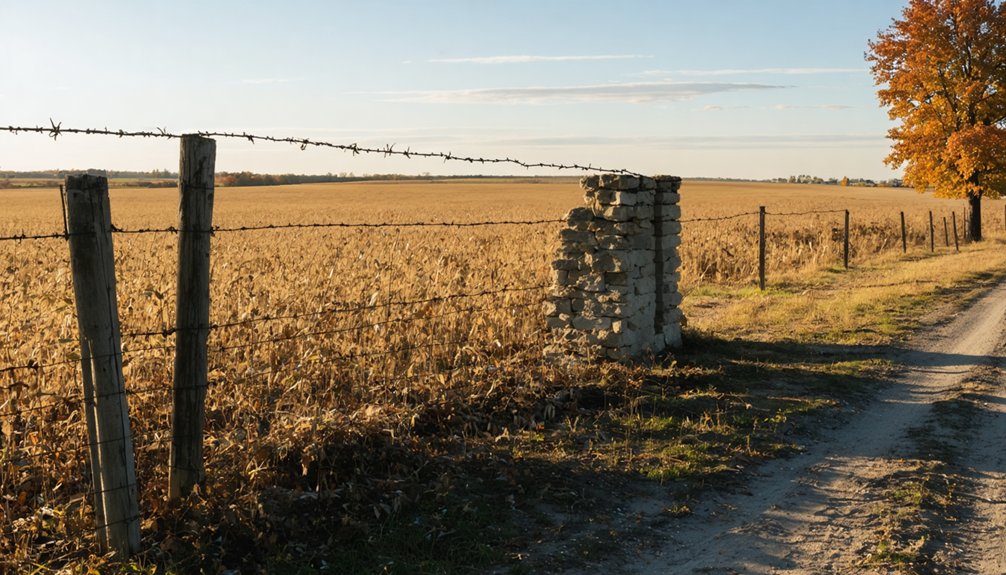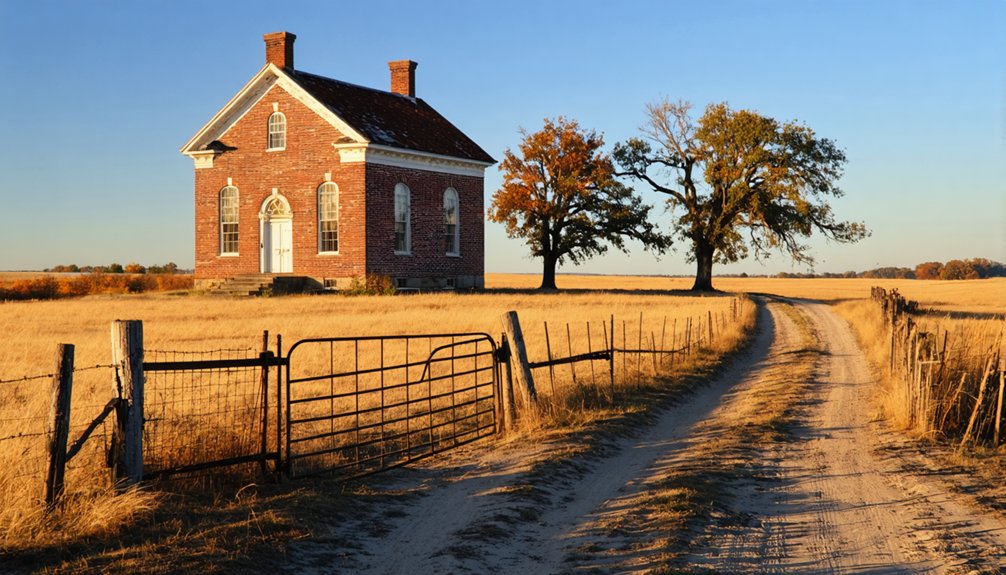
Start your ghost town exploration in Carlinville, Anderson Township’s county seat, where the ornate Anderson Mansion serves as your historical anchor. From there, Route 4 leads you through Macoupin County’s vanished mining communities—Greenridge, Reader, Schoper, and Barr—where coal depletion and railroad abandonment left only weathered foundations and overgrown streets. You’ll discover twelve forgotten settlements along quiet farm roads, each whispering stories of boom-and-bust cycles that transformed thriving towns into prairie silence. The routes ahead reveal where determination met destiny.
Key Takeaways
- Start at the Anderson Mansion in Carlinville for tours showcasing 1883 Italianate and Queen Anne architecture with original details.
- Follow Route 4 north from Carlinville to access Greenridge and other ghost town sites along quiet farm roads.
- Explore twelve ghost towns including Barr, Reader, Schoper, and Greenridge, all victims of mining collapse and railroad abandonment.
- Visit Carlinville’s million dollar courthouse and limestone jail before heading to abandoned settlements with weathered foundations.
- Respect private property boundaries and prepare for rural exploration when visiting overgrown ghost town remnants and forgotten pathways.
Discovering Anderson Ghost Town: A Faded Illinois Settlement
The Italianate mansion rises from the prairie landscape like a Victorian-era monument frozen in time, its 1883 first floor crowned by an 1892 Queen Anne second story that tells the architectural evolution of a banker’s wedding gift. You’ll find this three-story treasure among Macoupin County’s overlooked county landmarks, where thirteen rooms blend Italianate, Queen Anne, and Stick Style elements into architectural storytelling.
The property, built by banker C.H.C. Anderson for his son John, survived family ownership until the 1970s before the historical society rescued it from decay. Despite unverified mansion mysteries claiming Underground Railroad tunnels and Prohibition-era speakeasies, the real story proves more compelling: authentic restoration revealing central Illinois history through documented facts rather than folklore, earning National Register designation in 1992.
Understanding Macoupin County’s Ghost Town Legacy
Long before Anderson’s Italianate mansion stood sentinel over Macoupin County’s prairie, waves of settlement transformed this central Illinois landscape from Native American hunting grounds into a patchwork of ambitious townships that would rise, flourish, and vanish within generations.
Ambitious townships rose and vanished across the prairie, transforming Native hunting grounds into fleeting settlements within mere generations.
You’ll discover Anderson wasn’t alone—Barr, Hagaman, Macoupin Station, and Reader all followed similar trajectories from boom to abandonment. Railroad abandonment, coal depletion, and agricultural decline erased entire communities from maps, leaving behind cultural ephemera: obliterated cemeteries, unmarked cholera graves, and weathered foundations.
Greenridge’s coal-dependent economy collapsed when mines shuttered. Standard Oil’s 1918 boom town disappeared completely. The 1830-31 winter’s devastating snow ended Native hunting expeditions, foreshadowing the transient nature of settlements that followed.
These ghost towns reveal freedom’s darker side: communities built on unstable foundations, forgotten when economic winds shifted.
Anderson Mansion: Your Historical Home Base in Carlinville
Rising above Carlinville’s streetscape at 920 W. Breckenridge Street, the Anderson Mansion stands as your gateway to understanding Macoupin County’s architectural heritage. This 1883 Italianate structure, expanded in 1892 with Queen Anne elements, showcases interior restoration efforts that’ll transport you through decades of regional history.
Architectural Museum Highlights:
- Tower Views – Climb the distinctive square tower featuring stick style framework and gabled dormers
- Design Fusion – Explore the rare combination of Renaissance Revival, Italianate, and Stick styles under one roof
- Original Details – Examine stained glass windows, paired brackets, and dentillated cornices throughout
The Macoupin County Historical Society operates tours Wednesdays from 10:00 a.m. to 3:00 p.m., with $5 adult admission granting access to the mansion, schoolhouse, and historic outbuildings.
Mapping Your Route Through Macoupin’s Abandoned Communities
Your ghost town expedition begins in Carlinville, where Route 4 stretches northward like a ribbon through time, connecting you to Greenridge’s solitary house and the vanished settlements beyond.
The county’s rural backroads form a web of forgotten pathways, each turn revealing where Reader, Reeders, and Schoper once thrived before economic shifts erased them from the landscape.
While Route 66 grazes Macoupin’s western edge near Nilwood Township, the true discoveries lie along the quieter farm roads where twelve ghost towns whisper their stories to those willing to search.
Starting Point: Carlinville Hub
Beneath the shadow of its scandal-tinged courthouse, Carlinville sprawls across the prairie as the perfect launching point for your journey into Macoupin County’s vanished settlements. This county seat holds more than small-town charm—it’s where the million dollar courthouse scandal once made national headlines, and where carlinville town square haunts still whisper through limestone walls.
Before heading into the ghost towns, explore:
- The 1867 Courthouse – Its $1.3 million cost overrun bankrupted the county and sent officials fleeing
- Loomis House Hotel – Built from courthouse limestone by corrupt Judge Loomis himself
- Cannonball Jail – The Route 66 landmark with embedded ammunition that held prisoners until 1988
Stock up on supplies here before venturing into forgotten landscapes where coal mines once thrived.
Connecting Rural Ghost Sites
Decline pattern analysis reveals these settlements followed mining-era collapse, leaving breadcrumb trails of abandoned infrastructure you’ll follow between sites. Contact the Macoupin County Historical Society before departing—they’ll pinpoint remaining structures and accessible routes through private farmland.
Your township maps expose interconnecting paths modern GPS won’t recognize, threading you through Illinois’s forgotten industrial heartland where freedom-seekers discover America’s unscripted past along crumbling wagon trails and overgrown rail grades.
Route 66 Historic Corridor
Where Illinois’s Mother Road slices through Macoupin County’s coal-scarred prairie, you’ll trace three distinct Route 66 alignments that chart both the highway’s evolution and the communities it abandoned.
Three Layers of Forgotten Asphalt:
- 1930-1940 Original Alignment – Threads past Soulsby Station in Mount Olive and Henry’s Ra66it Ranch in Staunton, where abandoned infrastructure crumbles alongside functioning attractions
- 1940-1977 Four-Lane Route – Bypassed settlements like Zanesville, whose 1872 cross streets now fade into farmland half-mile from the modern corridor
- Railroad Routes Intersection – Where the 1894 timetable’s Zanesville stop met the Mother Road, creating doomed communities dependent on two dying transportation networks
I-55’s concrete fist demolished what remained, leaving 1986 aerial photographs as your treasure map to vanished railroad stops and ghost town foundations.
Exploring Nearby Ghost Towns: Barr, Greenridge, Reader, and Schoper
You’ll discover a constellation of abandoned settlements within a short drive of Anderson, each telling its own story of Macoupin County’s coal mining boom and bust.
The rural road network connecting Barr, Greenridge, Reader, and Schoper offers accessible exploration through farmland and forest where communities once thrived.
Before setting out, equip yourself with county plat maps, GPS coordinates, and an understanding of private property boundaries—these ghost town remnants require both preparation and respect.
When you stand amid the weathered foundations and overgrown streets of Barr, Greenridge, Reader, and Schoper, you’re witnessing the physical remnants of Macoupin County’s coal mining legacy. These ghost towns tell a stark story of decline:
- Economic Collapse – The Great Depression shuttered mines across southern Illinois, leaving an abandoned workforce that once numbered in the thousands with nowhere to turn.
- Corporate Consolidation – Standard Oil’s brief involvement (1917-1925) and shifting ownership patterns changed the Hoosier Mine’s fate, slashing production from peak output to just 100,000 tons annually.
- Technological Displacement – Mechanization, cheaper renewables, and new coal sources rendered these communities obsolete, transforming once-prosperous mining centers into faded storefronts and majestic buildings reclaimed by nature.
Rural Road Network Access
Although these ghost towns may appear lost to time, Macoupin County’s rural road network still provides surprisingly direct access to Barr, Greenridge, Reader, and Schoper. You’ll find these settlements connected through IDOT-classified county routes detailed in historical and modern highway maps.
Barr sits within Hilyard Precinct, accessible via rural roads near former coal operations. Greenridge’s location near Dorchester Township remains reachable through established township networks. Reader occupies terrain mapped since 1892, where railroad proximity once shaped development. Schoper’s routes appear on the 2001 General Highway Map, with terrain based accessibility supported by elevation data.
These mining-era communities don’t require specialized transportation needs—standard vehicles navigate the county’s maintained rural roads effectively. The carrier route maps confirm these paths remain passable, serving delivery networks across Macoupin’s expansive countryside.
Ghost Town Hunting Tips
Before setting out to explore Macoupin County’s abandoned settlements, gather 1925 topographic maps and modern GPS coordinates to maximize your ghost town discoveries. Self guided tours through this cluster reward those who venture beyond conventional tourism.
Essential Ghost Town Hunting Strategies:
- Start at Greenridge along Route 4 between Girard and Nilwood, where one remaining house marks the former downtown of this 300-resident mining community.
- Follow the railroad corridors connecting Barr, Reader (Reeders), and Schoper—these abandoned tracks reveal settlement patterns and historical preservation efforts.
- Time your exploration for daylight hours during spring or fall to avoid harsh winter conditions and summer heat.
Your 2WD vehicle handles these rural roads perfectly, allowing unrestricted access to multiple sites in a single day while you trace the coal mining legacy that shaped then abandoned these communities.
Hauntings, Legends, and Local Lore Along Your Journey
Ghost stories cling to Macoupin County like morning fog over its abandoned coal mines. You’ll discover alleged spectral phenomenon at the Anderson Mansion, where urban legends persist despite their unproven nature. The property’s false Underground Railroad connections spawned countless ghost tales that locals still share.
Your journey reveals darker truths: cholera-stricken railroad laborers buried along abandoned railroad infrastructure, their unmarked graves scattered near Plainview and Macoupin Station. Prohibition’s violent legacy left behind bootleggers’ spirits and murder victims’ restless souls throughout Carlinville.
Don’t miss “Millionaire’s Row,” where Victorian mansions harbor their own mysteries. The Marvel Theater’s phantom presence and coal mine Tommyknockers represent freedom from conventional history—unfiltered stories passed down through generations. These tales belong to you now, waiting along backroads where past and present blur.
Frequently Asked Questions
What Is the Best Time of Year to Visit Anderson Ghost Town?
You’ll find fall foliage season offers ideal conditions—cooler temperatures perfect for exploring freely, enhanced haunted atmosphere, and vibrant autumn colors. Winter solstice celebrations bring festive markets and indoor tours when outdoor adventures aren’t appealing.
Are Any Original Structures From Anderson Ghost Town Still Standing Today?
Yes, you’ll discover Anderson’s “ghost town” isn’t quite so ghostly—the remarkably preserved 1883 Anderson Mansion stands magnificently with original building foundations intact, though neighboring structures left only standing chimney stacks as historical markers of vanished dreams.
Do I Need Special Permits to Explore Abandoned Sites in Macoupin County?
You don’t need special permits to explore abandoned sites in unincorporated Macoupin County. However, you’ll want to ponder safety requirements and liability concerns, especially regarding private property boundaries and structural hazards at deteriorating locations.
Where Can I Find Reliable GPS Coordinates for Anderson Ghost Town?
You’ll find reliable GPS coordinates at 39.34389°N 89.84500°W through satellite mapping data like Google Maps. Cross-reference with historical records documentation from Macoupin County archives and Wikipedia’s verified entry to guarantee you’re exploring the correct location freely.
What Safety Precautions Should I Take When Visiting Remote Ghost Town Locations?
Bring adequate supplies and equipment—flashlights, first aid, water—while being aware of wildlife hazards lurking in forgotten spaces. Travel with trusted companions, inform others of your whereabouts, and wear protective gear for unpredictable terrain exploration.