
Planning a ghost town road trip to Ashland, Rhode Island means heading into the woods of Smithfield to find Hanton City, a colonial settlement abandoned in the early 1800s. You’ll navigate crumbling stone foundations, ancient walls, and a small burial site dating back to King Philip’s War. It’s rugged, unmarked, and largely forgotten — exactly what makes it worth the trip. Stick around to uncover everything you need to know before you go.
Key Takeaways
- Hanton City, located in Smithfield, Rhode Island, is a colonial ghost town abandoned by the early 1800s, also known as the “Lost City.”
- Access the site via a ¾-mile trail starting at 70 W. Reservoir Road, where the first landmark is an old cellar hole.
- Explore stone foundations, crumbling walls, an irrigation dam, and the Alfred Smith Cemetery containing two graves.
- Visit in late fall for easier navigation, pack sturdy boots, water, tick protection, and download an offline trail map.
- Plan two separate visits to fully explore the ruins, as overgrowth makes discovering everything in one trip difficult.
What Is the Hanton City Ghost Town in Rhode Island?
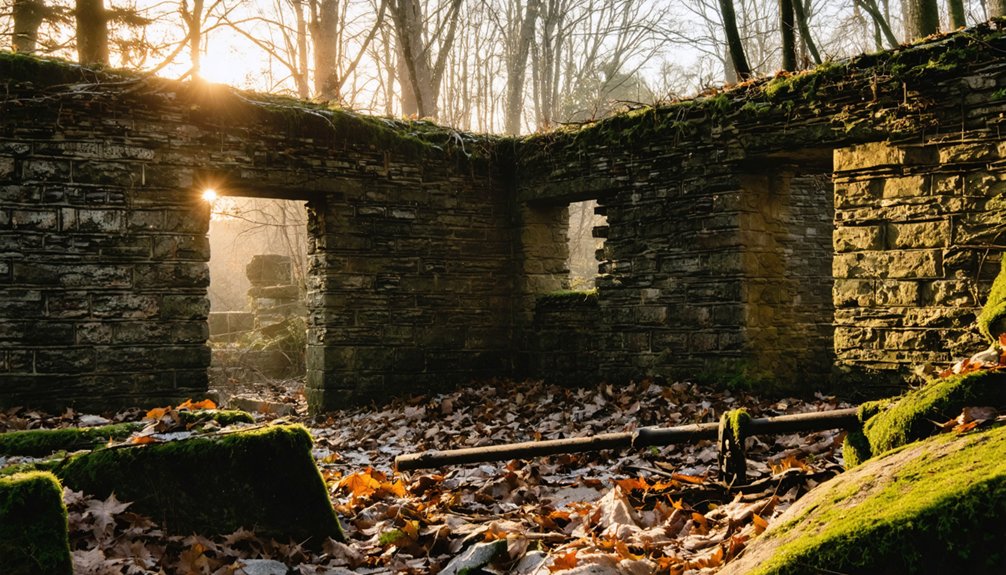
Nestled in the woods of Smithfield, Rhode Island, Hanton City is a colonial-era ghost town that’s been swallowed by centuries of overgrowth.
You’ll find stone foundations, crumbling walls, a defunct irrigation dam, and a small burial site scattered across a sprawling, heavily wooded landscape.
Founded in the late 1600s by English families following King Philip’s War, the settlement was completely abandoned by the early 1800s.
Established by English settlers after King Philip’s War, Hanton City thrived briefly before vanishing into abandonment by the 1800s.
Locals know it as the “Lost City” or “Haunted City,” and ghost stories have shadowed the site ever since.
Hanton City typifies the small New England farming communities that once dotted this region.
Today, it’s a fascinating open-air ruin hiding in plain sight — if you’re willing to push through the brush to find it.
Why These Families Left : And Never Came Back
When you walk through the crumbling stone foundations of Hanton City, you can’t help but wonder what finally broke these families’ resolve to stay.
The land itself worked against them — isolated from Smithfield’s main settlement, the community struggled under the weight of economic hardship, with little trade or outside support to sustain it.
Economic Hardships Forced Departure
By the early 1800s, the families of Hanton City had reached a breaking point. The land they’d cleared and farmed for generations simply couldn’t sustain them anymore. Economic decline crept in slowly, draining their resources and crushing their family legacy piece by piece.
Soil exhaustion, harsh New England winters, and isolation from thriving trade routes made survival increasingly difficult. You can almost picture it — families quietly loading their belongings, taking one last look at stone foundations they’d built with their own hands, then walking away forever.
Better opportunities existed elsewhere, and staying meant choosing struggle over freedom. They chose to leave.
The forests eventually reclaimed everything they’d built, swallowing their homes, their walls, and their stories beneath centuries of thick New England growth.
Isolation Drove Families Away
Economic hardship wasn’t the only force pushing these families out — isolation carved away at them just as deeply.
Cut off from Smithfield’s main settlement, the Paines, Hantons, and Shippees existed in a world apart. No easy roads connected them to markets, neighbors, or opportunity. That physical separation reshaped family dynamics over generations, straining relationships and limiting choices.
Young people seeking broader lives had nowhere to turn without leaving entirely. Isolation factors compounded with each passing decade — fewer resources, fewer connections, fewer reasons to stay.
When the early 1800s arrived, remaining meant accepting a shrinking world. Freedom demanded movement. So they left, one family at a time, surrendering their stone foundations and cleared fields to the relentless New England wilderness creeping back to claim everything.
The King Philip’s War Connection That Started It All
The story of Hanton City begins with one of colonial New England’s bloodiest conflicts: King Philip’s War (1675–1676). This devastating war between English colonists and Native American tribes reshaped the region’s entire landscape.
Hanton City’s origins trace back to King Philip’s War — one of colonial New England’s most devastating and bloody conflicts.
When the fighting ended, colonial settlements expanded rapidly as victorious English families claimed new territory.
Three founding families — the Paines, Hantons, and Shippees — likely received land grants as direct compensation for their war service. They carved out an independent life deep in what’s now Smithfield, Rhode Island, building stone foundations, walls, and a functional irrigation dam from scratch.
You’re fundamentally walking through land that freedom-seeking families earned through sacrifice. Their reward was autonomy — a self-sufficient community answering to nobody, tucked away from the growing colonial world surrounding them.
What You’ll Actually Find at the Hanton City Site
Once you push through the overgrowth and navigate the ¾-mile walk from 70 W. Reservoir Road, Hanton City reveals itself slowly. Your first landmark is an old cellar hole sitting in a clearing on the right — easy to miss if you’re not paying attention.
From there, you’ll discover crumbling stone foundations, ancient walls, and a defunct irrigation dam scattered across a surprisingly vast area.
The Alfred Smith Cemetery holds two graves: Alice Herrington and Daniel Brown, both quietly forgotten by time.
Don’t expect tidy ruins — vegetation swallows everything here. Most visitors need two trips to locate all the remains.
The ghost stories surrounding Hanton City only deepen when you’re standing amid centuries-old stonework, completely alone in the woods. Come prepared, stay curious, and bring a good map.
How to Reach the Hanton City Trail From Smithfield

Knowing what waits for you inside Hanton City makes getting there feel that much more urgent.
Knowing what hides inside Hanton City makes every step toward it feel like it already counts.
For trail access, head to 70 W. Reservoir Road in Smithfield, Rhode Island. That’s your launching point for the Hanton City Hiking Trail. From the trailhead, you’ll walk roughly three-quarters of a mile before spotting the first old cellar hole on your right, sitting inside a natural clearing.
The path itself isn’t complicated, but the site sprawls across a huge area once you’re inside. Overgrowth swallows the ruins fast, so bring a good eye and patience. Most explorers need at least two separate visits to track down everything the ghost town holds.
Wear sturdy boots, pack water, and give yourself enough daylight to wander freely.
The Best Time of Year to Visit Hanton City’s Ruins
Late fall strips the site bare in the best possible way. Once the leaves drop, seasonal changes reveal stone foundations and collapsed walls that thick summer vegetation completely swallows.
You’ll navigate the overgrown ruins far more easily when undergrowth dies back, making it simpler to track down every cellar hole and crumbling structure across the sprawling site.
Winter visits offer crisp visibility but frozen ground and snow can obscure low-lying features.
Spring brings fresh growth that quickly reclaims the ruins again.
If ghost sightings interest you, dusk on a clear October evening hits differently here. Long shadows stretch across the Alfred Smith Cemetery, and the silence feels earned.
Come prepared with sturdy boots, a trail map, and enough daylight to explore thoroughly without rushing.
What to Bring on a Hanton City Ghost Town Hike

Timing your visit right sets you up for success, but what you carry into the woods matters just as much.
Hanton City’s ghost town exploration demands preparation. Pack these hiking essentials before hitting the Hanton City Trail:
- Navigation: Download offline maps or bring a printed trail guide — cell service is unreliable.
- Footwear: Wear sturdy, waterproof boots for uneven, overgrown terrain.
- Water and snacks: You’ll likely make two visits to cover the sprawling ruins.
- Tick protection: Long pants, insect repellent, and a tick removal tool are non-negotiable.
- Camera: Stone foundations and the Alfred Smith Cemetery deserve documentation.
- Layers: Temperature shifts quickly under forest canopy.
Travel light, stay sharp, and you’ll move freely through one of Rhode Island’s most fascinating forgotten landscapes.
Other Haunted Rhode Island Sites Near Hanton City
Hanton City isn’t the only place in Rhode Island where history takes a darker turn. The state offers several haunted legends worth adding to your road trip itinerary.
Head to Exeter to explore the Mercy Brown vampire legend, where an 1892 exhumation sparked national fascination. The abandoned Ladd School, also in Exeter, closed in 1994 and reportedly delivers ghostly encounters through unexplained screams and shadowy figures.
Travel to Charlestown and you’ll find the General Stanton Inn, a colonial landmark dating to 1650, where permanent ghostly residents allegedly still roam.
For something more grounded in Revolutionary history, visit the General Nathanael Greene Homestead, reportedly haunted since 1770.
Rhode Island packs centuries of eerie history into a compact, drivable landscape, making it a compelling destination for any adventure-minded explorer.

Swapping ghost stories for practical preparation makes all the difference once you’re standing at the trailhead of Hanton City.
Traversing ruins without clear markings demands serious attention, so follow these safety tips before stepping off the path.
Wear sturdy boots — hidden foundation edges and crumbling stone walls twist ankles fast.
Download an offline trail map, since cell service gets unreliable deep in the woods. Bring a compass or GPS device as backup.
Walk slowly through dense vegetation, probing ahead with a hiking pole if possible.
Never step onto deteriorating stone foundations; they’re structurally unpredictable.
Tell someone your planned route and expected return time.
Plan for two separate visits — the ruins spread across a massive area, and rushing through unfamiliar overgrowth is how accidents happen.
Who This Hike Is Actually For : And Who Should Skip It
If you’re the type who thrives on rugged, self-guided exploration through dense overgrowth with minimal trail markers, Hanton City is your kind of challenge.
You’ll need solid navigation skills, sturdy footwear, and the patience to make more than one visit before you’ve tracked down everything the site has to offer.
But if you’re bringing young children, rely on clear signage, or struggle with uneven terrain, you’re better off skipping this one entirely.
Ideal Visitor Profiles
Not every hiker belongs on the Hanton City Trail, and that’s perfectly fine.
This trail rewards curious explorers drawn to ghost town legends and the historical significance of colonial New England. You’ll thrive here if you enjoy puzzle-solving your way through overgrown terrain, piecing together stone foundations and crumbling walls into a coherent story of families who vanished centuries ago.
You’re an ideal visitor if you’re comfortable traversing dense woods without clear signage, willing to return twice to uncover everything, and genuinely fascinated by forgotten communities.
History buffs, amateur archaeologists, and independent adventurers will find this deeply satisfying.
Skip this trail if you need manicured paths, clear markers, or quick payoffs.
Hanton City demands patience, curiosity, and a willingness to get a little lost.
Who Should Stay Home
Hanton City isn’t built for everyone, and knowing where you fall on that spectrum saves you a frustrating afternoon.
Skip this trail if you’re expecting manicured paths, clear signage, or quick ghost stories wrapped up neatly. Some visitors genuinely shouldn’t go:
- Mobility-limited hikers — uneven terrain, dense overgrowth, and no maintained surfaces make navigation genuinely difficult.
- Casual day-trippers — without solid hiking tips and preparation, you’ll leave having found almost nothing.
- Anyone expecting dramatic ruins — Hanton City rewards patience, not spectacle; stone foundations disappear under vegetation fast.
If discomfort frustrates rather than fuels you, this place will disappoint.
But if uncertainty excites you, and you’re willing to search hard for something most people never find, you’re exactly who belongs here.
Frequently Asked Questions
Is Hanton City Located in Ashland or Smithfield, Rhode Island?
You’ll find Hanton City nestled in Smithfield, not Ashland. Exploring its rich Hanton City history means understanding Ashland geography doesn’t include this colonial ghost town — Smithfield’s where your adventurous journey truly begins!
Can You Camp Overnight at the Hanton City Ghost Town Site?
The knowledge base doesn’t specify camping regulations for Hanton City, but since it’s an overgrown, trail-accessed site with no ghost town amenities, you’ll want to check with Smithfield authorities before planning an overnight stay.
Are There Any Guided Tours Available for Hanton City Ruins?
No official guided tours exist for Hanton City, but you’ll find guided exploration opportunities through local historical groups who recognize the site’s historical significance. You’re free to trek independently via the Hanton City Hiking Trail anytime!
Is the Hanton City Trail Accessible to Visitors With Disabilities?
Like nature’s own fortress, Hanton City’s trail conditions make disability access challenging. You’ll navigate rough, overgrown terrain that’s difficult even for able-bodied visitors, so it’s not recommended if you require mobility assistance.
Has Hanton City Ever Been Featured in Television or Film Productions?
There’s no confirmed record of Hanton City appearing in film adaptations or documentaries. However, you’d find its eerie stone ruins, overgrown foundations, and mysterious past make it a compelling subject worthy of future cinematic exploration.
References
- https://www.youtube.com/watch?v=kpy7zlXYrAU
- https://www.rimonthly.com/haunted-places-rhode-island/
- https://www.nostalgiaprovidence.com/rhode-islands-haunted-history/
- https://en.wikipedia.org/wiki/Hanton_City
- https://podcasts.apple.com/us/podcast/57-ghost-town-hanton-city/id1554896421?i=1000563483124
- https://www.youtube.com/shorts/eOO_4AnTeCI
- https://www.youtube.com/shorts/VL2Ovb_A1Tg