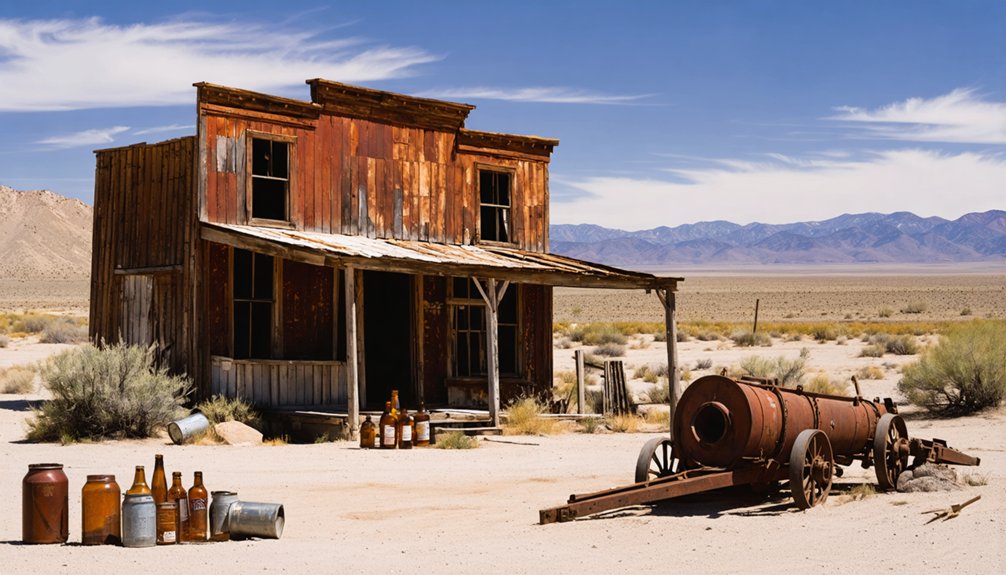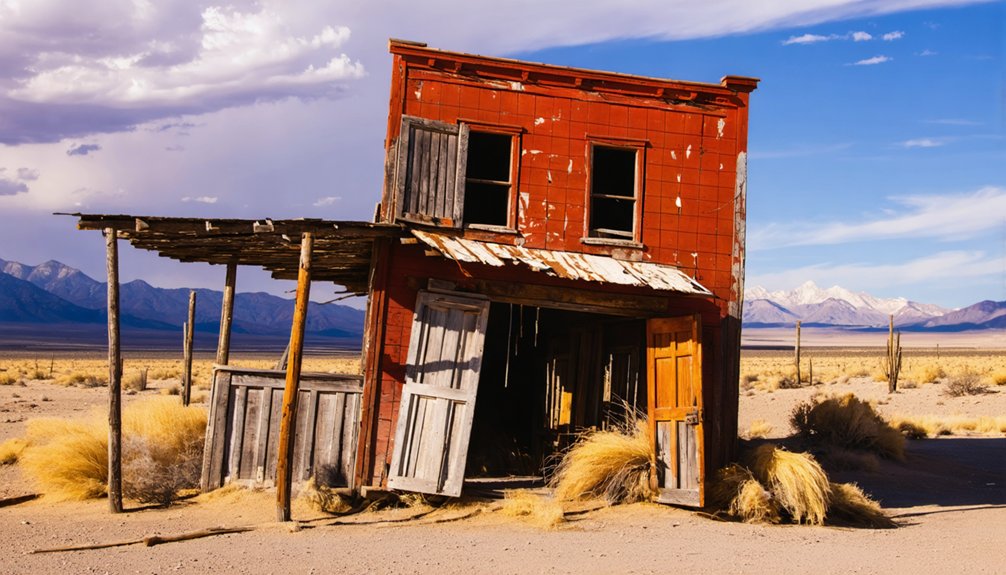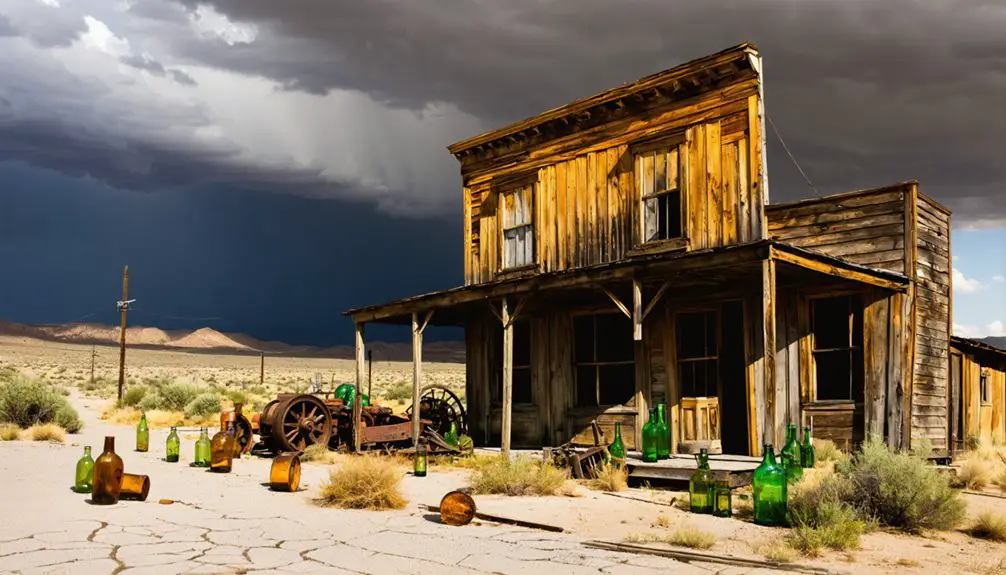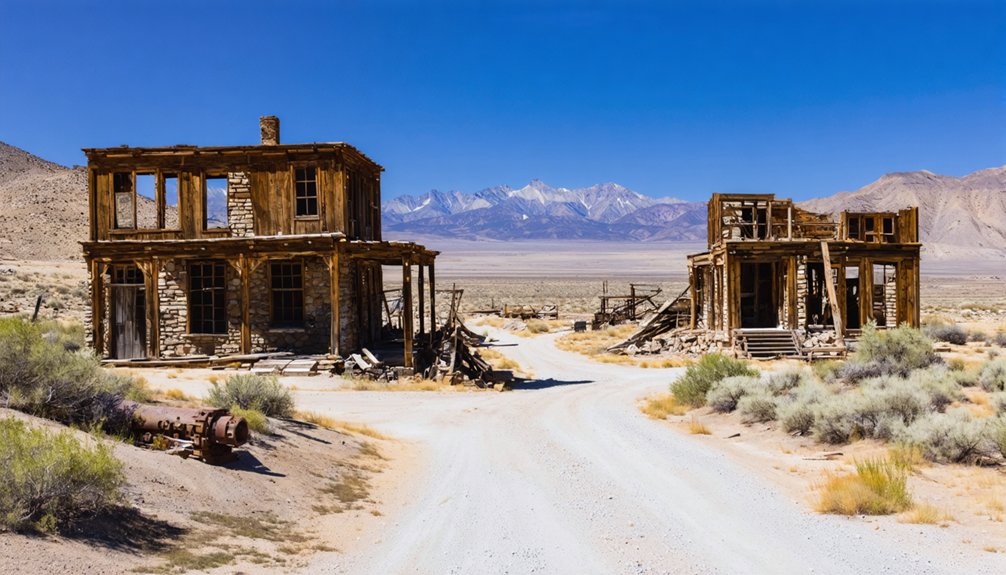
Planning a ghost town road trip to Aurora, Nevada starts in Hawthorne, where you’ll head south on Route 359 before turning onto Lucky Boy Pass Road for a roughly 22-mile drive into the high desert. Once there, you’ll explore a well-preserved cemetery, scattered mine relics, and the ruins of a town that once housed nearly 10,000 residents. Pair it with nearby Bodie for a full day trip. There’s plenty more to uncover about Aurora’s fascinating story.
Key Takeaways
- Aurora, Nevada, is located approximately 22 miles southwest of Hawthorne, accessible via Nevada State Route 359 and Lucky Boy Pass Road.
- Travel 5.9 miles south on Route 359 from Hawthorne’s stoplight, turn right onto Lucky Boy Pass Road, and cover 18.2 miles.
- Aurora’s well-preserved cemetery features weathered headstones and frontier atmosphere, with free access for visitors.
- Historical mining relics, including bottle fragments and rusted tools, highlight Aurora’s peak production of over $29 million in silver and gold.
- Combining Aurora with a visit to Bodie, California, just 12 miles away, makes an ideal full-day ghost town road trip.
What Made Aurora, Nevada a Ghost Town?
Aurora’s story is one of spectacular rise and inevitable collapse. When prospectors struck gold and silver in 1860, the town exploded almost overnight, drawing thousands chasing the gold rush dream.
Aurora’s story is one of spectacular rise and inevitable collapse — a gold rush dream that exploded overnight.
By 1863, nearly 10,000 people called Aurora home, making it Nevada’s second-largest city behind Virginia City.
But the boom couldn’t last. Mining decline hit hard after surface bonanzas dried up, and though a secondary rush briefly revived the town between 1870 and 1882, Aurora never recaptured its former glory.
Residents abandoned it steadily, and by 1897, even the post office shut down.
The final blow came in the 1940s when demolition crews tore down remaining buildings for their bricks.
Today, you’ll find little more than scattered foundations and mine tailings marking where a thriving city once stood.
How to Drive to Aurora Ghost Town From Hawthorne
Visiting what’s left of Aurora takes some planning, but the drive itself is part of the adventure. From Hawthorne, head 5.9 miles south on Nevada State Route 359, then turn right onto Lucky Boy Pass Road.
You’ll cover 18.2 rugged miles through high desert terrain before reaching this ghost town steeped in mining history.
- Start point: Hawthorne stoplight on Nevada State Route 359
- Key turn: Right onto Lucky Boy Pass Road near coordinates 38.475255 N
- Total distance: Approximately 22 miles southwest of Hawthorne
Expect rough dirt roads, so a high-clearance vehicle gives you the best shot at reaching the site comfortably.
The reward is an unfiltered look at authentic mining history with no admission fees and total freedom to explore.
The Cemetery, Mine Relics, and Ruins Still Standing at Aurora
Once you’ve made it out to Aurora, you’ll find the historic cemetery stands as one of the most striking and well-preserved features on the site, offering a haunting glimpse into the lives of those who once called this boom town home.
You can also spot surviving mine relics scattered across the landscape, remnants of the operations that once pulled over $29 million in silver and gold from these hills.
Most of the original buildings are gone, demolished during the 1940s brick salvage era, but minimal foundations and scattered artifacts remain, giving you enough context to piece together what Aurora once looked like at its peak.
Aurora’s Historic Cemetery Highlights
While most of Aurora’s historic structures were demolished for their brick during the 1940s, the site still rewards explorers with a handful of compelling remnants worth the drive out.
The cemetery stands as Aurora’s most powerful example of historic preservation, offering rich cemetery symbolism through weathered headstones that reflect the dreams and hardships of a frontier boomtown.
Here’s what you’ll find worth exploring:
- Headstones and markers revealing the diverse origins of miners who chased silver and gold in Nevada’s wild west
- Epitaphs and iconography carved into stone, preserving personal stories that survived long after the buildings vanished
- Authentic frontier atmosphere with minimal crowds, giving you unfiltered access to a genuine 19th-century burial ground
No admission fee makes this stop an easy, meaningful addition to your road trip.
Surviving Mine Relics Today
Beyond the cemetery’s weathered stones, Aurora’s surviving mine relics round out the experience, giving you a tangible sense of the industrial machinery that once drove this boomtown’s fortune.
Scattered across the site, you’ll find historical artifacts like bottle fragments, rusted tools, and mine tailings that reveal the mining techniques workers relied on during Aurora’s peak years. These remnants paint a vivid picture of the labor-intensive extraction methods that pulled over $29 million in silver and gold from the earth between 1860 and 1869.
Modern mining operations at the nearby Borealis Gold Project have claimed much of the original townsite, but the accessible areas remain free to explore.
Walk the grounds carefully, stay clear of active operations, and let these raw, unpolished relics tell Aurora’s industrial story on your own terms.
Remaining Ruins And Foundations
Foundations tell Aurora’s most honest story—low, crumbling outlines pressed into the desert floor where hotels, assay offices, and saloons once stood shoulder to shoulder.
These abandoned structures carry undeniable historical significance, even stripped down to rubble. Wartime demand for recycled brick during the 1940s gutted most standing buildings, leaving geometry and silence behind.
Walk the grid and you’ll still read the town’s bones clearly.
What you’ll find scattered across the site:
- Stone foundation outlines marking former commercial and residential blocks
- Mine tailings and scattered artifacts including bottle fragments and hand tools from daily frontier life
- Minimal but identifiable remnants where Aurora’s densest neighborhoods once concentrated activity
You’re free to explore non-mining areas without an admission fee, so move at your own pace.
Where to Stay Near Aurora and What to Bring to the Site
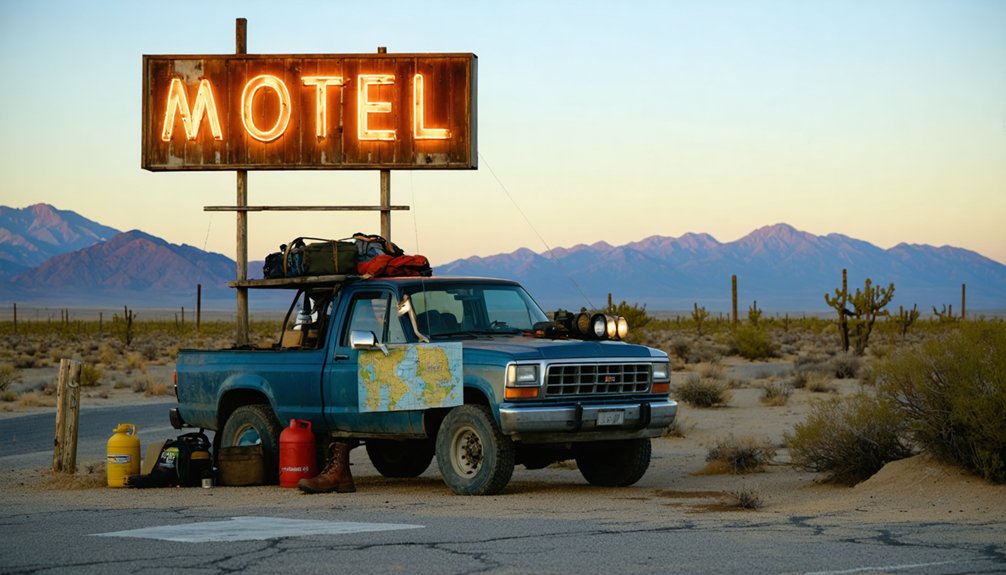
Hawthorne, Nevada, sitting roughly 22 miles northeast of Aurora, is your best bet for overnight accommodations, offering motels and basic amenities before you tackle the dirt roads heading toward the site.
Explore your accommodation options there, then fuel up and load your gear before heading out. The route crosses Lucky Boy Pass on rough, unpaved roads, so a high-clearance vehicle isn’t optional — it’s necessary.
Your packing essentials should include plenty of water, sturdy boots, snacks, and a first-aid kit since no services exist once you leave Hawthorne.
Bring a camera for the historic cemetery and mining relics scattered across the site. Cell service is unreliable, so download offline maps beforehand.
Aurora rewards prepared, self-sufficient explorers who respect both the landscape and its layered history.
Aurora’s Double County Seat and Wild Political Past
If you think Aurora’s geography is complicated, wait until you hear about its political history.
For nearly two years, Aurora pulled off something almost unheard of — simultaneously serving as the county seat for both Mono County, California, and Esmeralda County, Nevada.
That quirky double status finally ended in 1863 when surveyors officially fixed the border four miles to the west, confirming Aurora as firmly Nevada territory.
Dual County Seat Status
Aurora holds a political distinction that’s nearly impossible to believe: for nearly two years, it simultaneously served as the county seat for both Mono County in California and Esmeralda County in Nevada.
This unique governance created a political significance unlike anything else in American frontier history. Nobody knew exactly which state owned the land until surveyors finally settled the debate.
Key facts about Aurora’s dual county seat status:
- Aurora served as Mono County’s California seat from November 1861 until 1863.
- Nevada declared Aurora headquarters of Esmeralda County in August 1860.
- The border was officially fixed four miles west in 1863, placing Aurora firmly in Nevada.
That survey ended the political ambiguity, forcing California officials to relocate and cementing Aurora’s identity as a Nevada town.
Border Survey Resolution
The survey that finally resolved Aurora’s bizarre political limbo came in 1863, when officials fixed the California-Nevada border four miles west of town. That border resolution settled everything instantly — Aurora landed firmly inside Nevada, ending its strange dual identity almost overnight.
Once the county boundary was confirmed, Aurora surrendered its role as Mono County’s California seat and committed fully to Esmeralda County, Nevada.
Officials who’d been collecting taxes and enforcing laws under two separate governments suddenly had clarity.
For a freedom-loving town built by prospectors who answered to nobody, that political certainty actually mattered.
You could finally know which laws applied, which courts held jurisdiction, and which government you’d deal with. The wild double-government experiment was over, and Aurora got back to what it did best — mining.
Pair Aurora With Bodie Ghost Town for a Full Day Trip
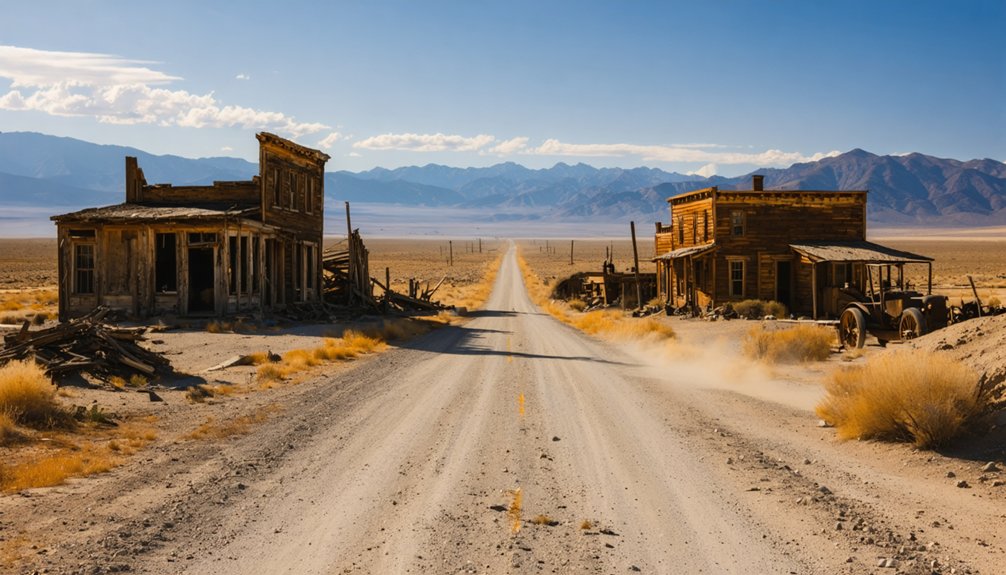
Since Aurora sits just 12 miles from Bodie, California’s most famous ghost town, you’d be missing out if you didn’t combine both into a single day trip.
Both sites share deep historic mining roots, and together they paint a vivid picture of the American West’s boom-and-bust era. Note that entering Aurora via the Bodie route requires paying the state park entrance fee.
Here’s what makes the combined trip worthwhile:
- Bodie attractions include preserved buildings, a church, and a stamp mill frozen in time.
- Historic mining relics at Aurora complement Bodie’s more structured museum experience.
- Exploring both sites rewards you with a fuller understanding of Nevada and California’s shared frontier heritage.
Plan for a full day — you’ll want it.
Frequently Asked Questions
Who Originally Discovered Gold and Silver in the Esmeralda Mining District?
James M. Braley, William B. Hurd, and James Corey made the Gold Discovery in 1860, though E.R. Hicks also reportedly uncovered gold while hunting. Their Mining Techniques revealed Esmeralda’s incredible silver and gold riches for you to explore!
What Was Aurora’s Population at Its Absolute Peak in 1863?
“Strike while the iron’s hot!” At Aurora’s mining boom peak in 1863, you’d have found nearly 10,000 souls chasing the gold rush dream, making it the second-largest city in all of Nevada.
How Much Total Revenue Did Aurora’s Surface Bonanzas Generate Before Depletion?
You’ll be amazed that Aurora’s surface bonanzas generated over $29 million between 1860 and 1869! Those early mining techniques created a massive economic impact before the resources were fully depleted, fueling one of the West’s most thrilling boom towns.
When Exactly Did Aurora’s Post Office Permanently Close Down?
You’ll find that Aurora’s post office history ended with a definitive closure date of 1897, marking the moment this once-thriving boomtown officially transformed into the ghost town you can explore today.
Was a Park Entrance Fee Required to Access the Aurora Townsite Directly?
You don’t need to worry about entrance fees for direct park access to Aurora’s townsite! You’ll explore freely without paying, though if you’re arriving via Bodie’s route, you’ll encounter that park’s required admission fee.
References
- https://travelnevada.com/ghost-town/aurora-ghost-town/
- https://www.youtube.com/watch?v=DHXklwqYeFU
- https://www.destination4x4.com/aurora-nevada-ghosttown-mineral-county/
- https://forgottennevada.org/sites/aurora.html
- https://westernmininghistory.com/towns/nevada/aurora/
- https://www.youtube.com/watch?v=W8dtWa42sgk
- https://www.youtube.com/watch?v=e5TRvW4KsK4
- https://www.youtube.com/watch?v=9prcgmDD1Sc
- https://www.youtube.com/watch?v=FGPTYfFiJpU
- https://nevadamining.org/nevada-ghost-town-aurora/