Planning a ghost town road trip to Gladecrest, Florida, means heading deep into western Palm Beach County, where sugarcane fields now swallow every trace of a community that once housed 72 residents. You’ll navigate Highway 441 west, winding through Twentymile Bend and Six Mile Bend before reaching the eerily silent site. Visit between fall and spring for comfortable exploring. Stick around, because there’s much more to uncover about this fascinating vanished world.
Key Takeaways
- Gladecrest is located in western Palm Beach County, Florida, and is now surrounded by vast sugarcane fields with no remaining structures.
- To reach Gladecrest, head west on Highway 441, navigate through Twentymile Bend, Nine Mile Bend, and turn south off Road 827.
- The site sits 1.5 miles south of Road 827 Hillsboro Canal Road, near Six Mile Bend.
- Visit during fall through spring for cooler temperatures, avoiding summer’s oppressive heat and heavy rainfall.
- Combine your trip by exploring nearby ghost towns like Kraemer Island, Bryant Village, Ritta, Gardena, and Fruitcrest.
What Is Gladecrest, and Is It Worth the Drive?
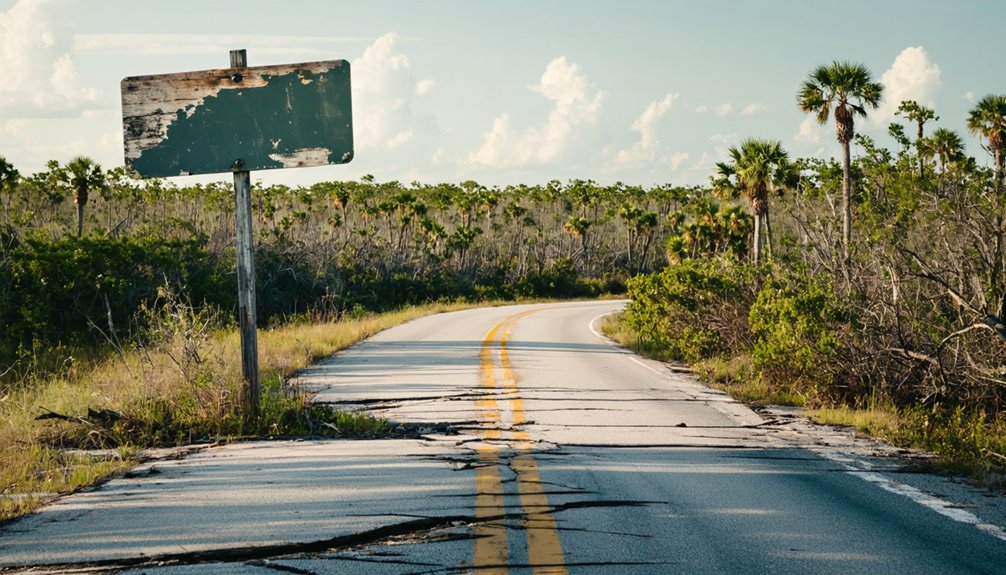
Tucked away in the sugarcane fields of western Palm Beach County, Gladecrest is one of Florida’s most thoroughly vanished ghost towns — no structures, no markers, no residents, just flat farmland where a small farming community once struggled to survive.
Its ghost town characteristics are about as pure as they come: the settlement peaked at just 72 residents in 1915, then collapsed entirely by 1921 following a devastating flood.
You won’t find it on modern maps.
How to Drive to the Gladecrest Ghost Town in Palm Beach County
Getting there’s half the adventure, and Gladecrest isn’t exactly a plug-and-go GPS destination. These driving directions put you in control of the journey.
Getting there is part of the experience — no GPS required, just a sense of direction and a spirit for adventure.
Head west on Highway 441 and turn onto Road 880 at Twentymile Bend. Continue west to Nine Mile Bend, then bear left onto 880 East Canal Street. At Six Mile Bend, turn left onto Road 827 Hillsboro Canal Road. The site sits 1.5 miles south from there.
You won’t find Gladecrest on modern maps, which itself speaks to its historical significance — a once-thriving farming settlement swallowed entirely by sugarcane fields and time.
No structures remain, no markers guide you. That rawness is precisely the point. You’re not visiting a curated attraction; you’re tracing the ghost of a community that simply vanished.
What Replaced Gladecrest: Sugarcane Fields and Silence
Where families once farmed and built their lives, an endless commercial sugarcane operation now stretches across the land. You won’t find a single structure, marker, or remnant of Gladecrest when you arrive — just vast, rustling fields that have swallowed every trace of the community.
The sugarcane history here reflects a broader regional transformation, where small independent settlements gave way to industrial agriculture following years of flooding and abandonment.
The environmental impact is equally striking. Natural Everglades ecosystems that once surrounded this settlement have been dramatically altered by large-scale farming operations.
Standing at this site, you’ll feel the weight of that silence — no buildings, no signs, not even a whisper of the 72 people who once called Gladecrest home.
Freedom, it turns out, sometimes means knowing when a place has truly vanished.
Which Ghost Towns in Palm Beach County Are Near Gladecrest?
Gladecrest didn’t vanish alone — several other ghost towns once dotted Palm Beach County, each with its own story of ambition and collapse.
Gladecrest wasn’t the only town swallowed by time — Palm Beach County’s forgotten landscape is littered with lost ambitions.
If you’re already making the drive out, you might as well explore the bigger picture of this region’s forgotten past.
Here are a few nearby ghost towns worth knowing:
- Kraemer Island – Founded in 1893, it’s one of the oldest lost settlements in the county.
- Bryant Village – Appeared in 1902, just a few years into the new century.
- Ritta – Emerged in 1909, another casualty of the region’s unforgiving conditions.
- Gardena and Fruitcrest – Both founded in 1912, just one year before Gladecrest itself.
Each settlement tried to tame the same wild landscape — and each eventually lost.
When Is the Best Time to Visit Gladecrest and the Surrounding Area?
Now that you know where to look for Gladecrest and its neighboring ghost towns, you’ll want to plan your visit carefully — because Florida’s climate can make or break the experience.
The best visiting season runs from fall through spring, when temperatures drop from brutal summer highs to something genuinely comfortable. Summer brings oppressive heat and heavy rainfall, making swampy Everglades terrain miserable and potentially dangerous to navigate.
Visiting during cooler months also connects you more deeply to the historical significance of Gladecrest’s story — settlers endured harsh conditions year-round, and standing in that sugarcane field during a crisp winter morning makes their struggle feel real.
You’ll move freely through the landscape, absorb the silence, and appreciate just how completely this once-thriving farming community has vanished into the Florida wilderness.
Frequently Asked Questions
What Was Gladecrest’s Total Population at Its Peak in 1915?
You’ll find Gladecrest’s peak population reached exactly 72 residents in spring 1915, a number carrying remarkable historical significance. These population dynamics reflect a vibrant, free-spirited community that boldly carved life from Florida’s wild Everglades landscape.
When Was Gladecrest Originally Founded as a Farming Settlement?
You’ll find Gladecrest’s historical significance rooted in late 1913, when pioneers established this farming settlement using early farming techniques. It’s a enthralling chapter of Florida’s frontier spirit, embodying freedom-seeking settlers carving life from the wilderness.
Are There Any Physical Structures or Remains Visible at Gladecrest Today?
Like a page wiped clean, you won’t find any ghostly artifacts or abandoned architecture at Gladecrest today. The sugarcane fields have swallowed every trace, leaving you standing on land that’s completely erased its past.
What Caused Residents to Initially Begin Leaving Gladecrest in 1915?
You’ll find that hardships drove the economic decline, pushing families to flee Gladecrest in fall 1915. Social factors intensified as vegetable production struggled, compelling residents to abandon their once-promising farming dreams for better opportunities elsewhere.
How Long Did Gladecrest Exist Before Becoming Completely Abandoned?
Like a candle burning briefly in the dark, Gladecrest existed for roughly eight years before complete abandonment in 1921. You’ll appreciate its historical significance among Florida’s ghost towns, knowing it flickered from 1913 to 1921.
References
- https://www.ghosttowns.com/states/fl/gladecrest.html
- https://www.palmbeachpost.com/story/news/local/2025/03/04/history-ghost-lost-towns-palm-beach-county-florida/78970195007/
- https://www.journaloffloridastudies.org/0102ghosttowns.html
- http://pbchistory.blogspot.com/2016/09/digging-up-palm-beach-countys-haunted.html
- https://freepages.history.rootsweb.com/~gtusa/usa/fl.htm
- https://www.youtube.com/watch?v=TxBONhwNi1k
- https://en.wikipedia.org/wiki/List_of_ghost_towns_in_Florida
- https://pbchistory.org/evergladesdestiny/
- https://www.youtube.com/watch?v=0kzAaaal1X0
- https://www.youtube.com/watch?v=FS0v3OQMNgw