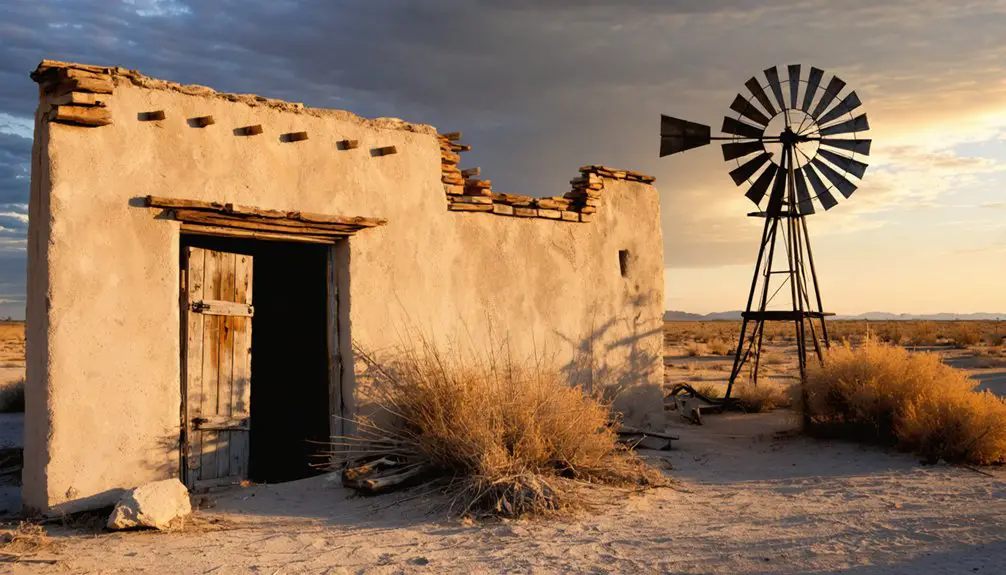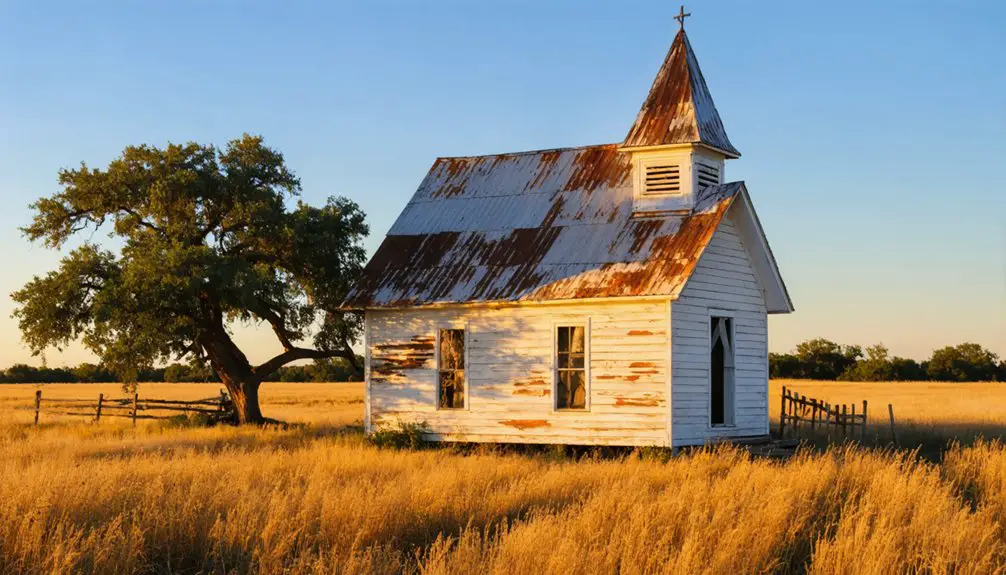
You’ll find Becton’s haunting remnants 24 miles east of Lubbock via Highway 84 and FM Road 400, where collapsed buildings and a solitary cemetery marker stand as evidence to a ranching community that couldn’t survive agricultural mechanization. The windswept South Plains landscape has reclaimed most structures, leaving behind foundations and rubble that whisper stories of early 20th-century boom and inevitable decline. Pair your visit with nearby ghost towns like Phillips and Belle Plain to discover the economic forces that transformed thriving settlements into silent ruins across Texas’s vast horizons.
Key Takeaways
- Becton is located 24 miles from Lubbock via US Highway 84 east through Slaton, then Farm to Market Road 400.
- The ghost town features mostly collapsed buildings, rubble, and a historical cemetery marker explaining its lost legacy.
- Wear sturdy boots, bring water and provisions, and use cameras or drones to document structures from a distance.
- Respect private property by staying outside fenced areas and never entering restricted properties or ignoring preservation guidelines.
- Combine your visit with nearby ghost towns like Phillips, Plemons, and Belle Plain for a complete exploration experience.
The History Behind Becton’s Name Changes and Settlement
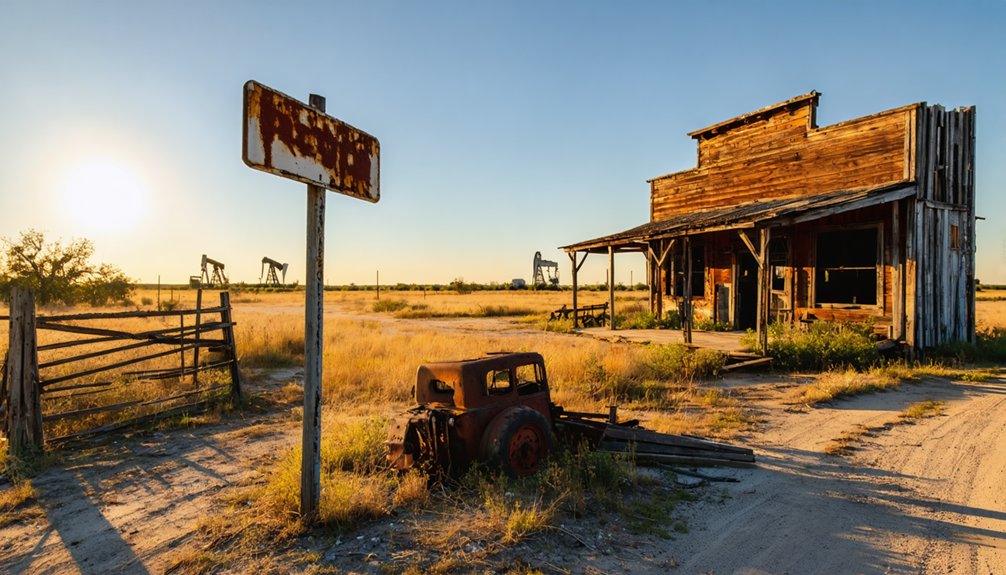
Deep in the South Plains of Lubbock County, a ranching settlement first took shape under the name of W. E. Bledsoe, honoring a Three Circle Ranch cattleman. You’ll find this place rode the wave of Texas’s agricultural economic boom, when wide-open rangeland promised prosperity to anyone willing to stake their claim.
But freedom came with constraints. When E. H. Moody sought postal service in 1917, federal regulations demanded a name change—another Texas town already claimed Bledsoe. The settlement became Becton, trading its original identity for connectivity to the outside world.
This compromise marked both recognition and the beginning of dependency. What started as an independent ranching outpost now needed government approval just to receive mail, foreshadowing the infrastructure challenges that would eventually empty these plains. Like Gomez in Terry County, Becton faced existential challenges that would determine whether it survived or became another footnote in Texas history. Similar to Thurber in Erath County, which once stood as the most populous city between Fort Worth and El Paso before becoming semi-abandoned, Becton’s trajectory reflected the vulnerability of Texas company towns and rural settlements to economic shifts.
What Remains Today: Exploring Becton’s Ruins and Landscape
The compromise that brought Becton its post office couldn’t save it from disappearing into the plains. Today, you’ll find mostly rubble where buildings once stood—most structures were hauled off to nearby Abernathy decades ago. What’s left has surrendered to the barren, windswept terrain of Lubbock County’s South Plains.
The cemetery stands as your primary destination, holding cultural heritage remnants that whisper stories of settlers who carved lives from unforgiving land. Its historical marker details the town’s lost legacy, offering context to the open fields stretching around you. Becton joins an estimated 511 ghost towns scattered across Texas, each marked by similar traces of vanished communities. Like Old Bluffton, which was submerged after the construction of Buchanan Dam in the 1930s, Becton represents one of many Texas towns that met their end through either natural forces or human development.
Drive the Lubbock County roads and you’ll spot foundations bleeding into pastureland, roofless walls casting shadows across sparse grass. It’s raw, unfiltered Texas—a landscape that reclaimed what civilization briefly borrowed.
Best Routes and Nearby Ghost Towns to Visit
From Lubbock’s city limits, your journey to Becton unfolds across 24 miles of unbroken Llano Estacado—flat, wind-carved plains that stretch toward horizons so distant they blur into mirages. Take US Highway 84 east through Slaton, then veer onto Farm to Market Road 400 where historic railroad crossings mark forgotten commerce routes and local legends of Becton whisper through collapsed wooden overpasses.
Extend your exploration beyond Becton’s remnants:
- Hutchinson County Loop: Phillips and Plemons offer cemetery solitude and oil-boom ghosts
- Belle Plain Expedition: Former Callahan County seat preserves courthouse foundations west of Abilene
- Fort Phantom Hill Circuit: Combine Jones County’s stone chimneys with Texon’s oil-era ruins
- Perico Traces: Panhandle’s Dallam County holds vanished settlements swallowed by wheat fields
- Benton City Trail: Navigate to Atascosa County’s vanished 1876 settlement where FM 3175 cuts through abandoned town sites southwest of San Antonio
Each route delivers liberation from modern constraints—pure exploration without guideposts or crowds. These journeys reveal how economic decline transformed once-thriving settlements into the ghost towns scattered across Texas today.
Understanding the Decline of This Texas Panhandle Community
Becton’s transformation from bustling community to windswept ghost town mirrors a pattern repeated across hundreds of Texas settlements—a slow hemorrhage of people, churches, and commerce that began in the mid-20th century and never reversed.
A slow hemorrhage of people, churches, and commerce that began in the mid-20th century and never reversed.
You’ll find the skeletal remains of a town strangled by economic vulnerability. Agricultural shifts hit hard—mechanization reduced labor needs while cotton market fluctuations pushed families toward urban opportunities.
The civic infrastructure decline tells its own story: Bledsoe Church of Christ closed its doors in the early 1970s, while Becton Baptist Church dissolved its congregation in 1973 after membership dwindled through the 1960s.
Without diversified investment in infrastructure, healthcare, and economic diversification, Becton couldn’t compete. When churches shuttered and businesses dried up, the exodus became inevitable. Today, only prairie wind occupies these abandoned streets. Like ghost towns across Texas, Becton now attracts history lovers and photographers drawn to its picturesque decay.
Essential Tips for Your Becton Ghost Town Adventure
Before you load up your truck for this remote Panhandle expedition, recognize that ghost town exploration demands different preparation than your typical Texas road trip. Becton’s scattered ruins require cautionary safety measures and responsible visitor conduct to preserve what remains.
Essential gear includes:
- Sturdy boots for traversing loose gravel around weathered foundations and overgrown cemetery paths
- Ample water and provisions since services don’t exist for miles
- Camera or drone for documenting crumbling adobe structures from respectful distances
- Detailed maps showing property boundaries near historic markers
Stay outside fenced areas, never enter restricted properties, and photograph artifacts without touching them. The windswept terrain and extreme Panhandle weather demand weather-appropriate clothing. Supervise children near unstable ruins. Your freedom to roam these forgotten settlements depends on respecting preservation guidelines and private land. Many of these once-thriving communities declined during the Great Depression, leading to fires and mass departures that left behind the ruins visible today. Consider pairing your ghost town exploration with nearby Big Bend National Park using a self-guided audio tour to maximize your West Texas adventure.
Frequently Asked Questions
Is Becton on Private Property or Open to Public Access?
Becton sits on private land ownership, blocking your wandering spirit. Public access restrictions fence off this ghost town’s secrets, leaving you gazing through barbed wire at faded dreams. You’ll need landowner permission before exploring these forgotten ruins.
What Time of Year Is Best to Visit Becton?
Visit Becton during fall foliage season—late October through November—when cooler temperatures make exploring historic landmarks comfortable. You’ll avoid brutal summer heat while wandering freely through weathered structures, with crisp autumn air enhancing your adventure through this abandoned Texas settlement.
Are There Restrooms or Facilities Available Near Becton?
No facilities exist in abandoned Becton itself. You’ll need to plan ahead for rest stop amenities in surrounding towns like Clarendon or Memphis. Nearby accommodations offer your only reliable access to restrooms and supplies for this remote adventure.
Is Cell Phone Service Available in the Becton Area?
You’ll face significant coverage issues in Becton’s remote West Texas location. Rural areas experience noticeably reduced signal availability, meaning you’ll encounter spotty connectivity from all major carriers. Download maps offline before venturing into this isolated ghost town territory.
What Safety Precautions Should Visitors Take When Exploring Becton?
Dress appropriately for extreme West Texas weather and bring emergency supplies including extra water, fuel, and navigation tools. You’ll need high-clearance transport, respect private boundaries, and prepare for complete isolation where cell service vanishes into endless desert horizons.
References
- https://www.ghostsandgetaways.com/blog-1/27-fascinating-ghost-towns-in-texas
- https://en.wikipedia.org/wiki/List_of_ghost_towns_in_Texas
- https://www.thelubbock.org/lubbock-news/lubbocks-legacy-how-ghost-towns-across-texas-reflect-the-struggles-of-small-communities
- https://www.tshaonline.org/handbook/entries/becton-tx
- https://www.texasstandard.org/stories/texas-population-boom-ghost-towns-rural-urban-suburban-shift/
- https://www.texastribune.org/2024/11/14/texas-population-changes-rural-urban/
- https://www.youtube.com/watch?v=Ux4FjzHs5DE
- https://www.youtube.com/watch?v=Q8x29dlPoA0
- https://www.youtube.com/watch?v=hzzN5tccSbU
- https://www.texasescapes.com/SouthTexasTowns/Benton-Texas.htm