Planning a ghost town road trip to Blumenthal, Texas means chasing down a forgotten German farming settlement 17 miles south of Industry in Colorado County. You won’t find it on most maps, and there’s no post office, no diner, no gas station — just limestone foundations, overgrown fence lines, and the quiet echo of immigrant determination. Spring wildflowers honor its name, “valley of flowers.” Pack water, sturdy boots, and a camera, because there’s far more to this story than the road reveals at first glance.
Key Takeaways
- Blumenthal, Texas, is a ghost town located 17 miles south of Industry in northern Colorado County, founded by German settlers before 1840.
- Few physical remnants remain, but visitors can spot limestone foundation stones, overgrown fence lines, mature settler-planted trees, and soil depressions.
- Spring and fall offer the best visiting conditions; avoid summer due to extreme heat and high humidity.
- Pack water, sturdy boots, offline maps, and sun protection, as Blumenthal has no commercial stops or reliable cell service.
- Nearby Columbus and Weimar provide fuel, food, and supplies before exploring Blumenthal and surrounding ghost towns like Frelsburg and Cat Spring.
Blumenthal, Texas: The Ghost Town That Never Had a Post Office
When you trace the quiet back roads of northern Colorado County, about 17 miles south of Industry, you’ll stumble upon a place that never quite became a place — Blumenthal, Texas.
Rooted in Blumenthal history, this settlement took shape before 1840 when German settlers carved a farming community near Redgates Creek. They named it beautifully — “valley of flowers” — yet it never grew beyond its agricultural bones.
No post office ever opened here. No commercial strip ever developed. It remained deliberately small, shaped by faith and fieldwork rather than ambition.
Why German Immigrants Founded Blumenthal: and What Happened to Them
Though the name Blumenthal means “valley of flowers,” the Germans who founded it weren’t chasing poetry — they were fleeing hardship. German migration brought these settlers to Colorado County before 1840, driven by the promise of land and self-determination.
They carved out a farming life along Redgates Creek, where agricultural practices shaped every sunrise. Community life centered around faith and education, anchored by Louis Cachand Ervendberg, Texas’ first known German Protestant missionary, who established a congregation in 1840.
Along Redgates Creek, faith and farming intertwined — Louis Ervendberg’s congregation rooting a community as firmly as any crop.
But freedom isn’t always permanent. As the agricultural economy faded, so did Blumenthal. Families scattered, structures crumbled, and the population shrank to nearly nothing by the mid-20th century.
Today, its historical significance survives in records — a quiet tribute to those who dared build something from nothing.
Which Ghost Towns Near Blumenthal Are Worth the Detour?
Blumenthal didn’t fall alone — it was one thread in a larger unraveling. The surrounding Colorado County countryside holds several communities that share its quiet fate, each worth a detour if you’re chasing ghost town legends across open Texas roads.
Frelsburg retains fragments of abandoned infrastructure and German architectural character.
Industry, just 17 miles north, was Texas’ first documented German settlement — still breathing, but barely.
Cat Spring carries an agricultural society dating to 1856, hauntingly preserved.
Cummins Creek and Biegel round out this forgotten corridor, each representing a small farming dream that economic shifts quietly extinguished.
Plot these stops deliberately. You’re not just sightseeing — you’re tracing an entire immigrant generation’s ambition, survival, and eventual disappearance into the Texas landscape.
How to Get to Blumenthal From Houston or Austin
Whether you’re rolling out of Houston or Austin, the drive to Blumenthal winds through the same rolling Colorado County terrain that German settlers once claimed as their own.
From Houston, you’ll head northwest on I-10 toward Industry, then cut south roughly 17 miles; from Austin, you’ll push east on Highway 290 before dropping down into Colorado County’s quiet back roads.
Either way, you’ll want to map out a few pit stops — Frelsburg, Cat Spring, and Industry all sit nearby and carry their own storied immigrant histories worth a pause.
Houston Route Directions
Reaching Blumenthal from Houston takes roughly 75 miles of westward driving, a journey that retraces the same general corridor German settlers once traveled as they pushed into Colorado County‘s fertile bottomlands.
Understanding Blumenthal history deepens every mile you cover.
Follow these directions:
- Take I-10 West from Houston toward Columbus
- Exit at Columbus and head north on US-90 toward Industry
- Continue approximately 17 miles south of Industry toward Colorado County’s back roads
- Navigate toward Redgates Creek, where Blumenthal’s remnants quietly persist
Ghost town preservation efforts guarantee this site remains historically documented, even as physical structures have largely vanished.
You’re not just driving through farmland — you’re tracing immigrant footsteps across terrain that shaped Texas long before commercial ambitions rewrote the landscape.
Austin Route Directions
Driving from Austin to Blumenthal puts you on a roughly 100-mile journey eastward into Colorado County, cutting through the same Hill Country corridor where German settlers once debated which river valley might sustain their ambitions.
Take US-290 East toward Brenham, then navigate south through Industry—the town that, unlike Blumenthal, actually survived. From Industry, head approximately 17 miles south until Redgates Creek country opens around you.
You won’t find road signs celebrating ghost town history here, and that’s precisely the point. Blumenthal’s community legacy exists in the silence between the trees, in soil that once fed families who built a Protestant congregation before Texas joined the Union.
This road rewards curiosity over comfort—bring paper maps and embrace the uncertainty.
Road Trip Pit Stops
Both Houston and Austin funnel you toward the same destination—a vanished German farming settlement that never had a post office, never drew a commercial district, and still managed to outlast most frontier ambitions by sheer agricultural stubbornness.
Before you chase ghost town legends through Colorado County, plan these pit stops:
- Industry, Texas – Grab fuel and supplies 17 miles north of Blumenthal; ask locals about regional folklore surrounding German immigrant settlements.
- Frelsburg – A neighboring community sharing similar heritage and abandonment patterns worth exploring.
- Cat Spring – Stop to photograph remaining historical architecture before reaching your destination.
- Redgates Creek vicinity – Park near the creek where Blumenthal once thrived and walk the land where Louis Ervendberg’s congregation first gathered in 1840.
What Physical Evidence Remains at Blumenthal Today
When you arrive at Blumenthal today, you won’t find much standing — the structures that once anchored this German immigrant farming community have largely crumbled or vanished entirely.
What you’ll find are the land’s natural bones: the roll of the terrain near Redgates Creek and the quiet fields that early settlers once worked.
Keep your eyes sharp for subtle remnants like old foundations, fence lines, or mature trees that often outlast every human-built structure on abandoned homesteads.
Remaining Structural Remnants
Arriving at the site of Blumenthal today, you’ll find nature has largely reclaimed what German settlers once carved out of the Texas landscape.
The remaining remnants carry deep historical significance for those willing to look closely.
Watch for these four physical clues:
- Scattered foundation stones — limestone outlines marking where farmhouses once stood
- Overgrown fence lines — old boundary markers still threading through the brush
- Mature trees — deliberately planted by settlers, now towering above abandoned clearings
- Soil depressions — subtle ground variations revealing former cellar pits or gathering areas
You’re fundamentally reading the land like a document.
Redgates Creek still flows nearby, unchanged.
Everything else — the congregation, the schoolhouse, the community itself — exists now only in the earth’s quiet memory.
Land And Natural Features
Beyond the foundation stones and fence lines, the land itself becomes your most reliable guide to understanding what Blumenthal once was. The natural landscape speaks volumes when human structures can’t. Redgates Creek still cuts through the surrounding terrain, offering the same water source that originally drew German settlers here before 1840. That creek hasn’t forgotten this community, even if most maps have.
Today, the rolling Colorado County terrain has reclaimed its authority. Fields that once supported farming families now serve primarily as wildlife habitat, sheltering deer, native birds, and the quiet persistence of untamed Texas nature.
You’ll notice how the land breathes differently here — unhurried, expansive, free. That agricultural silence isn’t emptiness; it’s the honest inheritance of a community that simply returned to the earth.
Best Time of Year for a Blumenthal Road Trip
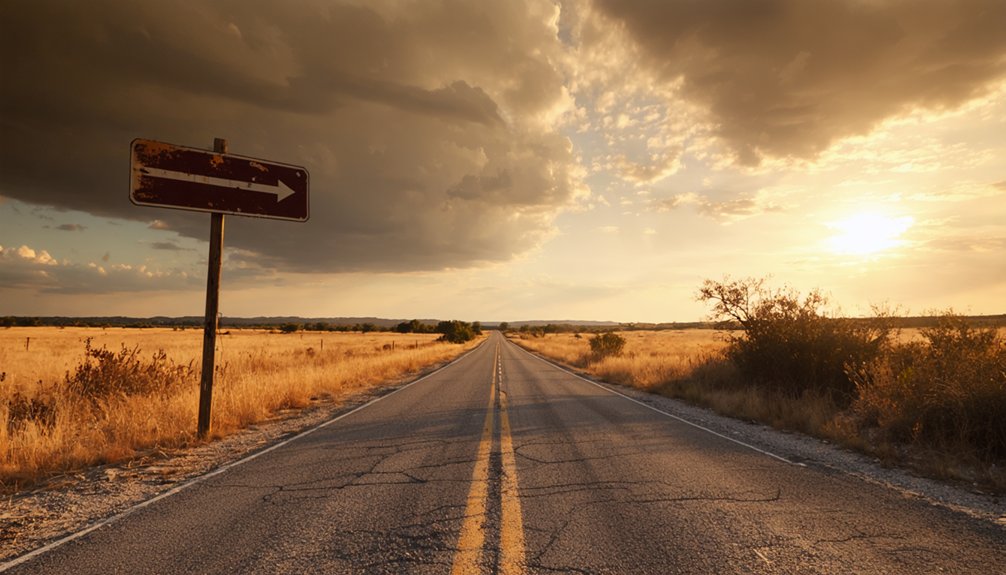
Timing your visit to Blumenthal wisely can make the difference between a rewarding journey and a miserable one. Texas weather is unforgiving, so knowing the best travel season matters. Ideal weather conditions peak during these windows:
Time your visit right—Texas weather is unforgiving, and the difference between rewarding and miserable is knowing when to go.
- Spring (March–May): Wildflowers bloom across Colorado County, echoing Blumenthal’s name—”valley of flowers.”
- Fall (October–November): Cooler temperatures make exploring open terrain comfortable and photography rewarding.
- Winter (December–February): Crowds disappear entirely, giving you raw, solitary access to forgotten history.
- Avoid Summer (June–August): Brutal heat and humidity punish unprepared travelers on exposed rural roads.
Pack water, wear sturdy boots, and bring a detailed map. Cell service is unreliable near Redgates Creek.
The freedom of open road exploration demands preparation—respect the land, and it’ll reward you.
What to Bring for a Day Trip to Blumenthal and Colorado County
Once you’ve locked in your travel window, packing smart separates a rewarding ghost town expedition from a frustrating one.
Blumenthal’s remote location near Redgates Creek means you’re stepping into terrain that doesn’t accommodate unpreparedness.
Bring these essentials:
- Water and snacks — no commercial stops exist here
- Sturdy boots — overgrown fields and uneven ground define this agricultural heritage landscape
- Camera and notebook — ghost town history deserves documentation
- Detailed maps or downloaded offline GPS — cell service is unreliable
- Sun protection — Colorado County’s open terrain offers little shade
- A local history reference — context transforms ruins into meaning
You’re not visiting a curated museum.
You’re reading a landscape where German immigrants once carved farmland from Texas wilderness.
Respect that, and arrive ready.
Where to Eat and Stay on a Colorado County Ghost Town Road Trip
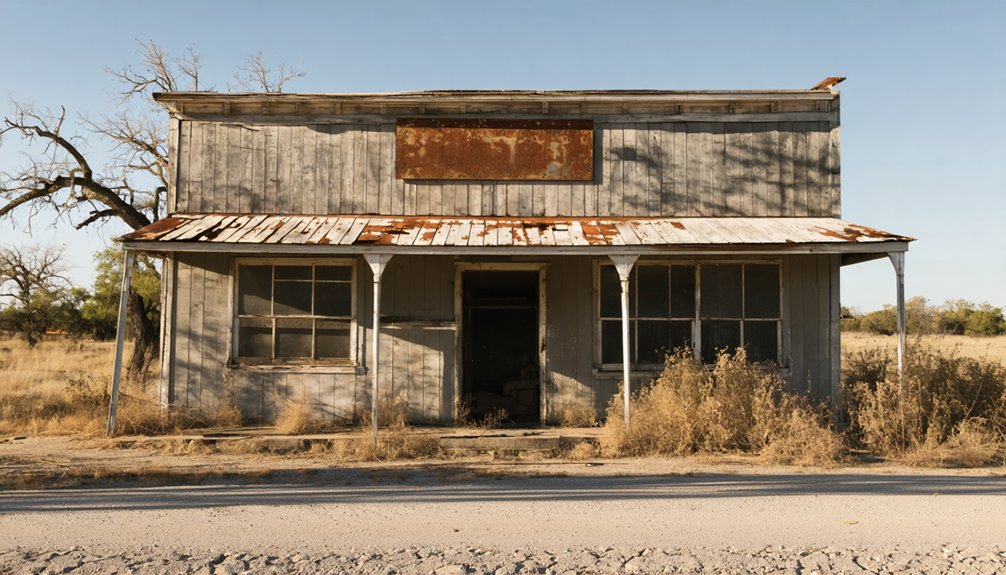
Blumenthal offers you no restaurant, no motel, and no gas station — that agricultural isolation is the whole point — so you’ll need to anchor your road trip to one of a handful of nearby towns that still pulse with life.
Base yourself in Columbus or Weimar, where local cuisine and historical landmarks reward every detour:
- Columbus – Dine at the Schobel’s Restaurant for honest Texas comfort food.
- Weimar – Grab fuel, provisions, and a solid meal before heading into rural Colorado County.
- Frelsburg – A neighboring German settlement worth exploring between bites.
- Cat Spring – Browse the agricultural fairgrounds, one of Texas’ oldest, before nightfall.
Book lodging in Columbus; it’s close, affordable, and keeps tomorrow’s ghost town wandering wide open.
How to Photograph Blumenthal’s Ruins and Surrounding Landscape
Nothing prepares you for the particular silence of Blumenthal — a silence that rewards the patient photographer willing to arrive at golden hour, when low-angled light rakes across weathered foundations and turns Redgates Creek into hammered copper.
Use landscape composition deliberately: position crumbling remnants in your foreground, let the creek’s curve lead the eye deeper into the frame, and let the open Texas sky dominate.
Your photography techniques should lean toward patience here — bracket your exposures, shoot wide then tight, and let shadows do the storytelling that words can’t.
German immigrants once called this place a valley of flowers. That history lives in the textures now — rusted iron, fractured limestone, wild grasses reclaiming everything.
Capture that quiet takeover. It’s the whole honest story of Blumenthal.
Frequently Asked Questions
Is a Guided Tour of Blumenthal Available for Ghost Town Visitors?
No guided experiences exist for Blumenthal, but you’ll chart your own adventurous path through local legends and forgotten German heritage. You’re free to explore this hauntingly beautiful, historically-grounded ghost town independently, discovering its secrets yourself.
Are There Any Annual Events Commemorating Blumenthal’s German Immigrant Heritage?
No documented German festivals or heritage celebrations exist for Blumenthal specifically, but you’ll discover nearby Colorado County communities actively honor this immigrant legacy — so fire up your GPS and explore those living tributes to freedom-seeking pioneers!
Can Visitors Legally Access and Explore the Blumenthal Ghost Town Site?
No definitive ghost town regulations govern Blumenthal’s access, but you’ll want to respect historical preservation and private property boundaries. Always research land ownership beforehand, embrace responsible exploration, and let the spirit of German immigrant heritage guide your adventurous journey.
Has Blumenthal Ever Appeared in Texas Ghost Town Documentaries or Films?
Like forgotten pages in history’s grand novel, Blumenthal hasn’t confirmed Texas film appearances or ghost town documentaries. You’ll find its story lives quietly beyond cameras, waiting for adventurous souls like you to uncover its authentic, untold freedom firsthand.
Are There Any Descendant Communities Preserving Blumenthal’s Cultural Legacy Today?
You’ll find descendant organizations in nearby Frelsburg and Cat Spring actively championing cultural preservation of Blumenthal’s German immigrant heritage. These freedom-loving communities keep the “valley of flowers” spirit alive through festivals and historical societies.
References
- https://www.youtube.com/shorts/uO1yqZcFNtc
- https://en.wikipedia.org/wiki/List_of_ghost_towns_in_Texas
- https://www.tshaonline.org/handbook/entries/blumenthal-tx-gillespie-county
- https://www.texasalmanac.com/places/blumenthal
- https://www.youtube.com/watch?v=phjUE19A8HM
- https://authentictexas.com/texas-ghost-towns/
- https://texashighways.com/travel-news/four-texas-ghost-towns/
- https://www.youtube.com/watch?v=Ux4FjzHs5DE